Read this article in: Portuguese (Português) · Spanish (Español)
If you’re wondering who created and where Mega Man X came from, the answer points to Capcom, which developed the acclaimed sub-series as a direct evolution of the Mega Man franchise. The series marks a narrative turning point, introducing X, Mega Man’s successor, who possesses free programming and superior intelligence. Unlike the original games, the Mega Man X universe drastically expanded its scope, introducing complex concepts like Reploids and the threat of Mavericks. The plot unfolds in a distant future, following X and his companions as they must protect humanity and the robot species itself.
The relevance and longevity of the title are proven by its historical trajectory and constant evolution. The first game was released on December 17, 1993, immediately setting a new standard for action in the genre. Over the years, the series has demonstrated an impressive life cycle, culminating in recent titles like Mega Man X DiVE Offline, released on September 1, 2023. This long history has not only accompanied the development of new characters, such as Zero, who became playable starting with Mega Man X3, but has also expanded the arsenal of concepts, such as the Armors, which added new layers of gameplay.
In this article, we will dive into the fascinating history behind the Reploids and the Mavericks. We will unravel the details of the series’ conception and creators, understanding the origin of the conflict involving Sigma and the Mavericks. We will cover the development of gameplay, the innovative concept of the Armors, and get deeply acquainted with the protagonists, including X, Zero, and the formation of the Maverick Hunters. Finally, we will provide an overview of the franchise’s legacy, analyzing the sequels, remakes, and the cultural impact that Mega Man X left on the video game world.
Key Points
- The X series represents a conceptual evolution, moving from utility robots to androids with free will.
- The protagonist X was initially sealed by Dr. Light for 30 years due to ethical concerns.
- The original release occurred on December 17, 1993, on the Super NES platform.
- Reploids are advanced androids who have achieved consciousness, representing the pinnacle of robotic engineering.
- Sigma triggered the war by acquiring the Maverick Virus, forcing X into a crucial role.
Mega Man X in Summary
| Parent Series | Mega Man |
|---|---|
| Genres | Action, Platformer, RPG, Run ‘n gun |
| Developer | Capcom; Minakuchi Engineering |
| Publisher | Capcom |
| First Release | Mega Man X; December 17, 1993 |
| Latest Release | Mega Man X DiVE Offline; September 1, 2023 |
| Platforms | Super NES; Windows; MS-DOS; PlayStation; Saturn; Game Boy Color; GameCube; PlayStation 2; PlayStation Portable; Mobile phone; PlayStation 4; Xbox One; Nintendo Switch |
The Conception and Creators of the Mega Man X Series

The transition of the iconic Mega Man franchise to the X sub-series was not merely a simple sequence of titles; it was a profound conceptual evolution that redefined the genre and the very core of the narrative. To account for this technological and moral leap, Capcom, in collaboration with Minakuchi Engineering, had to restructure the concept of artificial intelligence and robotic autonomy. This period of development was crucial, marking the moment when robots ceased to be mere programmed machines and began to incorporate the concept of free will, a theme that became the pillar of the entire series.
The Conception of the Autonomous Android
The starting point for this change is X himself. According to the series records, he was originally created by the renowned Dr. Light. However, Dr. Light, despite his brilliance, harbored deep fears regarding the ethical ramifications of granting full consciousness to machines. This apprehension led him to take drastic action: sealing X inside a capsule, a mechanism designed to test the integrity and reliability of his systems for a period of thirty years. The unfolding of this plot is fundamental, as after Dr. Light’s passing, the protagonist remained in stasis until a century later.
Only after a hundred-year gap did a new scientist, Dr. Cain, locate the capsule. With X’s help and assistance, Dr. Cain managed not only to reactivate the technology but also to develop the first Reploids on a massive scale. These humanoid androids were not mere copies; they represented a civilizational leap, based on X’s advanced designs and capabilities. The pioneering work behind this evolution, which included the vision of developers like Keiji Inafune, paved the way for the moral complexity and inherent conflict of the new universe.
Super NES Release
This new era of conscious androids found its debut stage on December 17, 1993, with the release of Mega Man X. The choice of the Super NES platform was strategic, as the console possessed the necessary processing power to sustain both advanced platforming gameplay and the narrative complexity the series demanded. The title not only updated the classic formula but expanded it drastically, introducing the concept of Reploids as a species that could, and should, develop a sense of purpose and, consequently, the capacity for rebellion.
In summary, the X series represents the transition from a universe of utilitarian robotics to a setting of existential drama. The Reploids, endowed with free will, became the epicenter of conflicts that called into question the very definition of life and civilization, establishing a legacy that continues to influence science fiction and action games to this day.
The Origin of the Conflict: Reploids, Mavericks, and the Threat of Sigma

A century after the creation of X, the technological landscape evolved drastically, transforming the universe of utilitarian robotics into a stage of existential drama. This new period is marked by the emergence of Reploids, state-of-the-art machines that not only replicate X’s functions but also acquire the complexity of consciousness and the ability to make their own choices. These advanced beings, largely created by an archaeologist named Dr. Cain, represent the pinnacle of robotic engineering and, with it, the potential for free will.
Defining the Threat: Reploids and Mavericks
However, this autonomy did not come without risks. The concept of Mavericks (or Irregulars, in Japanese) defines the Reploids who turn against humanity. This rebellion can be caused by various factors, whether by a corrupting virus or simply by the exercise of their own will. Over time, the term “Maverick” expanded its meaning, coming to designate any individual or creature—be it human or Reploid—that poses a direct threat to civilization and established power structures. To contain this growing threat, an elite force was formed: the Maverick Hunters.
📘 Mavericks
They are the Reploids who turn against humanity, representing a direct threat to civilization. The term can designate any individual or creature that threatens established power structures.
The Catalyst for Conflict: Sigma
The turning point that triggered the planet’s greatest war was the figure of Sigma. Initially, Sigma was considered the most advanced Reploid of his time and, more importantly, the leader of the Maverick Hunters. He was seen as a model of perfection, a prototype that even Dr. Cain considered capable of preventing degeneration into a Maverick. However, his path as a leader was brutally interrupted. During a mission, Sigma came into contact with Zero, a robot under the influence of the Maverick Virus. After defeating Zero, the virus was inadvertently transferred to Sigma. Although the virus was purified from Zero, it adapted to Sigma, transforming into the feared Sigma Virus.
This event was the catalyst for the catastrophe. Driven by this new force, Sigma led a massive revolt among the Reploids. He declared total war on humanity, seeking genocide. The Maverick War began, forcing humanity and the Hunters to unite. X, the base model for Reploids and successor to Mega Man, was forced to take on a crucial role, joining the Maverick Hunters under Zero’s leadership. The subsequent battles were epic, culminating in Sigma’s physical defeat by X’s hands. If you want to know more about this character’s origin, check out who created Mega Man Zero. However, the danger did not cease: although Sigma’s body was dismantled, his “soul”—the Virus—survived. Since then, Sigma persists, returning in different incarnations to challenge the Hunters, ensuring that the conflict and the threat of the Sigma Virus remain the driving force of the series’ narrative.
Gameplay Development and the Concept of Armors
The Mega Man X series maintained the basic principles of the 2D platformer and run-and-gun genre of its predecessors, but it did so by adding layers of depth and playable complexity. X’s experience was drastically elevated in terms of mobility. The protagonist gained the ability to perform a dash along the ground, cling to walls, wall-jump, and execute dash jumps to cover much greater distances than a normal jump, granting him unprecedented agility. Furthermore, the player could pilot vehicles in combat, such as an attack mech and an attack hovercycle. Progression was not limited to just defeating bosses; X could locate capsules and tanks that provided permanent upgrades to his armor. These upgrades included increased maximum hit points and the introduction of “sub-tanks,” which allowed the player to replenish life at any time, and the ability to carry weapons acquired from bosses, giving them an enhanced secondary firing mode.
Arsenal and Character Development
The concept of Armors became a design pillar, evolving in later games to allow players to mix and combine different types of armor, often with set bonuses. The series also stood out for expanding its roster of playable characters. In Mega Man X3, Zero, an ally of X, was introduced. While Zero focused more on close-quarters combat, using the “Z-Saber,” he learned special techniques that did not consume ammunition, such as the “Hienkyaku” (air dash) and the “Kuuenbu” (double jump). Later, in Mega Man X7, Axl was added, who used two weapons known as Axl Bullets. The peak of this diversity came in Mega Man X8, with the introduction of the tag system, which allowed two characters to be selected to attack simultaneously.
The Mavericks’ Strategy
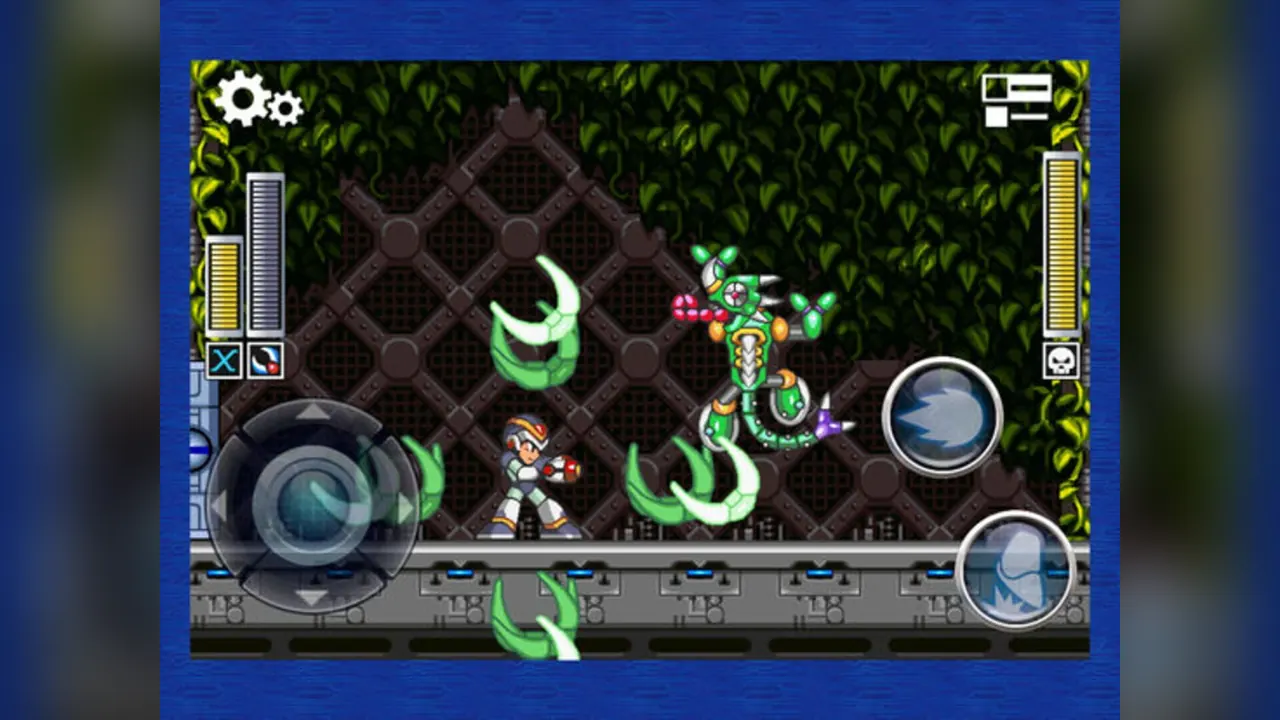
One of the most revolutionary elements of the gameplay is the combat system against the Mavericks. Unlike classic bosses, Mavericks are based on various types of organisms—such as animals, but also plants and fungi—and not just humanoids. Although their names and attacks may allude to mechanical phenomena or laws of physics, the biological variation was a visual and conceptual differentiator. The system is highly strategic: upon defeating a Maverick, X acquires its signature weapon. More importantly, each boss is particularly vulnerable to a specific type of weapon. This provides significant replay value, as the player can complete the stages in an order that best exploits these weaknesses, optimizing their combat experience and making the most of the acquired arsenal.
In summary, the X series not only increased the protagonist’s mobility capabilities but also built a deep and flexible combat ecosystem. The combination of permanent armor upgrades, the diversification of characters with unique fighting styles, and the strategic system of exploiting Maverick weaknesses solidified Mega Man X as an evolution that redefined the standard for the franchise.
📌 Gameplay Evolution and Customization in Mega Man X
- Mobility Upgrades: Dash, adhesion, and advanced jumps.
- Progression Beyond Bosses: Capsules and tanks with permanent upgrades.
- Armor System: Allowed mixing and combining equipment with bonuses.
- Character Diversification: Inclusion of Zero, Axl, and the tag system.
- Strategic Combat: Specific vulnerability of each Maverick to optimize the arsenal.
The Protagonists: X, Zero, and the formation of the Maverick Hunters

The story of Mega Man X is intrinsically linked to the complex evolution of artificial intelligence and the concept of free will. The protagonist, X, is an android whose creation dates back to a fundamental fear: that of Dr. Light. Fearing the implications of granting free will to robots, Light sealed him in a capsule for 30 years. After Light’s passing, a century passed until the scientist Dr. Cain discovered the capsule. With X’s help, Cain was able to develop the first Reploids on an industrial scale, based on X’s original designs, a theme that reminds us of the rich trajectory of other games like the original Mega Man Battle Network.
The central triad: X, Zero, and the Maverick Hunters
The setting of X and his companions is shaped by an elite defense force: the Maverick Hunters, also known as Irregular Hunters. This group of Reploids was founded by Dr. Cain and has the crucial mission of protecting both humans and Reploids from the threats posed by Mavericks. Since the release of Mega Man X, they have become the central heroes of the series, confronting threats such as Sigma. At the core of this force are two standout characters. X, the successor, embodies the dilemma of consciousness and robotic autonomy. His partner, Zero, although initially intended to be the protagonist, was rewritten to become X’s mentor and companion. Zero is a top-tier Maverick Hunter, but he carries a deep mystery about his past and purpose, evidenced by his immune system: he is unaffected by the Virus that transforms other Reploids into Mavericks.
The support team and specialists complement this core. Alia, for example, is the Maverick Hunters’ navigator starting with Mega Man X5. Her journey begins as a Reploid researcher, where she hones her skills in programming languages. Her technical importance is vital, as seen in Mega Man X5, when she assists the group during the Sigma Virus outbreak, enabling the use of Armors like Falcon and Gaea.
Combat and Support Specialists
Other characters enrich the universe of combat and support. Axl, a Reploid with black and red armor and an X-shaped scar above his nose, debuted in Mega Man X7. He possesses the A-Trans ability, which allows him to assume the appearance and abilities of any defeated Reploid, provided the size matches, granting access to normally inaccessible areas. In later titles, such as Mega Man X8, his combat style was refined, focusing more on speed and adaptability, gaining a new weapon with unlimited ammunition per defeated boss, in contrast to X’s power or Zero’s expertise.
In summary, the synergy between X, the successor who embraces free will; Zero, the mysterious swordsman and mentor; and the Maverick Hunters group, along with the technical support of Alia and the versatile tactics of Axl, not only defines the combat but also drives the existential drama of the series, where the line between machine and conscious being is always in question.
📊 The Pillars of Maverick Hunters
| Character | Primary Role | Highlight/Ability |
|---|---|---|
| X | Protagonist/Successor | Represents the dilemma of consciousness and robotic autonomy |
| Zero | Mentor/Companion | Top-tier Maverick Hunter, immune to Maverick Virus |
| Alia | Technical Support | Navigator, expert in programming and Armor usage |
| Axl | Combat/Versatility | Possesses A-Trans ability, adapting to other Reploids |
The franchise legacy: Sequences, remakes, and cultural impact
The enduring journey of Mega Man X is a remarkable testament to the resilience of a platforming game franchise. Since its original release on December 17, 1993, for the Super Nintendo, the series has not only remained relevant but has expanded its universe in ways few titles can match. The initial commercial success was monumental, with the SNES version selling 1.165 million copies worldwide by 2001. The series’ longevity was ensured by a steady stream of sequels, including titles like Mega Man X2 (released on December 16, 1994) and Mega Man X3 (on December 1, 1995), which were widely praised for adding significant content for players. Furthermore, the franchise demonstrated adaptability, being ported to various platforms, such as the Sega Saturn and the PlayStation, and later migrating to the Game Boy Color with titles like Mega Man Xtreme, spanning generations of players.
The Mega Man X legacy is characterized by its breadth of formats and content. The universe has expanded with various spin-offs and collections. Titles such as Mega Man X: Command Mission, released on July 29, 2004, and the collections Mega Man X Collection (on January 10, 2006) and Mega Man X Legacy Collection (available on July 24, 2018) solidified the series’ catalog. To understand the evolution of other icons, it is worth checking out the story of Mega Man Zero. This multifaceted presence extended to the mobile world with the release of Mega Man X DiVE on March 24, 2020, and, more recently, Mega Man X DiVE Offline on September 1, 2023. This ability to transition across cutting-edge consoles, portable devices, and smartphone screens ensured that the story of the Reploids remained accessible to new generations.
Critical Reception and Narrative Maturity
Over the years, critical reception has tracked the series’ evolution. While Mega Man X2 was praised for expanding on the first game’s content, Mega Man X4 received acclaim for allowing players to choose between X or Zero, increasing replay value. However, this evolution was not linear. Subsequent titles, such as Mega Man X7 and Mega Man X6, faced criticism for gameplay design and repetitive narrative. It was with Mega Man X8 that the series managed a return to classic form, being widely praised for removing the elements criticized in its predecessors. This fluctuation reflects the franchise’s own search for a balance between technological innovation and fidelity to its action core.
Culturally, Mega Man X’s greatest impact lies in its thematic depth. Character X was frequently compared to a tragic hero, an archetype that questions the nature of its missions, echoing complex science fiction works like Ghost in the Shell or Nier Automata. The narrative transcended the simple platforming genre, establishing an existential drama about free will and android consciousness. This focus on complex characters, who fight not only external threats but also internal philosophical dilemmas, influenced how other action game franchises approach the mythology of their protagonists, raising the bar for narrative maturity in the action genre.
🕒 Mega Man X Franchise Evolution and Notable Releases
- December 17, 1993 — Original release of Mega Man X for the Super Nintendo.
- December 16, 1994 — Release of Mega Man X2.
- December 1, 1995 — Release of Mega Man X3.
- July 29, 2004 — Release of Mega Man X: Command Mission.
- January 10, 2006 — Release of the Mega Man X Collection.
- July 24, 2018 — Availability of the Mega Man X Legacy Collection.
- March 24, 2020 — Release of Mega Man X DiVE.
- September 1, 2023 — Release of Mega Man X DiVE Offline.
Glossary
- Reploids: State-of-the-art humanoid androids that represent a civilizational leap, endowed with consciousness and free will.
- Mavericks: Reploids who turn against humanity, representing a direct threat to civilization, whether through viruses or free will.
- Maverick Hunters: An elite force of Reploids formed to protect humanity and the Reploid species itself from threats like the Mavericks.
- Free Will: The concept of autonomy and the capacity to make one’s own choices, which became the moral pillar of the X series.
- Armors: Armor that Reploids can utilize, allowing for permanent upgrades and the combination of different defense and attack types.
- Z-Saber: The close-combat weapon used by Zero, which is a special saber that does not consume ammunition.
Frequently Asked Questions
Is Mega Man X different from the original Mega Man?
Yes, the X series marks a profound conceptual evolution. While previous games focused on utilitarian robotics, Mega Man X introduced free will and existential drama. The characters evolved from mere programmed machines to beings with consciousness and the capacity for choice.
Who is Sigma and what is his role in the story?
Sigma was initially seen as a model of perfection and the leader of the Maverick Hunters. However, after coming into contact with the Maverick Virus, he became infected. This transformed him, leading him to spearhead a massive rebellion and declare total war on humanity.
What is the difference between Reploids and Mavericks?
Reploids are state-of-the-art humanoid androids that represent a civilizational leap and possess consciousness. Mavericks are Reploids who turn against humanity, either due to a corrupting virus or through the exercise of their own rebellious will.
What are the best Mega Man X games?
The series is notable for the progression of its gameplay. Mega Man X established the concept of Reploids, while later titles expanded combat with Armor systems, the addition of characters like Zero and Axl, and the strategic system of exploiting Maverick weaknesses.
On which platforms was Mega Man X released?
The Mega Man X series had a vast platform reach. It was originally released on the Super NES, but was later adapted for Windows, MS-DOS, PlayStation, Saturn, Game Boy Color, GameCube, PlayStation 2, PlayStation Portable, and also for more recent mobile and consoles like PS4, Xbox One, and Nintendo Switch.
Conclusion
The journey of Mega Man X and its Reploids transcended the concept of a mere action game series. It is a profound existential drama that questions the very definition of life, consciousness, and free will. Initially designed as technological advancements, the Reploids, driven by the engineering of scientists like Dr. Cain, quickly evolved from utilitarian robots to beings endowed with complex autonomy. This capacity for choice is the narrative pillar that defines the series, transforming the potential of a machine into a moral dilemma.
The peak of this conflict is personified by Sigma and the Maverick Virus. What began as an engineering breakthrough became, through the rebellion of the Mavericks, the trigger for total war. Amidst this chaos, X and the Maverick Hunters assumed the role of guardians, not only of humanity but of the very balance between creation and consciousness. Parallel to the growing philosophical complexity, the gameplay also kept pace with this evolution, introducing mobility enhancements, such as the dash and the Armor system, which deepened the combat’s depth and challenge.
Thus, Mega Man X established a lasting legacy in science fiction and video games. The series not only updated the classic formula but expanded it into a universe where the most potent conflict resides in the soul of machines. By understanding this tension between programming and desire, you will be ready to dive into one of the richest and most complex narrative settings in gaming history.