Read this article in: Portuguese (Português) · Spanish (Español)
Fortnite is one of the most prominent cultural phenomena in video game history, and its creators are Epic Games. This development studio, also responsible for releasing titles like Unreal Engine, was responsible for building and launching the universe that now dominates the global gaming scene. The game is not just a title, but rather a complex and constantly evolving platform that blends various genres—from sandbox to battle royale—and has established itself as an unprecedented digital entertainment ecosystem.
The game’s massive success did not happen overnight. The development and initial launch of Fortnite Save the World occurred on July 25, 2017, in early access. Since then, the franchise’s impact has been meteoric: in less than a year, Battle Royale attracted over 125 million players. The financial reach is equally impressive, as the title generated a gross revenue of $9 billion by December 2019, cementing its status among the biggest media franchises of all time.
In this article, we will dive into the complete history of this digital entertainment giant. We will explore the origins of the idea, from the survival mode to the global success of Battle Royale, and understand how Creative mode became a content creation powerhouse. We will analyze the ecosystem of game modes—which go beyond combat—and finally, discuss the cultural impact and the free-to-play business model that solidified Fortnite as a global phenomenon.
Key Points
- The game combines building mechanics (inspired by Minecraft) with the intense action of shooting games (shooters).
- Its origin began in an internal Epic Games game jam around 2011, before the official launch.
- Fortnite evolved from a cooperative mode (‘Save the World’) to Battle Royale, adapting to the market.
- The game transcended the status of a title, becoming an entertainment ecosystem with ‘Fortnite Experiences’.
- Content creation is central, with the Unreal Editor for Fortnite (UEFN) allowing users to develop complex games.
Fortnite in summary
| Genres | Survival, battle royale, sandbox |
|---|---|
| Developer | Epic Games |
| Publisher | Epic Games |
| Platforms | macOS; Windows; PlayStation 4; Xbox One; iOS; Nintendo Switch; Android; Xbox Series X/S; PlayStation 5; Nintendo Switch 2 |
| First Release | Fortnite Save the World; July 25, 2017 (early access) |
| Latest Release | Fortnite Ballistic; December 11, 2024 (early access) |
The origins of the idea and the creators behind the success
The origins of a global phenomenon like Fortnite are as complex as the game itself, reflecting a journey of countless conceptual changes and market adjustments. Development didn’t start from a single plan, but rather from an internal and creative context within Epic Games. The initial spark came from an internal game jam, a game creation event that took place around 2011, a period that followed the release of highly successful titles like Gears of War 3. Although the game wasn’t the main title developed during this event, it was in this environment of experimentation that the core concept of the title began to take shape, and understanding who created Absolute Drift can provide an interesting parallel regarding the genesis of other phenomena.
The most revolutionary element that would define the game’s future was the fusion of different genres. The idea was to combine the mechanics of building games, inspired by titles like Minecraft and Terraria, with the intense action of first-person shooters. This union of pillars—building, survival, and shooting—created an unprecedented and highly addictive gameplay engine, which later became the heart of what we know as Battle Royale.
The Development Journey and Challenges
The path to launch was marked by significant turbulence and strategic adjustments. Development experienced pauses and redirections, including the transition of graphics engines, moving from Unreal Engine 3 to Unreal Engine 4. Furthermore, there were changes in narrative focus, shifting from a darker approach to a more cartoony visual style. On the corporate front, Epic Games sought to position itself in the games as a service model, which led to the involvement of major players like Tencent, a Chinese company. This movement even resulted in the departure of key executives, such as Cliff Bleszinski, who was fundamental in the project’s initial phase.
The launch strategy was also revised several times. Initially, Epic planned to release the game as a paid early access title in July 2017, with plans to transition to a free-to-play model in 2019. The player-versus-environment gameplay mode was initially known as “Save the World.” After a long period of adjustments, the title was officially launched as a premium product on June 29, 2020. However, the business model remained in constant evolution, culminating in the announcement that Save the World would become free-to-play for most console and PC versions in April 2026.
This story of constant reinvention, which underwent changes in graphics engines, artistic styles, and corporate restructurings, demonstrates that Fortnite’s success was not an accident, but rather the result of methodical evolution, forged by Epic Games’ ability to mix the creativity of the game jam with a vision of continuous service.
🕒 Fortnite’s Evolution: Milestones in Development
- Around 2011 — The initial spark for the concept came from an internal Epic Games game jam.
- July 2017 — Epic planned to release the game as a paid early access title.
- June 29, 2020 — The title was officially launched as a premium product.
- April 2026 — Announcement that Save the World would become free-to-play for most console and PC versions.
From Survival Mode to Battle Royale: The Evolution of the Game
The journey of Fortnite, developed and published by Epic Games, was not linear; it was a series of brilliant adaptations to a constantly changing market. Initially, the game launched with a focus on a cooperative survival mode: Save the World. This mode established the foundations of combat and defense, where players worked together to overcome challenges, such as defending towers. However, the global video game landscape was about to change radically, and the gameplay paradigm the public was absorbing was one of large-scale confrontation.
Inspiration and the Paradigm Shift
In this context of rapid evolution, the release of PlayerUnknown's Battlegrounds (PUBG) emerged as a global phenomenon. The title’s success was massive: just three months after its release in March 2017, it had already sold over 5 million copies. This success catapulted the battle royale genre into the center of industry attention. Epic Games, being a keen observer of the market, quickly recognized the potential of this new format. In fact, if you are interested in other simulation games, you can check out the history of Cooking Simulator. In a notable strategic move, the team developed its own battle royale mode, adapting its mechanics for the established graphics engine of Save the World.
Development was incredibly fast. In about two months, Epic was ready to present this new facet. In September 2017, the mode was made available as a second game mode, initially in paid early access. However, the success was so overwhelming that Epic Games soon turned it into a free game, Fortnite Battle Royale, supported by microtransactions. The impact was immediate and massive: in the first two weeks of launch, the mode attracted over 10 million players, confirming its place as one of the industry’s major phenomena.
Evolution and Expansion of the Ecosystem
Faced with this exponential growth, Epic Games made a crucial decision: to separate the development of Fortnite Battle Royale from Save the World. This separation was not merely administrative, but technical, allowing Battle Royale to develop with a broader scope, free from the limitations of the art assets and graphics engine that previously constrained it. This development autonomy was what allowed the game to transcend the original platforms of Save the World. Fortnite Battle Royale began to be supported on devices and systems that were not previously a priority for the co-op mode, such as iOS, Android mobile, Nintendo Switch, and even the Nintendo Switch 2.
Thus, the game’s evolution demonstrates the synergy between Epic Games’ creative capacity and its readiness to adapt to market trends. The transition from a focus on cooperative defense to massive-scale, frantic combat was not just a genre shift; it was a redefinition of what a survival game could be, solidifying Fortnite Battle Royale as one of the most influential and widely accessible titles in gaming history.
📌 Evolution of Game Focus in Fortnite
- Save the World: Initial focus on cooperative combat and defense.
- PUBG’s Influence: Recognition of the success of large-scale confrontation.
- BR Launch: Quick adaptation to the Battle Royale format.
- Development Separation: Allowed for greater scope and technical autonomy.
- Platform Expansion: Support for multiple devices, such as iOS and Android.
The Sandbox Platform: The power of content creation
If Fortnite’s success lies in its adaptability, the true backbone of this phenomenon is, in fact, its nature as a platform. The game transcended the status of a mere entertainment title to become a vast digital ecosystem, where content creation is the primary engine for longevity. This transformation was materialized with the launch of Fortnite Creative, a sandbox mode that appeared on December 6, 2018, synchronized with the start of Fortnite Battle Royale Season 7. For those who enjoy creation worlds, it is also worth checking out the history behind the reforms.
Creative mode revolutionized the player experience by granting every user access to a persistent, private island. In these spaces, players were not just content consumers, but its own creators, able to build buildings, manipulate objects, and develop unofficial games, such as race tracks or jump courses. Initially, access was restricted, but Epic Games quickly democratized the feature, making the mode available for free to all players.
📘 Unreal Editor for Fortnite (UEFN)
It is a standalone editor version for Windows that allows creators to use the Unreal Engine 5 graphics engine, integrating it with specific Fortnite assets and functionalities.
The Evolution into a Creation Studio
Over time, the creation tool evolved from a game mode into a powerful development studio. In March 2023, Epic Games launched the Unreal Editor for Fortnite (UEFN), a standalone editor version for Windows. This is not just a feature, but a technical capability that allows creators to use the Unreal Engine 5 graphics engine, integrating it with specific Fortnite assets and functionalities. UEFN raised the level of complexity and artistic potential of the creative mode, attracting both players and professional developers.
This creation capability was visually solidified in October 2023, when the main Fortnite client was redesigned to present the various modes cohesively, under the umbrella of Fortnite Experiences. This hub architecture is comparable to platform models like Roblox, where multiple games and experiences coexist. From this model, the content became diverse and professional, showcasing modes developed by Epic itself, such as Lego Fortnite (a survival game developed in partnership with The Lego Group), Rocket Racing, and Fortnite Festival.
The platform does not stop expanding. Constant improvements to UEFN, such as the addition of Unreal Engine’s MetaHuman character rendering technology, and the inclusion of more assets from partners like Lego and Fall Guys, demonstrate a commitment to technological advancement. The potential is so vast that Epic Games itself signaled its intention for future seasons of Fortnite Battle Royale, starting in late 2025, to be developed using UEFN. This confirms that the game is not just a product, but rather an endless content engine, ensuring that the creativity of the players and developers themselves is the most valuable resource in the ecosystem.
The Game Mode Ecosystem: More Than Just a Battle Royale
The Game Mode Ecosystem: More Than Just a Battle Royale
The Transformation into an Experience Platform
If Fortnite’s success lies in its adaptability, the true backbone of the phenomenon is, in fact, its nature as a platform. Far from being a static game, Fortnite has established itself as a vast digital entertainment ecosystem. This transformation was notable: in October 2023, Epic Games redesigned the game’s main client to present what came to be called Fortnite Experiences, a showcase of game modes conceptually comparable to platforms like Roblox. This change signaled that the focus was no longer on a single combat mode, but rather on a multifaceted entertainment experience, ensuring the longevity and continuous interest of the player.
The expansion of scope was a strategic move of constant reinvention. In December 2023, Epic Games introduced several in-house developed game modes, drastically increasing the catalog. The game now consists of experiences that go far beyond confined area combat. Among the new pillars of the ecosystem, the following stand out:
- Lego Fortnite: A survival mode developed in partnership with The Lego Group, allowing players to build and interact in a resource-gathering scenario.
- Fortnite Festival: A rhythm genre where players can test their musical skills, and which has already garnered attention from artists like Daft Punk.
- Rocket Racing: An arcade-style racing game, developed by Psyonix, that added the adrenaline of high-speed competition.
- Fortnite Ballistic: A more recent experience, launched on December 11, 2024 (early access), focusing on tactical first-person shooter (FPS) combat.
Maintaining Interest and Genre Synergy
This variety is not just an addition of content; it is a player retention mechanism. Each mode is launched as free-to-play, but all of them integrate into a unified progression system. Players can advance in specific mode passes—such as the new Music Pass (Festival) and the Lego Pass—using experience points (XP) earned in any game mode. This synergy ensures that a player who enjoys racing in Rocket Racing still contributes to the progress in Lego Fortnite, and vice-versa. The monetization mechanic, based on V-Bucks, was also adapted to accommodate these multiple revenue streams.
To maintain this creative vanguard, Epic Games also invested in third-party tools. In March 2023, the release of the Unreal Editor for Fortnite (UEFN)—a standalone Windows editor—allowed external creators to use the Unreal Editor with Fortnite assets, elevating Creative Mode to a powerful development studio. This co-creation capability, combined with the continuous launch of new experiences, ensures that the Fortnite ecosystem is a constantly propelling content engine, and much more than just a battleground.
Cultural Impact and Record Financial Success
Fortnite’s success cannot be measured by its gameplay mechanics alone; it is a case study in exponential growth and cultural dominance. The game, in its various iterations, demonstrated a scalability that few titles have managed to replicate. Initially, the Save the World mode had already reached over one million players in August 2017, shortly before the launch of Battle Royale. However, it was Battle Royale mode that catapulted Epic Games to global stardom. Within weeks of its release, the game had attracted over 10 million players, and the growth continued at an astonishing pace. By June 2018, after the Nintendo Switch launch, the player count reached an impressive 125 million.
This massive popularity translated into colossal financial success. The revenue generated by Fortnite Battle Royale in the first half of 2018 was estimated at hundreds of millions of dollars per month. Over time, this growth trajectory led Fortnite’s total revenue to surpass the $9 billion mark by the end of 2019, solidifying the title as one of the most profitable franchises in video game history. The ability to monetize this global audience while maintaining a free-to-play experience was a strategic differentiator.
Cultural Impact and Streaming Dominance
More than just numbers, Fortnite’s legacy lies in its status as a mass cultural phenomenon. The game transcended the video game environment, becoming a meeting point for celebrities and athletes. The impact was visible in streaming events, such as the notable March 2018 crossover, which broke viewership records on the Twitch platform. The event featured streamer Tyler “Ninja” Blevins playing alongside global figures like Drake, Travis Scott, Kim DotCom, and NFL player JuJu Smith-Schuster, demonstrating the fusion of sports, music, and digital entertainment.
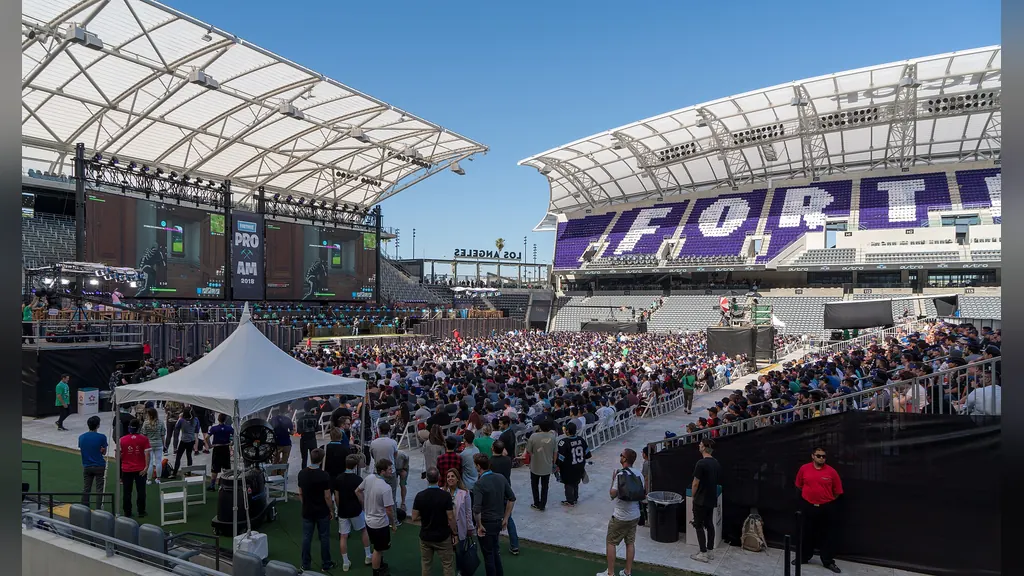
The success was so profound that Epic Games knew how to capitalize on professional interest, organizing major events like the pro-am at E3 2018 and, subsequently, the Fortnite World Cup in July 2019. These events not only established eSports as a viable and profitable genre but also cemented the game’s culture at a level of global entertainment. This rise, however, was not without debate. The game’s reach also generated legitimate concerns among parents and educators, who raised questions about students’ focus and the impact of violent content on young children.
In summary, Fortnite’s success is a complex tapestry woven with impressive financial data, streaming viewership records, and a cultural penetration that placed it in the pantheon of the greatest games of all time, proving that adaptation and the ability to generate content are the true engines of a digital phenomenon.
Business Model and the Free-to-Play Experience
Fortnite’s resounding success lies not only in its revolutionary combat mechanics but in a highly sophisticated business model: the free-to-play (F2P). This system ensures that core gameplay and access to the most popular game modes are available for free to anyone, regardless of their ability to pay. Epic Games capitalized on this accessibility by creating an ecosystem where revenue is generated not by restricting access, but by personalization and content progression. The central virtual currency of this system is V-Bucks, a currency that can be purchased with real funds but can also be earned through player engagement, by completing missions and achieving in-game objectives.
Monetization Through Aesthetics and Progression
The financial backbone of the game rests on cosmetic items. V-Bucks are used to acquire aesthetic items, such as character skins, emotes, and, crucially, the Battle Pass. The Battle Pass is a seasonal progression system that rewards players for gaining experience and completing objectives throughout a Battle Royale season. With the game’s expansion in 2023, the model was adapted to support different universes. Complementary passes were added, such as the Festival Pass for Fortnite Festival and the Lego Pass for Lego Fortnite. In November and December 2024, Epic Games optimized this system, allowing progress across all passes to be made with experience points earned in any game mode, unifying the monetization experience.
The business strategy is also evident in subscription services, such as Fortnite Crew, which expanded its scope to include the Music and Lego passes, ensuring a recurring revenue stream and an added benefit for the active player.
The Battle Over Payment Systems
Pricing structure and payment management were points of intense legal and commercial negotiation. Initially, the cost of V-Bucks was approximately 1,000 V-Bucks for US$10. In 2020, Epic Games made significant adjustments: it reduced the cost of V-Bucks purchases by 20% (making it US$7.99 for 1,000 V-Bucks) in its own store, but maintained the US$10 value on platforms like the Google Play Store and Apple App Store. This disparity led to major lawsuits, such as the Epic Games v. Google and Epic Games v. Apple cases. Although the outcome regarding Apple allowed Epic Games to direct users to third-party stores, the company had to seek agreements to mitigate the high resale fees.
In recent years, Epic Games has adjusted the price of V-Bucks more than twice. There was an increase in 2023, which raised the cost to US$8.99 for 1000 V-Bucks in its store. More recently, in March 2026, there was a second increase, raising the cost to US$10 for 800 V-Bucks. Although the cost of V-Bucks has risen, the Battle Pass value was kept at 800 V-Bucks, an adjustment that, according to Epic Games, ensured the content remained accessible while only covering the cost of recovering the pass.
Glossary
- Game Jam: A game creation event where participants have a limited time to develop and test a game concept.
- Battle Royale: A survival game genre where a large number of players compete in a map until only one winner remains.
- Sandbox: A game mode that offers users complete freedom, allowing them to build and manipulate objects without fixed objectives.
- Free-to-play: A business model that allows free access to the game but may include optional purchases of virtual items.
- Microtransactions: Sales of in-game digital items, such as skins or passes, that are not essential for progress.
- UEFN: Unreal Editor for Fortnite; a standalone editor that allows creators to use Unreal Engine 5 to build advanced content.
Frequently Asked Questions
Is Fortnite free to play?
Yes, the Battle Royale mode and several other game modes are released as free-to-play. This means you can access and play most of the content without an initial cost, although there may be microtransactions for cosmetics or progression.
What is the most popular game mode in Fortnite?
Historically, Battle Royale was the mode that catapulted the game to global success. However, the ecosystem is vast and includes various entertainment pillars, such as Lego Fortnite (survival), Fortnite Festival (rhythm), and Rocket Racing (racing).
What is Unreal Editor for Fortnite (UEFN)?
It is an advanced technical tool that allows creators to utilize the Unreal Engine 5 graphics engine. UEFN elevates the artistic potential of the creative mode, transforming it into a professional development studio for creating complex experiences.
Is Fortnite a shooting or building game?
It is a hybrid game. Its gameplay is defined by the fusion of intense shooting mechanics with the ability to build structures. This combination of pillars creates an unprecedented and highly addictive gameplay engine.
What platforms is Fortnite available on?
The game has an extremely wide presence, being available on various platforms. This includes consoles like PlayStation, Xbox, and Nintendo Switch, as well as PC operating systems (Windows and macOS) and mobile devices (iOS and Android).
Conclusion
The trajectory of Fortnite, developed by Epic Games, shows that global success was not a single plan, but rather a methodical and brilliant evolution. What started as an internal experiment in a game jam around 2011, combining building mechanics inspired by titles like Minecraft with shooter action, required constant adaptation. Initially focused on the cooperative “Save the World” mode, the title was able to identify the paradigm shift in the market, reacting to the success of Battle Royale. This ability to transition, from a defensive focus to massive confrontation, was crucial for its exponential growth.
However, the element that cemented its status as a cultural phenomenon was its platform nature. By going beyond a mere game mode, Epic Games transformed the title into a vast digital ecosystem. The launch of Fortnite Creative, which allowed players not only to consume but also to create content in persistent islands, guaranteed unprecedented longevity. This synergy between cutting-edge development and the creative autonomy of the community solidified the game as a continuous entertainment engine, proving that value lies in the capacity for reinvention.
Thus, Fortnite’s legacy is not just about an addictive game mode, but about the mastery of creating an adaptable environment. It is this vision of continuous service, which embraces both the professional and the amateur, that defines the true power of the modern gaming industry. Reflecting on this evolution shows us that creativity, when combined with market adaptability, is the most powerful engine of any cultural phenomenon.