Read this article in: Portuguese (Português) · Spanish (Español)
The game Dungeonborne was developed and published by the studio Mithril Interactive, which is responsible for bringing this dark fantasy action and RPG title to market. Initially known as Project Crawl, the project was shaped to fill a specific gap in the extraction RPG genre, combining elements of dungeon crawling, first-person combat, and battle royale mechanics. The title quickly established itself in the indie gaming scene, attracting the attention of the gaming community with its intense and perilous gameplay, where the main objective is survival and escape.
The game’s trajectory is marked by careful development and a documented life cycle. Public interest was piqued in February 2024, when a demo at Steam Next Fest allowed the public to see the potential of the concept. The early access launch occurred on July 18, 2024, utilizing Unreal Engine 5. However, the game’s life cycle had a clear conclusion: Mithril Interactive announced the closure of new accounts and purchases on February 28, 2025, with the definitive server shutdown scheduled for May 28, 2025. These chronological milestones and development history are crucial for understanding the title’s relevance.
In this article, we will dive into the complete history of Dungeonborne, following every phase of its existence. We will start with the concept’s origin and the creators behind the project, move through the technical development, address the complex gameplay and dungeon extraction mechanics, analyze the launch, critical reception, and monetization challenges. Finally, we will review the end of the life cycle and the legacy the game left on the extraction RPG genre.
Key Details
- Launched in early access on July 18, 2024, on Windows, using Unreal Engine 5.
- The game combines genres such as action RPG, dungeon crawl, and battle royale in a multiplayer mode.
- The core gameplay is the ‘extraction loop,’ where the risk of losing loot is high.
- The combat system is intensified by battle royale elements, such as a shrinking map.
- A public test reached a notable peak of 14,448 concurrent players on Steam.
Dungeonborne in summary
| Developer | Mithril Interactive |
|---|---|
| Publisher | Mithril Interactive |
| Engine | Unreal Engine 5 |
| Platform | Windows |
| Release | July 18, 2024 (early access) |
| Genres | Action RPG, Dungeon crawl, battle royale |
| Mode | Multiplayer |
The origin of the concept and the project’s creators

The genesis of Dungeonborne is intrinsically linked to Mithril Interactive, which took on the role of developer and publisher for the title. The initial concept that gave rise to the game was an ambitious extraction looter RPG set in a dark fantasy universe, a genre that has already established itself as a niche with great appeal for action and dark fantasy players; for those who enjoy investigative narratives, we recommend checking out the story of Disco Elysium, which is also award-winning. The focus has always been to deliver a dungeon experience that demands both strategic exploration and intense combat.
The Evolution of the Name and Concept
The project did not launch under its final name. Initially, Mithril Interactive presented the title under the alias Project Crawl. This development phase was crucial in shaping the game’s identity and testing the concept with the public. The transition from Project Crawl to Dungeonborne was not merely an aesthetic change, but a strategic adjustment aimed at solidifying the brand and the focus on deep and dangerous dungeons, reinforcing the narrative of survival and adventure.
The path to release was marked by public demonstration stages that increased the title’s recognition. One of the first highlights was the availability of a public demo during the Steam Next Fest in February 2024. During this period, the game began generating positive comparisons with other titles in the genre, such as Dark and Darker, solidifying its position in the first-person extraction RPG market.
Development continued at a rapid pace, culminating in a final public playtest in July 2024. The reception to this playtest was remarkable and demonstrated the growing interest from the community. According to reports from the time, the test reached an impressive peak of 14,448 concurrent players on Steam. This high number not only validated the game’s potential but also served as a major milestone of anticipation for the release date.
The culmination of this cycle of testing and refinements occurred on July 18, 2024, when Dungeonborne finally entered early access. From the start, the game has positioned itself as an action RPG and dungeon crawl title, promising players a high-risk, high-reward multiplayer experience where every loot drop and every combat encounter is part of an epic and dangerous journey, even recalling details from the creators of Guild Wars.
🕒 Dungeonborne’s Evolution and Milestones
- February 2024 — Availability of a public demo during the Steam Next Fest.
- July 2024 — Final public playtest with a peak of 14,448 concurrent players on Steam.
- July 18, 2024 — Launch in early access.
Technical Development: From Concept to Early Access

The technical development of Dungeonborne is a case study in the evolution of a niche gameplay concept into a robust early access product. From its early stages, the title demonstrated a significant technical focus, establishing a solid foundation for the dark fantasy action and RPG genre. The technological backbone of the project was defined by the use of Unreal Engine 5, a graphics engine known for its advanced visual capabilities, and its development platform was Windows. This technical choice not only ensured high-fidelity graphics but also allowed for the creation of a dynamic and complex multiplayer environment, essential for the dungeon crawling mechanic the game proposes, recalling that other classic titles like Eternal Sonata, a classic RPG, also required great technical effort.
From Demo to Mass Testing
The path to the public was not linear. Initially, the project was presented under the name Project Crawl before adopting the final name of Dungeonborne. The first significant public showcase took place during the Steam Next Fest in February 2024. This event allowed the developers at Mithril Interactive to demonstrate the game’s potential, generating immediate comparisons with other first-person extraction titles, such as Dark and Darker. These comparisons not only increased the title’s recognition but also signaled to the public’s expectations the level of depth and challenge players would find in the dungeon environment.
📘 Unreal Engine 5
It is a graphics engine known for its advanced visual capabilities. Its choice guaranteed high-fidelity graphics and supported a complex multiplayer environment.
The development lifecycle continued at a dizzying pace, moving from public demos to closed testing and finally to a large-scale public test. The gameplay refinement phase was crucial for adjusting the learning curve and the risk-reward experience. The peak of this testing period occurred in July 2024. The magnitude of this test was notable, reaching a peak of 14,448 concurrent players on the Steam platform, as reported by specialized outlets. This number not only validated public interest but also forced the developers to make critical adjustments to optimization and server stability to support such a high number of users in multiplayer mode.
This entire process of testing and gameplay adjustments culminated in the official early access date: July 18, 2024. This early access launch is not just a date milestone, but the convergence point of months of intense technical work. It represents the project’s transition from a controlled creation phase to a real testing environment, where direct player feedback becomes the primary engine for continuous game improvement. Thus, the public not only receives the final product but actively participates in shaping it, solidifying the development cycle of Dungeonborne.
Gameplay and the Dungeon Extraction Mechanic
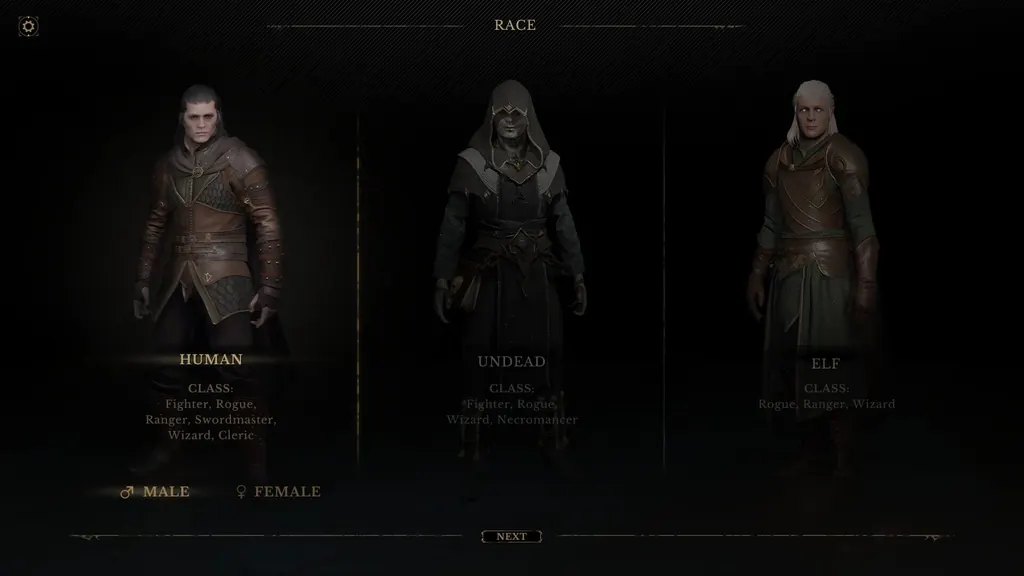
The core of Dungeonborne lies in a highly specialized gameplay mechanic: first-person dungeon extraction. The title is set in the action dungeon crawler genre, requiring players not only to navigate dangerous environments but also to actively manage the risk of their ventures. The experience is intrinsically a high-risk, high-reward cycle. Players begin their journeys by choosing a fantasy class and can enter dungeons both in groups and alone, facing a series of challenges ranging from encounters with hostile creatures to direct confrontations with other players.
The Extraction Loop and Risk Management
The game’s narrative and mechanical engine is the “extraction loop.” Basically, the player’s main objective is to collect as much treasure and gear as possible and, crucially, find an escape route. This system is built on a risk model that defines the value of every decision. Players have the freedom to carry weapons and armor into the dungeons, but this freedom comes with a severe penalty: if the player is defeated inside the map, they lose all the equipment they were carrying. Survival, therefore, is directly proportional to the value of one’s loot.
The game structure incorporates robust battle royale elements to heighten the tension. While players are busy scavenging and collecting treasures, the map is gradually shrunk by a mechanism similar to a containment ring, forcing participants closer to danger zones. This mechanism ensures that the confrontation is not only against monsters (PVE) but also against other players (PVP), intensifying the competition for the most valuable resource: survival and loot.
The combat system is designed to be dynamic and multifaceted. In addition to fighting monsters that inhabit the dungeon corridors, players must be prepared for PvP confrontations in enclosed environments. The extraction mechanic demands constant planning: how much is a legendary weapon worth? Is it safer to stay in the group or risk going alone to secure the best loot? Gameplay is therefore a delicate balance between tactical exploration and resource management under pressure.
All of this happens in a context of high technical performance. Developed in Unreal Engine 5, the title launched in early access on the Windows platform, establishing itself as an action RPG and dungeon crawl that promises immersion and adrenaline. The game model requires players to always be vigilant, as success is measured not only by how rich they leave the dungeon, but also by their ability to escape alive from the danger closing in around them.
📌 Core Pillars of Dungeonborne Gameplay
- First-Person Dungeon Extraction: The central focus of the game.
- Risk vs. Reward Cycle: Every decision must weigh danger against loot.
- Extraction Loop: Gathering treasures and, most importantly, finding the escape route.
- Hybrid Combat: Balancing fighting monsters (PVE) and other players (PVP).
Launch, Critical Reception, and Monetization Challenges
Dungeonborne’s path to the public was paved by demos and a phased release. The initial anticipation was palpable, especially during the Steam Next Fest in February 2024. Participation in this event allowed the public to experience a version of the game, generating considerable buzz about the potential of the extraction genre. After this testing phase, the title launched in early access (early access) on July 18, 2024, on Windows, using the Unreal Engine 5 engine. This launch established the game in the market as an action RPG and battle royale, maintaining a focus on the dungeon extraction mechanic.
Critical Reception and Gameplay Challenges
Initial critical coverage was mixed, reflecting the state of a title in early access. While outlets like GamesRadar+ described the Steam Next Fest demo as a “primitive, but promising” take on the genre, praising the inherent tension of the extraction cycle, they also pointed out strong criticisms. The combat, object interaction, and the overall state of the demo were considered slow and rough. Another review highlighted the good launch timing, suggesting that Dungeonborne could gain players while competing titles were unavailable on Steam. However, questions were raised by the community regarding class balance and connection issues.
Analysis from other portals, such as Massively Overpowered, reinforced the duality of the reception. On one hand, the game was praised for its strong class ideas and clear fantasy setting. On the other, severe criticism was directed at the looting system, the slow combat, and the feeling that the maps were limited, raising doubts about the title’s longevity. These initial feedbacks highlighted that, despite the potential of its core gameplay, technical polish and combat pacing were areas needing attention.
The Monetization Controversy
A significant point of friction after the early access launch was the auction house system (auction house). Players reported to the press, such as PCGamesN, that premium currency was required to list items in the auction. This requirement sparked criticism regarding the business model, raising concerns about accessibility and the cost of participating in the game’s economy. In direct response to the pressure and community concerns, Mithril Interactive acted quickly. The studio altered the monetization system, shifting from a seasonal purchase to a one-time purchase, demonstrating an ability to adjust the business model based on direct player feedback.
In summary, the trajectory of Dungeonborne from its public demos to early access was a case study in the life cycle of niche game development. The title managed to capitalize on the tension of the extraction genre but had to confront the challenge of balancing promising gameplay with persistent criticism regarding combat pacing and, crucially, adjusting its monetization model to maintain the goodwill of the player community.
✅ Advantages
- Inherent tension potential in the dungeon extraction cycle.
- Praise for strong class ideas and a clear fantasy setting.
- Good launch timing, allowing it to gain players while competitors were unavailable.
❌ Disadvantages
- Combat and object interaction considered slow and clunky in the initial demo.
- Criticism of the looting system and the feeling of limited maps.
- Questions raised about class balance and connection issues.
- The initial monetization model generated concerns about accessibility (use of premium currency in the auction).
The End of the Life Cycle and the Game’s Legacy
The life cycle of a game title, especially in a demanding niche like extraction RPGs, is rarely linear. The trajectory of Dungeonborne, although marked by intense development and a robust early access, was abruptly concluded. On February 28, 2025, Mithril Interactive announced the official shutdown of the game. This announcement marked the end of active operations, resulting in the immediate suspension of new accounts and any in-game purchases.
The situation unfolded at a rapid pace, less than a year after its early access launch. Players and the community noticed that the end was not an isolated event, but the peak of a series of dissatisfactions. Reports from specialized portals indicated that the main complaints from users included persistent balancing issues, the existence of excessively powerful items and enemies, slow content updates, and, critically, communication perceived as insufficient from the developers. In response to this pressure and growing frustration, the server shutdown was scheduled for May 28, 2025, permanently closing the project’s doors.
The Legacy of the Concept
The closure of Dungeonborne represents a turning point in the title’s development, but the core gameplay concept it explored—first-person dungeon crawling with battle royale elements—showed remarkable resilience. Far from completely fading away, the spirit of the game found a new vehicle. In a development that brought a glimmer of hope to the community, on July 6, 2026, Myrion Studio revealed Dungeon Betwixt, a first-person medieval looter and extraction RPG.
The most intriguing aspect for long-time fans is the personnel connection. Myrion Studio was founded by Elvis Zhou, a former lead producer at Mithril Interactive, who was responsible for guiding Dungeonborne from concept to launch. Zhou was joined by former core developers from Dungeonborne, covering areas such as design, art, and engineering. This convergence of talent suggests that the deep knowledge and passion for the “extraction loop” remain intact, migrating to a new title. Although Dungeon Betwixt does not yet have a set release date, its existence signals that the core mechanics and enthusiasm for this niche type of experience remain alive, promising a possible renaissance for the genre.
Glossary
- Dungeon crawl: A genre of games focused on exploration and combat in dangerous underground environments or dungeons.
- Extraction looter RPG: An RPG where the main objective is to collect valuable items (loot) in a dangerous environment and escape with them.
- Early access: A launch phase where the game is still under development, allowing players to test and help shape the product.
- Battle royale: A multiplayer game mode where several players fight on a map that gradually shrinks until only one winner remains.
- Unreal Engine 5: A high-performance graphics engine used to create virtual environments with advanced and complex graphics.
Frequently Asked Questions
Is Dungeonborne still active or has it been discontinued?
The title is active and available in early access since July 18, 2024. Development is ongoing, with player feedback being a primary driver for the game’s constant improvement.
What is the genre of Dungeonborne, and how does it compare to Dark and Darker?
Dungeonborne is an action RPG, dungeon crawler, and battle royale. It falls into the extraction RPG genre, sharing with titles like Dark and Darker the high-risk, high-reward mechanic within dangerous dungeons.
Is the game paid or free-to-play?
The gameplay model requires players to manage risk and loot. Although the monetization system has been adjusted to a one-time purchase, the in-game economy involves using premium currency to participate in certain features, such as the auction house.
What is the difference between Project Crawl and Dungeonborne?
Project Crawl was the initial name for the project. The transition to Dungeonborne was a strategic rebranding effort aimed at solidifying the game’s focus on deep, dangerous dungeons, reinforcing the survival narrative.
Why was Dungeonborne criticized regarding its auction system?
The criticism arose because premium currency was required to list items in the auction system. This requirement raised community concerns about accessibility and the cost of participating in the game’s economy.
Conclusion
Dungeonborne’s journey, from Project Crawl to an early access title, is a fascinating study of the evolution of a niche gameplay concept. Developed by Mithril Interactive and built on Unreal Engine 5, the game has successfully built a high-risk, high-reward narrative. The path to launch was validated by crucial milestones, such as the demonstration at Steam Next Fest in February 2024 and, more notably, a public test in July 2024 that reached an impressive peak of 14,448 concurrent players. These numbers not only attested to public interest but also forced the developers to refine a complex first-person dungeon experience.
The core of Dungeonborne lies in the extraction cycle: a system where survival is directly proportional to the value of the loot. Players face an intense balance between creature danger (PVE) and direct competition with other adventurers (PVP). The high-stakes model is reinforced by the mechanic of total equipment loss upon defeat, elements that elevate the tension of a traditional dungeon crawler to a true dark fantasy battle royale. Since its early access on July 18, 2024, the title has established itself as a robust and dynamic challenge.
Dungeonborne is not just a game; it is a promise of epic adventure where every risk decision can define the fate of your gear and your journey. If you are looking for a challenge that demands strategy, intense combat, and the adrenaline of monumental loot, it’s time to take the next step and dive into the depths of the dungeons.