
Read this article in: Portuguese (Português) · Spanish (Español)
If you ever wonder who created Fate/stay night, the answer points to a trio of talents who shaped one of the pillars of the visual novel genre: the developer Type-Moon, the artist Takashi Takeuchi, and the writer Kinoko Nasu. This complex universe of magic and epic confrontations is not just a game, but a rich narrative that has developed over decades. The story focuses on the Fifth Holy Grail War, a tournament of mages where Masters and Servants fight for a mystical objective. It is this combination of mythology, action, and deep character development that established the title as a cultural milestone in the speculative fiction scene.
The relevance of Fate/stay night is proven by its long and multifaceted development history. The title originally launched on January 30, 2004, for Windows PCs in Japan. Its journey of successes and adaptations is impressive: it was relaunched on various platforms, including the PlayStation 2 on April 19, 2007. More recently, the game reached a new level of global visibility with a remaster of Fate/stay night released for Nintendo Switch and PC on August 8, 2024, marking its first debut outside of Japan. This technical and commercial evolution attests to the enduring power of its narrative.
In this article, we will dive into the complete history that gave rise to this magic. We will address the title’s genesis, exploring the inspiration and creators behind the work. We will analyze the technical development and the complexity of the three narrative routes, and trace the game’s evolution, from PC to Switch. Finally, we will discuss the visual novel experience, its cultural impact, and the legacy that established it as a global phenomenon.
Key Points
- The story began as a writing exercise by Kinoko Nasu, not initially as a game.
- The Holy Grail War is a deadly tournament where mages fight for desires through Servants.
- The narrative is divided into three thematic arcs: Fate (‘ideal self’), UBW (‘struggling with oneself’), and Heaven’s Feel (‘reality vs. ideal’).
- The game is a visual novel focused on narrative choices and the ‘affection meter,’ not combat.
- The title has undergone constant platform evolution, culminating in the global launch on Nintendo Switch and Steam in 2024.
Fate/stay night in summary
| Developer | Type-Moon |
|---|---|
| Publishers | Type-Moon (Windows); Kadokawa Shoten (PS2, Vita); Aniplex (NS, Steam) |
| Artist | Takashi Takeuchi |
| Writer | Kinoko Nasu |
| Genre | Visual novel |
| Platforms | Windows, PlayStation 2, PlayStation Vita, iOS, Android, Nintendo Switch |
| Series | Fate |
| Release | Windows JP: 01/30/2004; WW: 08/08/2024; PS2 JP: 04/19/2007; PS Vita JP: 11/29/2012; iOS JP: 04/18/2015; Android JP: 05/29/2015; Switch WW: 08/08/2024 |
The Genesis of the Story: Inspiration and Creators
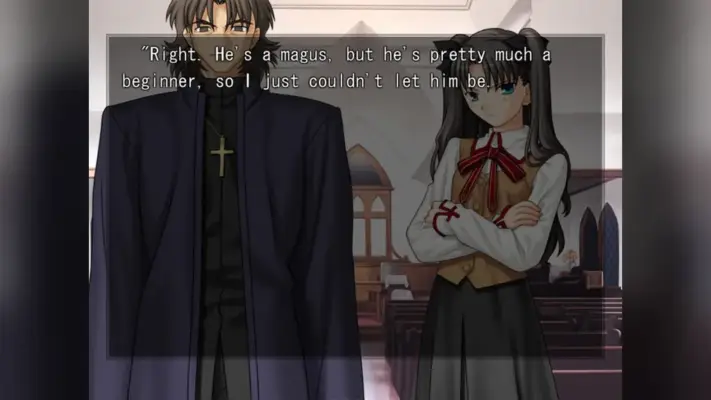
The seed of magic, however, did not originate in a commercial studio, but rather on pages written by Kinoko Nasu during his university years. Initially, the project was merely a writing exercise, and Nasu had no intention of turning it into a game. He began by writing only what would become the first route, the one for Fate. The inspiration for this narrative came from works of historical fantasy, such as Futaro Yamada’s novel, *Makai Tenshō*, which influenced Nasu to create a setting where heroic figures from various eras would gather. The original concept focused on a female master and her Servant, Saber (the embodiment of King Arthur as a man). Nasu, for example, details that in early drafts, Saber was a man and Shirou was a girl wearing glasses. This initial idea was later revisited in the original short *Fate/Prototype*, which accompanied the final volume of the OVA series *Carnival Phantasm*.
The Founding of Type-Moon and the Commercial Birth
In 1999, Nasu paused the project and, in a crucial move, co-founded Type-Moon with Japanese artist Takashi Takeuchi. Following the success of the duo’s first visual novel, *Tsukihime*, in 2000, Type-Moon transitioned from a *dōjin* organization to a commercial company. Nasu and Takeuchi then decided to transform the story of Fate into their first commercial product. There was an initial genre challenge: Nasu was concerned that the narrative, centered on a female protagonist, would not perform well in the *bishōjo* game market. It was Takeuchi who suggested changing the gender between the protagonist and Saber to better suit the gaming market—an adjustment that would shape the franchise’s aesthetic. Type-Moon’s ability to traverse various genres and styles is evident in titles such as magic RPGs and ballets, demonstrating the studio’s versatility.
The development of the narrative was a gradual and complex process. Nasu had initially planned only the prototype for the Fate route. However, it was the subsequent development that expanded the story into three distinct narratives. The second route, *Unlimited Blade Works*, emerged from the idea of a character confronting themselves and their own ideals—a concept Nasu explored while developing the arc. Finally, the third and most ambitious route, *Heaven’s Feel*, was born out of a need for narrative reconciliation. After the content written for *Unlimited Blade Works* was almost as extensive as *Tsukihime*, and due to the high costs of releasing two products simultaneously, the arcs of Illya and Sakura were partially combined, generating *Heaven’s Feel*. This tripartite structure allowed each route to have a unique central theme: Fate focuses on “the self as ideal,” *Unlimited Blade Works* deals with “struggling with oneself as ideal,” and *Heaven’s Feel* explores “the friction between the real and the ideal.”
Nasu’s vision for the main theme—”self-mastery”—guided the development, and he took total control of the project, making *Fate/stay night* the most significant work of his career. The collaboration between Nasu’s writing and Takeuchi’s art ensured that, despite the complexities and multiple release iterations—including versions for Windows (JP release on January 30, 2004), PlayStation 2 (April 19, 2007), PlayStation Vita (November 29, 2012), and the *Remastered* for Nintendo Switch and Steam on August 8, 2024—the core inspiration and thematic architecture remained intact.
The Technical Development and Complexity of the Routes
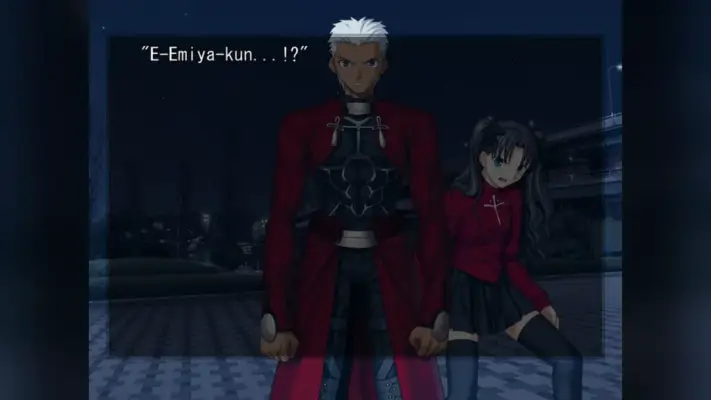
The narrative backbone of Fate/stay night is built around an extremely complex supernatural event: the Holy Grail War. This tournament is a deadly combat among mages, known as the Fourth Holy Grail War, where participants fight with magic and the help of Servants—heroes and legendary figures from various eras—in the hope of having their wishes granted by the powerful Holy Grail. The protagonist, Shirou Emiya, is an honest and dedicated young man whose deep sense of responsibility for those who died in his childhood in Fuyuki City shaped an ardent desire for justice and peace. It is amidst this scenario that his life is changed, and he is formally enrolled as a Master in the Grail War, guided by the appearance of Saber.
The Dynamic Between Master and Servant
The structure of the conflict lies in the symbiotic and tense relationship between the Masters, the human mages, and the Servants, the legendary combatants. Each Servant is a manifestation of a historical character, such as Saber, and they are summoned to assist their Masters. However, the nature of the War is dangerous, and Shirou’s destiny is as multifaceted as magic itself. The narrative unfolds into three equally powerful arcs, each representing a distinct philosophical path for the protagonist: Fate, Unlimited Blade Works, and Heaven’s Feel. These arcs are not mere developments, but rather different interpretations of what it means to be a hero.
The Three Routes and Shirou’s Destiny
The first route, Fate, focuses on the dynamic between Shirou and Saber. On this journey, Shirou confronts the idea that the Holy Grail is, in fact, cursed, a fact revealed when he discovers that his guardian, Kiritsugu, had already used Saber to destroy it—which, ironically, caused the fire that took his family. By rejecting the desire to change the past, Shirou and Saber accept the present, culminating in the destruction of the Grail.
Next, Unlimited Blade Works introduces Rin Tohsaka, a noble lineage mage, and her Servant, Archer. This arc is marked by a personal confrontation with the past. Shirou faces Archer, who is an older and disillusioned version of himself, questioning his ideal of heroism. The acceptance of the future, despite the regrets, becomes the pillar of this route. Finally, Heaven’s Feel focuses on Sakura Matou, Shirou’s long-time friend, who is, in fact, the true Master of Rider. In this route, the conflict is more intimate and somber: Shirou, upon falling in love with Sakura, abandons his ideal of justice in favor of saving her, confronting the threat of Angra Mainyu and the corrupting power of the Grail. Across all versions, Shirou Emiya’s destiny is redefined not by a granted wish, but by the choice of whom he decides to protect.
From PC to Switch: The Evolution of Platforms and Remakes
The journey of Fate/stay night is a notable example of how a successful narrative can transcend the limits of its original platform. If the starting point was the mind of Kinoko Nasu and the art of Takashi Takeuchi, the materialization of the game itself had a solid and definitive beginning: the original release for PCs running the Windows operating system on January 30, 2004, in Japan. This release established the title as one of the pillars of the visual novel genre, defining its complex routes (Fate, Unlimited Blade Works, and Heaven’s Feel) and its immediate cultural impact.
Adaptation Across Different Media
However, the title’s success required constant technical and content adaptation. The nature of a growing franchise meant that the game needed to be remade and adapted for different generations of consoles and mobile devices. A major milestone in this process was the release of Fate/Stay Night Réalta Nua for the PlayStation 2, which occurred on April 19, 2007. This version not only updated the graphics and redesigned the gameplay but also made significant content adjustments, such as replacing adult material and adding extended scenes.
This trend of *remake* and updating continued. The game was ported to the PlayStation Vita on November 29, 2012, a version that incorporated new animations produced by Ufotable studio and offered screen aspect ratio flexibility. Subsequently, the work expanded into the mobile landscape, arriving on iOS systems on April 18, 2015, and on Android on May 29, 2015, consolidating its presence across multiple platforms in Japanese territory.
Global Reach and the New Era of Platforms
The evolution of platform support culminated in a moment of great international significance. On January 30, 2024, Type-Moon announced Fate/Stay Night Remastered. This *remake* was published by Aniplex and, on August 8, 2024, was released globally for Nintendo Switch and PC via Steam. This event is crucial because it marked the first official debut of the visual novel outside of Japan, making the title accessible to an unprecedented global audience. The *Remastered* was based on the PS Vita version of *Réalta Nua*, ensuring that the gaming experience was updated to modern standards.
Thus, the trajectory of Fate/stay night is a case study in brand resilience. From the 2004 PC release to the 2024 Nintendo Switch version, each *remake* has not only updated the technology (migrating from 2D to HD formats and *streaming*), but has also expanded the material’s accessibility to new generations of players worldwide, proving the enduring strength of Kinoko Nasu’s narrative.
The Visual Novel Experience: Gameplay and the Power of Reading
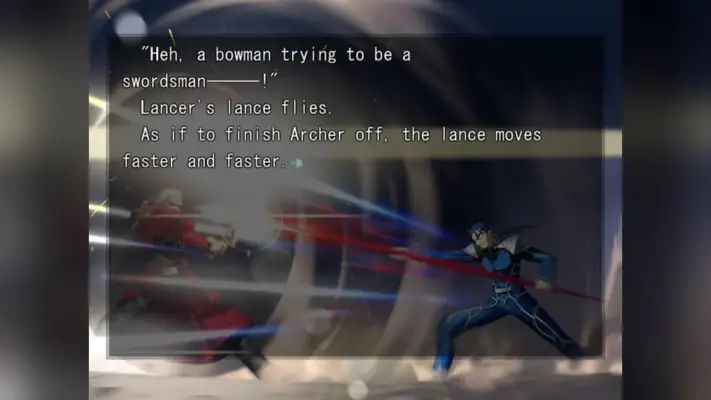
The experience of Fate/stay night transcends the traditional definition of an action game. The title is a classic and complex example of the visual novel genre. Unlike games focused on real-time combat, the gameplay in Fate/stay night requires minimal player interaction, as most of the time is dedicated to reading text. These texts vary between immersive narration, character dialogues, and the protagonists’ internal thoughts, immersing the user in the characters’ minds and the magical atmosphere of Fuyuki.
The Mechanics of Narrative Choice
The heart of the gameplay lies in the player’s decisions. Instead of physical confrontations, the challenge is making choices at decision points, where the user must select from options presented on the screen, usually between two and three alternatives. The time between these decision points is variable, creating constant tension that forces the player to consider the moral and relational implications of their actions. It is through these choices that the plot advances in specific and unique directions.
Narrative depth is the game’s most robust element. The story is structured around three main lines, corresponding to the three central heroines. If you want to learn more about the history and creators of this universe, it is essential to understand that for the player to have a chance to experience all facets of the conflict—and understand Shirou Emiya’s complete journey—they must play the title multiple times, choosing different paths at decision points. Completing one route is a prerequisite for unlocking access to the next, ensuring that the player has continuous and progressive engagement with the universe.
Development and Consequences
The game’s main focus is not combat power, but rather character development and the construction of the narrative destiny. A crucial mechanical system is the “affection meter.” When interacting with the heroines in each route, the responses provided by the player must be carefully chosen to please them, raising this meter. The way the player guides these relationships directly influences whether it will be possible to unlock a “True Ending,” which depends on a specific combination of choices and emotional bonds.
The game also establishes dramatic consequences for poor choices. The player can lose the game for various reasons, such as the protagonist’s death or the death of one of the heroines. In case of failure, the player is directed to an area called Tiger Dojo (タイガー道場), where characters like Taiga Fujimura and Illyasviel von Einzbern provide essential tips, motivating the player to try again, not just to win, but to correct the moral and narrative course of their favorite characters.
In summary, Fate/stay night is a work that transforms the act of reading into an act of active participation. It is a study of the weight of choices, where the magic and complexity of the Holy Grail War are explored not through epic battles, but through the emotional resonance of decisions made by a young man seeking his own ideal of justice.
Cultural Impact: Legacy, Adaptations, and Global Success
The cultural impact of *Fate/stay night* transcends the game format, cementing it as a fundamental pillar in the *visual novel* genre and establishing a vast and resilient intellectual property legacy. The commercial success was immediate and massive. The original PC version, released on January 30, 2004, sold 400,000 copies. This sales trajectory was marked by constant updates and new platforms: the title was released for the PlayStation 2 on April 19, 2007, selling 184,558 units, and remained relevant with re-releases, such as the one in 2009, with 21,937 sales. The franchise’s adaptability allowed it to reach various generations, registering significant sales of 58,157 units on the PlayStation Vita in 2013, and 86,836 units the following year. Accumulating these sales, the global total sales of the *visual novel* surpassed 751,488 copies.
Critical Acclaim and the Power of Narrative
The recognition of the title was not limited to just the numbers. The work received critical acclaim for its narrative depth and the way it utilized mythological material. This ability to intertwine myth and mystery is notable, as seen in titles that explore the complete history behind the mystery. In 2004, the game was recognized by the Getchu.com portal as one of the best-selling *visual novel* titles in the adult category. In 2007, the results from Dengeki G’s Magazine, in a survey of 249 titles, placed *Fate/stay night* second with 78 votes. Critics and academics praised the *visual novel* format for its capacity to present branching narrative arcs, giving players the opportunity to experience the story through different emotional lenses. Analysts, such as Chris Klug and Josiah Lebowitz, considered it a strong example of interactive narrative in 2011, comparing its complexity to a traditional novel.
The work’s success was also evident across multiple media. The anime series, released in 2006, with DVD and Blu-ray editions, sold 283,864 units in Japan. Furthermore, the franchise’s legacy expanded to the staggering success of *Fate/Grand Order*. This spin-off not only maintained fan interest but achieved global commercial success, surpassing the *Metal Gear* video game franchise in just four years, with revenue exceeding 5 billion dollars. In 2019, the brand’s strength was consolidated when the franchise won first place at the Comiket 96 event.
In summary, the trajectory of *Fate/stay night* is a case study in brand resilience. Its ability to transition across media—from the narrative decision-making game format to anime, manga, and large-scale games—without losing its core identity, makes it a milestone not only for the *visual novel* genre but for global Japanese pop culture itself.
Frequently Asked Questions
What is the difference between the three routes (Fate, UBW, and Heaven’s Feel)?
The routes explore distinct philosophical facets of the protagonist. Fate focuses on the ‘self as ideal,’ UBW deals with ‘struggling with oneself’ through a personal confrontation. Heaven’s Feel, in turn, explores the ‘friction between the real and the ideal,’ making it the most intimate and somber.
What is the Holy Grail War and what is the role of the Servants?
It is a deadly combat among mages, known as the Fourth Holy Grail War, where participants seek to fulfill wishes. Servants are heroes and legendary figures from various eras, summoned to assist the Masters, forming the core of the magical conflict.
Who is the protagonist of Fate/stay night and what is his role in the story?
The protagonist is Shirou Emiya, a dedicated young man whose deep sense of responsibility for childhood losses shaped a burning desire for justice. He is the Master in the Grail War, and his destiny is redefined by the choices he makes to protect those he loves.
Is the game more focused on the story or the combat gameplay?
The focus is predominantly narrative. It is a visual novel where gameplay requires minimal interaction, dedicating itself to reading texts and dialogues. The challenge lies in making moral and relational decisions, not in physical confrontations.
What is Type-Moon’s importance in the creation and maintenance of the Fate universe?
Type-Moon was co-founded by Nasu and Takeuchi and was crucial in transforming the project from a *dōjin* writing exercise into a commercial success. The company manages the complex development, adapting the title for multiple platforms, such as PS2, Vita, and the 2024 Remastered version.
Conclusion
The journey of Fate/stay night is a remarkable testament to how literary art can grow in complexity and scope. What began as a writing exercise by Kinoko Nasu, inspired by fantasy works, blossomed through the crucial collaboration with artist Takashi Takeuchi, transforming into a cultural pillar. The magical backbone—the Fifth Holy Grail War—is the stage for a profound philosophical debate. Far from being just a magic tournament, the plot establishes itself as a deep dive into the nature of the ideal, guided by Shirou Emiya’s desire to protect those he loves.
The genius of the work lies in its tripartite thematic structure. The routes Fate, Unlimited Blade Works, and Heaven’s Feel are not mere extensions, but distinct lenses through which the protagonist confronts what it means to be a hero. Whether accepting the present after betrayals, or confronting the most disillusioned version of himself, the narrative core remains: Shirou’s destiny is redefined not by a wish granted by the Grail, but by the conscious choice of whom he decides to protect. This thematic architecture ensured that the work transcended its multiple release iterations, from the PC in 2004 to current *remasters*.
Thus, Fate/stay night remains more than a magic visual novel; it is a meditation on sacrifice, regret, and the difficult task of “self-actualization.” Understanding this complexity is the first step to appreciating the depth of the work. Now that you know the origins and arcs, what reflection on your own ideal of heroism will you take with you?