Read this article in: Portuguese (Português) · Spanish (Español)
Papers, Please is a simulation and puzzle video game created by Lucas Pope, and independently developed and published by his company, 3909. The title captured the attention of players and critics by immersing the user in the role of an immigration inspector in a dystopian setting. Instead of offering grand action, the game proposes an intimate and bureaucratic experience, where the tension lies in precision and ethics. It is precisely this unique approach, which transforms the routine of passing through borders into an exercise of empathy and survival, that elevated the game to the status of interactive art, making it a cultural phenomenon in recent years.
The relevance of Papers, Please is proven not only by its critical impact but also by its commercial reach and longevity. Initially released on August 8, 2013, for Windows and OS X, the game quickly captured the public. Its captivating narrative and complex rule mechanics resulted in impressive success, surpassing the mark of five million copies sold throughout its history. Furthermore, the game received recognition in several awards, such as the Seumas McNally Grand Prize at the 2014 Independent Games Festival, consolidating it as a landmark in the history of independent video games.
In this article, we will take a complete journey to uncover the origin of this phenomenon. We will explore Lucas Pope’s vision behind the creation, the genesis of the fictional city of Arstotzka, and the dystopian setting surrounding it. We will also address the technical challenges of its development, detail the gameplay as an immigration inspector, trace the releases on various platforms—from the iPad in 2014 to Android in 2022—and, finally, analyze the cultural legacy and critical reception that made Papers, Please one of the most acclaimed games today.
Key Points
- The game was created by Lucas Pope and developed/published by 3909, and is classified as Puzzle and simulation.
- The action takes place in Arstotzka, a totalitarian and bureaucratic state, set in 1982.
- The central mechanic requires the player to act as an immigration inspector, checking documents under pressure.
- The visual aesthetic is deliberately ‘clunky,’ reinforcing the feeling of an oppressive state apparatus.
- The development was complex, requiring adaptations for multiple platforms (Windows, iOS, Android, etc.).
Papers, Please in Summary
| Developer | 3909 |
|---|---|
| Publisher | 3909 |
| Creator | Lucas Pope |
| Genre | Puzzle, simulation |
| Platforms | Microsoft Windows, OS X, Linux, iOS, PlayStation Vita, Android |
| Game Engine | Unity |
| Game Mode | Single-player |
Who Created Papers, Please? Lucas Pope’s Vision

Lucas Pope is the designer and creator behind Papers, Please, and the title is developed and published by his company, 3909. His professional career is marked by a transition from major game studios to the independent niche. Pope had previously worked on highly successful titles, including for Naughty Dog, where he participated in the *Uncharted* series. However, around 2010, after leaving the company, he and his wife, Keiko—who is also a game designer—decided to move to Saitama, Japan. This move was driven by a desire to move away from the “defined formula” of AAA games and dedicate himself to smaller, more experimental projects, seeking greater control over the artistic vision of his creations.
The Inspiration Behind Arstotzka
The idea for the game came from a mundane, yet deeply intriguing observation: immigration inspection work. Pope was fascinated by the repetition and tension inherent in passport control. Although the document checking mechanic was conceived early, it lacked a narrative context. The inspiration came from films depicting infiltration and escape plots from countries, such as *Argo* and the *Bourne* series. Pope then made a creative decision: instead of following the script of those who are escaping, he placed the player in the role of the inspector, the one who must prevent passage. Thus, he created the fictional state of Arstotzka, set in 1982 and loosely modeled after Eastern Bloc nations. The totalitarian and bureaucratic setting, which evokes elements of the Berlin Wall and communist administration, was a natural draw for him, inspired by his previous experiences, such as his game *The Republia Times*, and reinforces an interest in narratives of tension in any survival game story.
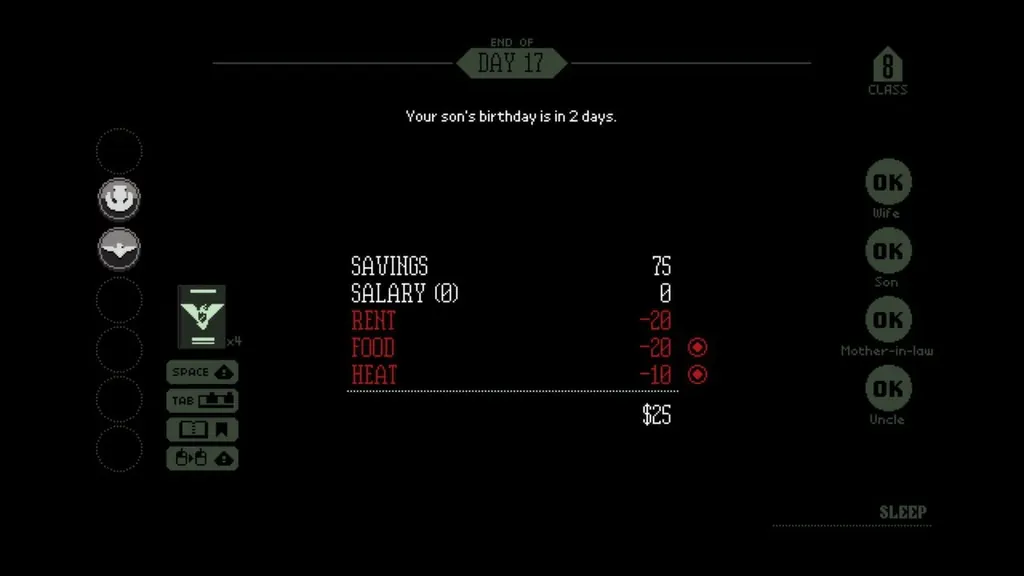
Development of Papers, Please began in November 2012, funded by personal savings from his time at Naughty Dog. Pope utilized open-source programming languages, such as Haxe, building upon structures that he and Keiko had previously developed. He deliberately kept the interface “clunky,” an aesthetic choice inspired by visual programming tools he had already used. Pope’s central goal was not to build a game based solely on addictive mechanics, but rather to provide an artistic experience focused on narrative and moral decision-making. Even the simplest elements, such as the family status screen at the end of each day, were kept minimalist so that the player could interpret the events without the game dictating a specific feeling.
The development journey was marked by constant adjustments. After initial success in forums and submitting the game to Steam Greenlight in April 2013, public attention led Pope to expand the moral complexity, adding tools like the body scanner to detect threats. To cater to players less interested in the dense narrative, he also implemented alternative modes, such as an “infinite” mode focused solely on the continuous processing of immigrants. This evolution demonstrates Pope’s commitment to ensuring that the game could be appreciated by those who value the puzzle as well as those who seek deep reflection on the human condition under the yoke of state bureaucracy.
The Origin of the Idea: Arstotzka and the Dystopian Setting
The genesis of Papers, Please? does not lie in complex technology, but rather in a profoundly human and, paradoxically, oppressive observation: the mechanism of the border. The game transports the player to a dystopian and bureaucratic setting, centered in Arstotzka, a fictional country that strongly evokes the atmosphere of Eastern European nations during the Cold War period. It is precisely this setting—the strong state control, the surveillance, and the constant pressure of rules—that gives the work its unique and dense tone.
The Context of Arstotzka
Arstotzka is the central stage of our narrative. The nation is portrayed as a highly regulated state, where control is exercised through an almost inescapable network of documentation and protocols. The sense of surveillance is so palpable that many critics compare the environment to works by George Orwell, suggesting a state where thought and movement are strictly controlled by the state apparatus. The Grestin East border, where the player operates, is more than a geographical limit; it is a point of political and social containment.
In this setting, the player assumes the role of an immigration agent. The function is to analyze the documentation of every individual seeking entry into the country. It is not a simple name-checking job; it is an exercise in discernment under pressure. The crowd of immigrants arriving at the border consists of people who may be seeking humanitarian aid or simply trying to cross, but among them lurk much greater dangers: smugglers, terrorists, and any individual who threatens the established order.
The complexity of the game flourishes precisely by transforming this social and political tension into a gameplay challenge. The inspector must act with speed and precision, as time is a scarce resource directly linked to the character’s survival. The speed with which the work is executed directly impacts the agent’s salary. This salary, in turn, is not just a number; it is vital for the maintenance of the inspector’s and his family’s life, requiring the player to be not only an expert in immigration rules but also a financial administrator in an oppressive system.
Thus, Papers, Please? uses the melodrama of bureaucracy to create a puzzle simulation. Every document, every stamp, and every decision to allow or deny entry into the country carries a narrative and practical weight. The game transforms state oppression into a logic challenge, forcing the player to become the implacable guardian of the borders, navigating between the need to survive economically and the moral dilemma of who should or should not be allowed to pass. This exploration of complex systems is a recurring theme, whether in moral dilemmas or in urban planning games.
The Development and Technical Challenges
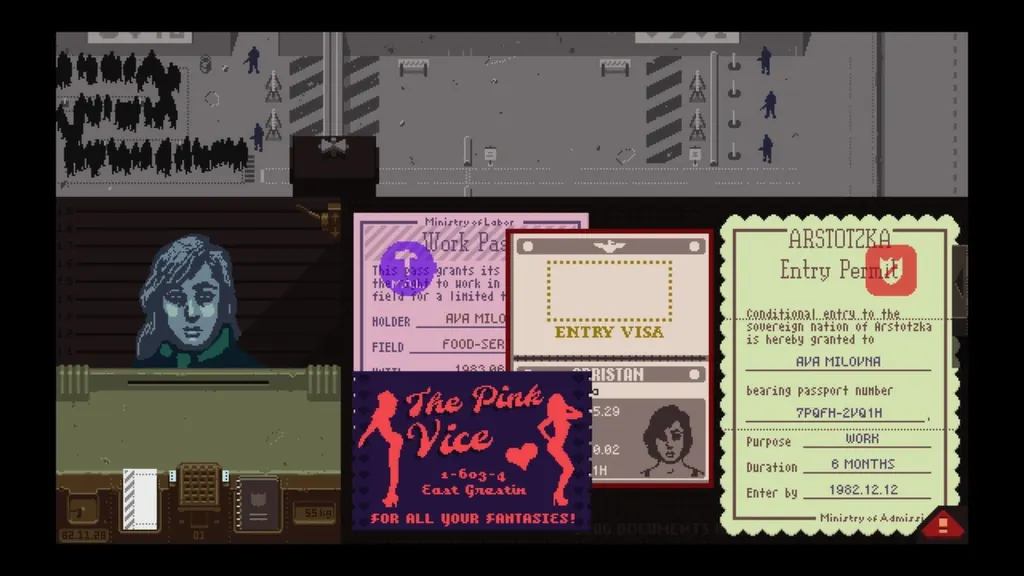
The development of *Papers, Please* was a classic example of how an independent project, born from a simple observation, can overcome monumental technical and logistical challenges. The work began in November 2012, funded by Lucas Pope’s personal savings from his time at Naughty Dog. Initially, the development used structures built in Haxe and the NME framework, inherited from previous works by Pope and his wife, Keiko. However, the ambition to bring the experience to multiple platforms required the use of robust tools like the Unity engine. The initial phase was one of experimentation: Pope expected the project to take only a few weeks, but the complexity of the immigration system, which required balancing rigid rules with elements of controlled randomness, extended the timeline to nine months.
One of the most unique aspects of the development was the visual aesthetic. Far from seeking a polished and modern interface, the user design was intentionally “clunky,” a choice inspired by visual programming tools like HyperCard. This decision was not merely stylistic but functional, as it contributed immensely to player immersion. The game’s visual simplicity and rigidity, which evoke old bureaucratic systems, reinforced the feeling of being within an oppressive state apparatus. As the game progressed, the narrative complexity increased, culminating in the inclusion of moral elements, such as the controversial body scanner, which added a layer of tension and ethical dilemma to the simple act of checking a passport.
Cross-Platform Challenges
The transition from a niche project to a global phenomenon presented significant technical challenges, particularly concerning the adaptation of the inspection experience across different devices. The initial releases occurred on August 8, 2013, for Windows and macOS, followed by versions for Linux on February 12, 2014. The adaptation journey continued with the launch for iPad on December 12, 2014, and later, for the PlayStation Vita on December 12, 2017. Each port required a fresh perspective on gameplay. Adapting to portable devices, such as the Vita and Android and iPhone cell phones, presented constant interface challenges. In 2022, with the release of updated versions for Android and iOS, the team had to redesign the game for smaller screens, ensuring that the inspection experience remained fluid and did not rely on zooming, thus maintaining the tension and precision that characterize the game.
In summary, the technical success of *Papers, Please* lies not only in the ability to port a complex simulation game to such diverse platforms (including operating systems like Windows, OS X, Linux, iOS, and Android), but also in the ability to maintain the integrity of its retro and bureaucratic interface—elements crucial to the immersion and dramatic impact of the experience.
Gameplay: The Role of the Immigration Inspector
The heart of Papers, Please beats at the border of Arstotzka in 1982. In this scenario of extremely high political tension, the player assumes the role of an immigration inspector, a post that transcends mere bureaucratic function. The game is, in its essence, a case study on systemic pressure and the human cost of rules. The central mechanic requires the agent to meticulously review the documents of every traveler arriving at the checkpoint, deciding whether the person is legitimate, must be denied entry, or needs to be detained for suspicion of being criminal, terrorist, or carrying falsified documents.
Bureaucracy as Narrative Engine
Each day of gameplay brings with it a set of specific rules that become progressively harder to follow, reflecting the deterioration of relations between Arstotzka and its neighbors. The flow of immigrants is constant, and the player must process as many as possible within a limited time, simulating a shift of work at a border checkpoint. When a document presents any discrepancy, the inspector cannot simply decide; they must follow a rigorous protocol. The available actions—from confronting the applicant, demanding missing documents, comparing fingerprints, or requesting full body scans—are tools that reinforce the title’s ’empathy game’ nature. The player feels the weight of every decision, as it affects not only the traveler’s fate but also their own stability.
The consequences of any error or success are immediate and palpable. The final act of accepting or denying entry is sealed with a stamp in the passport. However, failing to follow protocol can result in a protocol fine, sent via internal fax to the inspector’s cabin. Additionally, the player must manage finances in real time: at the end of each day, they receive a salary based on successful procedures and any bribes collected. However, this income must cover the family’s basic cost of living—rent, food, and heating. The risk of accumulating debt leads directly to Game Over, forcing the player to balance civic duty, family subsistence, and often, corruption.
Moral Dilemmas and the Cost of Survival
It is at this intersection between law and necessity that the gameplay reaches its dramatic peak. The complex rules system is constantly challenged by moral dilemmas. For example, the player may be confronted with the situation of allowing a supposedly legitimate spouse to pass, even if they do not have complete documentation, risking the entry of a terrorist. Simultaneously, the narrative introduces political factions like the EZIC group, which plans a coup d’état, forcing the inspector to make decisions with direct consequences on the game’s outcome. The game is therefore not just a document puzzle, but a brutal simulation of bureaucratic pressure, where personal survival is intrinsically linked to complying with rules that sometimes seem irrational or dangerously human. This complexity of systems and decisions is a recurring theme, whether in modern dilemmas or in grand historical sagas, such as the complete history of civilizations.
Releases, Platforms, and the Evolution of the Game
The Launch Trajectory and Global Expansion
The success of Papers, Please is not due only to its engaging gameplay, but also to its ability to cross digital borders. The game’s launch journey, developed and published by the 3909 studio by Lucas Pope, demonstrates a strategic growth that transformed a small independent work into a global phenomenon. The starting point was the desktop environment, with the initial release for Windows and macOS on August 8, 2013. Proof that the game would transcend computer platforms came shortly after, with its arrival on Linux on February 12, 2014.
The phase of portability to mobile and portable devices was marked by technical challenges and significant adjustments. The iPad was one of the first destinations, receiving a version on December 12, 2014. Supporting various operating systems required the development team to face complex obstacles, such as the case with iOS, where Apple initially required that the body scanning functionality be censored because they considered it pornographic. It was a process that, according to reports, was reversed after Apple recognized the misunderstanding, allowing the game to be resubmitted without cuts.
The release timeline continued to unfold with the arrival on the PlayStation Vita, on December 12, 2017. This launch for portable consoles solidified the title in a niche of simulation and puzzle games. More recently, on August 5, 2022, the game reached a new wave of modernization and reach. Updated versions were released for Android and iOS. These editions were redesigned for smaller screens, eliminating the need for zoom and ensuring that the inspection experience remained fluid and accessible on any modern mobile device.
This broad and progressive adaptation—from desktop to Linux, from tablet to portable console (Vita), and finally to smartphones (Android/iOS)—was not just a matter of technical compatibility. It ensured that the oppressive atmosphere and bureaucratic challenge of Arstotzka could be experienced by an increasingly vast audience. In summary, the technical success of Papers, Please lies precisely in its resilience and ability to remain relevant, regardless of the platform, cementing its position as a milestone in the history of independent games.
Critical Reception, Awards, and Cultural Legacy
The impact of Papers, Please? transcended the mere category of simulation games, establishing it as a case study on the capacity of digital media to address complex ethical and social dilemmas. The critical reception was immediate and extremely positive. Influential publications, such as The New Yorker, named the title the best video game of 2013, highlighting its “dark, yet touching” nature and its ability to provoke deep reflections on daily life in an environment of state control. Wired also listed the game among its best titles of 2013, praising how the combination of the prosaic title and sober presentation captured the essence of a worker’s life in a police state.
Beyond journalistic recognition, the game was awarded a pantheon of prestigious prizes. In 2014, it won the Seumas McNally Grand Prize, as well as “Excellence in Narrative” and “Excellence in Design” at the Independent Games Festival Awards. The year was equally marked by its nominations and victories at the BAFTA Video Games Awards, where it was honored with “Best Simulation Game.” More recently, in 2021, the title was recognized with the Peabody Award for Interactive Narrative and Game + Play, attesting to its lasting cultural value.
Artistic Legacy and the Concept of Empathy
The title’s success is frequently analyzed by experts who categorize it as a form of interactive art. Critics and analysts classify it as an “empathy game,” a type of RPG that invites players to inhabit complex emotional worlds. The developer himself, Lucas Pope, describes the experience as a “simulator of other people,” highlighting that the game’s power lies in immersing the player in another’s perspective. Although some players, like Stephanie Bendixsen, found the paperwork mechanics “boring,” the game’s moral depth captivated most. Critic Ben “Yahtzee” Croshaw, from The Escapist, praised precisely this tension, pointing out that the player is forced to weigh whether they want to “create a better world or just take care of themselves and their own.”
Commercial Success and Cultural Resonance
The artistic appeal translated into massive commercial success, demonstrating an independent concept’s ability to achieve global scale. Sales of Papers, Please? grew exponentially over the years. While the developer reported sales of 500,000 copies in March 2014, during the BAFTA Awards, the number surpassed 1.8 million units by August 2016. By its tenth anniversary, the game had sold an impressive 5 million units across all platforms. This exponential growth, combined with its ranking at 45th place on The Guardian’s list of The 50 Best Video Games of the 21st Century in 2019, solidifies its status not just as a game, but as a cultural milestone within the video game universe.
Frequently Asked Questions
Is Papers, Please a difficult game to pass?
The difficulty lies less in the mechanics and more in the moral dilemma and bureaucratic precision. The player must act quickly and follow rigorous protocols, as every mistake or success has immediate consequences. Furthermore, one must manage finances to support the family, making it a challenge of logic and survival.
What is the fictional country where the story takes place?
The story takes place in Arstotzka, a fictional state that strongly evokes the atmosphere of the Eastern Bloc countries during the Cold War. This setting is portrayed as highly regulated, where state control and surveillance are exercised through rigorous protocols and documentation.
Does the game have official sequels or continuations?
The provided content does not mention official sequels, prequels, or continuations of ‘Papers, Please’. The text focuses on the development journey, the inspirations, and the evolution of the moral complexity of the original title, without indicating new chapters or subsequent games.
What are the main themes addressed in Papers, Please?
The central themes are bureaucracy, state control, and moral dilemma. The game explores the tension between the need to survive economically and the ethical weight of following oppressive rules. It is a study of the human condition under the yoke of a vigilant state system.
What is the difference between the development and the release of the game?
Development occurred between 2012 and 2013, being a creation process that involved building the complexity of the immigration system and the ‘clunky’ aesthetic. The release, on the other hand, refers to the availability of the game on multiple platforms (Windows, iOS, Android, etc.) on specific dates, requiring technical adaptations to maintain the inspection experience across various screens.
Conclusion
The journey of *Papers, Please* is a powerful testament to how a mundane observation—border control—can transform into a complex artistic experience. Far from being a mere puzzle, the game immerses the player in the state of Arstotzka, a bureaucratic and oppressive setting that mirrors Cold War tension and the power of state control. Lucas Pope, by leaving the major AAA studios to focus on independent projects, did not just create a game, but a social commentary on surveillance and the nature of rules.
Since its beginning in 2012, the development not only overcame technical challenges, utilizing languages like Haxe, but also established an intentionally “clunky” aesthetic. This choice was not an oversight, but a narrative device that forced the player to feel the weight of bureaucracy. The moral dilemma—balancing the family’s need for financial survival with the weight of the lives passing through the border—is the heart of the work. *Papers, Please* transforms state oppression into a challenge of logic and human decision.
Thus, the title proves that the deepest reflection on the human condition can emerge from the simplest and most repetitive mechanisms. The genius lies in making us feel the weight of every stamp and every “no.” If you are drawn to the intersection of art and social criticism, it is time to experience the tension and dilemma of Arstotzka and discover what it truly means to be a border guard.