
Read this article in: Portuguese (Português) · Spanish (Español)
If you are looking for the 50 best games for Adventure Vision, prepare for a nostalgic trip to a console that defined the concept of arcade portability. The Adventure Vision, launched by Entex Industries, is a second-generation video game system that, despite its limited initial catalog, managed to capture the vibrant essence of the arcade. This article not only revisits the most iconic titles—such as the ports of Defender and Super Cobra, both originally from Konami and Williams Electronics, respectively—but also dives into the technology that allowed these arcade classics to reach a single, portable unit. It is a journey back in time that promises to revive the magic of red pixels.
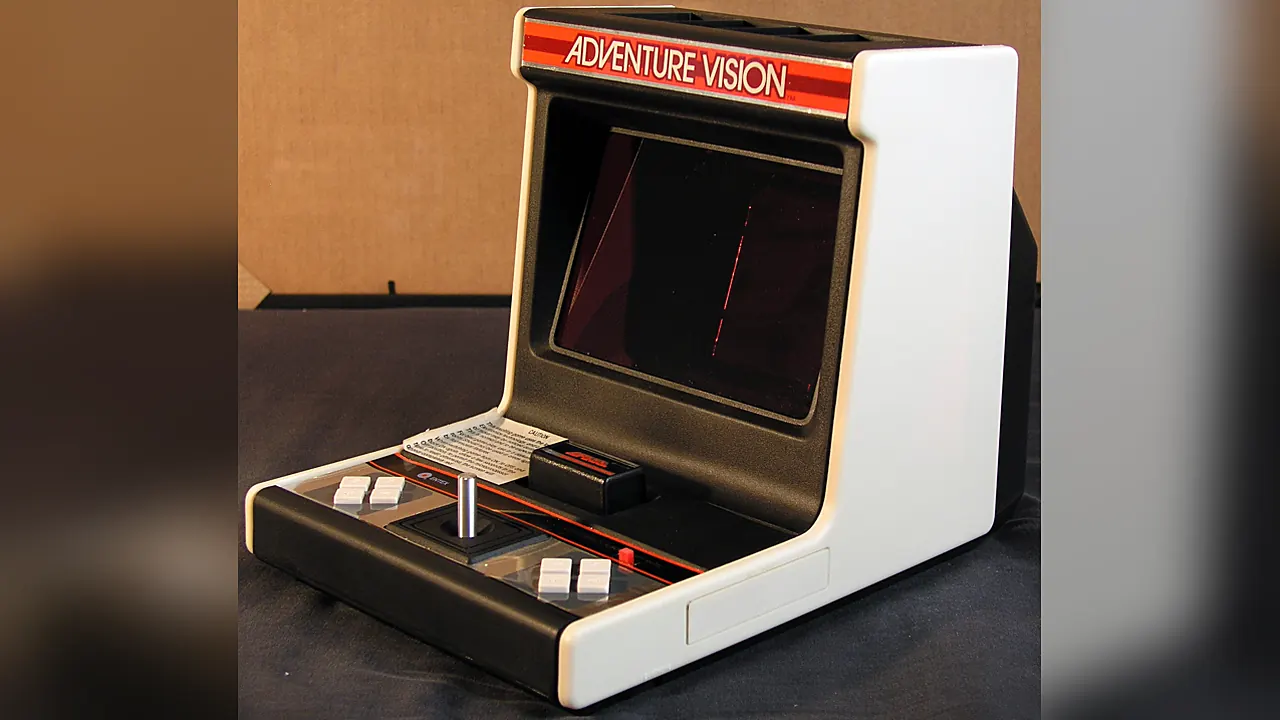
To understand the magnitude of this console, it is crucial to contextualize it in its time. The Adventure Vision appeared in August 1982, representing a significant technological leap for Entex Industries, which used it as a successor to the Entex Select-A-Game. The system was notable for its compact architecture: a single monitor, multifunctional controls, and computer hardware all in one unit. Technically, the heart of the system ran an Intel 8048 processor at 733 kHz and a National Semiconductor COP411L sound chip at 52.6 kHz. This combination of specifications positioned it as a fascinating piece of video game history, and its display technology, which combined red LEDs with a rotating mirror, is a study worthy milestone.
In this comprehensive guide, we will trace a detailed path for retro gaming fans. First, we will explore the Adventure Vision platform in its historical and technical context, understanding how this portable marvel worked. Next, we will dedicate a section to the game catalog, uncovering the influence of arcades on the title selection. Finally, we will establish rigorous selection criteria, explaining why every analyzed game is considered a true legendary classic. Prepare to relive the golden age of the arcade in a truly retro experience.
Key Points
- Launched in August 1982, it was Entex Industries’ second portable game console.
- It used an Intel 8048 CPU at 733 kHz, with 64 bytes of RAM and 1K of main memory.
- Its display was distinctive: 150 x 40 monochromatic red LED and rotating mirror.
- The catalog focused on adapting arcade hits, such as Defender and Super Cobra.
- Despite being discontinued in 1983, the system maintains its technical legacy and is supported by emulators.
Adventure Vision in Summary
| Manufacturer | Entex Industries |
|---|---|
| Type | Video Game Console |
| Generation | Second Generation |
| Release | August 1982 |
| Launch Price | $79.95 |
| Discontinued | 1983 |
| Units Sold | 50,757 |
| Media | ROM Cartridge |
| CPU | Intel 8048 @ 733 kHz |
| Memory | 64 bytes, 1K |
| Display | 150 x 40 Monochromatic Oscillating Red LED Display |
| Sound | National Semiconductor COP411L @ 52.6 kHz |
| Dimensions | 13.25 by 10 by 9 inches (337 mm × 254 mm × 229 mm) |
| Predecessor | Entex Select-A-Game |
The Adventure Vision Platform in Historical and Technical Context
To understand the uniqueness of the Adventure Vision, it is essential to revisit its launch context. Developed by Entex Industries, the console emerged in August 1982, marking the second generation of portable video game systems. It was not a debut system, but rather a direct successor to the Entex Select-A-Game console, which already positioned it in a specific market niche: that of the consumer seeking the arcade experience outside of arcade halls. With an introductory price of $79.95, the Adventure Vision promised to bring the magic of arcade games into the home, being a piece of equipment that, despite its short lifespan (discontinued in 1983), left an undeniable technical legacy in the history of retrogaming, a period that saw the emergence of various machines, such as the history of console development.
The Technical Specifications That Shaped the Experience
The heart of the Adventure Vision was a hardware architecture that, although limited, was extremely efficient and pioneering for its time. Its processing was based on an Intel 8048 CPU, operating at a frequency of 733 kHz. In terms of memory, the system utilized a combination of modules: 64 bytes of internal RAM for the 8048, supplemented by 1K of memory on the main PCB. The game cartridges, which contained 4K of ROM, ensured a variety of titles, while sound was managed by a National Semiconductor COP411L chip, operating at 52.6 kHz.
However, the hardware limitation is what defines the aesthetic and gaming experience. The graphics board was restricted to a monochromatic 150 x 40 pixels display. This restriction forced developers to be extremely creative, optimizing every processing cycle and every pixel to create playable worlds. The controls were robust and designed for portability, including a 4-directional joystick and four duplicated buttons on each side, ensuring precision in a compact format (13.25 by 10 by 9 inches).
The Unique Display Technology
The most distinctive and technically fascinating element of the Adventure Vision was its display. Instead of modern color screens, the console used a system of red LEDs combined with a rotating mirror. This display technique was not only a marvel of the era’s engineering but was also the factor that gave the gameplay an unmistakable and deeply nostalgic look. The monochromatic nature and the projection through the mirror created a visual atmosphere that the games were able to exploit to the maximum. This focus on retro aesthetics remains a fascinating topic in the industry, as we can see when exploring the history of console development.
This combination of powerful hardware for its time, yet visibly limited in visual resources, is what makes the Adventure Vision so fascinating. It not only emulated the concept of arcade gaming at home but also established a standard of portability that influenced subsequent generations. Its legacy is so strong that similar display techniques were noted in later devices, such as Nintendo’s Virtual Boy in 1995. Furthermore, the system remains academically alive, being supported today by emulators like MESS and AdViEmulator, ensuring that its titles and technical history remain accessible to retrogaming enthusiasts.
The Game Catalog and Arcade Influence

Diving into the Adventure Vision’s game catalog, the retrogaming enthusiast encounters a highly focused curatorial experience. Unlike subsequent consoles that accumulated vast catalogs of varied titles, the appeal of the Adventure Vision lies precisely in its scarcity and the nature of its collection. The console did not aim to be a game library, but rather a portal to the ultimate arcade experience of the time. Every available title is not an original game for the platform, but rather a meticulous transposition of gigantic arcade hits.
The Strength of Arcade Adaptation
This characteristic defines the heart of the console: the quality of the adapted games far surpasses the quantity. Entex knew how to capitalize on the prestige of arcade titles, allowing players to experience at home what was, at the time, synonymous with high-level arcade entertainment. The strength of the catalog, therefore, does not lie in the diversity of genres or the vast library of titles, but rather in the fidelity and technical excellence with which developers managed to port the magic of the arcade into a ROM cartridge format. Studying these titles is, in fact, studying the engineering of adaptation.
The list of available games is a direct testament to the collaborations and influences of the arcade industry. The main catalog includes titles that guarantee an instant immersion into the golden age of arcades. Among them, stand out:
- Defender: Based on the acclaimed title from Williams Electronics, a classic that demanded precision and strategy.
- Super Cobra: A direct homage to Konami’s success.
- Tartarugas: Another Konami title, featuring gameplay reminiscent of hits like Pac-Man.
- Space Force: Adapted from the arcade game Venture Line, bringing space action reminiscent of titles like Asteroids.
This selection is notable because it gathers different gameplay styles—from the complex aerial combat of *Defender* to the strategic labyrinths of *Tartarugas* and the space action of *Space Force*. The ability to adapt such distinct mechanics for the Adventure Vision hardware, which was a pioneering but visually limited system, demonstrates the technical talent behind Entex Industries.
In summary, the Adventure Vision catalog is not just a collection of games, but an ambassador of arcade culture. Instead of trying to compete with the sheer volume of titles found on a modern console, it focused on the depth and impact of a curated collection. This “few, but good” approach transforms every gaming session into a true nostalgic journey, solidifying the Adventure Vision as a fundamental piece of retrogaming history. It is fascinating to note how other systems, such as the Epoch Super Cassette Vision, also contributed in a revolutionary way to the scene.
Selection Criteria: Why These Games Are Legendary
Curating the 50 best games for the Adventure Vision is not merely a nostalgic exercise, but a case study on what defines excellence in a highly restricted technological environment. To compile this list, we established a rigorous methodology that transcends simple gameplay. Our criteria focus on three interconnected pillars: the cultural influence the titles exerted on arcade genres, the lasting impact of their gameplay despite hardware limitations, and, crucially, their degree of rarity and preservation over time.
Cultural Influence and Gameplay Depth
The first criterion is cultural influence. The selected games are not just fun titles; they are milestones that defined or refined entire genres. Revisiting titles like Defender or Space Force, we realize that the ability to create depth and challenge was the developers’ great achievement. Since the console operated with a 150 x 40 monochromatic LED display and only 64 bytes of memory, complexity did not come from raw power, but from algorithmic ingenuity. Arcade masters had to be incredibly efficient, turning technical limitations into design elements—which is the true meaning of a profound gameplay impact.
Rarity, Preservation, and Technical Legacy
The second pillar, and perhaps the most fascinating, is the factor of rarity and preservation. The Adventure Vision, launched in August 1982 and discontinued even in 1983, existed during a period of dizzying transition in the video game industry. This means that many of its ROM cartridges are pieces of history, and their survival is a testament to the dedication of enthusiasts. The difficulty in finding these cartridges, and the fact that the system is still supported by emulators like MESS and AdViEmulator, elevates the historical value of every title. It is this physical and digital scarcity that elevates these games to legendary status.
In summary, a game is considered “legendary” on this list when it manages to be an ambassador of arcade culture: it must have established a recognizable genre, presented complex gameplay even with limited visual resources, and, above all, survived the test of time, serving as a technical testament to a pioneering era. The selection, therefore, is a dive not only into the fun, but into the architecture of retro gaming history itself.
The 40 Best Games for Adventure Vision
1. Myst
Developer: Cyan | Genre: Adventure
Myst is a milestone in the history of adventure games, known for its immersive and mysterious environment. Players are transported to enigmatic worlds where they must unravel complex puzzles and explore forgotten ruins. What makes Myst a timeless classic is its contemplative atmosphere and the feeling of discovery. The exploration mechanics across different systems, such as Windows, Mac OS, and PlayStation, demanded intense dedication from players, transforming gameplay into a true dive into a universe of mysteries and natural beauty, keeping the player constantly on edge.
2. The Secret of Monkey Island
Developer: Lucasfilm Games | Genre: Adventure
This title is a pillar of the point-and-click genre, famous for its irreverent humor and charismatic characters. Players embark on a tropical adventure searching for treasures, solving enigmas while interacting with the laid-back charm of Monkey Island. The game stands out for its sharp writing and sense of humor that only LucasArts mastered. Available on various platforms, including Amiga, Atari ST, Mac OS, and Windows, it set a standard for fun narrative and addictive gameplay, becoming an eternal favorite among adventure fans.
3. Grim Fandango
Year: 1998 | Developer: LucasArts | Genre: Adventure
Grim Fandango is a masterpiece that blends the noir style of classic films with the magic of the underworld. Players take on the role of Manny Calavera, a travel agent in the Afterlife, searching for mysteries and treasures. The game stands out for its striking visuals and rich narrative, which explores themes like death and memory. Released for Windows, the title solidified LucasArts’ ability to create deep and stylized experiences, proving that adventure games could be both fun and artistically ambitious.
4. Syberia
Developer: Microïds | Genre: Adventure
Syberia is an adventure title that captivates with its stunning scenery and narrative depth. The plot involves the search for a lost friend through varied and mysterious landscapes. The game stands out for how it weaves environmental puzzles with an emotional story rich in mythology. With releases on multiple platforms, such as Windows, PlayStation 2, Xbox, iOS, and Nintendo DS, the title demonstrated its adaptability and universal appeal, proving that a well-told story can transcend any operating system.
5. Maniac Mansion
Year: 1987 | Developer: Lucasfilm Games | Genre: Adventure
Maniac Mansion is a classic that helped define the point-and-click adventure genre. Players must solve mysteries in a peculiar mansion, interacting with eccentric characters and uncovering secrets. The game stands out for its innovative gameplay and clever humor, which made it a favorite since its 1987 release. Its portability to iconic machines like Commodore 64, Apple II, IBM PC, Amiga, and Atari ST ensured that its magic was accessible to a vast audience, cementing its status as a historical milestone in video games.
6. Broken Sword: The Shadow of the Templars
Year: 1996 | Developer: Revolution Software | Genre: Adventure
This title is a perfect example of a mystery adventure, blending folklore, history, and conspiracies. Players follow the investigation of a secret conspiracy, delving into secret societies and ancient artifacts. The game stands out for its European atmosphere and the complexity of its enigmas. Released on September 30, 1996, for systems like MS-DOS, Windows, and PlayStation, it set a standard of gameplay that combines the emotion of classic adventure with visual sophistication, becoming a critical and commercial success.
7. King’s Quest IV: The Perils of Rosella
Year: 1988 | Developer: Sierra On-Line | Genre: Adventure
King’s Quest IV: The Perils of Rosella is a milestone in the series and a pinnacle of the text and graphic adventure genre. Players guide Prince Adam on an epic journey to save the kingdom. The game stands out for its narrative progression and the increasing difficulty of its puzzles, which required great logic and patience. Released in September 1988, for platforms like MS-DOS, Amiga, Apple IIGS, and Atari ST, it established Sierra On-Line as one of the biggest producers of interactive narratives, being a watershed moment for its time.
8. The Legend of Kyrandia: Fables and Fiends
Year: 1992 | Developer: Westwood Studios | Genre: Adventure
The saga of Kyrandia is a fantasy adventure that invites players to explore a world full of mythical creatures and ancient mysteries. Players must collect artifacts and unravel the secrets of a magical land. The game stands out for the richness of its fantasy universe and the variety of gameplay systems. Released on August 1, 1992, for Amiga, MS-DOS, Macintosh, and PC-98, it represented the peak of interactive fantasy for the computer audience of the time, becoming a benchmark title.
9. Gabriel Knight: Sins of the Fathers
Year: 1993 | Developer: Sierra On-Line | Genre: Adventure
Gabriel Knight: Sins of the Fathers is a dark and atmospheric title that plunges the player into a gothic and supernatural mystery. The plot involves the protagonist in a murder case and macabre secrets. The game stands out for its Victorian setting and the psychological depth of its characters. Released on December 17, 1993, for platforms like MS-DOS, Macintosh, and Windows, it raised the bar for drama in interactive adventures, proving that the genre could sustain mature and disturbing narratives.
10. Sam & Max Hit the Road
Year: 1993 | Developer: LucasArts | Genre: Adventure
Sam & Max Hit the Road is a classic comedy and adventure that follows the duo of Sam, the fox, and Max, the wolf. They embark on a journey full of adventures and eccentric characters. The game stands out for its witty dialogue and nonsense humor, characteristic of LucasArts. Released in November 1993, for MS-DOS, Mac OS, Windows, and Amiga, it kept the flame of point-and-click adventure alive with a touch of acid comedy, becoming a favorite that celebrates creativity and comedic timing.
11. Sherlock Holmes: Consulting Detective
Year: 1991 | Developer: ICOM Simulations | Genre: Mystery/Detective
This classic title casts the player as an assistant to Sherlock Holmes, requiring more than just solving riddles; one must reason like a true detective consultant. The game is a sophisticated dive into the mystery genre, where the investigation unfolds in Victorian London. What makes it exceptional is the need to interlink clues from different sources—from newspaper articles to testimonies—simulating the deductive method. It stands out for its narrative depth and the way it challenges the player to think laterally, making it a landmark for fans of literature and puzzles.
12. Manhunter: New York
Year: 1988 | Developer: Evryware | Genre: Adventure/Investigation
Set in the vibrant and mysterious backdrop of New York, Manhunter: New York is a title that captures the essence of 1980s investigative adventure games. The player is thrown into a complex plot, where solving a crime requires exploring alleys, confronting suspects, and assembling puzzles. The game is praised for its sense of place and the dense atmosphere surrounding the police investigation. Its robust gameplay and focus on interaction with the urban environment make it an excellent example of how the adventure genre could be used to create immersive and suspenseful experiences.
13. Zak McKracken and the Alien Mindbenders
Year: October 1988 | Developer: Lucasfilm Games | Genre: Sci-Fi/Adventure
Zak McKracken is one of the most memorable protagonists in sci-fi adventure. In this title, the player is catapulted into a universe filled with aliens and intergalactic mysteries. Lucasfilm Games managed to create an experience that balances classic adventure with cutting-edge sci-fi elements. The game is a landmark for its audacious narrative and the complexity of its puzzles, which require knowledge of alien technology and biology. It stands out for its thematic ambition, taking the player beyond the limits of Earth and challenging logic in a futuristic setting.
14. Mansion of Hidden Souls
Year: December 10, 1993 | Developer: System Sacom | Genre: Horror/Mystery
This adventure game is a dark dive into a gothic setting, perfect for lovers of suspense and period horror. Set in a mansion filled with secrets and lost souls, the player must unravel the mysteries that haunt the location. What it offers is an oppressive and detail-rich atmosphere, typical of the golden age of mystery adventure games. Its gameplay, adapted for the Sega CD, utilizes immersive graphics and soundtracks. It is a title that not only tests reasoning ability but also the player’s resistance to a macabre suspense.
15. Police Quest II: The Vengeance
Year: November 1988 | Developer: Sierra On-Line | Genre: Adventure/Detective
The sequel, Police Quest II: The Vengeance, deepens the police adventure genre while maintaining the high standard set by Sierra On-Line. The player encounters a revenge case that leads them through complex investigations and moral dilemmas. This title is a perfect example of how adventure games could simulate detailed police procedures, requiring logic and observation. It stands out for the depth of its interactions and the sense of progress during the investigation. It is a classic that captivates the player with the promise of uncovering the city’s darkest secrets, maintaining suspense until the very end.
16. The Journeyman Project
Year: January 6, 1993 | Developer: Presto Studios | Genre: Adventure/Sci-Fi
The Journeyman Project is an adventure that mixes exploration, mystery, and elements of science fiction. The game follows a journey project in search of knowledge and answers. It proves that the adventure genre could evolve in terms of narrative and platform scope, being released for Mac OS and Windows. What makes it special is the feeling of constant discovery, leading the player through various interconnected environments and enigmas. It represents a transitional moment for adventure games, offering a rich and educational experience, ideal for those who appreciate complex narratives and futuristic settings.
17. King’s Quest V: Absence Makes the Heart Go Yonder!
Year: November 9, 1990 | Developer: Sierra On-Line | Genre: RPG/Adventure
King’s Quest V is a pillar of adventure and RPG games, consolidating the formula of exploration and challenge in a medieval context. The game invites the player to adventure in a rich world, facing dangers and solving complex puzzles. Its importance lies in the mastery of its narrative and the depth of its game systems, which varied depending on the platform (Amiga, Mac OS, etc.). The title stands out for its timeless gameplay and its ability to keep the player engaged in an epic journey, serving as a milestone for the evolution of full-screen adventure games.
18. The Adventures of Willy Beamish
Year: 1991 | Developer: Dynamix | Genre: Adventure/Children’s
This title is a celebration of adventure with a lighter, more accessible touch, focusing on the antics of Willy Beamish. The game is an example of how the adventure platform could be adapted for a younger audience without losing the quality of the puzzles. It stands out for its color palette and playful atmosphere, while maintaining the genre’s characteristic challenge. Its ability to run on multiple platforms, including Amiga and Sega CD, shows the versatility of its engine. It is a fun and engaging experience that fills the void of lighter, yet equally intelligent, adventure titles.
19. Tass Times in Tonetown
Year: 1986 | Developer: Interplay Productions, Brainwave Creations | Genre: Adventure/Mystery
Tass Times in Tonetown is a classic that transports the player to the mysterious environment of Tonetown. This adventure game, developed by Interplay Productions and Brainwave Creations, is a dive into a mystery that requires observation and deductive reasoning. Its great strength lies in the versatility of its platforms (Apple II, Amiga, MS-DOS), ensuring that the experience was accessible to many players. The game stands out for its engaging plot and the way it builds suspense at every stage of the investigation. It is a landmark that defined the mystery adventure genre for its time, demanding attention to detail.
20. Dragon Lore: The Legend Begins
Year: 31 December 1994 | Developer: Cryo Interactive | Genre: RPG/Fantasy
Dragon Lore: The Legend Begins is a fantasy epic that immerses the player in a universe of dragons and magic. Developed by Cryo Interactive, the game is an RPG that requires exploration, combat, and unraveling a prophecy. It stands out for its rich setting and the depth of its combat and narrative systems. Released for platforms like MS-DOS and 3DO, the title represented the peak of the fusion between classic adventure and large-scale RPG elements. It is a fundamental work for those who appreciate epic fantasy stories, where every player decision shapes the destiny of the protagonists.
21. Conquests of Camelot: The Search for the Grail
Year: 1990 | Developer: Sierra On-Line | Genre: Adventure
This adventure classic places the player in the medieval setting of Camelot, plunging them into an epic quest for the Holy Grail. Developed by Sierra On-Line, the game requires players to use logical reasoning and explore a rich universe of mysteries and characters. What makes ‘Conquests of Camelot’ a landmark is its robust gameplay, which adapted perfectly to the Amiga, Atari ST, and MS-DOS systems. The engaging narrative and the complexity of the puzzles guarantee hours of immersion, setting a standard of excellence for adventure games of the era.
22. The Crystal Key
Year: 1999 | Developer: Earthlight Productions | Genre: Adventure
In ‘The Crystal Key’, players are invited to unravel a complex mystery in a point-and-click adventure setting. Released in 1999, this title represents the peak of adventure games for Windows and Mac OS platforms. The experience is marked by a rich narrative and a series of puzzles that require careful observation and deduction. The game stands out for its ability to keep the player engaged in an immersive mystery, serving as a notable example of how adventure games continued to flourish at the turn of the millennium, keeping the focus on the player’s intelligence.
23. Black Dahlia
Year: 1998 | Developer: Take-Two Interactive | Genre: Mystery
A mystery title released in 1998, ‘Black Dahlia’ casts the player in the role of a detective investigating a shocking crime. The game is an excellent example of how detective adventure games functioned on Windows at the turn of the millennium. The gameplay focuses on collecting clues, interrogations, and reconstructing crime scenes—elements that guarantee an immersive and challenging experience. What sets it apart is the dark atmosphere and focus on forensic reasoning, keeping the player constantly in the tension of unraveling one of the genre’s most intriguing mysteries.
24. Police Quest III: The Kindred
Year: 1991 | Developer: Sierra On-Line | Genre: Adventure/Detective
In ‘Police Quest III: The Kindred’, players are challenged to solve a police case in a richly detailed setting. This title, from Sierra On-Line, is a landmark for detective adventure games on MS-DOS and Amiga. The experience is deeply immersive, requiring the player to use investigative skills to connect evidence and arrest culprits. The game stands out for its fidelity to the police genre, offering gameplay that combines forensic investigation with the captivating narrative characteristic of Sierra, making it a genre classic.
25. The Lost Files of Sherlock Holmes: The Case of the Serrated Scalpel
Year: 1992 | Developer: Mythos Software, Inc. | Genre: Detective Adventure
This 1992 game transports the player into the universe of Sherlock Holmes, placing him at the center of an intriguing mystery. Developed by Mythos Software, Inc., the title is a respectful tribute to the great detective, playable on platforms such as 3DO and MS-DOS. The mechanics are purely deductive, forcing the player to reason like Holmes himself. What makes it exceptional is the combination of a classic literary setting with 90s technology, offering an intellectually stimulating mystery experience.
26. Time Tunnel
Year: 1985 | Developer: Applied Systems Engineering | Genre: Adventure
A pioneer in 1985, ‘Time Tunnel’ is an adventure title that stands out for its time travel theme. Created for the Commodore 64, this game utilized the machine’s technical limitations to create a fascinating exploration experience. The player must navigate different historical eras, solving puzzles that require knowledge and reasoning. It is a milestone in C64 game development, proving that complex narratives and science fiction themes could be executed even on more modest hardware, captivating generations of enthusiasts.
27. The Faery Tale Adventure
Year: 1987 | Developer: MicroIllusions | Genre: Fantasy Adventure
Released in 1987, ‘The Faery Tale Adventure’ is a vibrant dive into fairy tales, with gameplay that adapted to various platforms, including Amiga, Commodore 64, MS-DOS, and Genesis. Developed by MicroIllusions, the game invites the player to explore a magical world full of mysteries and fantastic creatures. Its cross-platform versatility and magical atmosphere make it a favorite. It is a perfect example of how adventure games could combine the timeless appeal of fairy tales with the puzzle challenges of the era.
28. Space Quest III: The Pirates of Pestulon
Year: 1989 | Developer: Sierra On-Line | Genre: Sci-Fi Adventure
A science fiction classic, ‘Space Quest III: The Pirates of Pestulon’ took players to a universe of space adventure in 1989. Developed by Sierra On-Line, the game is a milestone for the sci-fi genre on MS-DOS, Macintosh, Amiga, and Atari ST. Players must navigate dangerous galaxies, solving mysteries and confronting pirates. What sets it apart is the perfect blend of space exploration and point-and-click adventure gameplay, solidifying Sierra’s status as a leader in interplanetary narratives and keeping the player constantly engaged.
29. The Scoop
Year: 1986 | Developer: Telarium | Genre: Journalism/Adventure
Released in 1986, ‘The Scoop’ is an innovative title that casts the player as an investigative journalist. Developed by Telarium and Spinnaker Software, the game was playable on pioneering platforms like Apple II and MS-DOS. The gameplay mechanics focus on gathering information, writing articles, and exposing scandals. This title stands out for treating journalism in a playful and challenging way, being one of the first to apply the theme of investigative reporting in an adventure format, captivating enthusiasts of the time.
30. The 7th Guest
Year: 1993 | Developer: Trilobyte | Genre: Interactive Mystery
An pioneer of interactive mystery, ‘The 7th Guest’ was released in 1993, revolutionizing the adventure format. Developed by Trilobyte, it led players to a haunted mansion, requiring them to solve enigmas in a rich multimedia environment. Its adaptability, moving from MS-DOS to CD-i, Mac OS, and iOS, demonstrates its longevity. The game is notable for its gothic atmosphere and the integration of different media, setting a new standard for interactive mysteries and the use of CD-ROM in games.
31. The Legend of the Prophet and the Assassin
Year: 2000 | Developer: Arxel Tribe | Genre: Adventure
This Arxel Tribe title transports the player to an epic and intrigue-filled setting, where the destiny of a prophet and an assassin intertwine. Released in 2000, the game stands out for its rich and complex narrative, requiring the player to make difficult moral decisions that shape the unfolding plot. The experience is a deep dive into themes of destiny, power, and sacrifice. Its gameplay, adapted for systems like Windows and Mac OS, offers an immersion that made it a milestone in digital adventure of its time, proving the depth of narrative games.
32. The Space Bar
Year: 1997 | Developer: Boffo Games | Genre: Adventure
In ‘The Space Bar’, Boffo Games invites us on an intriguing journey set in a technological and mysterious universe. Released in 1997, the game captivates the player with its puzzles and its science fiction atmosphere. What makes it a classic is the way it blends classic adventure with futuristic elements, challenging the player’s logic at every corner. With support for Windows and Mac OS, the game demonstrates platform versatility that allowed its captivating story to reach a vast audience, making it an excellent example of technological adventure.
33. The Dark Half
Year: 1992 | Developer: Symtus | Genre: Adventure
A seminal title released in 1992, ‘The Dark Half’ by Symtus is a dark dive into an engaging mystery. The game captivates the player with its gothic atmosphere and its well-crafted puzzles, which require reasoning and keen observation. Its ability to run on Amiga, Macintosh, and MS-DOS ensured that this experience of horror and mystery reached various machines of the era. It is a brilliant example of how the point-and-click adventure could be sophisticated, maintaining tension and narrative depth at every step of the player.
34. Jewels of the Oracle
Year: 1995 | Developer: Dreamcatcher Interactive | Genre: Adventure
Released in 1995, ‘Jewels of the Oracle’ by Dreamcatcher Interactive is a work rich in mythology and mystery. The game places the player in the role of someone searching for forgotten knowledge, navigating a universe of legends and oracle enigmas. What distinguishes this title is its narrative ambition and its support for multiple platforms, including Windows, Mac, and Saturn. The combination of mystical elements with engaging gameplay makes it a highlight of 90s adventure. It is an invitation to unravel ancient secrets and restore lost wisdom.
35. The Black Sanctum
Year: 1984 | Developer: Mark Data Products | Genre: Adventure
Considered a pioneer, ‘The Black Sanctum’ by Mark Data Products, released in 1984, is a milestone in the history of adventure games. Running on iconic systems like TRS-80 and MS-DOS, the game set standards for narrative and challenge for its time. It is a testament to the ability to tell complex stories on limited hardware, requiring the player’s imagination to fill in visual gaps. Its importance lies in being one of the titles that helped pave the way for the genre, proving the narrative potential of personal computers in the early days of computing.
36. Dune
Year: 1992 | Developer: Cryo Interactive | Genre: Adventure
Adapting the epic saga of Frank Herbert, ‘Dune’ by Cryo Interactive, released in 1992, is a deep dive into a universe of politics, ecology, and survival. The game is notable for its fidelity to the original material and its robust gameplay, which adapted to various platforms, such as MS-DOS, Amiga, and Sega CD. It manages to balance the grandeur of science fiction narrative with the puzzle-solving mechanics characteristic of the genre. It is a title that not only entertains but also educates about the complexity of its universe.
37. Putt-Putt Joins the Parade
Year: 1992 | Developer: Humongous Entertainment | Genre: Adventure
‘Putt-Putt Joins the Parade’ by Humongous Entertainment, released in 1992, represents the peak of casual and fun adventure. The game is famous for its accessible gameplay, which blends puzzle elements with mini-golf mechanics, ensuring fun for all ages. Its portability, supporting 3DO, MS-DOS, Macintosh, and Windows, attests to its universal appeal. What elevates it is the charm of its characters and constant sense of humor, making it a timeless classic and one of the most beloved titles in the genre.
38. Noir: A Shadowy Thriller
Year: 1996 | Developer: Cyberdreams | Genre: Adventure
With ‘Noir: A Shadowy Thriller’, Cyberdreams transports us to the dark and cynical universe of film noir. Released in 1996, the game is a narrative puzzle that plunges the player into a period mystery, full of twists and morally ambiguous characters. Its exclusivity on MS-DOS reinforces the vintage atmosphere, mimicking the aesthetic of classic films. The game stands out for its refined writing and suspense building, making it an immersive experience that perfectly fills the niche of investigative thrillers.
39. Gobliiins
Year: 1991 | Developer: Coktel Vision | Genre: Adventure
‘Gobliiins’, by Coktel Vision, is a cult adventure classic, released in 1991. What makes this game unique is its peculiar humor and puzzle mechanics that require lateral thinking, often in a comical way. Its incredible portability, moving from Amiga and Atari ST to iPhone and Macintosh, attests to its relevance. The game is a tribute to the point-and-click adventure, maintaining a light and intelligent fantasy tone. It is a title that withstands time, proving that the genius of puzzle design has no expiration date.
40. Indiana Jones and the Last Crusade
Year: 1989 | Developer: Lucasfilm Games | Genre: Adventure
Released in 1989, ‘Indiana Jones and the Last Crusade’ by Lucasfilm Games is a milestone that connected the gaming public to the Indiana Jones cinematic universe. The game is an example of epic adventure that adapted to an impressive number of systems, including MS-DOS, Amiga, Macintosh, and Atari ST. It captures the emotion of archaeological adventure, mixing puzzles with the exploration of grand settings. It is a title that not only pays homage to the film but also raises the production standard for the genre, making it a critical and popular success.
Frequently Asked Questions
Does the Adventure Vision still work today?
Yes, the system remains academically accessible. Although discontinued in 1983, its legacy is maintained by specialized emulators, such as MESS and AdViEmulator. These tools ensure that retro gaming enthusiasts can continue to explore its titles and technical history.
What is the difference between the Adventure Vision and the Entex Select-A-Game?
The Adventure Vision was not a debut system, but rather a direct successor to the Entex Select-A-Game. It represented the evolution of the Entex portable console line, seeking to bring the arcade game experience into the home, while maintaining focus on a specific market niche.
Why does the Adventure Vision monitor only display red pixels?
This feature was a distinctive technical element of the time. The console used a system of red LEDs combined with a rotating mirror for display. This technique was not only an engineering marvel but also gave the gameplay a monochromatic and deeply nostalgic look.
Are the games for this console hard to find or expensive for collectors?
Yes. Due to its short lifecycle, having been released in 1982 and discontinued in 1983, many of its ROM cartridges are considered historical pieces. Its physical and digital scarcity elevates the historical value of every title for retrogaming enthusiasts.
Is the Adventure Vision a more important console than the other portable arcade systems of the time?
The text does not compare its importance, but highlights its pioneering role. It is fundamental for having established a standard of portability and for being an ambassador of arcade culture. Its strength lies in the curation of adapted games, which surpassed quantity by focusing on the technical excellence of emulating major arcade titles.
Conclusion
The journey through the 50 best Adventure Vision titles reveals that the true genius of this console does not lie in its processing power, but rather in the art of adaptation. Launched in August 1982 by Entex Industries, the machine overcame its technical limitations—such as the 150 x 40 pixel monochrome display and the Intel 8048 CPU—transforming restrictions into catalysts for creativity. Studying this collection is, therefore, a dive into the engineering of nostalgia, where every pixel and every processing cycle was optimized to replicate the vibrant and complex experience of the most renowned arcades.
The appeal of the Adventure Vision lies in its precise curation. Far from being a mere catalog, the system functioned as an ambassador of arcade culture. Iconic titles, such as *Defender* and *Super Cobra*, were not simply ported; they were transposed with fidelity, demonstrating the lasting impact of their gameplay mechanics. This “few, but excellent” approach elevates the console to a case study on how gameplay depth and cultural influence can overcome resource scarcity in a pioneering technological environment.
Ultimately, the Adventure Vision is more than a piece of obsolete hardware; it is a fundamental milestone that established standards of portability and efficiency that resonate even today in retrogaming. Its legacy proves that innovation does not always require raw power, but rather technical mastery and artistic vision. Now that you have reviewed this portal for classics, challenge yourself to explore emulators like MESS or AdViEmulator and relive the magic of the arcade on a 21st-century screen.