
Read this article in: Portuguese (Português) · Spanish (Español)
Who is Grady Booch? He is an eminent American software engineer, recognized globally for his foundational contributions to software architecture and collaborative development environments. Born on February 27, 1955, Booch has established a career defined by innovative work in software engineering. He is best known for co-developing the Unified Modeling Language (UML) alongside James Rumbaugh and Ivar Jacobson. His career has seen him hold key roles at major technology firms, including IBM and Rational Software, cementing his reputation as a pioneer in object-oriented methodology.
Booch’s influence permeates modern software development, fundamentally changing how complex systems are designed and built. His early professional life included service with the United States Air Force from 1977 to 1981, followed by significant work at Rational Software from 1981 to 2003. His achievements have been formally recognized with prestigious honors, including the IBM Fellow designation in 2003 and the BCS Lovelace Medal in 2012. These accolades underscore his lasting impact on the field of computer science.
This biography traces the arc of his remarkable career, beginning with his foundational education at the U.S. Air Force Academy and the University of California, Santa Barbara. We will explore his early work in defense engineering, his pivotal role in pioneering object-oriented methods, and the revolutionary creation of the Unified Modeling Language (UML). Finally, we examine his enduring influence through his leadership at IBM and Rational Software, solidifying his place in the history of computing.
Key Takeaways
- Born February 27, 1955, Booch studied at the U.S. Air Force Academy and UCSB, building a rigorous technical foundation.
- His early career included project engineering at Vandenberg Air Force Base, managing complex, mission-critical aerospace systems.
- He developed the comprehensive ‘Booch method’ in his seminal 1991/1994 work, *Object Oriented Analysis and Design*.
- Booch was pivotal in standardizing software design by developing the Unified Modeling Language (UML) and advocating for design patterns.
- He worked at Rational Software (1981–2003) and IBM (1982–2026), receiving the IBM Fellow award in 2003.
Grady Booch at a Glance
| Born | February 27, 1955; Amarillo, Texas, U.S. |
|---|---|
| Education | U.S. Air Force Academy (B.S.); University of California, Santa Barbara (M.S.) |
| Known for | Booch method; Unified Modeling Language |
| Awards | BCS Lovelace Medal (2012); IBM Fellow (2003) |
| Workplaces | IBM; Rational Software |
| Citizenship | United States |
| Occupation | Computer scientist; Engineer; Software developer; Board member of Computer History Museum (2007–2020) |
| Employer | United States Air Force (1977–1981); Rational Software (1981–2003); IBM (1982–2026); IBM (2003–2026) |
| Notable work | Unified Modeling Language |
| Member of | Institute of Electrical and Electronics Engineers; Association for Computing Machinery (1995–present); American Association for the Advancement of Science |
Foundational Years and Education
Grady Booch, an American computer scientist and engineer, began his life on February 27, 1955, in Amarillo, Texas. From the outset, his trajectory was set toward highly structured and rigorous technical disciplines. His educational journey reflected a commitment to mastering complex systems, starting with the demanding structure of the United States Air Force Academy.
Academic Foundations
His undergraduate studies culminated in 1977 when he earned his bachelor’s degree from the U.S. Air Force Academy. This rigorous military academic environment provided him with a foundational understanding of engineering principles, a discipline that would later prove crucial as he navigated the rapidly evolving landscape of computing. Following his time at the Academy, Booch continued his academic pursuits, seeking advanced study in a different, specialized field of engineering.
He subsequently enrolled at the University of California, Santa Barbara. There, he immersed himself in the challenging field of electrical engineering. This period of intense focus paid off in 1979, when he successfully completed his master’s degree. The transition from the institutional structure of the Air Force Academy to the specialized research environment of UCSB allowed him to broaden his technical base, equipping him with the high-level electrical engineering knowledge that informed his later work in software architecture.
These foundational years—the discipline instilled at the Academy and the specialized depth gained in electrical engineering at UCSB—did more than just provide credentials; they shaped a methodical approach to problem-solving. Booch’s subsequent professional life, which saw him become a pivotal figure in software development, was built upon this bedrock of formal, high-level technical training. His continuous engagement with the technical community is further evidenced by his professional memberships, including the Institute of Electrical and Electronics Engineers and the Association for Computing Machinery, affiliations that underscore his commitment to the highest standards of computer science and engineering practice.
Early Career in Defense and Engineering
Grady Booch’s initial foray into the world of computing was less a planned curriculum and more a serendipitous encounter with early mainframes. His first true exposure to programming occurred on an IBM 1130. The story itself speaks to the persistence required in nascent technological fields: a salesman, initially perhaps dismissive, handed him a Fortran manual. Booch, however, proved himself resourceful, returning the following week having already read the material and written a small program. This dedication earned him precious programming time on the machine during weekends and late evenings, a formative experience that launched his career.
Following his foundational education, his professional trajectory immediately placed him within the high-stakes environment of U.S. defense technology. After graduating, Booch worked at Vandenberg Air Force Base. There, he began his career as a project engineer, a role that quickly evolved as he took on responsibilities managing ground-support missions for complex aerospace projects, including the space shuttle. This hands-on experience in massive, mission-critical systems provided an early, intense education in the sheer scale and complexity of modern engineering challenges.
His career continued to deepen his connection to both the military-industrial complex and academia. After earning his master’s degree, Booch transitioned into an instructional role, serving as an instructor at the Air Force Academy. This shift allowed him to move from the direct execution of projects to the teaching and standardization of engineering principles. By the early 1980s, his deep technical knowledge and experience managing large-scale systems prepared him for the corporate side of software development, leading him into the burgeoning field of software architecture.
This early career path—from the primitive yet powerful IBM 1130 to managing space shuttle missions at Vandenberg Air Force Base and instructing at the Air Force Academy—provided the crucible for his later methodological breakthroughs. It was within this highly regulated, mission-critical ecosystem that he developed the expertise necessary to eventually author the influential ‘Booch method’ of software development, a framework that would define object-oriented analysis and design for decades to come.
Pioneering Object-Oriented Methods
The shift toward object-oriented programming marked a fundamental turning point in software engineering, and at the heart of this revolution was the development of the Booch method. While the field was rapidly adopting object-oriented paradigms, Booch formalized a comprehensive framework detailing how such complex systems should be analyzed and constructed. He presented this methodology in his seminal work, Object Oriented Analysis and Design With Applications, published across 1991 and 1994.
This framework was conceived during Booch’s tenure at Rational Software, the company that would eventually be acquired by IBM. The method itself was a robust combination of three elements: an object-oriented modeling language, a systematic, iterative development process, and a set of recommended best practices—such as the strategic addition of new classes to streamline convoluted code. The comprehensive nature of the methodology meant it was widely adopted for object-oriented analysis and design, benefiting from substantial support tools and detailed documentation.
The Dual Engine of Development
The process defined by the Booch method was organized around a sophisticated dual structure: a macro process guiding the overall project lifecycle, and a micro process governing the details of specific components. The macro process mapped out the required activities across the project’s lifespan. This cycle began with Conceptualization, which involved establishing the core requirements; moved into Analysis to develop a model of the desired behavior; continued with Design to create a functional architecture; addressed Evolution for the actual implementation; and concluded with Maintenance for ongoing changes after delivery.
Complementing this macro view was the micro process, which provided the detailed steps for any new classes, structures, or behaviors that emerged during the larger development cycle. This micro cycle mandated four precise steps: the identification of classes and objects, the identification of their specific semantics, the identification of their relationships, and finally, the rigorous specification of their interfaces and implementation.
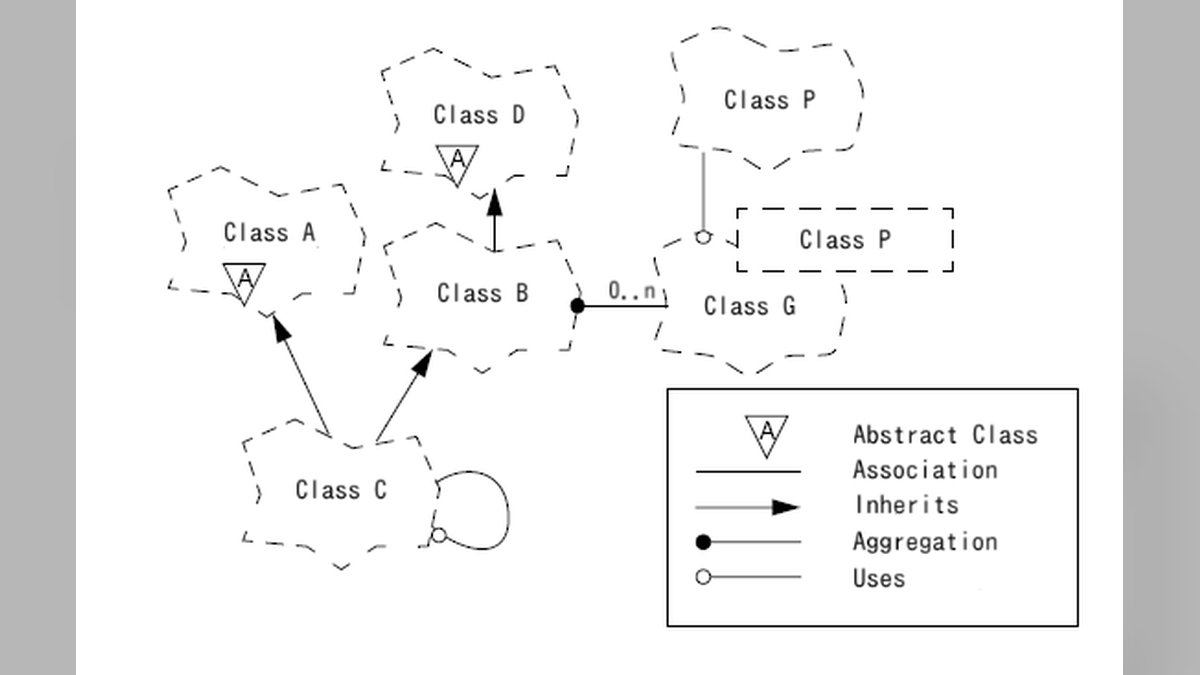
The visual representation of this approach was marked by a distinct notation, characterized by cloud shapes used to denote classes. While this notation aspect has since been succeeded by the Unified Modeling Language (UML)—a language that incorporated Booch’s graphical elements alongside techniques from Object Modeling Technique (OMT) and Object-Oriented Software Engineering (OOSE)—the core methodological principles endured. More broadly, the structured approach of the Booch method was absorbed into subsequent industry standards, most notably forming the foundation for the Rational Unified Process (RUP), ensuring his methodology left an indelible mark on modern software architecture.
📌 Components of the Booch Method
- Object-oriented modeling language
- Systematic, iterative development process
- Recommended best practices (e.g., adding new classes)
The Creation of Unified Modeling Language (UML)
The evolution of software design was guided by Grady Booch’s rigorous methodologies, establishing a systematic approach to development that moved far beyond mere coding practices. While his earlier work defined the internal mechanics of the Booch method—a structured process involving both a macro lifecycle view and a micro process for component details—the next major frontier was standardization. The discipline needed a common, universally understood language to describe the complex systems he helped engineer.
The Rise of Standardized Modeling
This necessity for a shared vocabulary led to the development of a comprehensive graphical standard that would define the architecture of software across diverse industries. This emerging language, which would become known as the Unified Modeling Language (UML), was the culmination of decades of systematic thought regarding system representation. It provided a formal, visual blueprint, allowing architects to communicate complex ideas—such as class relationships, state transitions, and deployment structures—without ambiguity.
📘 Unified Modeling Language (UML)
UML is a comprehensive graphical standard that defines the architecture of software, providing a formal, visual blueprint to communicate complex ideas without ambiguity.
Booch remained a tireless advocate for the power of structured modeling. This dedication was not limited to process flow; it extended deeply into the realm of reusable solutions. He became a noted advocate of design patterns, a concept that shifted software development from bespoke problem-solving toward applying proven, time-tested architectural solutions. His deep understanding of these recurring software structures was cemented by his contribution to the seminal work, Design Patterns. Writing the foreword to this highly influential text helped cement the pattern-based approach as a fundamental pillar of modern software engineering.
The integration of these modeling standards—the structural rules of UML combined with the conceptual guidance of design patterns—solidified Booch’s role not just as a methodologist, but as a definer of the architectural landscape itself. His ability to synthesize granular coding practices with high-level, abstract visual models was pivotal. By advocating for and helping to formalize these languages, Booch ensured that software development could scale, allowing engineering teams to tackle increasingly massive and intricate systems with confidence in their foundational design.
This body of work—advocating for patterns and defining the visual syntax for systems—cemented his reputation within the industry. It demonstrated that the art of software design was not merely writing code, but mastering the ability to model reality accurately and communicate that model efficiently to a global team.
Leadership at IBM and Rational Software
Booch’s professional journey took him through several pivotal roles that defined modern software development practice. After his initial work at Vandenberg Air Force Base, a major waypoint was his tenure at Rational Software Corporation. He served in a critical capacity, ascending to Chief Scientist of the company from its founding in 1981. During this period, his rigorous methodologies crystallized into the ‘Booch method’ of software development, formally presented in his 1991/94 book, Object Oriented Analysis and Design With Applications. This seminal work, published in 1992 and revised in 1994, established a robust framework that went beyond mere coding practices.
The methodology he developed was comprehensive, structured around three pillars: an object-oriented modeling language, an iterative object-oriented development process, and a set of recommended practices, such as adding more classes to simplify complex code. The process itself was organized around a sophisticated dual structure. The macro process provided the guiding cycle for the overall project lifecycle, identifying key activities including Conceptualization (establishing core requirements), Analysis (developing a model of desired behavior), Design (creating an architecture), Evolution (for implementation), and Maintenance (for post-delivery evolution). Complementing this macro view was the micro process, which provided detailed instructions for any new classes, structures, or behaviors that emerged during the larger cycle. This micro process followed its own cycle: the Identification of classes and objects, the Identification of their semantics, the Identification of their relationships, and the Specification of their interfaces and implementation.
The IBM Continuum
The significance of his work at Rational Software was cemented by the company’s acquisition by IBM in 2003. Booch remained deeply embedded within the organization, continuing his work until March 2008. Following this period, his responsibilities expanded within the research arm. He became Chief Scientist, Software Engineering in IBM Research. His long-term commitment to the field continued at IBM Research – Almaden, where he served as Chief Scientist for Software Engineering until December 2025. In these roles, he continued his deep engagement with the art and science of software development, notably furthering his work on the “Handbook of Software Architecture.” Beyond his research publications, he established a reputation as a global mentor, serving as an architect and architectural mentor for numerous complex software-intensive systems around the world.
His dedication to the craft was evident even before the modern OO boom, demonstrated by his work in the 1980s when he authored one of the more popular books on programming in Ada. Throughout his decades of service at IBM, Booch has consistently advocated for the rigorous, systematic approach that defines modern software architecture.
🕒 Key Career Milestones
- 1981 — Boonch begins tenure at Rational Software Corporation, ascending to Chief Scientist.
- 1992/1994 — Publishes seminal work, Object Oriented Analysis and Design With Applications, establishing the Booch method.
- 2003 — Rational Software is acquired by IBM; Booch remains deeply embedded in the organization.
- 2008 — Continues work at IBM Research, expanding responsibilities.
- December 2025 — Serves as Chief Scientist for Software Engineering at IBM Research – Almaden.
Industry Recognition and Academic Honors
The measure of a foundational figure in software architecture is often found not just in the methodologies they create, but in the sustained recognition from their peers. For Grady Booch, the accolades have accumulated over decades, charting a career that fundamentally reshaped how complex systems are designed and built. The industry’s highest honors have consistently acknowledged his pioneering work, particularly in the realm of object modeling, which paved the way for the Unified Modeling Language.
A Chronicle of Industry Acclaim
The professional acknowledgment of Booch’s contributions began to solidify in the mid-1990s. In 1995, he was inducted as a Fellow of the Association for Computing Machinery (ACM), marking him among the most distinguished members of the field. This recognition was followed by a major corporate honor: he was named an IBM Fellow in 2003, shortly after his employment with IBM. His standing within the broader scientific community continued to grow, leading to his recognition as an IEEE Fellow in 2010.
The accolades continued to build in prominence, signaling his continuous, deep impact on computer science. In 2007, he was invited to give the prestigious Turing Lecture. This was followed by the awarding of the IEEE Computer Society Computer Pioneer Award in 2016, an honor specifically recognizing his pioneering work in Object Modeling that directly led to the creation of the Unified Modeling Language (UML). Furthermore, his deep commitment to the discipline was recognized through his service as a board member of the Computer History Museum, a role he maintained from 2007 to 2020.
Perhaps the most enduring international recognition arrived in 2012. The British Computer Society (BCS) awarded him the prestigious Lovelace Medal. This honor was accompanied by his delivery of the 2013 Lovelace Lecture, cementing his status not merely as an architect, but as a thought leader whose work continues to define the trajectory of the entire industry. These cumulative honors—from the ACM to the BCS, and the IEEE awards—establish a clear record of his indispensable role in defining the modern practices of software development.
📊 Key Industry and Academic Honors Received by Grady Booch
| Year | Honor/Recognition | Significance |
|---|---|---|
| 1995 | ACM Fellow | Induction as a distinguished member of the field |
| 2003 | IBM Fellow | Major corporate recognition following employment with IBM |
| 2010 | IEEE Fellow | Recognition of standing within the broader scientific community |
| 2012 | BCS Lovelace Medal | Prestigious international honor from the British Computer Society |
| 2016 | IEEE Computer Society Computer Pioneer Award | Recognized pioneering work in Object Modeling leading to UML |
Enduring Influence on Software Architecture
Even after defining some of the most critical paradigms of modern software development, Grady Booch has maintained a deeply engaged, advisory role at the cutting edge of the industry. His influence remains visible through his continued tenure at IBM Research – Almaden, where he serves as Chief Scientist for Software Engineering. This position allows him to guide the next generation of computational practices, leading several long-term projects in software engineering that shape corporate technology strategy. Central to his ongoing intellectual contribution is his continued work on the “Handbook of Software Architecture,” a resource that serves as a comprehensive guide for practitioners navigating the complexities of modern, large-scale systems.
This sustained commitment to architectural theory is matched by his extensive global engagement in practice. Booch has repeatedly served as an architect and architectural mentor for numerous complex software-intensive systems spanning the globe. This advisory capacity allows him to bridge the gap between abstract theory—like the principles detailed in his “Handbook”—and the messy realities of implementation. By guiding diverse organizations in tackling their most intricate software challenges, he ensures that the principles of robust design are not confined to academic texts but are actively adopted in critical, real-world deployments.
His professional journey has seen him integrate his foundational knowledge of structured modeling with the demands of the largest technology corporations, including his time at IBM and Rational Software. Furthermore, his commitment to the history and future of computing is recognized by his service as a board member of the Computer History Museum from 2007 to 2020. These varied roles—from Chief Scientist at IBM Research to global mentor—underscore a rare and enduring ability to shape both the academic discourse and the practical application of software engineering. His life work continues to define what it means to architect a resilient, scalable, and manageable system in the rapidly evolving digital landscape.
Frequently Asked Questions About Grady Booch
What is Grady Booch best known for in the technology industry?
Booch is internationally recognized for his innovative work in software architecture and object-oriented development. He is best known for developing the comprehensive ‘Booch method’ and playing a key role in the creation of the Unified Modeling Language (UML). His work defined object-oriented analysis and design for decades.
When was Grady Booch born and where did he study?
Grady Booch was born on February 27, 1955, in Amarillo, Texas. He began his education at the U.S. Air Force Academy, earning his bachelor’s degree, and later pursued his master’s degree at the University of California, Santa Barbara.
Which key languages or frameworks did Grady Booch help develop?
Booch is credited with developing the structured ‘Booch method,’ a framework for object-oriented analysis. He was also instrumental in the creation of the Unified Modeling Language (UML) and is noted for his advocacy and contribution to the foundational principles of design patterns.
What major awards has Grady Booch received throughout his career?
Booch has received significant professional recognition, including the IBM Fellow award in 2003. He also received the BCS Lovelace Medal in 2012, acknowledging his substantial contributions to the fields of computer science and engineering.
Where did Booch work after earning his master’s degree?
After completing his master’s degree, Booch began his professional career at Vandenberg Air Force Base, serving as a project engineer. Later, his career advanced through Rational Software Corporation (1981–2003) and subsequently at IBM (1982–2026).
Final Thoughts: The Legacy of Grady Booch
Grady Booch’s career trajectory is a profound case study in how rigorous academic training—from the U.S. Air Force Academy to the University of California, Santa Barbara—can shape a foundational methodology that redefines an entire industry. His early work, spanning from the IBM 1130 to managing space shuttle missions at Vandenberg Air Force Base, provided the crucible for his later breakthroughs. He is most recognized for developing the Booch method, a comprehensive framework for object-oriented analysis and design detailed in his work across 1991 and 1994. This structured approach, which combined a macro lifecycle view with a micro process for component details, established systematic practices that became foundational to modern software architecture, notably informing the Rational Unified Process.
The enduring significance of his work lies in his commitment to standardization, culminating in the development of the Unified Modeling Language (UML). While the Booch method defined the process, UML provided the universally understood graphical language to describe complex systems. His contributions have been recognized with prestigious honors, including the IBM Fellow award in 2003 and the BCS Lovelace Medal in 2012. Booch’s continued engagement with the technical community, marked by memberships in the Institute of Electrical and Electronics Engineers and the Association for Computing Machinery, underscores his lifelong dedication to the highest standards of computer science.
From the mission-critical systems of the defense sector to the global standard of software modeling, Grady Booch built a career that did more than simply write code; he engineered the very language through which modern technology is conceived. His legacy proves that true architectural innovation often begins not with a machine, but with a deeply systematic and methodical mind, guiding us toward the next era of digital design.
Sources and Further Reading
- Grady Booch — Wikipedia (text available under CC BY-SA 4.0)
- Object-oriented Analysis and Design with Applications — archive.org
- Trends in programming — bcs.org
- Grady Booch | IEEE Computer Society — computer.org