Read this article in: Portuguese (Português) · Spanish (Español)
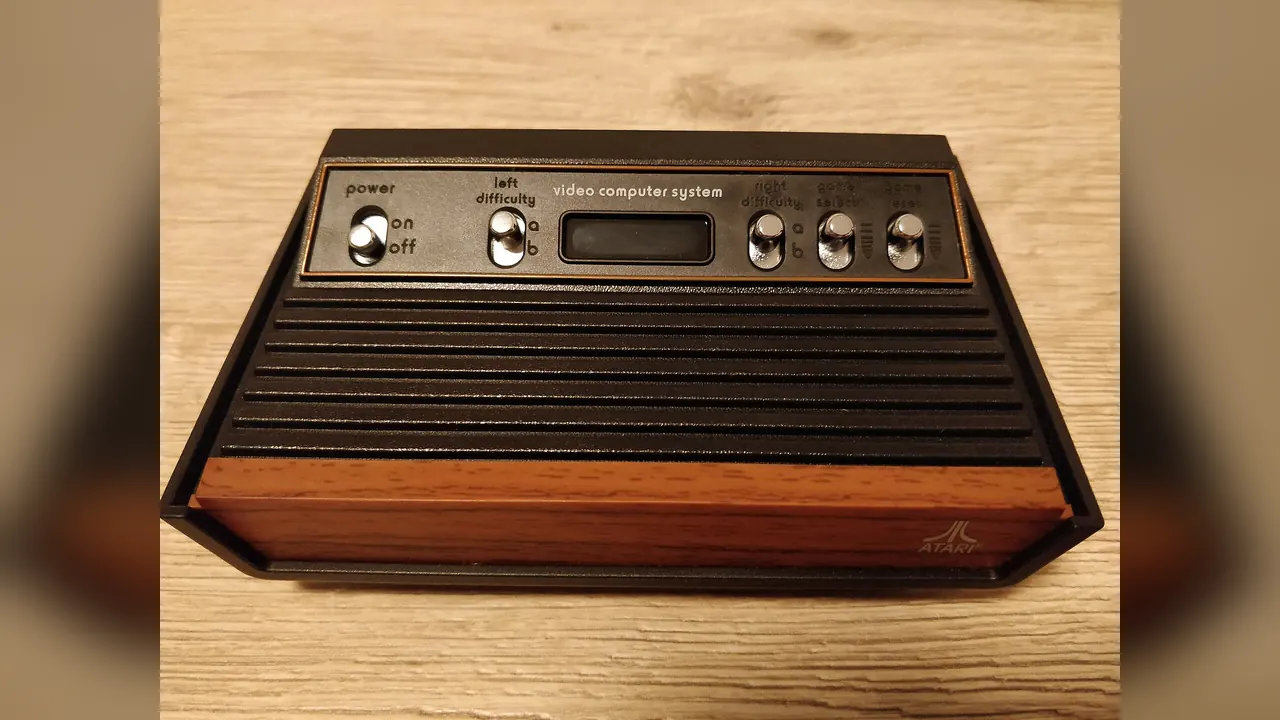
The Atari Flashback 2 is a dedicated video console that represents a crucial point in the line of systems reviving the legacy of classic Atari games. Released in August 2005, this model stood out as the only one in the series to incorporate an System on a Chip (SoC) based on the Atari 2600. Unlike traditional cartridge consoles, the Flashback 2 is a “plug-and-play” version that comes with pre-loaded games, featuring a miniature replica of the original 2600 console. It established a standard of engineering and design that would be followed by several iterations over the decades.
The relevance of the Flashback line extends far beyond its initial release. The development cycle began in 2004 with the original model, which resembled the Atari 7800. After the design transitioned to the 2600 format, Flashback 2, with its 40 built-in games, cemented the console’s focus. Development of the series continued until Atari, Inc. stopped internal production in 2011, transferring the license to AtGames, which maintained the product’s evolution. The longevity of the line is proven by the release of the Atari Flashback 12 Gold model in 2023.
In this article, we will delve deeply into the development trajectory that led to the Flashback 2 and its successors. We will analyze the genesis of the Flashback and the market context in which it emerged, examine the development and engineering behind the hardware, and detail the initial catalog, including the secrets and exclusive features of this console. In the end, you will have a complete view of the ‘plug-and-play’ architecture and the legacy that this line of dedicated consoles built in the gaming scene.
Key Points
- The Flashback 2 came with 40 pre-installed games, focusing on the vast Atari 2600 catalog.
- The console was a miniature replica, measuring about two-thirds the size of the original 2600.
- The engineering of the Flashback 2 utilized a System on a Chip (SoC) to recreate the hardware.
- The Flashback 2 included secret games, Super Breakout and Warlords, accessible through combinations.
- The line evolved with the Flashback 2+ in 2010, which added 20 new games to the catalog.
Atari Flashback 2 Specifications
| Developer | AtGames; Atari, Inc. (until 2011) |
|---|---|
| Manufacturer | Legacy Engineering Group (2004–2011); AtGames (2011–present) |
| Type | Dedicated console |
| Lifespan | 2004–present |
| Units sold | 1 million+ |
| Chip system | Atari 2600 -on-a-chip |
| Dimensions (Flashback 12 Gold) | 5.7 in × 3.8 in × 1.7 in (14.5 cm × 9.7 cm × 4.3 cm) |
| Weight (Flashback 12 Gold) | 1.07 lb (0.49 kg) |
The Genesis of the Flashback and the Market Context
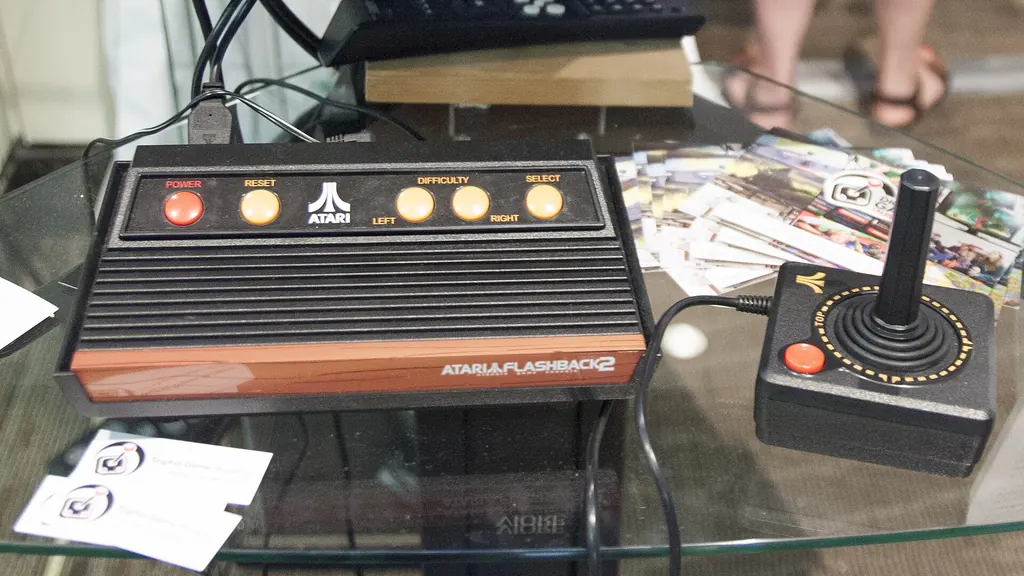
The dedicated video game console scene in the early 2000s presented a niche market focused on nostalgia, but with technical and production challenges. In this context, the Atari Flashback 1 was released in November 2004, establishing the first milestone for the line. Developed by Curt Vendel and his company, Legacy Engineering Group, the console was aesthetically based on the Atari 7800, and its controllers were miniaturized versions of the original joysticks, although supplemented with “pause” and “select” buttons. However, the Flashback 1’s design had a fundamental limitation for the most demanding collectors: it did not have a cartridge slot, making it incompatible with original 7800 games.
Instead of relying on external media, the Flashback 1 delivered its game library internally, featuring 20 pre-installed titles. This selection included 15 games from the Atari 2600 and five titles from the 7800. It is important to note that the console operated with an famiclone technology, not with original Atari hardware. This characteristic generated debates within the community, as the conversions of classic games were the subject of severe criticism. Critics such as Craig Harris, from IGN, pointed out issues like “flicker,” poor collision detection, and audio glitches, rating the performances as “horrifying,” despite acknowledging the comfort of the reduced controllers.
The Search for a Cartridge-Free Experience
Despite the controversies surrounding the quality of the conversions, the Flashback 1 managed to sell approximately 500,000 units. The market, however, demonstrated a specific demand: the search for a truly plug-and-play solution. Retro consumers, while appreciating the legacy revival, wanted a more immediate experience, free from the complexity and cost associated with swapping cartridges.
This market perception was the driving force behind the line’s evolution. The decision to focus on the Atari 2600 for the subsequent generation of consoles, such as the Flashback 2, was a direct response to this desire. By shifting the focus to the 2600 architecture, the Flashback line solidified its value proposition: to offer a vast collection of classic games in a dedicated console format, where simplicity and ease of use were prioritized over absolute fidelity to the original hardware. This strategic change paved the way for the line’s consolidation as a robust and accessible alternative for consumers who valued convenience.
✅ Advantages
- Value proposition: offering classic games in a dedicated format.
- Simplicity and ease of use were prioritized.
- Controllers were miniaturized versions of the originals.
❌ Disadvantages
- The Flashback 1 did not have a cartridge slot.
- The conversions of classic games were criticized.
- Critics pointed out issues such as ‘flicker’ and audio glitches.
Hardware development and engineering
The transition in the design of the Flashback 2 represents a fascinating milestone in dedicated console engineering, as the central challenge was condensing the essence of a classic system into a drastically reduced format. Unlike other niche devices, the Flashback 2 was designed as a miniature replica of the Atari 2600, measuring approximately two-thirds the size of the original console. This pursuit of physical fidelity was a pillar of the project, and the attention to detail extended to the controllers, which were also reproductions of the 2600 joysticks; to better understand this journey, check out the console’s development history. To maintain authenticity and functionality, the development team, including Vendel and Legacy Engineering, used materials sourced from the Atari History Museum, ensuring the new hardware maintained a tangible connection to Atari’s past.
The technical heart of the Flashback 2 lies in the use of a System on a Chip (SoC)—specifically the “Atari 2600 -on-a-chip.” This component allowed the complex hardware architecture of the Atari 2600 to be completely recreated on a single chip. This approach was not just about miniaturization; it was an engineering feat that allowed the games to run in a manner resembling their original operation. The ability to incorporate the entire system into a compact chip is what allowed the console, released in August 2005, to come with 40 pre-installed games, eliminating the need for external media.
📘 System on a Chip (SoC)
It is a component that allows a complex hardware architecture, such as that of the Atari 2600, to be recreated on a single, compact chip. This technology was crucial for the miniaturization of the Flashback 2.
The engineering of the Flashback 2 was also evident in its user interface, which adopted a distinct approach from that seen in older consoles. Instead of using physical switches, the console employed several buttons for vital functions, such as power adjustment and reset. The gaming experience was refined by dedicated buttons: a “select” button was used to switch between single-player and multiplayer modes in compatible titles, and two other buttons were used to adjust the joystick difficulty for the left and right controllers, respectively. Connectivity was simplified, with the AV cable fixed to the back of the console. Furthermore, there was a physical switch that allowed the display of games to switch between color and black and white, offering a layer of technical control to the player.
Modularity was a crucial design aspect. The Flashback 2 motherboard was designed to be modifiable, theoretically allowing for the acceptance of original 2600 cartridges, a concept intrinsically linked to the console’s development. This feature opened avenues for future modifications and expansions. The initial success was notable, with the model selling 860,000 units in the United States. The project’s evolution continued with the release of the Atari Flashback 2+ in February 2010, which, while retaining the base of classic games, added 20 new titles, demonstrating the continuous capability of the line’s adaptation engineering.
The Initial Catalog and the Secrets of the Flashback 2
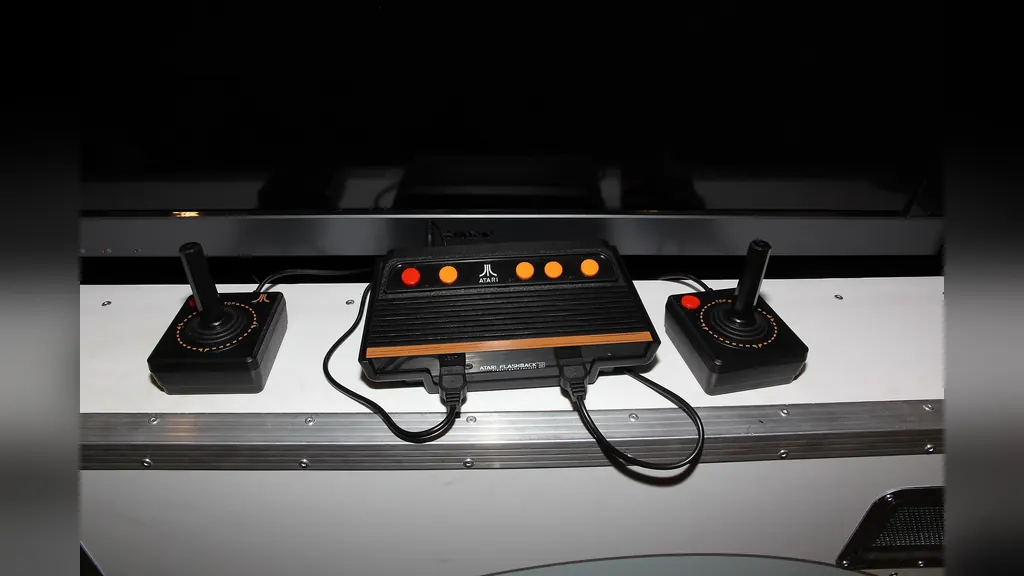
The Atari Flashback 2, released in August 2005, was not just an update, but a redefinition of the dedicated console experience. In contrast to the previous model, the Flashback 2 solidified the promise of reviving nostalgia in an even more compact and refined format. The console was presented with a substantial library of 40 pre-installed games, all from the vast Atari 2600 catalog. In terms of design, the Flashback 2 is remarkably small, being an almost faithful replica of the Atari 2600, measuring about two-thirds the size of the original. This miniaturization, combined with the use of joysticks that are direct replicas of the original models, established a standard of physical and functional fidelity that was a crucial engineering differentiator for the line.
The engineering of the Flashback 2 was meticulous. Unlike more conventional systems, the console used dedicated buttons instead of simple switches. These buttons were used for essential functions, such as powering on and resetting the system, as well as a “select” button that allowed the user to choose between single-player and multiplayer game modes. Additionally, two specific buttons allowed for adjusting the joystick difficulty for the left and right controls, offering an unprecedented layer of customization for a dedicated system. The AV cable, meanwhile, was part of the construction, fixed to the back of the console, reinforcing the idea of a highly integrated “plug-and-play” system. For example, the Flashback 12 Gold measured 5.7 inches wide by 3.8 inches deep, demonstrating the success of technological condensation.
The Hidden Secrets of the Catalog
Although the 40 pre-installed games were already robust content—including five titles that were unreleased prototypes and two games from Activision, such as Pitfall! and River Raid—the true touch of engineering and design in the Flashback 2 lay in its hidden content. The console didn’t just come with ready-made games; it possessed “secrets.”
Accessible only through specific joystick movements in the main menu, Flashback 2 hid two secret titles: Super Breakout and Warlords. The inclusion of these secret games transcends a mere bonus; they function as a design and engineering differentiator, requiring the user to interact with the system’s internal architecture in a non-linear way. This feature demonstrates a level of intentional programming and design complexity, turning menu navigation into a small puzzle. This approach, which rewards user exploration and experimentation, was a distinctive element of the Flashback 2 experience, elevating the console from a simple game library to an interactive design piece.
📌 Flashback 2 Engineering Features
- Compact design, near-faithful replica of the Atari 2600
- Use of dedicated buttons for essential functions
- ‘Select’ button to choose single-player/multiplayer modes
- Two buttons for joystick difficulty adjustment
- AV cable integrated into the build for plug-and-play
Release, price, and the successor line
The Atari Flashback 2 represented a redefinition of the dedicated console, being released in August 2005. With a retail price of $30, it not only maintained the proposal to revive the Atari legacy but significantly improved it in terms of engineering and user experience. Unlike previous models, the Flashback 2 was a compact system, almost a replica of the Atari 2600, measuring about two-thirds the size of the original, and came equipped with 40 pre-installed Atari 2600 games. This console was the result of a return by the Vendel and Legacy Engineering team, which used materials from the Atari History Museum to recreate the original hardware on a single chip, ensuring that the games ran authentically.
The technical innovation of the Flashback 2 was notable. The design was meticulously thought out for modularity and expansion. Although the system used a System on a Chip (SoC), its motherboard was designed to accept Atari 2600 cartridges, a concept central to the console’s development, and it is fascinating to learn more about the console’s development history. Furthermore, the user interface was elevated beyond simple switches. The Flashback 2 incorporated dedicated buttons, including a “select” button to choose between single-player and multiplayer game modes, and two other buttons to adjust joystick difficulty, a level of detail unprecedented for the line.
The evolution of the successor line
The Flashback 2’s performance surpassed that of its predecessor, and the market responded positively. The console sold 860,000 units in the United States and was discontinued in 2006, although a PAL version was never released. The success and technical foundation of the Flashback 2 paved the way for the next iteration: the Atari Flashback 2+. In January 2010, Atari announced the Flashback 2+, which was set to launch on February 22, 2010. This new version retained a base of 20 classic Atari 2600 games but supplemented the catalog with 20 new Atari games, swapping out some titles for sports games like Pitfall! and River Raid.
The product line demonstrates a longevity that spans decades. While the Flashback 2 and 2+ represented the most intensive development phase under Legacy Engineering (which operated from 2004 to 2011), the system’s production continued and modernized. Starting in 2011, manufacturing was transferred to AtGames, which ensures the continuation of the Flashback lineage to the present day, maintaining the promise of a dedicated console focused on nostalgia and constant evolution.
📊 Release and Succession Comparison
| Model | Release Date | Initial Games | Notes |
|---|---|---|---|
| Flashback 2 | August 2005 | 40 Atari 2600 games | 860,000 units sold in the US |
| Flashback 2+ | February 22, 2010 | 20 classic + 20 new | Included sports games like Pitfall! and River Raid |
The ‘plug-and-play’ architecture and user experience
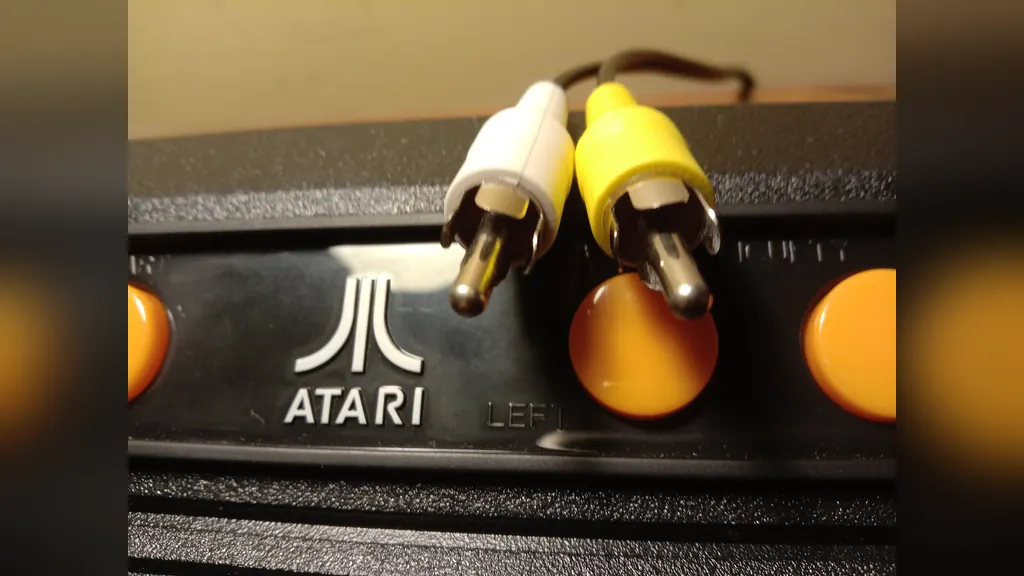
The dedicated console architecture, a pillar of the Atari Flashback line, established a highly self-contained entertainment model. Unlike systems that relied on external media, the Flashback delivered its game library in an entirely built-in manner. This design not only eliminated the need to buy and manage cartridges but also consolidated the gaming experience into a single, compact, and robust device. The console, in essence, was a capsule of nostalgia, designed to be operated with minimal user intervention, aligning with the concept of a truly “plug-and-play” system for the niche audience.
The System’s Design and Evolution
The first console, released in 2004, featured a design reminiscent of the Atari 7800, and came with a pair of controllers simulating the style of that system. Internally, the original Flashback utilized “NES-on-a-chip” hardware. Although the included games were ports, developed by Atari Inc. and Atari Corp. from titles for the 2600 and 7800 systems, the engineering focus was on functionality and delivering pre-loaded content, ensuring the user had immediate access to the gaming experience.
The longevity and success of the line were evident through constant technical revisions. The evolution of the hardware, which spanned several generations (such as the Flashback 2 and its Rev. 0X, Rev. A, and Rev. C revisions), demonstrates the rigor of the development process. These revisions, which sometimes corrected audio emulation issues or refined the color palette for better display on different televisions, ensured that the user experience was constantly refined, maintaining the promise of a cohesive and functional system.
Hardware Experience and Convenience
The system’s practicality was a decisive factor. By incorporating content directly into its memory, the Flashback eliminated the friction inherent in buying and swapping cartridges. Its ability to function as a standalone audio and video system, designed to connect to older televisions, solidified its role as a dedicated entertainment device. Even in later versions, such as the Flashback 3, where the system migrated to an ARM-based processor, the core premise remained: to condense the essence of classics into a discrete and functional console format.
The pursuit of technical optimization is notable in revisions like Rev. C, which introduced a smaller PCB aimed at simplifying cartridge port installation. Although the system’s primary function was that of a pre-loaded game console, the meticulousness of the development, visible in details such as the twinkling in games like Lunar Lander (a reflection of fidelity to the original Atari 2600 hardware), attests to the care taken to maintain the integrity of the classic experience, even in a compact and simplified format.
Reception and the Legacy of the Flashback Line
The reception of the Atari Flashback line, and particularly the Flashback 2, transcended mere unit sales, establishing a model of highly self-contained and practical entertainment. The dedicated console, which enjoyed decades of longevity, managed to capture the interest of an audience that valued nostalgia without wanting to invest in complex systems. The pursuit of technical optimization, which led to successive revisions of the line, was a decisive factor in the product’s credibility. The ability to offer a classic experience in a “plug-and-play” manner positioned the Flashback as a pioneer in reviving old consoles, proving that the market niche for nostalgia was robust.
The evolution of the hardware and support demonstrated the line’s commitment to maintaining its model. Manufacturing and development went through different phases, with Atari, Inc. serving as the developer until 2011, before it was taken over by AtGames. To better understand this trajectory, it is interesting to check out the history of the Atari Flashback X. The system, which remains a dedicated console, supported the inclusion of online services, allowing for firmware updates in several versions, such as Flashback 9, 9 Gold, X, X Deluxe, 50th Gold, and 12 Gold. In terms of design, miniaturization was notable; for example, the Flashback 12 Gold had compact dimensions of 5.7 in × 3.8 in × 1.7 in (14.5 cm × 9.7 cm × 4.3 cm) and a weight of 1.07 lb (0.49 kg), highlighting the focus on portability and practicality.
The Legacy of Emulation and the Leap to the Flashback 3
The line’s legacy was not exhausted with dedicated circuit hardware. The transition to the Flashback 3, released in September 2011 and manufactured by AtGames, represented a fascinating paradigm shift. While its predecessors were dedicated chip-based systems, the Flashback 3 migrated to using emulation. This new approach allowed the console to incorporate an even more extensive catalog, offering up to 60 Atari 2600 games, in addition to being equipped with two joysticks. The casing design of the Flashback 3 was similar to that of the Flashback 2, maintaining the line’s visual identity.
However, this technical change brought with it a point of debate. Unlike previous models, the Flashback 3 used emulation and, therefore, could not be modified to run original 2600 cartridges. Content quality was also a topic of discussion, with PCMag opining that some of the games were inferior to their original arcade counterparts. Despite this criticism, the Flashback 3 cemented the mini-console model as a software and emulation-based entertainment system, consolidating the trend of reviving classics in an accessible and practical format for the modern consumer.
Frequently Asked Questions
What is the main difference between the Atari Flashback 1 and the Flashback 2?
The primary difference lies in the system’s focus. While the Flashback 1 was based on the Atari 7800 and did not have a cartridge slot, the Flashback 2 was dedicated to the Atari 2600. It used SoC technology to miniaturize the system and offered a library of 40 pre-installed games.
What does the term ‘SoC’ mean on this console?
SoC, or System on a Chip, is an integrated circuit that contains all the necessary components of a system. In this case, it allowed the entire complex architecture of the Atari 2600 to be recreated and executed on a single compact chip, facilitating miniaturization.
Is the Atari Flashback 2 still sold, or is it just an old model?
The Flashback 2 model was discontinued in 2006. However, the line of dedicated consoles continued its evolution with subsequent iterations, such as the Flashback 2+, and the Flashback series manufacturing continues to this day.
How are the games run on the Flashback 2, since it doesn’t use cartridges?
The games are run from internal memory, which makes it a self-contained system. This approach eliminated the need for external media, allowing the console to deliver its vast library of classic titles immediately and plug-and-play.
What were the secret games that came with the Flashback 2?
The Flashback 2 featured an interactive design element that hid two secret titles. These games were Super Breakout and Warlords, and they could only be accessed through specific joystick movements in the main menu.
Conclusion
The trajectory of the Atari Flashback line is a fascinating case study in niche adaptation. Following the technical challenges and conversion controversies of the Flashback 1, the development of the Flashback 2 marked a strategic redefinition. The line migrated from a convenience-based proposition to a feat of meticulous engineering. The console not only rescued nostalgia, but it did so in a drastically reduced format, presenting itself as a miniature replica of the Atari 2600, a pillar of the project’s physical fidelity.
The heart of this evolution lies in the use of the “Atari 2600 -on-a-chip.” This approach allowed the entire complex system architecture to be condensed into a single component, enabling the launch with a vast library of 40 pre-installed games. The Flashback 2 refined the user experience with dedicated buttons, such as the “select” button to switch game modes and specific buttons for difficulty adjustment, elevating the level of control in a dedicated console. The modularity, which theoretically allowed for the acceptance of original 2600 cartridges, sealed its value proposition.
In summary, the Flashback 2 transcended the status of a mere update; it established itself as a retro engineering milestone. By combining the precision of the physical replica with the efficiency of an SoC, the line proved that convenience and technical fidelity can coexist. For those who appreciate the legacy of video games, this line demonstrates how far engineering can go to keep the magic of the classics alive. How about exploring the technical depth behind other dedicated consoles?