Read this article in: Portuguese (Português) · Spanish (Español)
The VideoBrain Family Computer represents a fascinating, yet melancholic, chapter in the history of home computing. Released in 1977 by Umtech Incorporated, this unit was one of the first 8-bit tabletop computers to attempt to bring computing into the home. Its design aimed to provide an advanced computing experience for the average consumer, utilizing the Fairchild F8 processor. However, despite its technical potential, the console faced significant challenges that led to its swift discontinuation, making it a classic case study on the difficulty of making technology viable in a rapidly evolving consumer market.
The technical relevance of the VideoBrain is notable, especially considering its launch context. Designed by David Chung and Albert Yu, the machine boasted robust graphics specifications for its time, such as the ability to display 384 x 336 graphics in 16 colors. It was equipped with a full-sized keyboard, a distinguishing feature compared to other early models. However, its limitations in RAM memory, restricted to only 1 KB, and the decision to prioritize languages like APL/S over BASIC were factors that directly impacted public acceptance and its commercial success.
In this article, we will delve deeply into the trajectory of the VideoBrain. We will explore everything from the origin and market context of home computers to a detailed analysis of its architecture and technical decisions. We will cover the hardware specifications, the user experience, the initial software catalog, and finally, examine the critical reception and usability challenges that shaped the legacy of this pioneering console in the video game landscape.
Key Points
- Launched by Umtech Incorporated in 1977, the VideoBrain aimed to democratize computing power for the home.
- The core architecture utilized the Fairchild F8 processor, supporting 1 kilobytes of RAM.
- The system was visually advanced, displaying 384×336 graphics and 16 colors via an RF connector.
- Interactivity was ensured by a 36-key keyboard and support for joysticks and cartridges.
- It was highly expandable, using modules like the Expander 2 to connect modems and mainframes.
VideoBrain Family Computer Spec Sheet
| Manufacturer | Umtech Incorporated |
|---|---|
| Type | Home computer |
| Release | 1977 |
| CPU | Fairchild F8 |
| Memory | 1 kilobytes RAM |
| Removable storage | Cartridges |
| Display | RF connector for TV, 384 x 336 graphics, 128 x 56 semi-graphics, 16 colors |
| Graphics | UV-201, UV-202 |
| Input | 36-key keyboard |
| Control input | Joysticks |
Origin and context of the home computer market

The year 1977 marked a turning point in the technological landscape, signaling the transition of computers from giant, restricted machines for large corporations to devices that could theoretically reach the home. In this context of emerging consumer electronics, a latent need arose: a desktop computer that was both powerful enough for complex tasks and accessible enough for the average consumer. The ambition of bringing processing power outside the corporate environment was the driving force behind the entire home computer industry.
The Vision of Umtech Incorporated
It was in this scenario that Umtech Incorporated, operating as VideoBrain Computer Company of California, conceived the VideoBrain Family Computer. The machine was a direct reflection of this ambition for technological democratization. Although the system was remarkably advanced for its time, the hardware—which used the Fairchild F8 CPU, 1 kilobytes of RAM, and connected via an RF connector to the television—occupied a niche between electronic craftsmanship and mass-market consumer goods. To better understand the evolution of these devices, it is interesting to look at the history of portable consoles. The system incorporated a 36-key keyboard and accepted joystick controllers, demonstrating from the outset a clear intention to serve both the professional user and the entertainment enthusiast.
The VideoBrain did not launch, however, in major retailers on a wide scale. It was not an easily accessible product, although the Macy’s department store briefly displayed the computer on its shelves. The purchase price reflected this exclusivity and the complexity of the system, ranging from $500 to $1100, depending on the selected accessories. This initial price range, while high, was an effort to establish a market standard, later reduced to just $300 for the base computer, or broader packages that reached $900.
The Software Ecosystem and the Nascent Market
Um dos aspectos mais visionários e revolucionários do VideoBrain, e o que moldou seu contexto de mercado, foi o foco em software em cartuchos. O uso de cartuchos para armazenar programas representou uma novidade para os sistemas domésticos de computação. Isso permitia que o sistema fosse um ecossistema, e não apenas uma caixa de metal. A comercialização do software era meticulosamente segmentada, refletindo as diversas necessidades do consumidor:
- Games and educational software: priced between $20 and $40.
- Productivity tools: with higher values, ranging from $70 to $150.
In summary, the VideoBrain Family Computer, launched in 1977, was not just a computer, but a business model proposal. It attempted to combine the processing power of a desktop computer with the convenience of an entertainment system, establishing the concept that the home computer should be a multifunctional and accessible center, paving the way, albeit complexly and expensively, for future generations of interactive machines.
📊 Key Specifications of the VideoBrain Family Computer
| Component | Technical Detail | Function/Feature |
|---|---|---|
| CPU | Fairchild F8 | Central processing of the machine |
| RAM Memory | 1 kilobytes | System memory capacity |
| Video Connection | RF connector to TV | Video output for display |
| Data Input | 36-key keyboard and Joysticks | User Interaction (Text and Games) |
| Storage | Cartridges | Allowed the software ecosystem |
Architecture and Technical Development Decisions
The backbone of the VideoBrain Family Computer lies in its pioneering architecture, an engineering effort that sought to integrate advanced processing and multimedia capabilities into a home format in 1977. The system was built around the Fairchild F8 processor, a chip that represented a significant leap in 8-bit processing capability for its time. Developing a system with this level of complexity in a scenario where computers were still large machines required bold technical decisions, marking the VideoBrain not just as a console, but as a complete computing platform, and it is fascinating to compare its trajectory with that of other iconic consoles, such as the Mega Duck Super Junior Computer.
The Processor Core and Memory
The use of the Fairchild F8 allowed the VideoBrain to operate with a memory system composed of 1 kilobytes of RAM and 4 kilobytes of ROM. While these values seem modest by today’s standards, they supported an extraordinarily rich set of functionalities for the 1977 market. The processor was responsible for powering a sophisticated graphics system, capable of generating 384 x 336 graphics and 128 x 56 character graphics, utilizing 16 colors. This graphical capability was enabled by proprietary chips, the UV-201 and UV-202, and the video was transmitted to the connected television via an RF connector. Complementing this visual power, the system included a 36-key keyboard, a notable feature that set it apart from many popular video game consoles of the era, which often dispensed with keyboards in favor of action buttons.
Architectural and Software Decisions
Technically speaking, the choice of an 8-bit system and the integration of multiple peripherals—such as joysticks, the cartridge connector, and the keyboard—represented a considerable engineering challenge. The system was not limited to basic processing; it was designed to be expandable. To this end, modules such as the Expander 1 were developed, which allowed for the connection of input/output (I/O) devices, such as cassette tape recorders and RS-232 ports for printers. Another crucial module was the Expander 2, a 300 baud acoustic modem that allowed the VideoBrain to function as a terminal when connected to a compatible mainframe, demonstrating a vision of connectivity far ahead of its time.
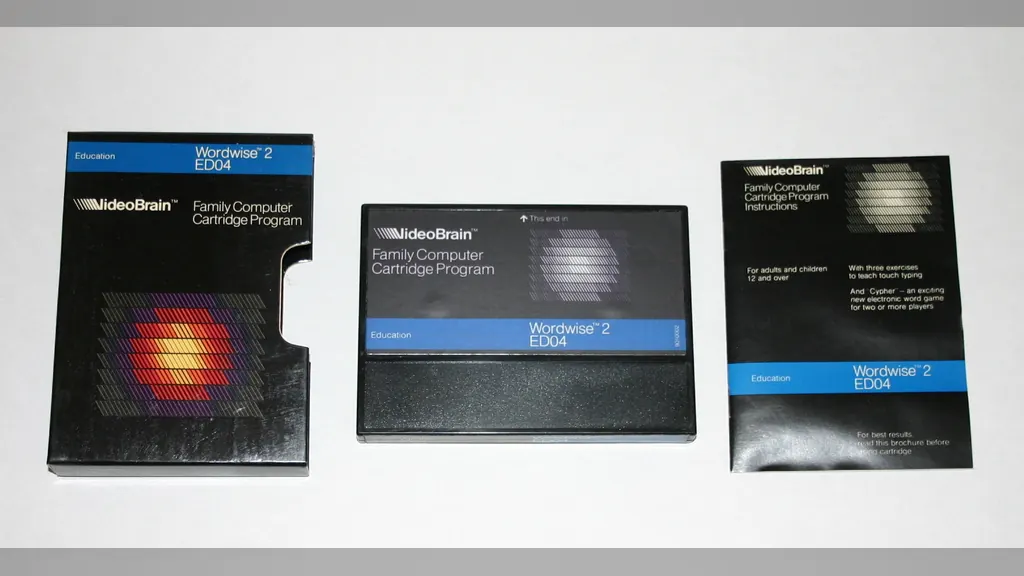
VideoBrain’s technical ambition was reflected in its software ecosystem. The system not only came with four pre-installed titles (a simple text editor, a clock, a countdown timer, and a color bar generator) but also supported a vast catalog of software on cartridges. These cartridges, with a data capacity of up to 12KiB, were the main expansion method, and the connection method was unique: instead of complex contacts, the cartridges featured an exposed strip of conductive traces that plugged directly into the computer’s pins. This robust and multifaceted architecture, anchored by the Fairchild F8, positioned the VideoBrain as a multi-purpose machine, demanding a development sophistication that went beyond mere entertainment.
📌 Key Architectural Components
- Fairchild F8 Processor: Pioneering 8-bit chip.
- Memory: 1 KB of RAM and 4 KB of ROM.
- Graphics Output: 384×336 graphics and 128×56 semi-graphic characters.
- Input: 36-key keyboard and joysticks.
- Expandability: Modules such as Expander 1 (I/O) and Expander 2 (Acoustic Modem).
Hardware Specifications and User Experience
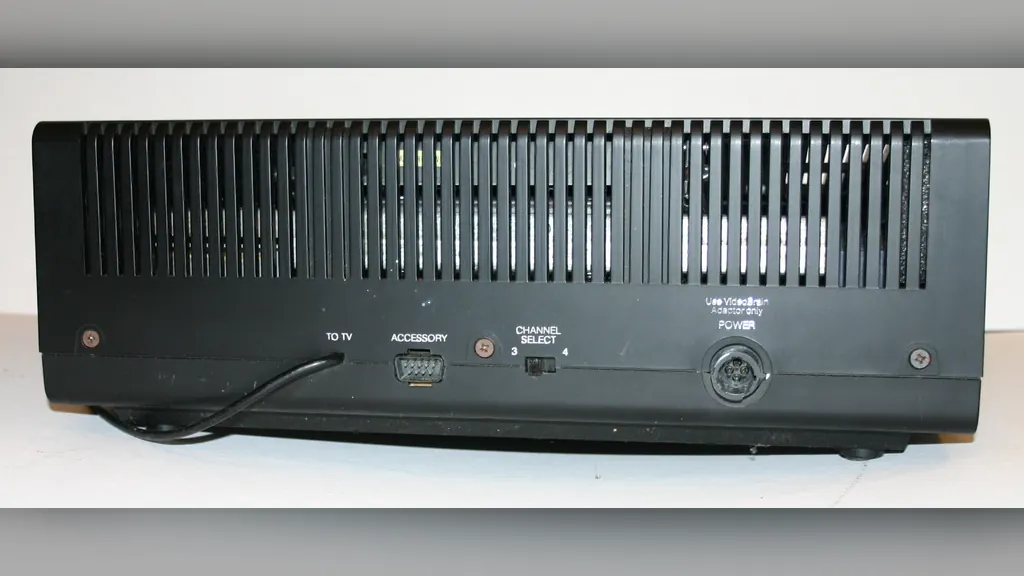
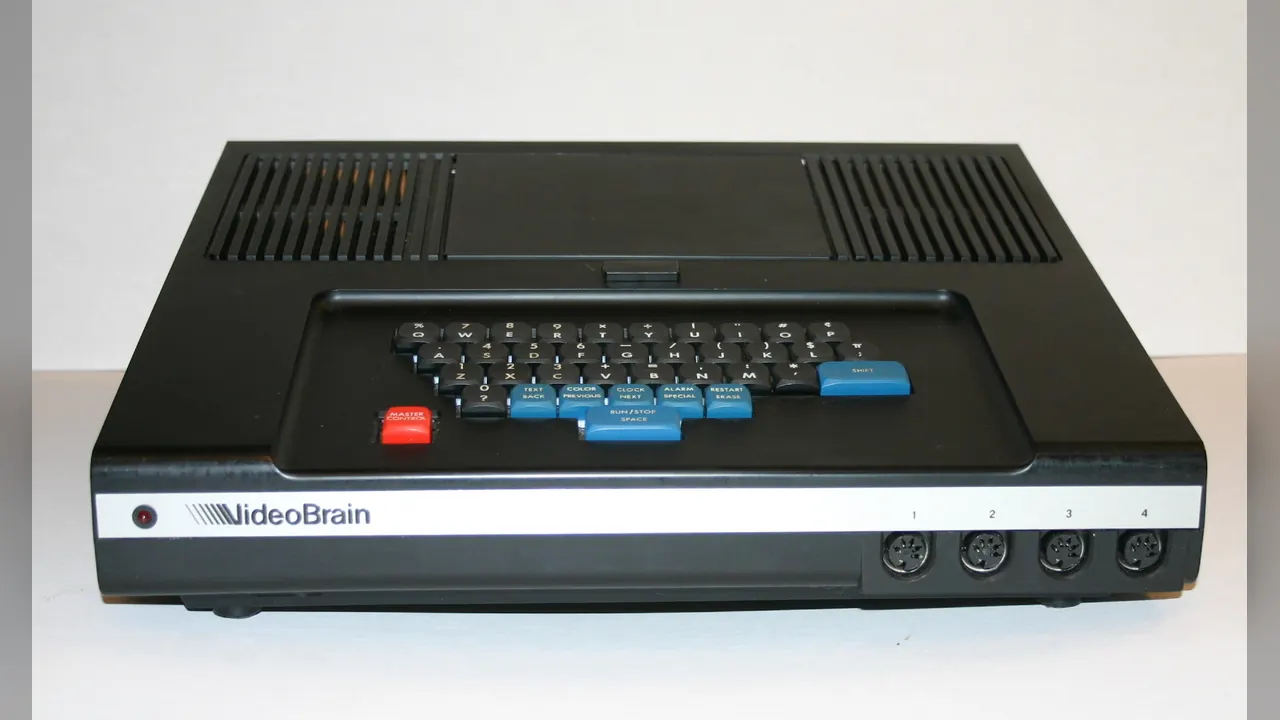
The VideoBrain Family Computer, developed by Umtech Incorporated and released in 1977, was a complex machine whose technical specifications reflected an ambition to integrate various functionalities into a single home format. Its backbone was the Fairchild F8 processor. In terms of memory, the system operated with 1 kilobytes of RAM and 4 kilobytes of ROM. Although the 1KB RAM limitation was a reflection of the cost and technological constraints of the time, the system was capable of generating a rich and multifaceted visual experience. The display was connected to the television via an RF connector and offered impressive graphics capabilities for the period: it supported 384×336 graphics, in addition to 128×56 semi-graphic characters, all within a total of 16 colors. This advanced graphics capability was enabled by proprietary chips, such as the UV-201 and UV-202, which managed the video and audio output.
Interactivity and Input Devices
Interaction with the VideoBrain was ensured by a robust set of peripherals. The system featured four joystick ports, a cartridge connector, and an expansion port. One of the most distinctive and technically notable aspects was its 36-key keyboard. This keyboard, although considered poorly designed and difficult to use, was a striking differentiator compared to the competition. While most popular video game consoles of the era did not offer a physical keyboard, and many kit computers also opted for toggle switches as primary input, the VideoBrain positioned itself as a general-purpose tool, requiring complex text input.
📘 RF Connector
It is the type of connector used to connect the VideoBrain display to the television. This connector was common at the time, transmitting the video signal in a simple manner.
System Storage and Expandability
The storage system was remarkably innovative. The VideoBrain used removable cartridges that held up to 12KiB of data. Unlike many game systems, the VideoBrain cartridge connector featured a unique characteristic: an exposed strip of conductive traces that simply slotted into the computer’s pins. Furthermore, the architecture was modular, allowing its capabilities to be extended through hardware modules. The Expander 1 was an I/O interface module that allowed for the connection of cassette tape recorders to save or load data, and it included two RS-232 ports for connecting printers. The Expander 2, on the other hand, added a 300 baud acoustic modem, enabling the VideoBrain to function as a terminal when connected to a compatible mainframe.
To complement its functionality, the system came with four built-in software titles, available even without inserting a cartridge: a simple text editor, a clock, a countdown timer, and a color bar generator. This combination of robust hardware, 16-color graphics capability, and an expansion ecosystem that ranged from modems to printers, established the VideoBrain not just as a console, but as a cutting-edge multimedia computing platform for 1977.
Launch, Distribution, and Initial Catalog
From its conception by Umtech Incorporated, operating as VideoBrain Computer Company of California, the VideoBrain Family Computer was a product of monumental ambition, but its commercial launch did not follow the expected pattern of wide distribution. Rather than being generally available in major retail chains, the machine had limited availability, initially being showcased in stores like the Macy’s department store. This context of limited launch and high initial cost shaped the device’s perception, positioning it as a niche, cutting-edge product intended for an audience with significant purchasing power. Selling prices were notably high, varying initially from $500 to $1100, depending on the combination of accessories the consumer chose.
The Cartridge Business Model
The most revolutionary aspect of the VideoBrain, and what set it apart from many computers of the time, was its focus on a modular software ecosystem based on cartridges. The use of cartridges for storing new titles was pioneering in home computer systems. This architecture not only ensured the system’s longevity but also allowed the VideoBrain to establish itself not just as a machine, but as a complete business model. The initial software catalog demonstrated the platform’s versatility, segmenting content into distinct categories, each with its own market value.
The diversity of available content was remarkable and was structured in clear price tiers, reflecting the software’s function. For entertainment enthusiasts, video games and educational titles were available in a more accessible price range, varying between $20 and $40. On the other hand, the productivity tool segment—software intended for work and efficiency—featured higher values, ranging from $70 to $150. This price and category differentiation not only aided in catalog management but also reinforced the idea that the VideoBrain was a multi-functional tool, suitable for both leisure and professional environments.
Over time, the market and sales strategy allowed for price adjustments, making access to the computer more viable. The cost of the machine itself was reduced to about $300, while the most comprehensive sale packages could be acquired in price ranges varying between $350 and $900. This progressive cost reduction, combined with the wide range of cartridge software, consolidated the VideoBrain Family Computer in the 1977 technological landscape, marking an inflection point where processing power and multimedia potential were sold not just in hardware, but in an ecosystem of digital experiences.
✅ Advantages
- Modular, cartridge-based software ecosystem, ensuring longevity.
- Versatility allowing use for leisure (games) and work (productivity).
- The cartridge architecture established a complete business model for the system.
❌ Disadvantages
- Limited initial release, not following wide distribution in major retailers.
- High initial cost, positioning it as a niche and cutting-edge product.
- High initial selling prices, ranging from $500 to $1100.
Critical reception and usability challenges
The commercial failure of the VideoBrain Family Computer was a complex outcome, rooted not only in technical limitations but primarily in design and market strategy flaws. Critical reception pointed out several deficiencies that prevented its mass adoption. One of the most frequently cited issues was the poor usability, particularly the keyboard. This component, although an essential peripheral, was described as confusing and unintuitive, turning even simple text entry tasks into a tedious and frustrating process for the home user.
Software and Programming Limitations
Beyond the interface problems, the software ecosystem had significant gaps. While the home computer market was consolidating, the VideoBrain was criticized for not offering the BASIC programming language, which was extremely popular at the time. This absence forced users to adopt APL/S, a language considered much more obscure and difficult to learn. In terms of content, the available software library struggled to reach the target audience. Much of the material was aimed at productivity or educational niches, visibly lacking varied entertainment titles that could engage the casual consumer.
The VideoBrain’s design, compared to competitors like the Apple II, was seen as a more closed system, focused on simplicity and low cost for the home user. However, this attempt at simplification, combined with a lack of openness and a non-standardized keyboard layout, drastically limited its potential. While the Apple was an open system, with various expansion slots and complete documentation for enthusiasts, the VideoBrain felt like a more restricted system, which diminished its appeal to both the advanced programmer and the average user.
Marketing and Distribution Challenges
Perhaps the most determining factor in the failure was the combination of poor distribution and low consumer awareness in 1977. The general public still had a very low understanding of the benefits of owning a computer at home. The VideoBrain’s sales strategy was limited, being sold mainly through mail-order outfits and only having a brief display in department stores, such as Macy’s Department Stores. This distribution channel was drastically less efficient and visible than that of the video game consoles of the time, which were easily found in various department and toy stores.
In summary, the VideoBrain Family Computer was a product of monumental technical ambition, but its success was undermined by design decisions that harmed the user experience (such as the keyboard and the absence of BASIC), and by a flawed market strategy that could not compete with the visibility and accessibility of its rivals during a time of great technological uncertainty.
The Legacy of VideoBrain in the Video Game Scene
Despite the commercial failure of the VideoBrain Family Computer, released in 1977 by Umtech Incorporated, its impact on the home computer landscape cannot be summarized by its brief lifespan alone. The system, with its monumental technical ambition, established design precedents that, even if not replicated on a large scale, were crucial to the industry’s development. To better understand the context of that era, it is interesting to analyze the development of interactive consoles. The most notable aspect of the VideoBrain was its focus on a modular software ecosystem based on cartridges, a pioneering approach in the tabletop computer market. Although the user experience was hampered by design flaws—such as the 36-key keyboard and the user interface—the very existence of a system that treated software as a distinct product, with clear price points (ranging from $20 to $40 for games and educational titles), was a revolutionary conceptual step.
The Legacy of Modularity and Software
The system demonstrated that a computer’s value resided not just in its processor (the Fairchild F8, with 1 kilobytes of RAM), but in its capacity for content expansion. The cartridge architecture, with its unique connector and exposed conductive traces, forced the market to consider software not as an add-on, but as the engine of value. This concept of a “content ecosystem” is a pillar that still supports the business model of digital platforms today, from video games to modern operating systems. The inclusion of advanced peripherals, such as the Expander 1, which allowed for the connection of cassette tape recorders or even acoustic modems for Timeshare functionality, showed a vision of interconnected computing far ahead of its time.
However, VideoBrain’s greatest legacy challenge lies in the lesson that technical ambition does not guarantee market success. With a software catalog that never exceeded 25 titles, the system suffered from a critical “content scarcity.” While Umtech dreamed of a vast universe of possibilities—evidenced by productivity tools priced between $70 and $150—the market did not receive the necessary volume to justify the investment. This taught the industry, painfully, that usability and user experience (UX) are factors as determining as raw hardware capability.
In summary, the VideoBrain Family Computer did not influence the market through its perfection, but rather through its ability to expose the tensions between technical innovation and commercial acceptance. Its short run serves as a classic case study: its pioneering work in areas like graphics processing (384 x 336 graphics in 16 colors) and its modular software model were engineering successes. However, the combination of flawed interface design, limited distribution, and, most importantly, an insufficient software catalog proved that, even with cutting-edge hardware, success depends on a robust content lifecycle and a cohesive market strategy. The VideoBrain thus remains a didactic landmark: a reminder that the path to technological revolution is as complex as its conception.
Glossary
- Fairchild F8: The 8-bit central processing unit (CPU) used in the system, representing a significant leap in processing power for the time.
- RF Connector: The type of connector used to transmit the computer’s video and audio signal directly to a television.
- Acoustic Modem: An expansion module that allowed data communication (300 baud) through sound connections, such as a telephone line.
- Mainframe: A large-scale computer used in corporate environments, to which the VideoBrain could connect to function as a terminal.
Frequently Asked Questions
Was the VideoBrain Family Computer a commercial success?
The launch was not widely available in major retail stores; it was a niche, cutting-edge product. Its initial price was high, ranging between $500 and $1100. Although it established a robust business model with cartridge software, its availability was limited, reflecting its status as advanced technology.
What programming language was used on the VideoBrain, and why was it chosen?
Information regarding the specific programming language is not available. However, the system was designed to be a general-purpose platform, supporting everything from productivity tools to games. This architectural versatility allowed it to be a multifunctional hub, going beyond mere entertainment.
What were the main graphics specifications of the VideoBrain (resolution and colors)?
The VideoBrain offered impressive graphics capabilities for 1977. It supported a resolution of 384×336 graphics and also 128×56 semi-graphic characters. All this visual content could be displayed in a total of 16 colors, transmitted to the television via an RF connector.
Was the VideoBrain compatible with other computing systems of the time?
Yes, the system was designed to be highly expandable. Through modules like the Expander 2, it could function as a terminal when connected to a compatible mainframe. Furthermore, the Expander 1 allowed for the connection of peripherals such as printers and cassette tape recorders.
Who were the main engineers and designers behind the VideoBrain?
The development of the VideoBrain Family Computer was conducted by Umtech Incorporated, operating as VideoBrain Computer Company of California. The technical ambition and design of the system reflected the company’s effort to create a complete multimedia platform, combining the power of a desktop computer with home convenience.
Conclusion
The VideoBrain Family Computer, released in 1977, transcended the definition of a mere console; it was an ambitious proposal for the democratization of technology. Its architecture, based on the Fairchild F8 processor, represented an engineering leap by attempting to integrate advanced processing capabilities—such as generating 384×336 graphics and using a 36-key keyboard—into a home format. Although limited to 1 kilobyte of RAM, the system was a laboratory of functionalities, proving that a desktop computer could be, simultaneously, a productivity tool and an entertainment center.
The true genius of the VideoBrain, however, lay in its business model: the software cartridge ecosystem. By separating the hardware from the content, Umtech created an expandable system that was not just a metal box, but a multifunctional platform. This concept—that value would reside in the content and the ability to upgrade—paved, in a complex and costly way, the path for the development of modern personal computers. The VideoBrain was not just a product, but a demonstration of a future where computing would be inherently interactive and accessible.
By revisiting the VideoBrain, we understand that commercial failure does not negate the brilliance of its vision. It is in this case study that the proof lies that great ideas often just await the right moment to flourish.