Read this article in: Portuguese (Português) · Spanish (Español)
For those looking to understand the origins of the maritime and buccaneer world, Sea of Thieves is an action-adventure game developed by Rare and published by Activision. The game allows players to take on the role of a pirate in a vast open world, where exploration and combat are central elements. Since its inception, the title has captivated the gaming community by offering a first-person sailing experience where players can form alliances or face off in epic battles aboard a ship.
The significance of Sea of Thieves is marked by its long development cycle and tremendous commercial success. The game concept was first envisioned in 2014, and the title debuted on March 20, 2018, for Windows and Xbox One. Over the years, the game has solidified itself as a global phenomenon, surpassing the 40 million player mark by April 2024. Beyond its multiplatform release, the game demonstrates a commitment to the “Game as a Service” model, proving its longevity and impact on digital entertainment.
In this article, we will dive into the complete history of the game, unraveling everything from its initial inspiration to its modern expansion. We will cover the genesis of the idea, the key figures behind its creation, the technical development, and the “Game as a Service” philosophy that has fueled its growth. We will explore the cooperative gameplay in the open world, the different phases of multiplatform release, and finally, analyze the commercial impact and legacy of Sea of Thieves in the gaming landscape.
Key Points
- Developed by Rare and published by Activision, the game is a multiplayer action-adventure title.
- The main focus is ‘Group-based Narrative,’ where players create spontaneous stories.
- Gameplay requires cooperation, with defined roles such as navigator, gunner, and lookout.
- The title uses Unreal Engine 4 and is available on multiple platforms, including PS5.
- The ‘Game as a Service’ model ensures that the pirate universe is in constant evolution and updates.
Sea of Thieves in Summary
| Developer | Rare |
|---|---|
| Publisher | Activision |
| Director | Gregg Mayles |
| Platforms | Windows; Xbox One; Xbox Series X/S; PlayStation 5 |
| Genre | Action-Adventure |
| Mode | Multiplayer |
| Release | Windows, Xbox One; March 20, 2018; Xbox Series X/S; March 13, 2024; PlayStation 5; April 30, 2024 |
The Genesis of the Idea: Inspirations and the Open World Concept
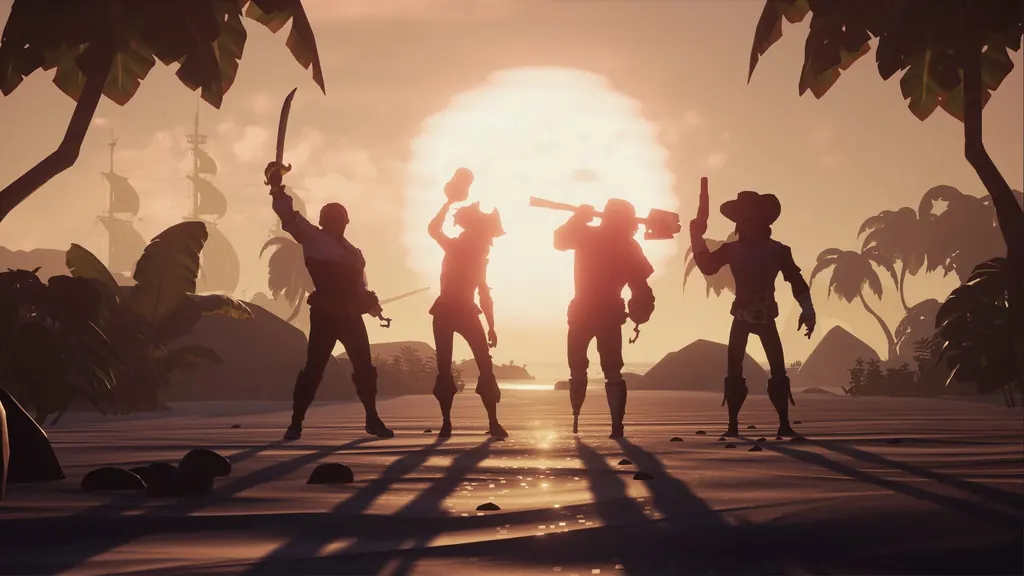
The genesis of Sea of Thieves dates back to 2014, a time when Rare was searching for a new direction for developing multiplayer games. The core concept that would shape the title, initially called “Athena,” was not focused on pirates at the time. Director Gregg Mayles described the idea as “Narrative in a group,” a concept that envisioned a different kind of multiplayer game where the main focus would be allowing the players themselves to create “experiences that are fun to watch.”
The inspiration for this model came unexpectedly from PC survival and simulation games. Rare noticed how players in titles like DayZ, Rust, and Eve Online were capable of building complex narratives using only the game’s tools. However, the team identified that many of these games were excessively punishing. Therefore, Rare’s goal was to create an experience that was significantly lighter and more accessible—a “light canvass of a world”—where the narrative was not an element structured by the studio, but rather generated organically by the players themselves, as seen in the secrets of New World.
The Transition to the Pirate Theme and Creative Freedom
Although the company initially explored other themes, such as dinosaurs and vampires, the pirate universe ultimately solidified as the ideal setting. The choice of the buccaneer theme not only appealed to players but also aligned perfectly with the concept of freedom and cooperation. The theme allowed players an almost unlimited autonomy to decide how to behave in the world. To materialize this vision, the team drew inspiration from cinematic classics, such as Pirates of the Caribbean and Black Sails. Designer Mike Chapman, for his part, drew direct parallels with the movie The Goonies, where a group of friends unites in a treasure hunt, creating a memorable journey.
This focus on spontaneity led Joe Neate, the game’s executive director, to describe the experience as an “improv” comedy, emphasizing that the game should be about going “off-script.” To ensure the focus remained on action and story creation, and not on complex customization, the team implemented a “pirate infinite generator,” which randomly created a carousel of eight characters instead of allowing players to create full avatars. This mechanic, combined with the hand-painted texture style, gave the world an “timeless” and cheerful look, reinforcing the promise of an open world where the story would indeed be written by every buccaneer who inhabited it, a rich universe like the one explored in The Secret History of Warcraft.
📌 Conceptual Pillars of Sea of Thieves
- Group Narrative: Focusing on Player-Generated Experiences.
- Lightheartedness and Accessibility: Avoiding the Over-Punishment Found in Other Simulation Games.
- Creative Freedom: Near-Unlimited Autonomy for Players to Define Behavior.
- Improvisation (Improv): The game must be about going ‘off-script,’ without a fixed plot.
Who Created Sea of Thieves? The Team Behind the Buccaneers
The creation of Sea of Thieves was a monumental undertaking that redefined Rare’s development profile. Although the game was announced in 2015 and initially launched in 2018, the creative and technical process was extensive, involving nearly all 200 studio employees. The project was not merely about creating a game, but about orchestrating a collaborative narrative experience—a challenge that required the expertise of various specialized departments, such as writers, artists, programmers, and composers.
The Creative Vision and the Team Behind the Myth
The game’s central vision was shaped by key figures at Rare. Gregg Mayles, the project director, coined the concept of “group narrative,” describing it as a different kind of multiplayer game focused on generating “experiences that are fun to watch.” Although the initial codename was “Athena” and the focus was not immediately on a pirate universe, the team managed to transform this vision into a buccaneer setting. To better understand the programming languages behind such creations, it is interesting to know about the origin of the Lua language. The team brought in specific talents for each aspect: Mike Chapman was the designer, while Joe Neate served as producer. The talent roster was robust, including Peter Campbell for programming development, Ryan Stevenson for art, Chris Allcock and Mike Chapman for writing, and Robin Beanland and Chloe Kwok for musical composition.
The technical development process was equally significant. Sea of Thieves marked a major transition for Rare, as they began utilizing the powerful Unreal Engine 4 from Epic Games. This technological shift was crucial for supporting the scope of an open-world, persistent game. Initially, the playable prototype, called Athena, was created in five months using the Unity engine, but adopting Unreal Engine 4 allowed Rare to refine the gameplay and scale of the game, ensuring top-notch graphics and features for launch on multiple platforms, including Windows, Xbox One, Xbox Series X/S, and PlayStation 5.
Transparent Development and Player Involvement
To ensure the game achieved its goal of being a social and cooperative space, Rare adopted an unprecedented and more transparent development approach. Instead of maintaining mystery, the studio invited over 30,000 players to participate in the Insider Program. This early access program allowed the community to test the game and provide direct feedback, enabling developers to adjust content and improve player interaction. Cooperation and shared experience were thus not just a design goal, but a direct result of community engagement.
In summary, the success of Sea of Thieves is not due only to its appealing theme, but to the synergy of a multidisciplinary team. The use of Unreal Engine 4, Gregg Mayles’ conceptual vision, and the involvement of nearly 200 collaborators culminated in a title that prioritizes human interaction and the creation of spontaneous stories, setting a new standard for open-world cooperative games.
Technical Development and the ‘Game as a Service’ Philosophy
The development of Sea of Thieves was an extensive and meticulous process, marked by a conceptual evolution that began long before the pirate universe was solidified. Rare, the title’s developer, began conceptualizing the game in 2014. Initially, the focus was not on corsairs, but on a concept called “Group Narrative.” Gregg Mayles, the game director, described this vision as a concept anticipating a different type of multiplayer experience: a place where players could create “experiences that are fun to watch.”
Technical and Conceptual Evolution
The initial prototype, codenamed “Athena,” was created in just five months and used the Unity game engine. However, the project represented a significant technical milestone for Rare, marking the studio’s transition from using its proprietary engine to adopting Epic Games’ Unreal Engine 4. The choice of this engine was crucial to support the ambition of a large-scale game with high visual fidelity. Although the game was announced at E3 in 2015 and initially scheduled for 2017, development faced delays, culminating in the March 20, 2018, release.
To ensure the game fulfilled its purpose as a social and cooperative space, Rare adopted an unprecedented and transparent development approach. Instead of maintaining mystery, the company invited players to actively participate in the development cycle through the Insider Program. This program granted access to development builds for over 30,000 players, allowing Rare to test features and, more importantly, gather direct feedback from the community. This constant dialogue not only improved gameplay but also influenced internal decisions; for example, the participants’ desire for more gameplay options led to the inclusion of a solo mode.
This development philosophy was not just about building a game, but about creating a living environment, a true “Game as a Service.” The vision behind the title was that the pirate experience should be fluid and constantly changing, requiring continuous updates to maintain engagement. Rare’s central goal was to balance the experience for all types of players—from the novice seeking only the fun of a cruise to the veteran who wants to master combat and navigation mechanics. This multifaceted approach ensured that Sea of Thieves was not just a launched product, but a permanently developing universe, where content and narrative expand with the community itself.
🕒 Sea of Thieves Development Evolution
- 2014 — Rare begins conceptualizing the game, initially focusing on the concept of ‘Narrative in a Group’.
- E3 2015 — The game is announced, with initial programming set for 2017.
- March 20, 2018 — Official game launch.
Cooperative gameplay in a pirate open world
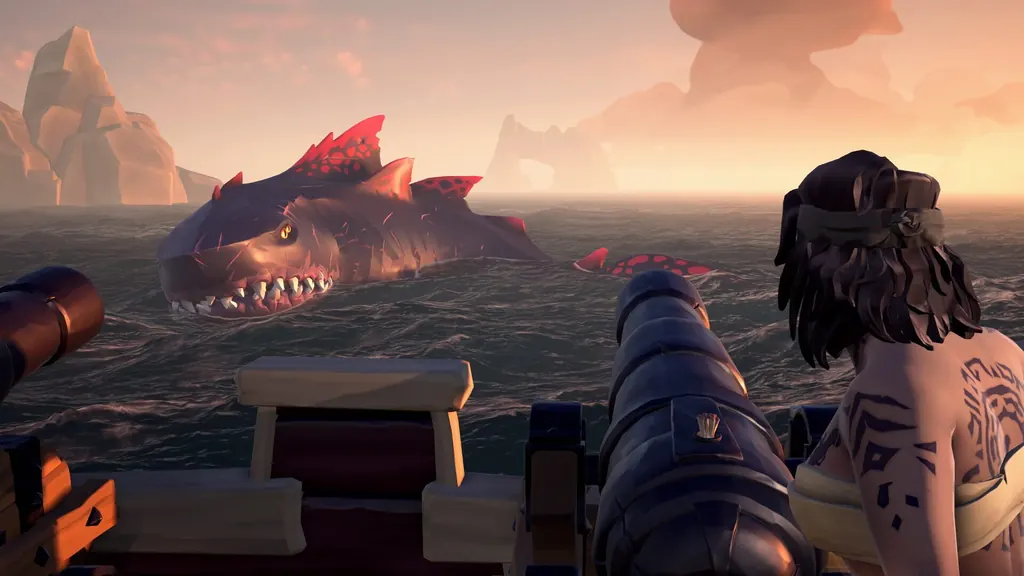
The gameplay of Sea of Thieves is a first-person immersion in a vast and dynamic open world where adventure is inherently cooperative. The game is not just a stage for pirates, but a true shared game world, which ensures that players regularly encounter each other on their journeys. The experience requires participants to take on different roles on a pirate ship, whether it’s a small and agile sloop, or larger vessels like the three-person brigantine or the four-person galleon. It is the synergy of these roles that defines success on the high seas, turning every voyage into a coordinated crew effort.
Coordination on the high seas
Navigating a galleon, for example, requires more than just rowing. Players must divide into specific and vital tasks for the crew’s survival and progress. One player might be in charge of steering the ship, while another must raise the sails. There are also crucial roles, such as the navigator, who guides the course, and the gunner, responsible for maneuvering and firing the cannons. Furthermore, the lookout, positioned in the crow’s nest, is essential for spotting things. This division of labor is not limited to navigation; players can also get involved in onboard combat, whether by manning the cannons or engaging in close-quarters combat on enemy ships.
📘 Crow’s Nest
It is the elevated spot on the ship’s mast, essential for the lookout. From there, the player can scout the environment and spot enemies.
The open world invites constant exploration. Players embark on missions, collect loot, and prepare for combat against other groups or against the environment itself. The game’s physics are exaggerated, allowing for acrobatic combat moves, such as being thrown by cannons. Survival is also a complex mechanic: if areas below the deck take damage, water begins to leak from holes, requiring the crew to use wooden planks to plug the leaks and buckets to bail out the water. This reinforces the aspect of survival simulation within an epic adventure.
Alliances and Constant Danger
Cooperation can extend beyond the immediate crew. Players can form alliances with other crews, which grants them benefits like sharing gold and reputation points when a treasure item is sold by an alliance member. Even when an alliance is formed, it doesn’t prevent the crews from fighting each other. Danger, however, is constant. Upon encountering hostile players, the action can escalate quickly, either through cannons or a direct assault on the ship. Additionally, the game establishes a life-and-death system: if a player falls, there is a limited time window for a crewmate or ally to revive them. Otherwise, they are sent to the ghost ship known as the Ferry of the Damned, where they await their return.
Beyond random encounters, the game offers structured challenge modes. A competitive PvP mode, the “Arena,” was introduced (though it was later removed). More recently, the “Hourglass” mode was added in Season 8, and the “Safer Seas” mode in December 2023, which offers an experience focused on environmental combat. This variety of objectives—from resource gathering and mission completion to participating in large-scale naval confrontations—ensures that the gameplay remains dynamic and always moving.
Launch and Cross-Platform Expansion

The journey of Sea of Thieves to become the global phenomenon it is today was marked by a meticulous, multiplatform development and release strategy. The game was officially announced at a time of high anticipation: the Microsoft conference at the Electronic Entertainment Expo (E3) in 2015. At the time, the game was presented as one of Rare’s most ambitious projects.
Releases and the Xbox Era
Initially slated for 2017, the title experienced a necessary delay, finally launching on March 20, 2018. This initial release was strategic, as the game was integrated into Microsoft’s Xbox Play Anywhere program, ensuring players could access the content on both Windows 10 and Xbox One platforms. More than that, from the outset, Sea of Thieves was part of the Xbox Game Pass ecosystem, a factor crucial to the game’s commercial success because it allowed subscribers access to the title on day one.
The game’s expansion did not stop at the first-generation console. On June 3, 2020, the title launched on the Steam platform for PC, solidifying the game as a truly multiplatform title. Microsoft, in turn, maintained continuous support and development, with the game receiving numerous updates and features, encouraging the community to create its own challenges and events.
Arrival on PlayStation 5
The most recent and significant chapter in the history of Sea of Thieves is its arrival on the PlayStation 5. On April 30, 2024, the game launched on this platform. This release not only expanded the player base to a new consumer demographic but also marked a historic moment for Rare, as it represented the first time the studio had released one of its titles on a Sony console. This achievement reaffirms Sea of Thieves’ status as a global phenomenon, capable of crossing platform barriers and attracting millions of buccaneers, regardless of whether they use a console or PC.
The trajectory of Sea of Thieves, from its announcement at E3 in 2015 to its launch on the PlayStation 5 in 2024, demonstrates not only the success of its open-world and cooperative concept but also a franchise’s ability to adapt and thrive on every new generation and operating system, establishing itself as a pillar of modern cooperative entertainment.
📊 Sea of Thieves Evolution and Releases
| Date/Event | Platform | Launch Highlight |
|---|---|---|
| E3 2015 | Announcement | Presented as an ambitious Rare project |
| March 20, 2018 | Windows 10 and Xbox One | Initial launch, integrated with Xbox Play Anywhere and Game Pass |
| June 3, 2020 | Steam (PC) | Solidification as a multiplatform title |
| April 30, 2024 | PlayStation 5 | Historic launch for Rare on the Sony console |
Commercial reception, impact, and legacy in entertainment
The success of Sea of Thieves transcended the adventure game niche, transforming into a global consumer phenomenon and a financial pillar for Microsoft’s title catalog. The game attracted a massive player base, surpassing the 40 million mark, a number that underscores the enduring appeal of the pirate formula in a cooperative multiplayer environment. Commercially, the title proved to be a success in sales and engagement, establishing the “Game as a Service” model as a highly effective strategy, where constant content is the engine of continued success.
Critical Reception and Content Challenges
Despite its public success, the initial critical reception was notably mixed, reflecting a game that, while possessing a brilliant playable foundation, was perceived as incomplete. Review aggregators like Metacritic reflected this duality, assigning scores such as 69/100 for the Xbox One version and 67/100 for the Windows version. Specialized critics converged on a central point: the urgent need for more depth and content.
Many analysts pointed to a lack of variety. For instance, Brandin Tyrrel of IGN, while giving it a 7/10 and acknowledging that the experience is “fun with friends,” felt “stuck” in a repetitive routine. Similarly, Kirk McKeand of VG247 warned that without the addition of “more ways to play” and mission variety, player numbers could drop substantially. Even Michael Goroff of Electronic Gaming Monthly, despite praising the beautiful visuals and excellent sailing mechanics, described the gameplay as seeming “completely lacking in gameplay terms.”
Legacy in the Microsoft Ecosystem and the Future
The trajectory of Sea of Thieves is not just that of a game, but of a case study in intellectual property development. For Microsoft, the title solidified the capability of its entertainment ecosystem to create open-world experiences that value social interaction above all else. The game’s success demonstrated that cooperative appeal and the exploration of a shared world are powerful retention draws.
The title’s commercial and cultural impact was so great that it extended its reach beyond the digital universe. Its massive success positioned it as an ideal candidate for media adaptations, notably the development of a live-action film. Thus, Sea of Thieves not only secured its place in the cross-platform title catalog (available on Windows, Xbox Series X/S, PlayStation 5, and others) but also paved the way for the legend of the buccaneers to be told in new entertainment formats.
Frequently Asked Questions
Is Sea of Thieves a good game to play alone or in a group?
It is an intrinsically cooperative game because the adventure requires players to take on team roles, such as navigator and gunner. However, the open world allows you to explore and engage in missions even when playing alone, ensuring the experience is rich in both modes.
What is the difference between playing on PC and PlayStation 5 in Sea of Thieves?
The game was designed to be played on multiple platforms, including PC and PlayStation 5. While the platforms ensure access to the same pirate universe, the core experience of cooperation and open-world exploration is maintained across all devices, focusing on shared adventure.
What does ‘Game as a Service’ mean in Sea of Thieves?
It means that the game is not a static product. It is a constantly developing universe, receiving updates and content continuously. This ensures that the pirate world remains alive and that the narrative and challenges expand with the community itself.
Which companies do players need to complete voyages in Sea of Thieves?
Voyages and missions are based on player cooperation. You can form alliances with other crews, which offers benefits like shared gold. However, the danger and adventure come from other hostile corsairs or the wild environment itself.
Is Sea of Thieves a pirate game that requires knowledge of real navigation?
It does not require knowledge of real navigation. Although the gameplay simulates life at sea, the game’s physics are exaggerated for entertainment purposes. You must coordinate vital roles, such as steering the course and raising sails, in an epic adventure setting.
Conclusion
The development of Sea of Thieves is a case study on how creative vision can overcome technical and conceptual limitations. The title originated in 2014, under the concept of “Narrative in Group Form,” conceived by Gregg Mayles, which aimed to create a multiplayer space where player interactions were the main focus, rather than a story rigidly structured by the studio. Although it went through different themes, the pirate universe solidified itself as the perfect setting for this freedom, allowing for almost unlimited autonomy and a focus on spontaneity, like an improv comedy.
This endeavor was monumental, requiring the synergy of nearly 200 employees and a crucial technological transition for Rare, which adopted the powerful Unreal Engine 4. Beyond the technical effort, the game’s success lies in its transparent development methodology: the involvement of over 30,000 players in the Insider Program not only improved the product but solidified the concept that the cooperative experience is a direct result of community participation. Sea of Thieves, therefore, transcended being just a pirate game; it is the materialization of a new standard for open worlds where the story is written in real time.
Observing the journey of Sea of Thieves, it’s clear that advanced technology and an appealing theme are merely tools. The real engine of the game is human interaction, proving that when the focus is on the freedom to create memorable experiences, any world can become a stage for unforgettable adventures.