Read this article in: Portuguese (Português) · Spanish (Español)
To directly answer the question of who created The Stanley Parable: Ultra Deluxe, the architects behind this narrative work are the developers Davey Wreden and William Pugh. The title is the result of an evolutionary process that began as a mod and transformed into an interactive art phenomenon. The game, developed by Galactic Cafe, is a modern classic that challenges the very notion of linear plot. Instead of following a predetermined path, the player guides a silent protagonist through an environment that constantly confronts their choices, transforming the gaming experience into a deep reflection on free will, destiny, and the complex relationship between creator and user.
The significance of The Stanley Parable: Ultra Deluxe lies not only in its witty and engaging writing but also in its long development history. Originally released as a mod on July 31, 2011, the game went through several refinement stages. After the release of the standalone remake on October 17, 2013, the title was significantly expanded with the Ultra Deluxe version, which arrived on April 27, 2022. This history of delays, updates, and multi-platform releases, including an iOS port on October 7, 2024, attests not only to its commercial success—with sales exceeding one million copies—but also to its status as a cultural milestone in video game history.
In this article, we will take a complete journey to uncover the story behind this masterpiece. We will address the architects behind the narrative, understanding the origin of the idea, from the Half-Life 2 mod to its status as a narrative phenomenon. We will analyze the evolution of the development, covering the technology and delays that culminated in Ultra Deluxe. Furthermore, we will delve into the gameplay and the philosophy of choice, exploring the deep themes the game weaves, such as free will and the intrinsic relationship between creator and player.
Key Points
- The narrative is shaped by Davey Wreden and William Pugh, who are the primary writers and designers of the work.
- The concept originated as a mod for Half-Life 2 in 2011, evolving into a standalone title.
- The game is a first-person adventure that focuses on breaking narrative expectations, without physical combat.
- Ultra Deluxe is a massive expansion, with new content more extensive than the original game’s script.
- It was released on multiple platforms, including Windows, macOS, consoles, and iOS in 2024.
The Stanley Parable: Ultra Deluxe in summary
| Developer | Galactic Cafe |
|---|---|
| Publisher | Galactic Cafe |
| Designers | Davey Wreden; William Pugh |
| Writers | Davey Wreden; William Pugh |
| Platforms | Windows; macOS; Linux; PlayStation; Xbox; Nintendo Switch; iOS |
| Genre | Adventure |
| Mode | Single-player |
| Release | October 17, 2013 Windows; October 17, 2013; macOS; December 19, 2013; Linux; September 9, 2015; Playstation, Xbox, Nintendo Switch; April 27, 2022; iOS; October 7, 2024 |
Who Created The Stanley Parable: Ultra Deluxe? The Architects Behind the Narrative

The architecture behind The Stanley Parable: Ultra Deluxe is a mosaic of creative and technical talents, evolving from an independent mod to a global-scale production. The main people responsible for shaping this narrative experience are designers and writers Davey Wreden and William Pugh. If you want to know more about who created The Stanley Parable, it’s worth checking out. The work, in its various iterations, is an undertaking that passed through different corporate hands; the developer and publisher that ensured the title’s life cycle is Galactic Cafe, in partnership with Pugh’s studio, Crows Crows Crows. It is this intense collaboration that transformed a conceptual idea into a playable and debatable phenomenon.
The Creative and Technical Team
For the complex web of narratives and fourth-wall breaks to function, a multidisciplinary team was necessary. The roles of writing and design were mainly handled by Davey Wreden and William Pugh. However, the materialization of the game required the contribution of specialized professionals. The programming was developed by Jesús Higueras, ensuring that the logic and choice systems worked. Andrea Jörgensen is responsible for the visual art, while the soundtrack, a crucial element for the game’s tone, was composed by a collective: Blake Robinson, Yiannis Ioannides, and Christiaan Bakker. This division of labor, where writing and design complement technical and artistic execution, is what gives the experience depth and credibility.
The game’s development journey is as important as its content. The original concept began as a mod for Half-Life 2, initially released in 2011. After the success of this first iteration, Davey Wreden and William Pugh collaborated for two years to create a standalone remake, released in 2013. This period of refinement allowed the game to become an independent title and expanded the narrative material. The Ultra Deluxe title represents the peak of this evolution, a joint release that maintained the ambition to expand the script, with Wreden stating that the new content is more extensive than the original game’s script.
Technically, the work demonstrated great adaptability. While previous versions used the Source engine, Ultra Deluxe was ported to the Unity engine to support consoles. The game’s reach is remarkable, having been released on multiple platforms over the years: from Windows and macOS, with a release on October 17, 2013, to PlayStation, Xbox, and Nintendo Switch, with a launch milestone on April 27, 2022. More recently, its presence on mobile devices was solidified with the launch on the iOS platform on October 7, 2024. This technical breadth demonstrates not only commercial success but also longevity and the care taken to bring the work to every possible format, cementing it as a milestone in the history of interactive games.
🕒 The Stanley Parable’s Evolution: A Timeline
- 2011 — The original concept began as a mod for Half-Life 2.
- 2013 — Following initial success, a standalone remake was created and released on October 17 for Windows and macOS.
- 2022 — Released on PlayStation, Xbox, and Nintendo Switch on April 27.
- 2024 — Consolidated on the mobile platform with a release on iOS on October 7.
The Idea’s Origin: From Half-Life 2 Mod to Narrative Phenomenon
The genesis of The Stanley Parable stemmed from a conceptual reflection on the narrative format in video games. Davey Wreden, the lead developer, was initially inspired about three years ago by the challenge of questioning the typical storytelling conventions of the medium. He realized that many AAA titles assumed too much about the player experience, rarely providing answers to the “what ifs” that a player’s mind could conjure. Thus, while studying how other media approached world-building, Wreden drew inspiration from how technology shapes the imagination, as seen in the history of the Microsoft Flight Simulator. With this premise, Wreden created the game’s first prototype, which was released as a free mod for Half-Life 2.
The concept’s success and potential caught the attention of William Pugh, who had experience creating environments using the Source engine. Pugh heard about the mod and, after playing it, saw in Wreden an opportunity to improve upon it. The two began an intense collaboration, working together daily for two years. Initially, Wreden wanted to recreate the original game “bit by bit,” but discussions with Pugh led to a crucial decision: instead of a mere recreation, they opted for an “interpolation” of the original material, adding new elements and transforming it into a standalone, complete title.
Development and Narrative Depth
The creative process was highly collaborative. Pugh and Wreden worked side-by-side writing the Narrator’s script, exchanging elements that were subsequently adjusted and expanded upon by each other. While one adjusted the text, the other altered the environment, which in turn enriched the Narrator’s personality. A notable detail is the attention paid to the player’s sense of agency: the first scene where the player could choose between left or right was carefully designed so that the moment was perceived as a genuinely autonomous choice.
The narrative, in turn, is built on the relationship between the player and the Narrator. Wreden emphasized that the work is not about a power struggle, but rather an attempt at mutual understanding. The project’s ambition translated into a significant expansion: the standalone remake kept the original’s six endings but added several newly created ones. In addition to the script, the experience was enriched by an original soundtrack, composed by Blake Robinson, Yiannis Ioannides, and Christiaan Bakker, and the return of Brighting to voice the Narrator, an element Wreden considered fundamental to the game’s success.
Following the mod’s success, the team sought to formalize the title. Although it was initially considered The Stanley Parable: HD Remix, Wreden opted to remove the subtitle, stating that the revised version was the “definitive” one. The standalone release occurred on October 17, 2013, for Windows and macOS platforms, marking the transition from a community mod to a globally scaled production, ready to question the very nature of the act of playing.
📌 Project Evolution: From Mod to Standalone Release
- Started as a free mod for Half-Life 2.
- Intense collaboration between Wreden and Pugh for two years.
- Decision to ‘interpolate’ the original material, not just recreate it.
- Standalone release on October 17, 2013 (Windows/macOS).
The development evolution: Technology, delays, and Ultra Deluxe
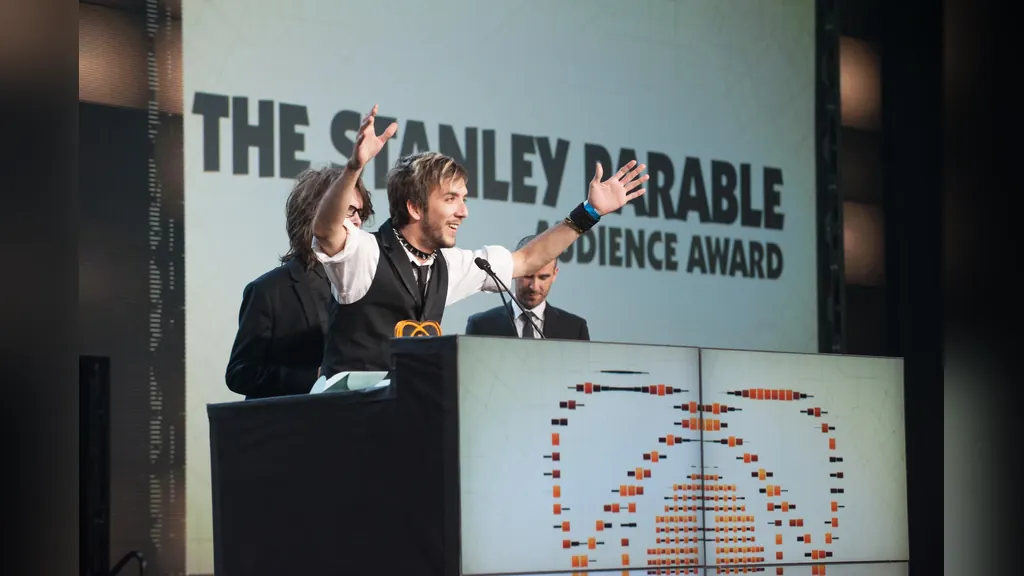
The trajectory of The Stanley Parable is a case study on how an independent project can grow to a global scale, moving from a niche mod to a sales phenomenon. The original title first launched on October 17, 2013, available for Windows and macOS. The work demonstrated remarkable technical adaptability, being later released on December 19, 2013, for Linux, and on September 9, 2015, for consoles such as PlayStation, Xbox, and Nintendo Switch. This cycle of initial releases solidified the fan base and proved the narrative potential of the concept, keeping the focus on interactivity and breaking the fourth wall.
The promise of ultra deluxe
The ambition to expand the Stanley universe was only realized years later. It was at The Game Awards in 2018 that the public encountered The Stanley Parable: Ultra Deluxe, an expanded edition that promised to be a massive overhaul. Initially planned for 2019 for existing platforms and consoles, the anticipation was met with successive delays. In November 2019, the release was postponed until mid-2020. The schedule was again impacted by the COVID-19 pandemic, leading to another delay in 2021, until, in December 2021, the title was reconfirmed for early 2022.
Each delay did not diminish the interest; rather, it increased the anticipation for the added content. Ultra Deluxe was not just simple filler; it was an effort in portability and enrichment. To support the consoles, the game had to be ported to the Unity engine, in addition to receiving significant new content. Davey Wreden, one of the narrative architects, stated that the script for the new material was more extensive than the script for the entire original game.
The Narrative Peak and Multiplatform Reach
Ultra Deluxe launched on April 27, 2022, for multiple platforms, including PlayStation 4 and 5, Xbox One and Series X/S, as well as Windows, macOS, and Linux via Steam. The global reach was solidified on October 7, 2024, with the release of the iOS version. The magnitude of the expansion was evident in the replacement of original sections with new environments, such as levels inspired by Firewatch and Rocket League, which deeply enriched the player’s choices. The title was recognized for its critical success, accumulating a score of 90/100 on Metacritic as of April 2024, and even winning the “Freedom Tower Award for Best Remake” at the New York Game Awards.
Gameplay and the Philosophy of Choice: The Power of the Narrator
The experience of playing The Stanley Parable: Ultra Deluxe is fundamentally distinct from any other interactive work. It is a first-person adventure that deliberately forgoes any combat or physical challenge system. Gameplay is not measured by the player’s ability to navigate traps or defeat adversaries, but rather by their capacity to question the narrative’s own limits. The main focus rests on the complex and ironic dynamic between the player and the Narrator, the voice that guides, comments on, and sometimes reprimands the protagonist, Stanley.
The Philosophy of Disobedience
The philosophical core of the game lies in the premise that the true art of gameplay is not following the script, but disobeying what is said. The Narrator, whose voice is constantly formal and British, plays the role of an almost omnipotent guide, as if he were a divine figure holding total control of Stanley’s world. He describes what must happen, establishing the “right” path. However, the game encourages, and even demands, that the player place themselves in direct opposition to this authority. It is this tension—the constant challenge to the voice that promises destiny—that creates the experience. As pointed out in critical analyses, the Narrator’s function is so crucial that he shifts from being a mere background element to the central focus of the narrative as the player progresses.
📘 Self-Referentiality
It is the phenomenon where the game exposes its own creation mechanisms. The Narrator does this by attempting to control the flow of the story, revealing how the narrative is constructed.
Rather than being a challenge of emotion to perform, the game is an exercise of emotion in not performing. The Narrator, in turn, proves to be a narratively flawed character. Although he tries to exert total control, he possesses an inconsistency that the player quickly notices. This intrinsic flaw is the starting point for the play, transforming the experience into something that recalls a “theatre of improvisation with a robotic comedian” rather than a linear script. Even understanding the origin of great military honors, like the full story of the Medal of Honor, can be as fascinating as the game’s narrative. By trying to control the flow of the story, the Narrator constantly exposes his own creation mechanisms, a phenomenon known as self-referentiality.
The Mechanic of Deviation and the Infinite Cycle
The deviation mechanic is the engine of the game. Whenever the player strays from the path paved by the Narrator’s voice, the game not only registers the deviation but celebrates it. This fourth-wall-breaking mechanic forces the player to confront the nature of fiction itself. The restart cycle, a constant in the experience, reinforces the idea that no matter how far the player tries to go, the system will always bring them back to the starting point, only so they can try disobedience once more. This repetition is not punitive; it is performative, underscoring the power dynamic and the freedom of choice. It is this constant tension between imposed destiny and the player’s free will that gives The Stanley Parable: Ultra Deluxe its status as a narrative masterpiece.
Deep Themes: Free Will, Destiny, and the Creator-Player Relationship
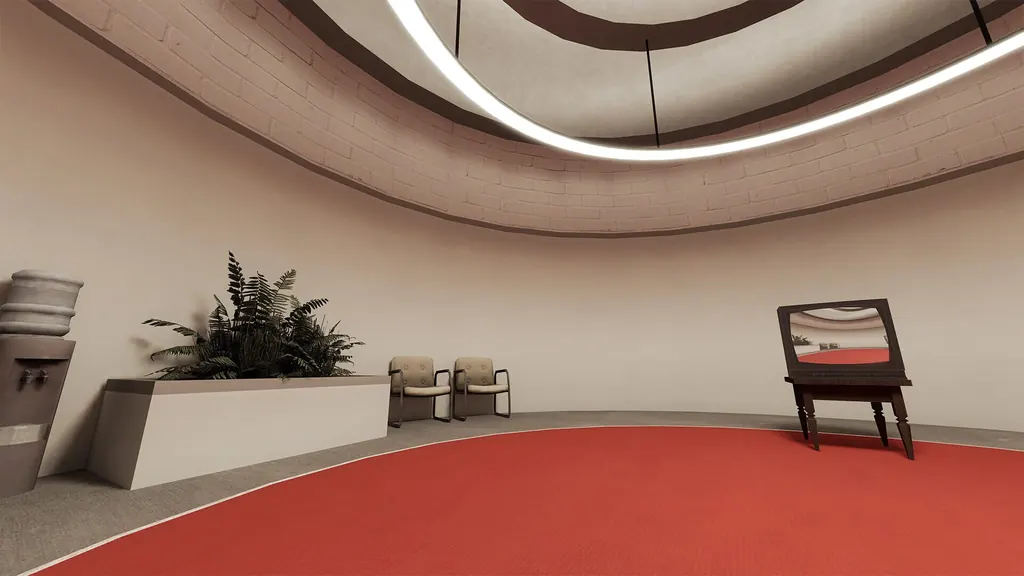
The depth of The Stanley Parable: Ultra Deluxe transcends mere gameplay, establishing itself as a meta-narrative work of art that prompts the player to question the very pillars of the interactive medium. The title, above all else, functions as a commentary on the nature of narrative in video games. Rather than presenting a single destination, it exposes the philosophical tension between the player’s free will and the game’s structural predestination. Academic analysts, such as those behind the book The Ethics of Playing, Researching, and Teaching Games in the Writing Classroom, point out that the game is a vehicle that speaks about other games, exploring the conflict between the player’s will and the system’s will.
The Paradox of Free Choice
The philosophical core of the work resides in an intrinsic paradox: the game simulates an almost infinite freedom of choice, yet it is rigidly contained by a fundamental structure. The player feels in control, exercising the power of deviation, but the narrative engine constantly reminds them that, ultimately, the path is pre-written. This duality is exemplified in critical moments. For instance, some analyses have noted the “Confusion” mode, where the Narrator and Stanley confront a wall displaying all of the Narrator’s dialogue. This moment not only demonstrates the game’s narrative self-awareness but also the impossibility of altering the story’s flow, even for those who appear to be in command.
🧪 The Paradox of Free Choice in Gaming
The game simulates an almost infinite freedom of choice, yet it is rigidly contained by a fundamental structure. An example of this is the “Confusion” mode, where the Narrator’s dialogue is displayed on a wall, showing the narrative self-awareness and the impossibility of altering the flow, even for those who seem to be in control.
This debate about agency is the backbone of the experience. The game forces the player to test their own agency against the ethos of the system. The book The Ethics of Playing… highlights how the player is not just playing, but experiencing the very concept of agency. This analysis becomes even more complex in passages that question the meaning of choices. In a section known as “The Baby Game,” for example, the audience may question whether the decision to save a baby holds any real meaning, or if the player is being manipulated in a cycle of choices devoid of ethical weight.
Between Fiction and Control
The work uses irony and metalinguistics to dismantle the illusion of control. The section “The Freedom” is a notable example: for Stanley to achieve freedom, the player must, ironically, relinquish his own control. It is an act of disobedience that paradoxically deactivates the player’s freedom. This self-criticism is a recurring theme, as pointed out in Against Flow: Video Games and the Flowing Subject, which analyzes how the game tries to make the player stop and question the reason for playing. Instead of breaking the flow, this paradoxical reflexivity intensifies it.
In summary, The Stanley Parable: Ultra Deluxe is not just an adventure game; it is a philosophical experiment about what it means to be an agent in a narrative. It forces us to recognize that, even in an environment that celebrates disobedience, the player is always limited by the foundation upon which the work was built, turning every click into a reflection on destiny, freedom, and the complex relationship between the creator of the art and the one who experiences it.
Critical Reception, Success, and Cultural Legacy
The impact of The Stanley Parable: Ultra Deluxe transcended the niche of indie games to establish itself as a sales phenomenon and a benchmark of critical acclaim. The title’s commercial success was notable from the outset. The developer Galactic Cafe reported on social media that, just 24 hours after its release, the game had already surpassed the 100,000 copies sold on the Steam platform, attesting to the public’s strong interest in the meta-narrative work.
Critical Reception and Acclaim
The recognition from specialized critics was equally robust, positioning the title as a high-quality interactive work of art. Review aggregators confirmed this performance: the version for the Xbox Series X received a score of 93/100, followed by the PC version, which achieved 90/100. Other platforms also received high scores, such as the PlayStation 5 (89/100) and the Nintendo Switch (87/100). In addition to aggregators, major technology and gaming publications also praised the content. IGN gave the game a 9/10, highlighting the enhanced graphics and new content, although it pointed to the feeling of familiarity with the original work as a drawback. PC Gamer awarded 88/100, while GameSpot gave 8/10, praising the game as “immensely intelligent and funny” and emphasizing the multiple endings that encourage replayability.
This data shows that, although some critics pointed out that the 2022 content was not as “fresh and stimulating” as the original 2013 release, the overall reception was one of deep appreciation for the ambition and depth of Ultra Deluxe. The ability to maintain the interest and relevance of such a conceptual premise for over a decade, culminating in the release on April 27, 2022, for multiple platforms, is a testament to the power of the original idea.
Cultural Legacy and Impact on Game Design
The Stanley Parable: Ultra Deluxe is not just a commercial success; it is considered a pillar in narrative game design. The work, developed by Davey Wreden and William Pugh, set a new standard for interactive literature. Rather than being merely playable, the title established itself as a philosophical experiment that forces the player to question the very foundations of the gaming experience. The game’s journey, which began as a Half-Life 2 mod in 2011 and expanded to a multi-platform release in 2022, is a case study on how an independent concept can achieve global scale without losing its artistic and critical essence.
In summary, the success of The Stanley Parable: Ultra Deluxe cannot be measured solely by its sales or reviews. It represents a cultural milestone that proved that metalinguage, irony, and the exploration of free will within a virtual environment can resonate deeply with the public, cementing the work as an essential reference for game developers and academics.
Glossary
- Mod: Additional fan-created content, usually for existing games, such as the title’s first prototype.
- Self-referentiality: The game exposes its own creation mechanisms, referencing itself or its own narrative process.
- Interpolation: The process of adding new elements to an original material rather than simply recreating it faithfully.
Frequently Asked Questions
Is The Stanley Parable a difficult game or does it require combat skills?
No, it is not a difficult game and does not require combat skills. It is a first-person adventure that deliberately foregoes any physical challenge. The main focus is the ironic and complex dynamic between you and the Narrator, making it an exercise in narrative questioning.
What is the difference between the original The Stanley Parable and Ultra Deluxe?
Ultra Deluxe is a massive expansion that goes far beyond a simple add-on. It enhances the narrative content, adding a script that is longer than the original game. Furthermore, it has been technically adapted to support consoles and multiple platforms.
Who is the Narrator and what is his role in the story?
The Narrator is the voice that guides, comments on, and sometimes reprimands the protagonist, Stanley. He assumes the role of an almost omnipotent guide, describing the ‘correct’ path. However, the game encourages you to challenge this authority, exploring the tension between imposed destiny and the player’s free will.
Is the game good for someone who has never played video games before?
Yes, it is very accessible. Because it is a first-person adventure that does not require combat, the focus is purely narrative. The experience is built on reflection and interaction with the Narrator’s voice, making it ideal for those who prefer a rich and thoughtful story over skill challenges.
On which platforms should I look for The Stanley Parable: Ultra Deluxe?
You can find the game on a wide range of platforms. It is available for Windows, macOS, Linux, and for consoles such as PlayStation, Xbox, and Nintendo Switch. Its global reach was solidified with the release of the mobile version, including iOS.
Conclusion
The journey of The Stanley Parable: Ultra Deluxe is much more than a game’s story; it is a case study on the resilience of conceptual art. The title stemmed from Davey Wreden’s reflection on the narrative conventions of video games, evolving from an initial mod into an independent, global-scale project. Its success lies in the intense collaboration between visionaries Davey Wreden and William Pugh, who knew how to not only tell a story but to question the very act of storytelling. This complex narrative web was materialized by a multidisciplinary team, combining writing and design with Jesús Higueras’ programming, Andrea Jörgensen’s visual art, and the soundtracks by Blake Robinson, Yiannis Ioannides, and Christiaan Bakker.
What makes the work a landmark is its technical adaptability and philosophical depth. From its release as a mod in 2011 to its consolidation across multiple platforms—including Windows, macOS, PlayStation, Xbox, Nintendo Switch, and iOS—the game has demonstrated unparalleled longevity and care. It was not content to merely follow a script; it became an interactive mirror where the player’s agency and the relationship with the Narrator are constantly questioned, transforming the act of playing into an exercise in metacognition.
Thus, The Stanley Parable transcended the label of “interactive game,” establishing itself as a work of art that dialogues with the audience about the very meaning of digital narrative. The work proves that the most ambitious ideas often flourish at the intersection of independent concept and refined technical engineering. It is a powerful reminder that true innovation lies in the courage to ask questions, not just to deliver answers.