Read this article in: Portuguese (Português) · Spanish (Español)
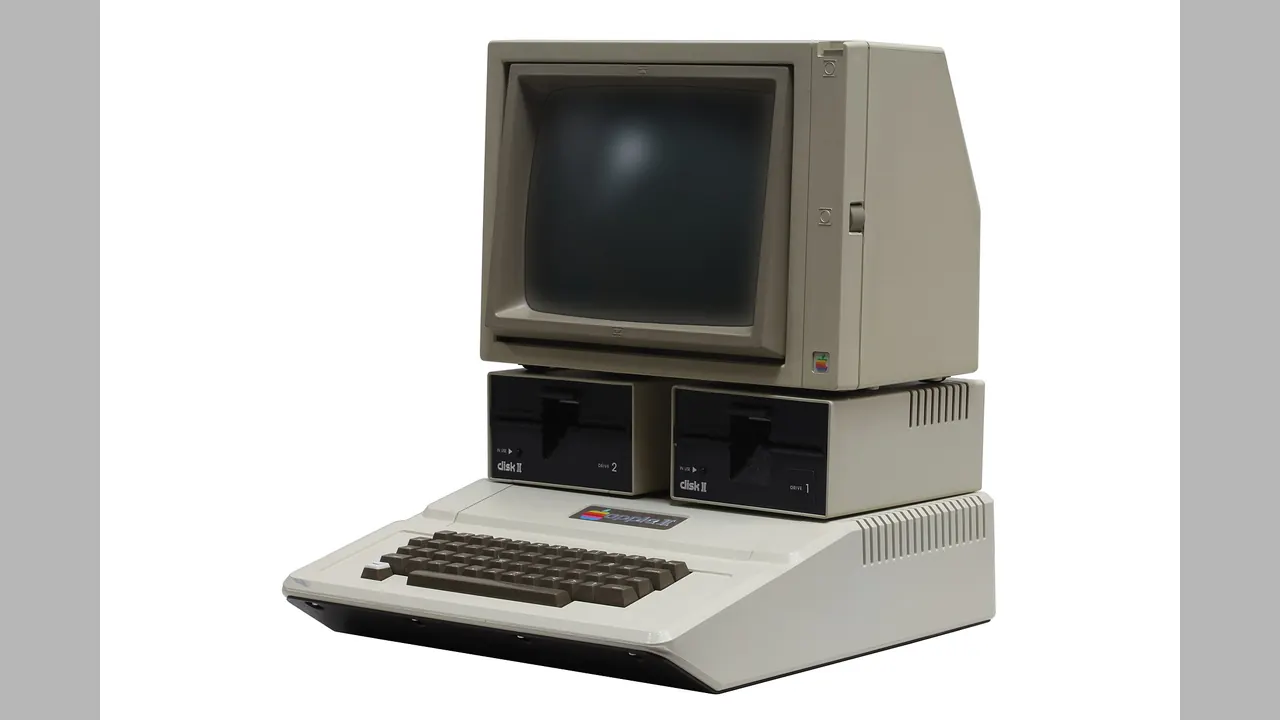
The history of the Apple II is a fundamental milestone in personal computing. Although manufactured by Apple Computer, Inc., the credit for the original and revolutionary design belongs to Steve Wozniak. Launched to the market in June 1977, the Apple II was not just another computer; it represented an architectural leap for the consumer market. Unlike previous models, the Apple II offered an open architecture, a full case, and features such as color graphics and a built-in keyboard, making it a complete system, ready for use in educational and corporate environments.
The significance of this machine is undeniable and is supported by concrete data from its history. The Apple II was released in June 1977 and, throughout its production, achieved the impressive milestone of 6 million units sold. Its success was not due only to the hardware, but to its adaptability and the software ecosystem it generated. A notable example is the release of the VisiCalc spreadsheet program in 1979, which solidified the use of computers in offices and accelerated the large-scale adoption of the technology, consolidating the home computer market.
In this article, we will dive deep into the history of this technological icon. You will discover the genesis of the Apple II, meeting the creators and the magical year it all began. We will analyze the historical context and the problem it solved, detailing its revolutionary architecture and the evolution of the series through its various versions. Furthermore, we will explore the software that transformed the professional market and, finally, trace the legacy and lasting impact of the Apple II on the technology that shapes our world to this day.
Key Points
- Launched on June 10, 1977, the Apple II sold 6 million units, defining the personal computer market.
- Steve Wozniak was the primary designer, and the Apple II pioneered taking computing out of industrial laboratories.
- The Disk II, a 5+1/4-inch floppy disk, was an engineering feat that replaced cassette tapes, increasing reliability.
- The modular architecture with multiple expansion slots allowed the Apple II to be adapted for countless functions.
- The line evolved significantly, going through models like the Apple IIe and IIGS, until it was discontinued in 1993.
Apple II in Summary
| Manufacturer | Apple Computer, Inc. |
|---|---|
| Developer | Steve Wozniak (original lead designer) |
| Release | June 1977 ( original Apple II ) |
| Discontinuation | October 1993 ( 1993-10 ) |
| Units Sold | 6 million |
| Operating Systems | Apple DOS; Apple ProDOS; Apple Pascal; Apple GS/OS |
| CPU | II, II+ & IIe: 6502 @ 1.023 MHz; Enhanced IIe, IIc, IIc+ & IIe Card: 65C02 @ 1.023 MHz; IIGS: 65C816 @ 2.8 MHz |
| Storage | Compact Cassette; 5 + 1 ⁄ 4-inch 140 KB Disk II floppy disk (optional); 3 + 1 ⁄ 2-inch 800K floppy disk (optional) |
| Display | NTSC video out (built-in RCA connector ) |
| Sound | 1-bit speaker (built-in) |
| Predecessor | Apple I |
| Successor | Apple III (intended); Mac |
The Genesis of the Apple II: The Creators and the Magic Year
The history of the Apple II is inseparable from the genius of its main designer, Steve Wozniak. At a time when computing was still largely the domain of large corporations and amateur electronics enthusiasts, Apple Computer, Inc., led by Steve Jobs and Wozniak, perceived a revolutionary potential: to take the machine out of the lab and put it into the hands of the public. If you are interested in how mobile devices evolved, it is worth checking out the evolution of the smartphone that changed the world. The Apple II did not come from a strictly commercial plan, but from a brilliant engineering project that gradually managed to transition from a hobby to a mass-market consumer product. This movement was crucial and defined the birth of personal computing as we know it.
The Magic Year of 1977
The starting point came on June 10, 1977. On this date, the first Apple IIs were sold, marking a turning point in technology. The initial computer was powered by a MOS Technology 6502 microprocessor, operating at 1.023 MHz, and came equipped with 4 KB of RAM and the Integer BASIC programming language embedded in the ROM. The system was designed to display text in mono-color, with 40 columns by 24 lines, using NTSC video output, which made it adaptable to common television monitors. The model’s success was monumental, accumulating sales of 6 million units over its lifespan, which extended until October 1993.
The Apple II, along with the Commodore PET and the TRS-80, formed what became known as the “Trinity of 1977″—a group of machines that, in a short time, established the personal computer market, proving that the public was ready for the digital revolution. The Apple II’s hardware was an engineering feat, especially the Disk II interface, created by Steve Wozniak. This 5+1⁄4-inch floppy disk storage system was a true “masterpiece of component economy,” replacing the use of audio cassettes for data storage and retrieval.
Evolution for the Professional
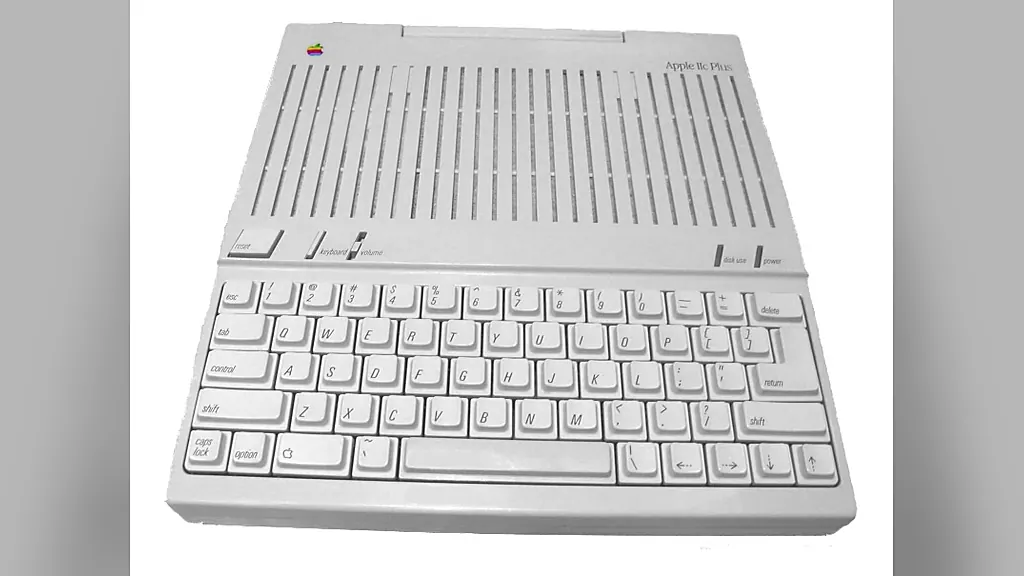
The longevity of the Apple II was not due only to its launch, but to its adaptability. Initially, the sound system was rudimentary, relying on a toggle circuit to emit beeps through a built-in speaker; however, the power of the software was what generated the sonic complexity. The design with multiple expansion slots allowed for the integration of a variety of third-party peripherals—from hard drive controllers and additional memory to network cards—transforming the computer into an open platform. Evolution continued with the Apple II Plus, released in June 1979, which brought Applesoft BASIC in ROM and increased the RAM to 48 KB. Subsequently, the Apple IIe model (1983) offered improved cost-effectiveness and more features, such as the display of uppercase and lowercase letters, and the Apple IIc (1984) introduced the concept of portability, being the first model to use the low-power 65C02 processor.
Thus, what began as a garage project by Wozniak in 1977 evolved through technical and commercial refinements, becoming an engine of innovation that paved the way for the modern computer.
🕒 The Apple II Revolution Timeline
- June 10, 1977 — Launch of the first Apple IIs, marking a turning point in technology.
- June 1979 — Launch of the Apple II Plus, which brought Applesoft BASIC in ROM and increased the RAM to 48 KB.
- 1983 — Launch of the Apple IIe model, improving cost-effectiveness and features like uppercase and lowercase letter display.
- 1984 — Introduction of the Apple IIc, which brought the concept of portability with the low-power 65C02 processor.
- October 1993 — End of production for the Apple II model.
The historical context and the problem the Apple II solved
Before the advent of the Apple II, the computing world was dominated by machines that were mostly complex, expensive industrial equipment, inaccessible to the average user, whether a student or a small business owner. Owning a computer often meant acquiring a set of parts and boards—a true kit—that required advanced technical knowledge, specialized tools, and often manual assembly to function. The cost was not just that of the hardware, but also the barrier to entry of the knowledge needed to operate and maintain it.
The democratization of the machine
The Apple II, launched on June 10, 1977, represented a radical break from that paradigm. It wasn’t just a circuit board processor; it was designed and marketed as a complete consumer appliance. This shift was the most revolutionary element for the market. Instead of selling a collection of components, Apple delivered a ready-to-use machine, complete with an integrated plastic case and a built-in keyboard. This approach made personal computing tangible and, crucially, accessible to schools and businesses that previously viewed the computer as an industrial luxury.
The physical design was a testament to this consumer intent. The equipment not only came with a practical keyboard but also featured advanced graphics capabilities for the time, such as the use of colored stripes on the casing’s logo—a detail that underscored its ability to process and display more than just plain text.
Innovation in Use and Structure
Beyond the attractive enclosure, the Apple II incorporated engineering solutions that increased its usability and longevity. While the original system was powered by an external power supply that needed to be connected separately, Rod Holt’s work on the power supply, utilizing a switched-mode power supply design, resulted in a more compact unit that generated less heat.
Expandability was another crucial differentiator. The computer featured multiple expansion slots that allowed for the connection of a wide range of third-party peripherals. This included cards for serial controllers, memory, and even hard disk drives and networking components. For data storage, the introduction of the Disk II, a 5 + 1/4-inch external floppy disk device designed by Steve Wozniak, replaced older cassette tapes, representing a remarkable engineering feat in terms of electronic component efficiency.
In summary, the Apple II was not just a computer; it was the first device to package computing power into a consumer format, complete with graphics, an integrated keyboard, and expansion slots, paving the way for technology to leave academic laboratories and finally reach the desks and classrooms of the world.
📌 What Made the Apple II Revolutionary?
- It was presented as a complete consumer appliance, not just a kit of parts.
- It featured an integrated plastic case and built-in keyboard, making it tangible.
- It incorporated advanced graphics capabilities for the time, beyond simple text.
- It offered multiple expansion slots for third-party peripherals.
- It introduced the Disk II, a floppy disk device, replacing cassette tapes.
Architecture and the Revolutionary Hardware Design
The Technical Backbone and Modular Revolution
The success of the Apple II lay not only in its captivating physical design but also in its deeply innovative and, crucially, open hardware architecture. The heart of the initial system was the MOS Technology 6502 processor, operating at 1.023 MHz. This processor, and its variations like the 65C02, brought to life a computer that, while still operating with a cassette audio interface for data loading, already envisioned a future of unprecedented expansion. The screen was controlled by NTSC video, displaying text in monochrome colors, but the true technical power resided in the multiple expansion slots.
📘 Modular Architecture
This refers to the Apple II’s ability to use multiple expansion slots for users and third parties to add peripheral cards, allowing for functions far beyond Apple’s original design.
This modular characteristic was the major differentiator. The slots allowed users, and more importantly, third parties, to add a vast range of peripheral cards. It wasn’t just about connecting a mouse; it was possible to integrate serial controllers, memory boards, real-time clocks, and even entirely different processors. This flexibility was an invitation to innovation, allowing the Apple II to be adapted for functions far beyond what Apple had initially designed. This concept of open hardware paved the way for the modern peripheral industry.
The Leap in Reliability with the Disk II
One of the most significant leaps in terms of usability and reliability was the introduction of the external Disk II drive. While original models relied on cassette tapes for data storage and retrieval—a method notoriously prone to failure and noise—the 5+1/4 inch Disk II changed the game. This component, whose interface was designed by Steve Wozniak, was a true feat of engineering due to its component economy, replacing the unreliable analog method with a standardized digital storage medium. The ability to save data in a more robust and accessible format was a game-changer for professional use.
Beyond memory and disk, the system was remarkably clever in its details. For instance, the sound system did not use a dedicated sound synthesis chip; instead, it employed a toggle circuit in a built-in speaker. All sounds, including music and synthesized voice, were generated entirely by software controlling the speaker’s click at the precise moment—an ingenious solution that demonstrated the ability to do a lot with few resources. The longevity of the Apple II, which was in circulation from June 10, 1977, until it was discontinued in October 1993, is largely due to this architecture that embraced expansion and modular innovation.
The Series Evolution: Versions and Continuous Improvements
The longevity of the Apple II was not due only to its initial architecture, but to its remarkable capacity for evolution. After its original launch on June 10, 1977, the series underwent technical and commercial refinements that kept it at the forefront of personal computing for decades. The first significant step was the release of the Apple II Plus in June 1979. This model brought a crucial improvement for developers: the inclusion of Applesoft BASIC in the ROM. Although the original Apple II had Integer BASIC, Applesoft, a Microsoft-developed variant of BASIC, supported floating-point arithmetic, making application development more robust and standard for the series.
The following years brought models aimed at both cost reduction and increased features. In 1983, the Apple IIe was introduced. This model represented a balance between being more powerful and more economical, using newer chips to reduce the number of components. Usability improvements were notable, including support for both uppercase and lowercase letter display and a significant increase in standard RAM, which reached 64 KB. The IIe became the most popular model in the line, and its adaptability, remaining with few changes for almost 11 years, is a testament to its lasting success.
The Leap to the Advanced Era
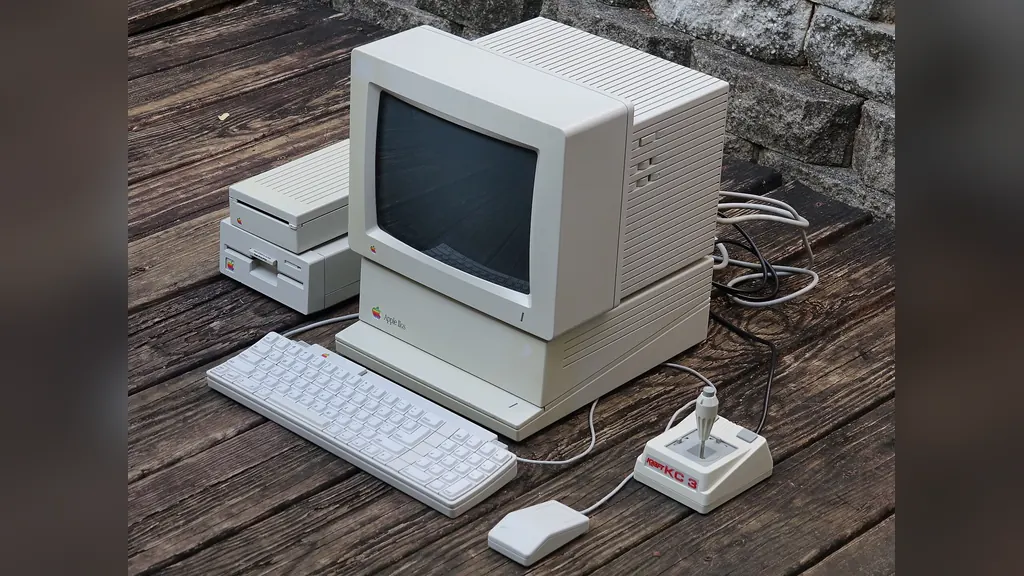
The evolution did not stop at the IIe. Development continued with intermediate models, such as the Apple IIc (1984) and its successor, the Apple IIc Plus (1988), which gradually improved the hardware and integration. However, the most radical and transformative leap was the release of the Apple IIGS on September 15, 1986. This model was not just an update; it was a technological watershed.
The Apple IIGS represented a fundamental architectural shift. It migrated to a 16-bit microprocessor, the 65C816, operating at 2.8 MHz, and incorporated 24-bit addressing, allowing for massive expansions of up to 8 MB of RAM. Multimedia improvements were equally revolutionary. Graphically, the IIGS came to support 4096 colors and enhanced resolution modes, such as 320×200 and 640×400. Furthermore, audio, which previously relied on a simple click speaker, gained a built-in music synthesizer, surpassing any capability of a previous home computer. The operating system was also modernized with a Macintosh-style Finder and Unix-like shell support, while maintaining almost total compatibility with the legacy software of the IIe series.
In summary, every version—from the Apple II Plus with its enhanced BASIC, through the IIe with more memory and features, to the Apple IIGS with its 16-bit architecture and vibrant colors—demonstrated that the strength of the computer came not just from its hardware, but from the incessant capacity for adaptation and functional improvement that kept the series relevant for decades.
The Software That Transformed the Professional Market
If the Apple II was the physical body that put computing power in the user’s hands, it was the software that gave the soul and, more importantly, the commercial purpose to the device. The true revolution of the Apple II lay not just in its open hardware architecture—though that was a colossal advantage—but in the ability of the software ecosystem to evolve to meet the complex demands of offices and universities. Initially, the operating system came with a basic BASIC on ROM, but the breakthrough came with the release of Applesoft BASIC, a more robust variant that allowed users to go far beyond simple programming, paving the way for the development of more sophisticated applications.
From Garage Programming to Business Spreadsheets
The growth of software was accompanied by a constant evolution in operating systems. When the Disk II floppy drive was released in 1978, a new operating system was required: Apple DOS. This was a job commissioned to Shepardson Microsystems and developed by Paul Laughton. The final version of this software, Apple DOS 3.3, was crucial for adding disk support, allowing the computer to handle files in a more organized manner. Subsequently, Apple DOS was replaced by ProDOS, which improved the system by incorporating hierarchical file management and supporting larger storage devices.
However, the catalyst that transformed the computer from a technological toy into an essential work tool was the release of VisiCalc. This spreadsheet, made available in 1979, irreversibly changed the market paradigm. Suddenly, offices and universities realized that the Apple II was not just a machine for games or rudimentary calculations, but a powerful business assistant capable of modeling finances and managing complex data in interactive spreadsheets. VisiCalc concretely demonstrated the economic value of the computer, accelerating its adoption on a professional scale.
Convergence with the Corporate Market
The expandability of the software kept the Apple II relevant for years. Through third-party expansion cards, the system could be adapted to run operating systems like CP/M, allowing users to run standard software of the time, such as WordStar and dBase II. This compatibility ensured that the Apple II could integrate into the vast and growing corporate software ecosystem. Furthermore, the platform demonstrated its ability to absorb new interfaces: the release of MousePaint in 1984 and, notably, the Apple IIGS in 1986, which adopted the user interface look of the Macintosh, including mouse support, signaled the system’s transition to a more user-friendly graphical environment.
The enduring success of the Apple II was therefore not a singular achievement. It was the masterful combination of open hardware and, most importantly, incredibly adaptable software. Whether through the robustness of Apple DOS, the revolutionary functionality of VisiCalc, or the ability to run niche applications via expansion modules, the Apple II proved itself to be a platform for continuous evolution. It didn’t just keep pace with the history of computing; it redefined it, establishing the standard that a machine’s utility ultimately resides in the quality and versatility of its programs—a concept that connects directly to the understanding of how open-source licenses changed the technological landscape.
📊 Apple II Operating System Evolution
| Operating System | Primary Function | Importance/Milestone |
|---|---|---|
| BASIC (ROM) | Basic programming | Initial system |
| Applesoft BASIC | More robust programming variant | Allowed for more sophisticated applications |
| Apple DOS (up to 3.3) | Disk support (Disk II) | Crucial for organized file handling |
| ProDOS | Hierarchical file management | Support for larger storage devices |
| VisiCalc | Spreadsheet program | Catalyst that transformed professional computer use |
Legacy and lasting impact on technology
The legacy of the Apple II transcends the mere count of years of existence; it represents a watershed moment in the history of computing. With the sale of an impressive 6 million units over its lifetime, the Apple II was not just a commercial success, but a cultural phenomenon. Although Apple subsequently launched more modern machines, like the Macintosh, it was the longevity and adaptability of the Apple II that maintained its relevance for years. It established a new paradigm: the computer was no longer equipment restricted to academic laboratories or large corporations; it could be, and became, a mass-market consumer item, accessible to the home user and the independent professional.
The open architecture as an engine for innovation
The secret to the Apple II’s durability lay in its deeply innovative and, crucially, open hardware architecture. Unlike closed systems, the Apple II was designed with multiple expansion slots, allowing the developer community and third-party companies to transform the machine. This modularity was its major advantage. The ability to add peripheral cards—such as serial controllers, video controllers, memory boards, and networking components—meant that the system could adapt to unprecedented needs, remaining relevant long after its initial model. The development of the Disk II, an external 5 + 1/4-inch floppy disk created by Steve Wozniak, was a notable example of this ingenuity, replacing expensive tape cartridges and raising the standard for data storage.
This system opening not only allowed for the integration of new technologies but also spurred the development of alternative processors and operating systems. The possibility of attaching accelerator boards, for example, allowed the computer’s processing power to be doubled or quadrupled, drastically extending its useful life cycle. The Apple II, therefore, was less a static product and more a constantly evolving platform.
In summary, the Apple II not only demonstrated that computing power could be packaged into an attractive consumer format, complete with graphics and an integrated keyboard, but it also proved that the open ecosystem was the engine of technological growth. To better understand this trajectory, it is interesting to recall the beginning of this journey, such as with the first personal computer, the Apple I. Its life cycle, which ended with discontinuation in October 1993, cemented its place in history as the first device to democratize access to technology, paving the way for the computer to become a central element of modern life and the global market.
Glossary
- 6502: A classic 8-bit microprocessor used in the original Apple II, which defined the machine’s processing power for decades.
- Disk II: A 5+1/4 inch flexible disk storage system that replaced cassette tapes, increasing data reliability.
- Switched-mode power supply: A more modern and efficient type of power supply that resulted in more compact equipment that generates less heat.
- Toggle circuit: A simple electronic circuit used to generate basic sounds, controlling a built-in speaker without the need for a dedicated sound synthesis chip.
Frequently Asked Questions
Who was primarily responsible for the design of the Apple II?
Steve Wozniak was primarily responsible for the design of the Apple II. He not only conceived the hardware but was also fundamental in creating the Disk II interface. His genius was crucial in transforming an engineering project into an electronic product accessible to the general public.
What was the main innovation of the Apple II that set it apart from other computers of the time?
The main innovation was the democratization of computing. While competing machines were complex and expensive kits, the Apple II was designed and marketed as a complete consumer appliance, with an integrated case and keyboard. This made technology tangible and accessible to schools and small businesses.
What was VisiCalc and why was it so important to the success of the Apple II?
Its importance lies in transforming the Apple II from a hobby tool into an indispensable business tool. It demonstrated the computer’s potential for professional use, boosting the machine’s commercial success.
What is the difference between the Apple II and the Apple IIGS?
The difference is architectural and in capability. The Apple II operated with older processors (like the 6502) and an NTSC video system. The Apple IIGS, however, represented a technological leap, migrating to a 16-bit processor (65C816) and supporting advanced features, such as 4096 colors and 24-bit addressing.
Is the Apple II still used today?
Historically, the Apple II’s active life ended in October 1993. It was a transition milestone, paving the way for modern computing. Although it is no longer a commercial product, its legacy of open architecture and modularity continues to influence computer design to this day.
Conclusion
The trajectory of the Apple II transcends the mere history of a computer; it represents the precise moment technology left industrial labs and became a mass-market consumer item. Launched on June 10, 1977, the machine, the result of a brilliant engineering project led by Steve Wozniak, not only competed with the “1977 Trinity” but redefined the concept of accessibility. Before the Apple II, computing was a complex and inaccessible luxury; with it, Apple packaged processing power into a practical format, complete with a keyboard and graphics capabilities, democratizing access to the machine and paving the way for the personal computing era.
The true genius of the Apple II, however, lies in its open architecture. More than just an attractive case, it was a modular platform. The multiple expansion slots and the development of components like the Disk II—an innovative storage system that replaced cassette tapes—ensured that the system was a continuous engine of innovation. Its ability to accept third-party peripherals ensured its longevity, allowing it to evolve from an initial 4 KB RAM system to a powerful workstation, capable of sustaining professional and academic development for decades. In short, the Apple II was not just a product; it was the catalyst that proved to the world that the computer should be, and remain, on our desks.
By understanding this history, we realize that technological power always resides in the capacity for adaptation and the openness of its standards. It is this mindset of constant evolution that must guide not only engineers but also innovators in all sectors.
Sources and References
- Apple II (original) — Wikipedia
- Apple II — Wikipedia (in English)
- June 10, 1977 – Apple II Shipped Today