Read this article in: Portuguese (Português) · Spanish (Español)
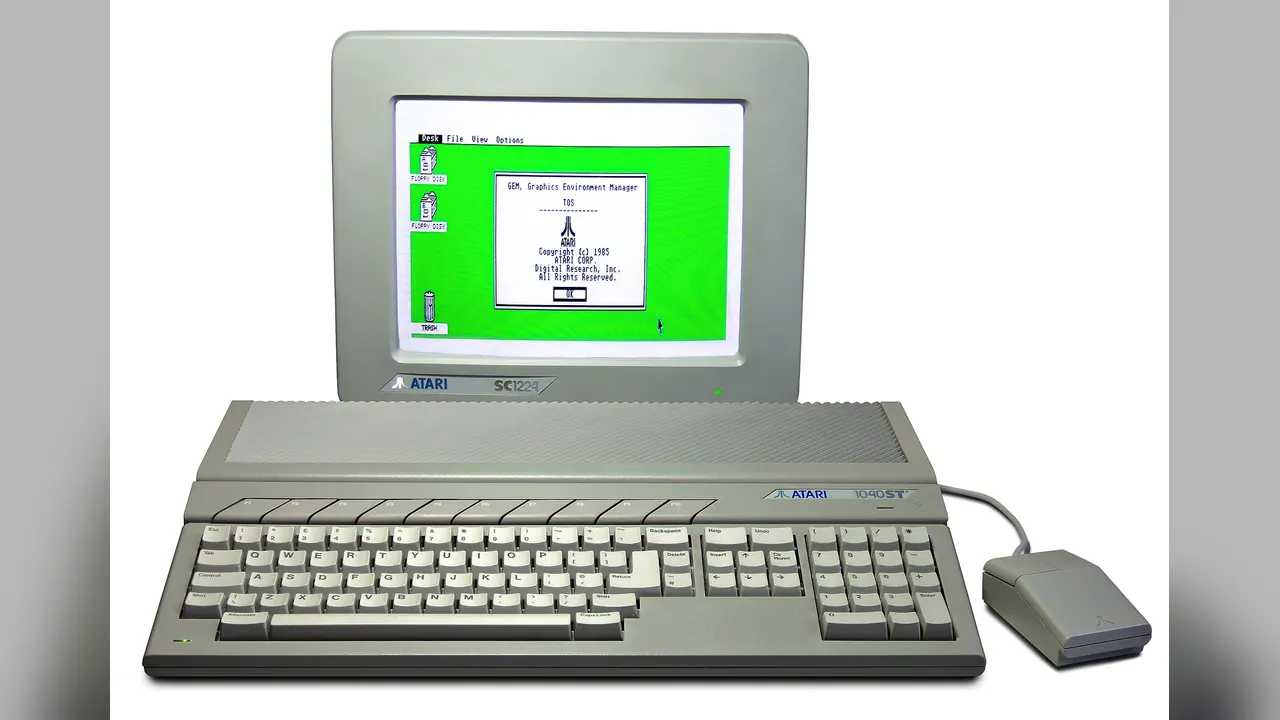
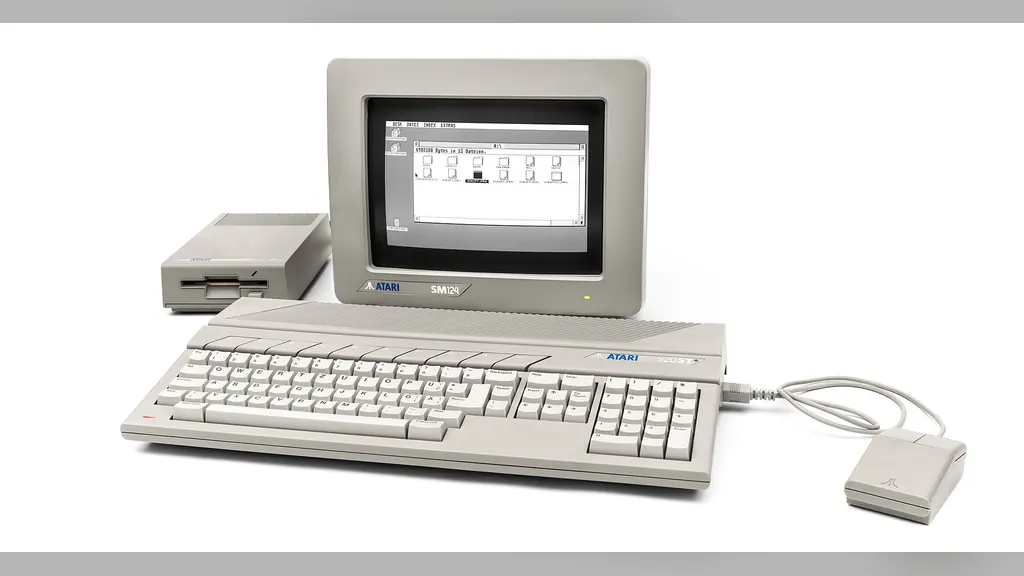
The Atari ST was developed and manufactured by Atari Corporation, emerging as the direct successor to the company’s own 8-bit computers. Its birth is intrinsically linked to the intense rivalry in the personal computer market of the mid-1980s. The initial model, the 520ST, had a limited release in April and June of 1985, but it quickly established itself as a revolutionary machine. It marked the transition to the 16/32-bit processor era, a technological leap that placed it alongside giants like the Amiga and the Macintosh, setting a new standard for personal graphic computing.
The relevance of the Atari ST is proven by both its technical power and its global adoption. Launched in June 1985, the system was powered by the 68000 @ 8+ MHz processor and ran on an operating system based on GEM. The commercial impact was notable, as the line sold over 3 million units in Europe. More than just a product, the Atari ST represented a milestone in the evolution of computing, offering advanced features like color graphics and built-in MIDI ports, making it a powerful tool for professionals in various fields.
In this article, we will dive into the fascinating trajectory of the Atari ST. We will begin with the origins of the rivalry and the architects behind its conception, analyzing the technological leap from the 8-bit to the 16/32-bit era. We will explore its launch and adoption in the global market, tracing the evolution through its line of successors, and finally, we will discuss the profound cultural impact and lasting legacy that the Atari ST left on the world of computing.
Key Points
- Launched in June 1985, the ST capitalized on competitors’ delays, solidifying its position in the high-performance market.
- The 16/32-bit architecture, based on the Motorola 68000 processor, allowed for a crucial leap in power for its time.
- The Atari TOS operating system utilized the GEM graphical interface, revolutionizing file and program navigation.
- The ST supported advanced multimedia, with resolutions such as 320×200 and the YM2149F sound chip.
- Advanced models, such as the STE, expanded the color palette to 4,096 and added the Blitter coprocessor.
Atari ST in Summary
| Developer | Atari Corporation |
|---|---|
| Manufacturer | Atari Corporation |
| Type | Personal computer |
| Release | June 1985 |
| Initial Price | US$799.99 (monochrome); US$999.99 (color monitor) |
| Discontinuation | 1993 |
| Units Sold | Over 3 million (Europe) |
| Operating System | Digital Research’s GEM in Atari TOS |
| CPU | 68000 @ 8+ MHz |
| Memory | 512 KB to 4 MB |
| Graphics | 320 × 200 (16 colors); 640 × 200 (4 colors); 640 × 400 (monochrome) |
| Sound | YM2149F |
| Predecessor | Atari 8-bit Computers |
The Origin of the Rivalry and the Architects of the ST
The origin of the Atari ST is deeply rooted in a scene of intense market rivalry, primarily between the giants of the time: Atari, Inc., and Commodore International. The technological context was one of effervescence, driving the need for a leap from 8-bit processing to the more robust 16/32-bit standard. This competitive environment was the stage for the protagonists who would shape the computer’s destiny. One of the first names to stand out was Jay Miner, a designer who had worked on the custom chips for the Atari 2600 and Atari’s own 8-bit computers. When his idea for a new chipset was rejected by Atari management, he left the company in 1982 to found Hi-Toro, which would soon become Amiga, and begin developing the “Lorraine” chipset.
The Corporate Battle and the Formation of Atari Corporation
As the Amiga’s development progressed, the corporate scene unfolded with strategic moves. In January 1984, Jack Tramiel left Commodore International and founded Tramel Technology, Ltd., with former Commodore employees. Interested in Atari’s global distribution network and manufacturing, Tramiel negotiated with Warner Communications and, in July 1984, managed to acquire Atari’s consumer division, including the home console and computer departments. Tramel Technology subsequently changed its name to Atari Corporation. The unfolding of this agreement was marked by legal disputes: Commodore, for its part, attempted to buy Amiga Corp., believing it would void pending contracts. In response, Tramel sued Amiga Corp. on August 13, 1984, seeking damages and a court order to prevent the use of the technology. This legal dispute left the Amiga team in a state of uncertainty through mid-1984.
The Technical Project and the Lead Architect
Amid this whirlwind of disputes and acquisitions, the technical design of the new computer was led by Shiraz Shivji, a former Commodore employee and specialist who had previously worked on the development of the Commodore 64. The Atari ST project was completed in just five months in 1984. Initially, various processors were investigated, such as the 32-bit National Semiconductor NS32000, but the engineers were disappointed with the performance and migrated to the Motorola 68000. For more information on the evolution of these components, you can check out the history of AMD Ryzen processors. The design was so advanced that it was showcased at the Consumer Electronics Show in January 1985. It is also important to note that, instead of using a custom sound processor, like the AMY, which was under development at Atari, the team opted for a commercial component: the Yamaha YM2149F variant, a variation of the General Instrument AY-3-8910.
The result of this complex scenario of rivalry, legal disputes, and cutting-edge engineering was the launch of the Atari ST in June 1985. The window of opportunity created by Commodore’s delay in releasing its competitor (the Amiga 1000, announced in July 1985, but not available until 1986) allowed Atari to bring the Atari 520ST to market in June 1985, solidifying its presence in the high-performance personal computing market.
🕒 Atari ST Revolution Timeline
- 1982 — Jay Miner leaves Atari to found Hi-Toro and begin developing the ‘Lorraine’ chipset.
- January 1984 — Jack Tramiel leaves Commodore and founds Tramel Technology, Ltd.
- July 1984 — Tramel Technology acquires Atari’s consumer division, renaming it Atari Corporation.
- August 13, 1984 — Tramel sues Amiga Corp., creating uncertainty for the Amiga project.
- 1984 — The technical design for the Atari ST was completed in just five months, migrating to the Motorola 68000 processor.
- January 1985 — The Atari ST design is displayed at the Consumer Electronics Show.
- June 1985 — Launch of the Atari ST, capitalizing on the window of opportunity left by Commodore.
- July 1985 — Commodore announces the Amiga 1000, but it will not be available until 1986.
The Technological Leap: From 8-bit to 16/32 bits

The technological leap of the Atari ST represents more than just a simple hardware upgrade; it was a complete architectural transition, moving away from the limitations of the 8-bit era to the intermediate power of 16 and 32 bits. This advance was fundamental in allowing the computer to become a professional and creative tool. The heart of this leap was the adoption of the Motorola 68000 processor. After investigating different options, including the National Semiconductor NS32000, the engineers settled on the 68000, ensuring a robust platform capable of operating at over 8 MHz, a crucial performance jump for the applications of the time—something that contrasts with the advancements in storage systems like those that drove the creation of Synology DSM NAS.
The Graphical and Operational Revolution
The “ST” concept (Sixteen/Thirty-two) encapsulated this superior capability. To harness this power, the Atari ST embraced Graphical User Interfaces (GUIs). The operating system, known as Atari TOS (The Operating System), utilized GEM, an interface based on GUI systems. This graphical environment was revolutionary because it allowed users to navigate files and programs visually, without relying exclusively on text commands. Furthermore, support for the GEMDOS file system guaranteed a fast, hierarchical system, essential for using hard drives, giving the ST an unprecedented data organization in the personal market of the time.
In terms of multimedia capability, the ST drastically raised the bar. Graphically, the system supported resolutions like 320 × 200 pixels with 16 colors, or 640 × 400 in monochrome mode. The soundtrack and sound were enhanced by the integration of the YM2149F chip, a common Yamaha sound processor, which ensured superior sound quality compared to 8-bit models. The physical design, meanwhile, was characterized by angular lines, and the inclusion of peripherals like the MIDI port and custom monitor ports solidified the ST as a machine ready for both the music studio and the modern office.
Evolution and Multimedia Zenith
This path of improvement culminated in advanced models like the STE (Enhanced ST), which represented the peak of the line. The STE not only maintained the improvements of the ST but added unprecedented professional features. Notable among these are the extended color palette, with 4,096 available colors, and the Blitter coprocessor, capable of moving large blocks of graphic data in RAM at up to 4 Mbytes/s. The STE also introduced support for 2-channel 8-bit PCM audio via a DMA chip, in addition to joystick analog ports and video synchronization (Genlock) support. These enhancements confirmed the Atari ST as a cutting-edge computer, capable of challenging the status quo of personal computing.
📌 Key Technological Advancements of the Atari ST
- Motorola 68000 Processor, ensuring robustness and high frequency.
- Graphical User Interface (GUI) with the Atari TOS and GEM system.
- Fast and hierarchical file system support with GEMDOS.
- Graphic capability of up to 320×200 with 16 colors or 640×400 monochrome.
- Sound improvement with the YM2149F chip, superior to 8-bit models.
- The STE model added a 4,096-color palette and the Blitter coprocessor.
Launch and Adoption in the Global Market
The launch of the Atari ST marked a turning point not only for Atari Corporation but for the global personal computing market. After months of intensive development, the 520ST was announced in January 1985 at the Winter Consumer Electronics Show in Las Vegas. The unit reached the general public in July 1985, and the initial success was immediate. The machine was a tremendous commercial success, especially in Europe, where the exchange rate amplified the appeal of cost-effectiveness. In a short time, Atari reported selling over 50,000 520ST units, proving that the ST had transitioned from an engineering concept to a marketable off-the-shelf product, comparable to the revolution of global VoIP.
Evolution and Professional Appeal
The ST’s technical power, which operated with a 68000 processor and memory capacities ranging from 512 KB to 4 MB, allowed it to transcend mere home use. Developers and professional companies quickly recognized its potential in high-demand areas, such as Computer-Aided Design (CAD) and Desktop Publishing. The operating system, based on Digital Research’s GEM, and the ability to display graphics in various resolutions—such as 320 × 200 with 16 colors, 640 × 200 with 4 colors, and even 640 × 400 in monochrome mode—were fundamental to these applications. Support for color and monochrome monitors guaranteed the versatility needed for different workflows.
The line of successors and constant improvements were crucial in sustaining this growth. Although the initial model was the 520ST, Atari quickly released variants like the 130ST and the 260ST. It is important to note that the 260ST was released in a limited capacity in Europe, demonstrating the company’s ability to adapt its products to regional needs. This progression of models, culminating in more powerful machines, like those preceding the 1040STE, kept the ST at the technological forefront. The appeal of “Power without the price” made the ST significantly more accessible than many competitors of the time, including the Macintosh Plus.
The market reacted positively to the performance and the price. In a scenario where many major software companies were still hesitant to support new platforms, the development community mobilized. At COMDEX in Las Vegas in November 1985, the industry was surprised by the presence of over 30 companies exhibiting software for the ST, a number that contrasted sharply with the little available for the competition. The ST’s ability to run advanced software and support various interfaces ensured that it was seen not just as a toy, but as a serious work tool, solidifying its reputation and paving the way for its lasting impact.
📊 Technical Specifications and Atari ST Models
| Model/Aspect | Technical Detail | Market Observation |
|---|---|---|
| Processor | 68000 | Allowed applications beyond home use |
| RAM Memory | 512 KB up to 4 MB | Varies by model and use |
| Graphics Resolutions | 320×200 (16 colors); 640×200 (4 colors); 640×400 (mono) | Guarantee of versatility for different workflows |
| Variant Models | 520ST, 130ST, 260ST | The progression kept the ST at the technological forefront |
Evolution and the ST successor line
The evolution of the Atari ST line was not just about increasing speed; it was a continuous series of architectural enhancements aimed at bringing the personal computer into the professional and multimedia fields. The first major iteration of this improvement cycle occurred in late 1989 with the release of the STE (Enhanced ST), in the 520STE and 1040STE models. The STE represented a significant leap in multimedia capability and color palette. While the original ST offered 512 colors, the STE expanded this palette to an impressive 4,096 available colors. Furthermore, the STE introduced the Blitter coprocessor, which drastically accelerated the handling of large blocks of graphic data, and an 8-bit PCM, 2-channel stereo DMA (Direct Memory Access) audio chip. For more advanced users, the Mega STE model consolidated these advances, featuring a more robust design and functionalities such as a VME expansion slot and network support, all running on the TOS 2.00 operating system.
The Transition to Workstations
In 1990, the focus of improvement shifted, and Atari launched the Atari TT030. This model was clearly oriented toward the workstation market. The “TT” name (Thirty-two/Thirty-two) was a technical reflection, as the Motorola 68030 processor used in the unit had both internal and external 32-bit buses. The TT030 not only incorporated the power of the 68030 but also presented a refreshed physical design, including a case with an integrated hard drive bay. This change signaled that the ST line was solidifying itself in high-performance equipment, capable of handling tasks more complex than the typical home computer.
The Peak and End of the ST Line
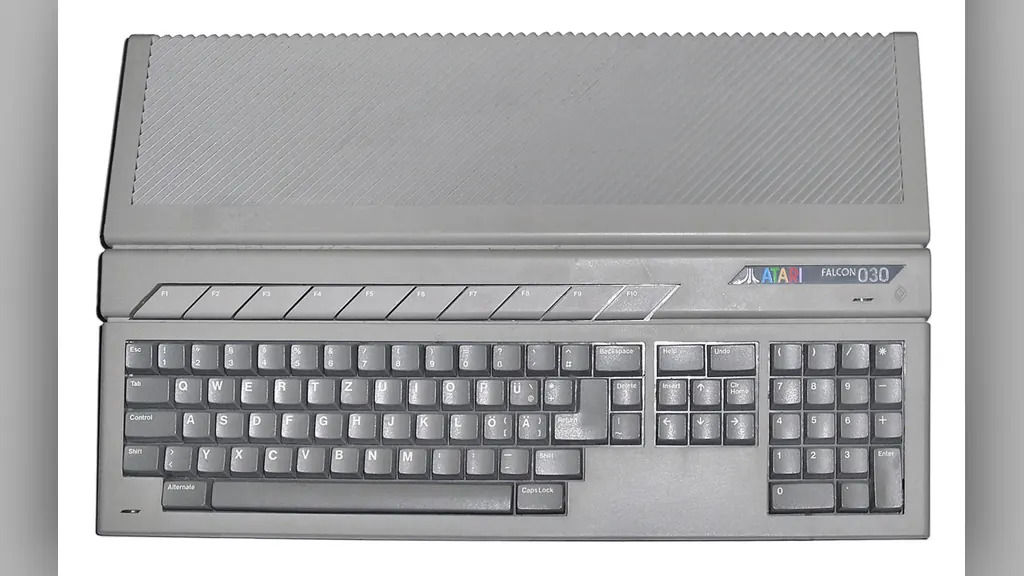
The technical peak of the line occurred in 1992 with the release of the Falcon030. The Falcon retained the 68030 processor but brought crucial improvements for audio and video. It was equipped with a Motorola 56001 digital audio signal processor, allowing it to support sampling frequencies above 44.1 kHz. One of its highlights was the ability to play back and record samples, supporting up to 8 mono and 4 stereo channels, using the same DMA interface as the STE. Despite the processor being 32-bit, the Falcon utilized a 16-bit bus, which helped reduce costs. This series of advances, from the STE to the Falcon, kept the ST line relevant for years, but the succession trajectory ended in 1993, the year Atari discontinued the ST computer line.
The Cultural Impact and Legacy of the Atari ST
The Atari ST transcended the status of a mere gaming computer to firmly establish itself as a professional workstation. Its cultural impact is perhaps most visible in its creative capabilities, especially in the fields of music and design. The inclusion of MIDI (Musical Instrument Digital Interface) ports was a crucial differentiator that allowed the ST to integrate into the professional music production ecosystem, which drastically elevated its appeal to musicians and composers worldwide.
Success in the Professional Market
The ST’s ability to process tasks beyond entertainment was quickly recognized in the corporate market. Initially, sales success was notable in Europe, but it was in locations like West Germany that the machine found a robust market niche. Small businesses began using the ST for serious applications, such as desktop publishing and CAD (Computer-Aided Design). To meet this growing demand, Atari introduced the ST1 model at Comdex in 1986, which was soon renamed Mega, signaling its transition and focus on professional use.
📘 Electronic Layout (Desktop Publishing)
This refers to the process of composing and laying out printed materials, such as magazines and brochures, using computers. The Atari ST allowed small businesses to perform these serious applications.
The Mega represented a leap in usability and power. It was equipped with a high-quality, detachable keyboard, a more durable chassis to support the weight of a monitor, and an internal bus expansion connector. The machine could be supplemented with an optional 20 MB hard drive. This combination of features allowed for low-cost publishing packages, for example, when paired with Atari’s own laser printer.
Graphics performance was another pillar of its legacy. Although the architecture was powerful, Atari maintained control over the user experience through technical improvements. The blitter coprocessor, for instance, enhanced graphics performance, although its use depended on written programs that detected its presence. This capability for modular enhancement and support for operating systems like GEM (Graphical Environment Manager) on the base Atari TOS ensured that the ST remained relevant in a constantly and dizzyingly developing market. The Atari ST, therefore, not only accompanied the transition from home computers to general-purpose machines but actively helped shape the standard for how the computer would be used in the workplace.
Glossary
- 16/32 bits: An architectural term indicating the leap in processor capability, moving from 8 bits to the processing power of 16 and 32 bits.
- Motorola 68000: The main processor of the Atari ST. It was a robust component that drove the system’s performance leap compared to previous models.
- GEM: A graphical user interface (GUI) used on the Atari ST. It allowed users to navigate programs and files in a visual and intuitive manner.
- YM2149F: A Yamaha sound chip. It was integrated into the ST to ensure superior sound quality compared to 8-bit models.
- Blitter: A graphics coprocessor that accelerated the handling of large blocks of graphic data in RAM, increasing visual performance.
Frequently Asked Questions
What is the main difference between the Atari ST and the Commodore Amiga?
Both competed in the same technological landscape, but the Atari ST stood out due to its robust 32-bit architecture and its focus on professional tools. The ST was designed to offer a stable and powerful platform, capable of supporting everything from home use to complex applications like CAD and desktop publishing.
Was the Atari ST used only for games or also for professional work?
Definitely not. The ST was conceived to transcend home use. Its technical power and ability to run advanced software made it an essential professional tool. It was widely adopted in fields such as Computer-Aided Design (CAD) and desktop publishing.
What was the processor and architecture of the Atari ST?
The heart of the Atari ST was the Motorola 68000 processor. This processor allowed the computer to operate on a 16 and 32-bit architecture. This transition was fundamental because it guaranteed a significantly more robust platform capable of handling the growing computational power demanded by the applications of the time.
Why was the Atari ST discontinued in 1993?
Available information on the computer’s history confirms that it was discontinued in 1993. However, the material does not specify the exact reason for the end of the production line, only marking the year the model was withdrawn from the market.
What does the name ‘ST’ mean in technical terms?
The name ‘ST’ is an abbreviation that encapsulates the superior capability of the machine. It stands for ‘Sixteen/Thirty-two’, referring to its processing architecture. This technical nomenclature indicated the leap in capacity of the system, moving beyond 8-bit limitations to the intermediate power of 16 and 32 bits.
Conclusion
The emergence of the Atari ST was not a mere engineering accident, but the direct result of an intense corporate battle and a technology innovation show. The transition from 8-bit processing to the robust 16/32-bit standard, anchored by the Motorola 68000 processor, represented an architectural leap that redefined the personal computer. This power was channeled through graphical user interfaces (GUI) and operating systems like Atari TOS, allowing the ST not only to process data but to present it in a visually advanced way, with superior graphics and sound support for its time.
Since its launch in June 1985, the Atari ST established itself as a high-performance machine capable of going beyond home use. Its capabilities were quickly adopted in professional fields such as Computer-Aided Design (CAD) and electronic publishing. The ST proved that the convergence of advanced hardware, such as the YM2149F chip, and intuitive software was the path to the future. Understanding this trajectory is understanding how market competition drives technological advancement. To fully appreciate this history, it is essential to investigate how computing pioneers shaped the market we use today.