Read this article in: Portuguese (Português) · Spanish (Español)
DuckDB is an open-source, columnar Relational Database Management System (RDBMS) originally developed by Mark Raasveldt and Hannes Mühleisen. Designed to meet a specific need in the data market—real-time analytical processing—DuckDB stands out as an in-process analytical database solution. Unlike traditional transaction-focused RDBMSs (OLTP), it specializes in online analytical processing (OLAP) workloads, allowing for complex, high-performance queries directly within the host application, without needing an external server.
The project’s journey is marked by both academic and practical focus. DuckDB originated at the Centrum Wiskunde & Informatica (CWI), a Dutch national institute for research in mathematics and computer science. Initial development took place in 2018, with a subsequent public release in 2019. Its growth and adoption are evidenced by impressive figures, such as recording over 6 million downloads per month. Furthermore, its robustness and performance have led to its adoption by tech giants like Google, Facebook, and Airbnb, solidifying it as an essential tool in the modern data analysis universe.
In this article, we will dive into the complete history and architecture that have made DuckDB a game-changer. We will explore everything from the project’s genesis and the vision of its creators to the context that demanded an embedded OLAP engine. We will analyze the cutting-edge architecture, such as vectorized processing and the dependency-free embedded model. Finally, we will cover the extension ecosystem, support for modern data formats, and the governance that ensures the project’s future.
Key Points
- It is an embedded OLAP engine, ideal for complex analyses without requiring an external database server.
- Its architecture is inherently columnar, optimizing reads by processing only the necessary data attributes.
- It uses vectorized processing, handling data in batches (vectors) to ensure high query efficiency.
- The in-process model eliminates communication bottlenecks, allowing for direct and fast integration with the host application.
- It is cross-platform, written in C++, and can run in web environments via WebAssembly.
DuckDB in Summary
| Developer | DuckLabs |
|---|---|
| Stable Release | v2.0.1 / November 20, 2026 |
| Language | C++ |
| Platforms | Cross-platform |
| Type | Column-oriented DBMS; RDBMS |
| License | MIT License |
| Repository | github.com/duckdb |
The Genesis of the Project and Its Creators

The story of DuckDB did not begin in a purely commercial setting, but rather in the rigor of academia. The project was conceived by Mark Raasveldt and Hannes Mühleisen. The initial birthplace of the development was the Centrum Wiskunde & Informatica (CWI), a renowned research institution in the Netherlands. It was in this environment that, in 2018, the research that would become one of the most influential database systems today was born. To better understand the context of analytical databases, it is worth looking at the history of other analytical databases. The co-founders had a very specific goal: to fill a market gap for an OLAP (Online Analytical Processing) solution that was high-performing and, crucially, could be embedded—meaning it could be integrated directly into the application, without the need for a complex external server.
Development proceeded at an organic pace, typical of a cutting-edge research project. After starting in 2018, the project was presented at the ACM SIGMOD conference in 2019. The early versions (0.x) were fundamental in establishing the technical foundation. During this period, the focus was on progressively introducing critical features, such as support for extensions, improvements to the SQL parser, and the definition of a stable storage format. This academic phase allowed the research community to test and refine the core engine, paving the way for a robust and scalable solution.
Project Maturity and Governance
The maturity milestone for DuckDB was the release of version 1.0.0, which occurred on June 3, 2024, under the codename SnowDuck. This release signaled the project’s transition from a purely experimental phase to a state of production readiness. The longevity and stability of the code are ensured by a careful governance structure. DuckDB’s development is supervised by the DuckDB Foundation, a Dutch non-profit organization that holds the project’s intellectual property under the permissive MIT License. It is important to note that the foundation has actively opposed venture capital funding, arguing that this type of investment would force the project toward monetization, which would conflict with the initial goal of keeping DuckDB open and accessible to all researchers and developers.
Even with this strong academic governance, the adoption ecosystem has grown significantly. Although support and commercial consulting are provided by DuckDB Labs, a company co-founded by Raasveldt and Mühleisen, the cloud analytics platform, MotherDuck, launched in 2022, built on the DuckDB engine and attracting venture capital investments. This combination of high-level academic research, community governance, and emerging commercial support has solidified DuckDB as a columnar, relational database system capable of meeting both scientific rigor and the practical demands of the modern market.
🕒 DuckDB Timeline: From Research to Commercial Launch
- 2018 — Start of academic research at Centrum Wiskunde & Informatica (CWI), Netherlands.
- 2019 — Project presented at the ACM SIGMOD conference, focusing on early versions (0.x).
- 2022 — Launch of the cloud analytics platform, MotherDuck, built on the DuckDB engine.
- June 3, 2024 — Release of version 1.0.0 (under the codename SnowDuck), marking the transition to production use.
The Context: The Need for an Embedded OLAP Engine
The modern data analytics landscape is characterized by a growing volume and increasing diversity of information sources. In this context, an analytics tool cannot be merely a data repository but must be a processing engine optimized for complex queries. It is fundamental for anyone working with data to understand the difference between transactional and analytical models. While OLTP (Online Transactional Processing) systems are designed to manage daily operations—such as recording a sale or updating a user profile—OLAP (Online Analytical Processing) engines are geared toward deep analysis. They need to process large volumes of data, performing aggregations, scans, and joins across entire tables, rather than just point-in-time transactions.
The Niche of Embedded Analytics
The major market gap that DuckDB aims to fill is precisely the need for an extremely powerful OLAP engine that does not require the complexity, overhead, or infrastructure of an external database server. Traditionally, running large-scale analyses required a data scientist to use a distributed cluster, such as Apache Spark, which added layers of abstraction and dependencies. DuckDB inverts this paradigm by being an embedded engine. It was designed to run within a host process, such as a Python or R interpreter, without depending on external services, which drastically simplifies the workflow.
This embedded architecture is enabled by advanced technologies, such as vectorized query execution. This mechanism allows the engine to process data in optimized column batches, a model ideal for typical OLAP operations, such as aggregation and joins across large tables. Furthermore, the focus on columnar storage and processing flexibility make it ideal for scenarios where exploratory data analysis (EDA) is the primary task, whether in Python or R notebooks.
This capability for external serverless operation gives DuckDB unmatched versatility, allowing it to be used in various points of the data ecosystem. It is widely adopted in data engineering pipelines that need to process modern formats like Parquet, CSV, and JSON, without the need to trigger a distributed cluster. Its use ranges from notebook analysis to direct browser analysis, thanks to its WebAssembly compilation. Being an open-source system with an MIT license, and due to its cross-platform nature, DuckDB (developed by DuckLabs) has established itself as a robust component in lakehouse architectures, complementing solutions like MotherDuck and DuckLake. To better understand the power of analytical databases, it is worth checking out how analytical databases work. This combination of OLAP analytical power with the simplicity of an embedded engine is what defines its market niche.
📊 Comparison: OLTP vs. OLAP
| Model | Primary Focus | Operation Example |
|---|---|---|
| OLTP (Online Transactional Processing) | Managing daily operations | Recording a sale or updating a profile |
| OLAP (Online Analytical Processing) | Deep data analysis | Aggregations, scans, and joins across entire tables |
Cutting-edge architecture: columns and vectorized processing

DuckDB’s true technical innovation lies in its low-level architecture, which positions it as a high-performance data analysis engine. Unlike many traditional systems, DuckDB is an inherently columnar Relational Database Management System (RDBMS). This storage model is crucial for analytical workloads (OLAP) because, instead of storing data row by row, it groups values by column. This means that when performing a query that requires only a subset of attributes from a massive table—such as calculating the average of a specific column—the database engine only needs to read the relevant data blocks, completely ignoring the rest of the columns. This process of selective sparse column scanning is what drastically optimizes reading and, consequently, performance on large volumes of data, a concept that contrasts with the history of other models like MongoDB, a NoSQL database.
The Power of Vectorized Processing
DuckDB’s most notable performance differentiator is its vectorized query execution engine. Instead of processing each value in a sequential loop (which is inherently slow in terms of CPU cycles), the vectorized engine is designed to process data in batches or “vectors” per column. This batch processing allows the system to perform mathematical and logical operations on large groups of values simultaneously, minimizing the number of CPU cycles required per processed value. Conceptually, this model is an advancement with roots in projects like MonetDB and Vectorwise, and it ensures that DuckDB maintains near-linear efficiency, even when handling complex aggregations over entire tables or large joins.
Complementing this efficiency, DuckDB adopts an in-process model that eliminates data communication bottlenecks. It does not operate as an external server but rather as a library linked directly to the host process. This integration allows for extremely fast data transfer between the application and the DBMS, often without the need for data copies. A practical example of this technological marriage is the ability of the DuckDB Python package to run queries directly on popular data structures, such as pandas DataFrames, without needing to import or copy the content, making the workflow incredibly fluid.
Structure and Portability
Technically, DuckDB is written in C++ and is developed to be cross-platform. Its design is remarkably robust because it does not depend on any complex external infrastructure, allowing it to be compiled with just a C++17 compiler. Furthermore, it uses a single-file storage format optimized to support efficient scans, bulk update operations, attachments, and deletions. To expand its reach, DuckDB has even been compiled for WebAssembly (using emscripten), meaning that SQL queries can be run in browser-based analysis tools, expanding its use to web environments. Its unique architecture—combining columnar storage, vectorized processing, and in-process operation—is what gives DuckDB its unmatched versatility in the modern data ecosystem.
In-Process Model and Absence of External Dependencies
DuckDB’s true technical advantage lies in its low-level architecture, positioning it not only as a high-performance data analysis engine but also as an extremely agile integration solution. This agility is primarily guaranteed by its embedded operational model, known as in-process. Instead of running as an external database server, like many traditional systems, DuckDB is linked directly to the host application’s process, effectively functioning as a library. This approach completely eliminates the data communication bottleneck that would occur over a network or through separate processes. In practical terms, this means that data transfer between the application and the database happens at very high speed, sometimes without any data copying. For example, when using the DuckDB Python package, it is possible to run queries directly on data structures like pandas DataFrames, without the need to import or copy the data into an intermediate format.
Ease of Deployment and Portability
The efficiency of the embedded model is enhanced by extraordinary deployment simplicity. Technically, DuckDB is written in C++ and designed to be cross-platform. This feature is a pillar of its adoption across various ecosystems. To compile the system, only a C++17 compiler is required. All the source code is distributed in an optimized manner—usually as two files, a header and an implementation file, called an amalgamation—which drastically simplifies integration for developers. It operates on systems like Linux, macOS, and Windows, and supports architectures such as x86 and ARM. Furthermore, its ability to compile to WebAssembly via DuckDB-Wasm allows advanced data analysis to run directly in the browser, expanding the analytical engine’s reach beyond the server environment.
This combination of embedded architecture and low coupling of external dependencies gives DuckDB unparalleled versatility. Instead of requiring the complex infrastructure and overhead of a dedicated server, it behaves like a native component of the application. This makes it ideal for Edge Computing scenarios, microservices, or desktop applications that need a powerful OLAP engine but cannot tolerate the complexity of managing a separate database process. The stability and maturity of the project, proven in version 2.0.1, released on November 20, 2026, solidify DuckDB as a robust tool for the modern data analysis landscape.
📌 Advantages of the DuckDB Embedded Model
- Eliminates data communication bottlenecks over networks or separate processes.
- Allows direct querying on structures like pandas DataFrames.
- Simple to deploy, requiring only a C++17 compiler.
- Portability to Linux, macOS, Windows, and x86/ARM architectures.
- Ability to run in the browser via WebAssembly (DuckDB-Wasm).
Ecosystem and Integration with Modern Data Formats
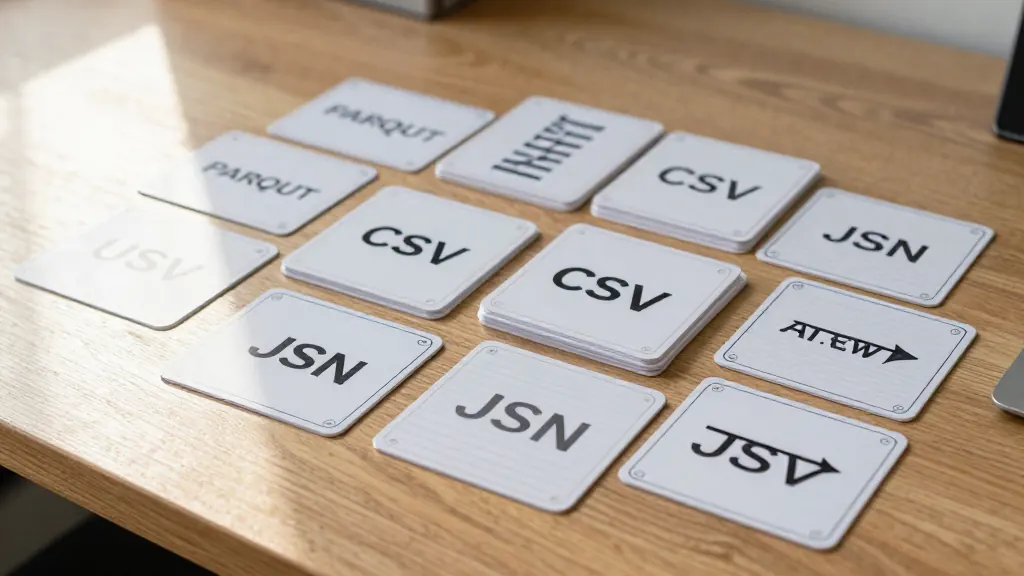
The DuckDB ecosystem is built on a fundamental pillar: the ability to be a highly flexible analytical engine adaptable to the demands of the modern data workflow. Unlike systems that require data preparation or transformation into specific formats, DuckDB was designed to interact natively with the data formats most used in the industry. It efficiently processes formats such as Apache Parquet, CSV, JSON, and Apache Arrow, while also supporting advanced standards like Delta Lake and Apache Iceberg. This capability to read and query data directly from these formats makes it an essential component in data engineering pipelines, allowing analysts and engineers to process large volumes of information without the immediate need to load the data into complex internal structures.
Extensibility and Cutting-Edge Data Formats
DuckDB’s true long-term strength lies in its robust extension system. This mechanism allows developers to add specialized functionality without modifying the core of the database. Official extensions exemplify this capability: there is httpfs, which enables reading and writing remote files via HTTP and Amazon S3; the spatial extension, which adds advanced geospatial functions (ST_*) for geographic analysis; and support for iceberg and delta, ensuring integration with major lakehouse table standards. Furthermore, the project is advancing the metadata architecture with ducklake, a lakehouse format announced in 2025. It redefines the concept by moving all metadata structures into an SQL database, leveraging its ACID properties to manage catalogs and tables, while the data remains in open formats like Parquet.
This versatility is not limited to file formats. DuckDB also supports an extensive SQL dialect, which includes window functions, complex data types (arrays, structs, maps), and arbitrary correlated subqueries. The query engine, which derives its parser from PostgreSQL’s pg_query library, ensures a powerful and familiar syntax for relational database users.
Integration Across the Data Ecosystem
To ensure that DuckDB can operate at any point in the workflow, it features deep integrations with the major languages and tools in the data ecosystem. It is widely used for exploratory data analysis (EDA) in Python and R notebooks, and supports popular libraries such as pandas, Polars, and Arrow in Python, and dplyr in R. Furthermore, its cross-platform nature and support for ADBC (Arrow Database Connectivity) facilitate data transfer between systems without unnecessary copies. This capability makes it an ideal tool for data engineering pipelines looking to replace, in small to medium-sized workloads, the complexity and overhead of distributed clusters, such as Apache Spark, especially on more modest hardware. The use of DuckDB by global companies like Facebook, Google, and Airbnb attests to its growing adoption and robustness in the modern data landscape.
Project Governance and Commercial Adoption
The sustainability of a high-performance open-source project is often the most complex challenge, and DuckDB has built a robust governance model to mitigate this risk. The project’s development is overseen by the DuckDB Foundation, a Dutch non-profit organization. It is under its stewardship that the database’s intellectual property is maintained, ensuring its long-term upkeep under the permissive MIT license. A crucial point reinforcing its open nature is the foundation’s commitment not to accept venture capital (VC) funding, as it believes such external investment could force the project toward monetization, which would contradict the primary goal of keeping DuckDB accessible to all developers.
Evolution and Business Model
While the foundation keeps the code open, commercial support and consulting are offered by partner entities, creating a healthy market ecosystem. DuckDB Labs, a company co-founded by Raasveldt and Mühleisen, is responsible for this commercial support. Meanwhile, MotherDuck, an independent company founded in 2022, built a cloud analytics platform based on DuckDB, which allowed it to raise investments from renowned funds, such as Andreessen Horowitz. This division of roles—non-profit governance, commercial support, and cloud platform—ensures that the project can evolve technologically without compromising its open nature.
The maturity of the project is also a pillar of its adoption. After starting as research in 2018 and being presented in 2019, DuckDB reached a significant milestone with the release of version 1.0.0 in June 2024, marking its readiness for use in production environments. To ensure longevity, the project adopted a Long-Term Support (LTS) cycle, where alternating versions receive community support for one year after release. If community support for an LTS version expires, commercial support can be purchased through DuckDB Labs.
Enterprise Adoption and Use Cases
DuckDB’s robustness at the enterprise scale is validated by its widespread adoption in major technology companies. The database is used by industry giants, including Google, Facebook, and Airbnb. Its use goes beyond exploratory data analysis (EDA) in Python and R notebook environments; it is a vital component in data engineering pipelines that process formats like Parquet, CSV, and JSON without requiring the complexity of a distributed cluster. In many cases, it acts as an efficient replacement for more complex tools, such as Apache Spark, especially for small to medium-sized workloads.
This versatility led to DuckDB being named the third most desired database by developers in 2024, according to the Stack Overflow Developer Survey. The ability to be used at various points in the workflow, even directly in the browser via DuckDB-Wasm, solidifies its position as a flexible analytical engine highly adaptable to the demands of the modern data ecosystem.
Glossary
- OLAP (Online Analytical Processing): A processing model focused on deep analysis of large volumes of data, such as aggregations and scans across entire tables.
- Vectorized query execution: A method of processing data in batches or ‘vectors’ by column, rather than one by one, ensuring maximum efficiency in queries.
- Cross-platform: The ability to run and be compiled for various operating systems, such as Linux, macOS, and Windows.
Frequently Asked Questions
Is DuckDB better than SQLite for data analysis?
Although both are embedded engines, DuckDB is specifically optimized for analytical workloads (OLAP). It incorporates advanced features like columnar storage and vectorized processing, which are crucial for processing large volumes of data and performing complex aggregations much more efficiently than engines focused only on transactions.
What is the main difference between using DuckDB and a traditional database like PostgreSQL?
The main difference is the operational architecture. Traditional databases function as external servers, requiring network communication. DuckDB, on the other hand, is an in-process embedded engine. This eliminates network communication overhead, allowing it to be linked directly to the application process, resulting in simpler and extremely fast integration.
Does DuckDB support ACID transactions on large volumes of data?
As a Relational Database Management System (RDBMS), DuckDB is designed to be robust and reliable in its operations. Its architecture is optimized for Online Analytical Processing (OLAP), ensuring that even with large volumes of data, it maintains the integrity and stability necessary for cutting-edge analysis.
What programming languages can use DuckDB (Python, R, etc.)?
It is built to be highly versatile. Besides being cross-platform, it offers native support for popular data analysis languages like Python and R. Additionally, its ability to compile to WebAssembly allows advanced analysis to run directly in web browsers.
What does ‘columnar’ mean, and why is that good for analysis?
It means that, instead of storing data row by row, it groups values by column. For analysis, this is excellent because if you only need to calculate the average of a specific column, the database engine only needs to read the relevant data blocks, completely ignoring the rest of the columns, which drastically optimizes reading and performance.
Conclusion
The trajectory of DuckDB illustrates a fascinating intersection between the rigor of academic research and the relentless demands of the modern data market. Born in the research environment of CWI, the project overcame the barrier of being merely a theoretical experiment, transforming into a columnar, relational data analysis engine. Its genius lies in solving the market gap for a high-performance OLAP system that does not require the complexity and overhead of an external server. By being an embedded engine, it inverts the paradigm, allowing complex analyses to run directly within host processes, such as a Python or R interpreter.
Technically, the power of DuckDB lies in its low-level architecture, which utilizes vectorized processing and columnar storage. This model allows the system to perform selective and optimized scans, processing data in batches that are ideal for aggregations and large-scale queries, which are essential characteristics of OLAP. This combination of performance with ease of use establishes it as a robust component in lakehouse architectures, complementing data ecosystems without requiring complex infrastructure. By maintaining an open governance model, the project ensures that its analytical power remains accessible to all researchers and developers.
DuckDB is not just another database; it is the embodiment of an architecture optimized for the era of exploratory analytics. Understanding its origins and the engineering behind its embedded engine is crucial for any professional seeking efficiency and scalability. Therefore, when facing an analytical challenge, always consider whether an embedded, vectorized engine can drastically simplify your workflow, turning complexity into pure performance.