Read this article in: Portuguese (Português) · Spanish (Español)
Dear Esther is a narrative exploration video game, and its creation and development are credited to the studio The Chinese Room. Although the game is widely known for its contemplative atmosphere and deep storyline, its history is complex, marked by an evolution that transformed it from an academic experiment into a cultural phenomenon. The project, conceived and written by Dan Pinchbeck, stemmed from an innovative approach to video games, focusing on the experience of exploration and immersive narrative rather than traditional gameplay mechanics.
The significance of Dear Esther is proven by its development trajectory. Initially, the game was released in 2008 as a free modification for the Source engine, a period when the studio was still a research project. Later, after a complete redesign, it had its commercial release in 2012 for Windows and OS X. This evolution and the success of its adaptations, such as the versions for PlayStation 4 and Xbox One in 2016, not only solidified the studio The Chinese Room but also popularized the “walking simulator” genre in the following decades, influencing an entire generation of developers.
In this article, we will delve into the fascinating history of how Dear Esther achieved its status as a digital work of art. We will trace the genesis of the project, from its early days as a free mod to its successful commercial launch. We will explore the revolutionary concept of the “walking simulator,” understand the development process, and finally, analyze the legacy the game left for spiritual successors of interactive narrative, showing how it redefined what a video game can be.
Key Points
- The project originated in 2008 as an academic mod, not a commercial title, in Portsmouth.
- The narrative was led by Dan Pinchbeck, who focused on a poetic and symbolic language.
- The game is a ‘walking simulator,’ where exploration and audio are the central mechanics.
- The commercial launch was challenging, requiring support from the Indie Fund after losing university funding.
- The soundtrack was revamped by Jessica Curry, who nearly doubled the original music’s length.
Dear Esther in summary
| Developer | The Chinese Room |
|---|---|
| Publishers | The Chinese Room; Curve Digital (consoles); Secret Mode (Landmark Edition) |
| Producer | Dan Pinchbeck |
| Writer | Dan Pinchbeck |
| Composer | Jessica Curry |
| Platforms | Microsoft Windows; OS X; PlayStation 4; Xbox One; iOS |
| Genre | Adventure |
| Mode | Single-player |
The genesis of the project and the creators behind the story

The journey of Dear Esther began unexpectedly, far from commercial game studios. Originally, the project was one of several mods developed by The Chinese Room while the studio was still operating as an academic research unit at the University of Portsmouth. Initially funded by a grant from the Arts and Humanities Research Council, the project was led by Dan Pinchbeck, who was a professor and lecturer at the institution at the time. The first draft of the game, therefore, was born in a research environment, not one of pure entertainment.
The Academic Vision and Poetic Writing
The creative core behind the narrative was Dan Pinchbeck. He not only wrote the script but also provided the artistic and literary direction for the project. Pinchbeck cited the work of William S. Burroughs as a major structural influence, but his main interest was moving the narrative toward a more “rich, visual, symbolic, and poetic” use of language, moving away from the common descriptive tone found in games. Meanwhile, independent artist Robert Briscoe began working on a complete redesign of Dear Esther in 2009, with Pinchbeck’s full support. Briscoe focused on refining the island’s setting, aiming to eliminate the confusion of the original layout and fill the environment with “visually interesting” features.
The Transition to Market and Financial Challenges
The path from academic research to commercial release was fraught with obstacles. In March 2011, The Chinese Room lost financial support from the University. The studio faced a legal impasse because the University’s legal department refused to sign the Source Engine licensing agreement necessary for a commercial launch. Faced with this, The Chinese Room sought support from the Indie Fund. After demonstrations of the game, the fund agreed to finance the project. The reception was immediate: in just six hours after launching on Steam, over 16,000 units were sold, allowing the developers to fully repay the Indie Fund’s investment.
Sound and Technical Polish
The final polish of the game involved essential contributions from other talents. The voice of the narrator in Dear Esther was provided by Nigel Carrington, whose script was expanded for the remake version. The soundtrack was composed by Jessica Curry, Pinchbeck’s wife and the studio’s co-director. Curry not only composed but also re-orchestrated the music, expanding and enriching it to nearly double the length of the original score. Development continued with releases on multiple platforms: while the original game debuted on Windows on February 14, 2012, versions for PlayStation 4 and Xbox One were released by Curve Digital in September 2016. Subsequently, the Dear Esther: Landmark Edition was made available in 2017, utilizing the Unity engine, and an iOS version arrived in October 2019.
🕒 Milestones in the Dear Esther Journey
- 2009 — Robert Briscoe begins working on a complete redesign of the game, improving the island’s setting.
- March 2011 — The Chinese Room loses financial support from the University, facing a legal impasse.
- February 14, 2012 — The original game debuts for Windows.
- September 2016 — Versions for PlayStation 4 and Xbox One are released by Curve Digital.
- 2017 — Release of the Dear Esther: Landmark Edition, using the Unity engine.
- October 2019 — iOS version available.
The Origin of the Idea: From a Free Mod to an Artistic Phenomenon

The journey of Dear Esther, however, did not begin in a AAA development studio. On the contrary, its origins were deeply rooted in the culture of independent modifications, a digital ecosystem where artistic experimentation often precedes commercial success. The project’s first release, in 2008, was not a complete game, but rather a free modification (mod) for the Source engine. This starting point is crucial, as it demonstrates that the work’s value lay in its narrative and atmosphere, rather than in the technical complexity of a commercial title. It was in this context of experimentation that the creative core, led by Dan Pinchbeck, was able to present a singular and highly poetic vision.
Initial Artistic Recognition
The conceptual strength of the free mod was quickly recognized in digital art and independent development circles. The work’s artistic impact was undeniable, even before any high-level polish. In 2008, the original release was selected for the prestigious Prix Ars Electronica Animation Exhibition, a mark of quality that validates work within the visual arts. Additionally, the mod achieved significant recognition, making it into the top 100 mods on Mod DB that year. Such awards and selections confirmed that the ambition of Dear Esther transcended the game genre, being seen as a piece of digital art in itself.
The recognition didn’t stop there. In 2009, the project solidified its artistic status by winning the Best World/Story award at the IndieCade Independent Game awards. This award history shows that the concept and narrative were potent enough to captivate judges and critics across multiple platforms. If you are interested in how other innovative works were created, you can check out the story behind Half-Life: Alyx. The critical reception, while mostly positive regarding the work’s soul, was not without its detractors. In 2009, the website Honest Gamers, in its review, praised the game’s original tone, highlighting how it “taps into an emotion that few games dare to address: unhappiness.” Jessica Curry’s soundtrack also received praise for creating “an impressively ethereal atmosphere.”
However, the initial success was accompanied by constructive criticism, which is important for understanding the development journey. Despite the praise for the premise and narrative, the original mod received complaints about technical flaws, such as poor level design and the presence of various glitches or bugs in movement across the terrain. This mix of artistic acclaim and technical issues reinforced the project’s pioneering and experimental nature. The fact that it was a free mod, yet generated so much international enthusiasm and recognition, proved that Dear Esther’s potential lay in its narrative core. This initial validation, almost a grassroots phenomenon, paved the way for the project to undergo more robust development and eventually, a commercial release.
📌 The Beginning of Dear Esther: Features of the Original Release
- Initial release in 2008 as a free mod.
- Used the Source engine, focusing on narrative atmosphere.
- Featured at the Prix Ars Electronica Animation Exhibition.
- Recognized in the top 100 mods of Mod DB in 2008.
- Won the Best World/Story award at IndieCade 2009.
The exploration experience: the concept of the ‘walking simulator’
The exploration experience: the concept of the “walking simulator”
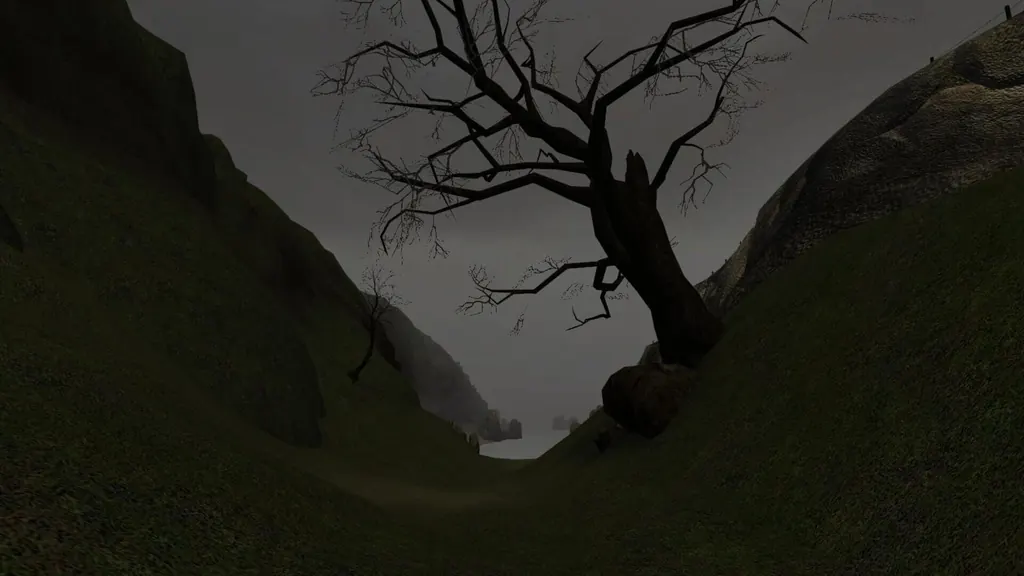
The beating heart of Dear Esther lies in its remarkably minimalist gameplay. Far from any traditional mechanics of puzzles or combat, the only invitation extended to the player is the exploration of a deserted island in the Hebrides. This model, which helped solidify the genre known as the “walking simulator,” transforms movement into action and the environment into the main character. There is no clear objective other than walking, but it is precisely this freedom of movement that forces the player to engage deeply with the setting and, above all, with the audio.
📘 walking simulator
It is a game genre where environmental exploration is the main focus, and player movement is considered the primary action, rather than combat or puzzle mechanics.
The narrative is constructed in an intimate and fragmented way. The player follows an anonymous man who reads aloud a series of letter excerpts dedicated to his deceased wife, Esther. The central mystery is the accident that took her life. The story’s progression is organic and geographical: as the player reaches new locations on the island, a new letter fragment is played, always related to that specific area. This narrative architecture ensures that discovery is gradual, and the different audio fragments presented in each playthrough can reveal slightly different aspects of the story, enriching the sense of discovery and the ambiguity of the plot.
The Tapestry of Characters and Mysteries
Throughout the island, the player not only explores but also collects visual and auditory clues. The environment is rich with abandoned details, such as building remnants and wreckage from a shipwreck, in addition to a system of caverns whose walls are adorned with intriguing images—diagrams referencing chemistry, circuits, neurons, and bacteria. The narrator refers to several characters who are never seen but who shape the context of the tragedy. There is Donnelly, a man who mapped the island in the past; Paul, a drunk driver implicated in the accident; and Jakobson, a pastor who lived on the island in the 18th century. The mix of these characters, referenced in different topics, blurs the identities, forcing the player to weave their own conclusions.
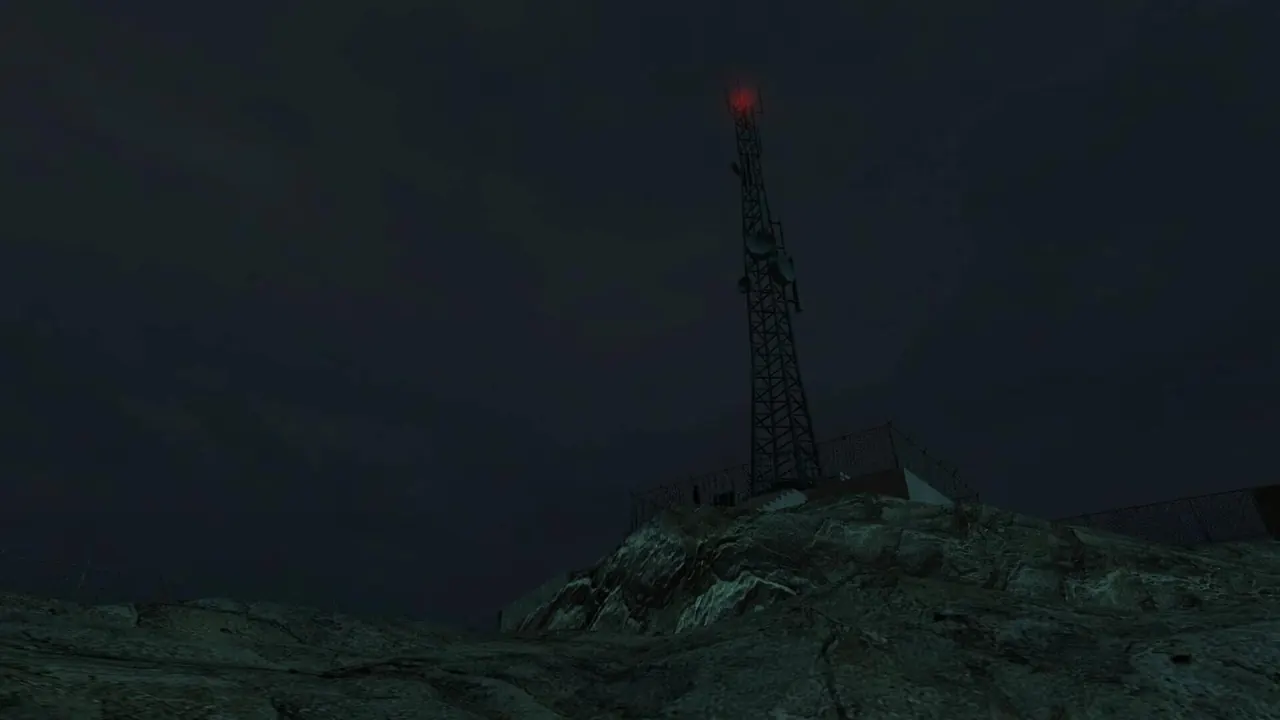
The experience reaches its peak in moments of constant tension and evasion. At several points, a figure is seen moving away from the player in the distance, disappearing before it can be reached. This visual chase game is subverted by the player’s passivity. The ending forces the player to climb to the radio mast on the island’s peak, where the final monologue and the subsequent fall transform his shadow into that of a bird. The journey culminates in the act of crossing the island’s bay, flying low over countless paper boats—each representing a letter the narrator wrote to Esther.
Development and Transition to Commercial Release
The journey of Dear Esther, from a simple academic experiment to a global artistic phenomenon, was marked by a rigorous process of development and adaptation. Initially, the work was one of the mods developed by the studio The Chinese Room while it was still a research project at the University of Portsmouth. The original 2008 project, for example, was funded by a grant from the Arts and Humanities Research Council and led by Dan Pinchbeck, a professor and lecturer at the university. The conceptual strength of the narrative, which cites structural influences from William S. Burroughs, was already evident, but the transition to a commercial product required a complete reconstruction.
Reinventing the Project and Technical Challenges
The polishing process began significantly in 2009 when artist Robert Briscoe started the complete redesign of the game, with full support from Pinchbeck. Briscoe not only maintained focus on the narrative depth but also revamped the island’s setting. His goal was to eliminate the confusion of the original layout and fill the environment with “richer and more visually interesting” details. However, the path to commercial release was abruptly halted in March 2011 when The Chinese Room lost financial support from the university. The studio needed the university to pay for the Source Engine license, which was essential for any commercial release, but the legal department refused to sign the agreement.
Faced with this impasse, the studio approached Indie Fund. Although initially hesitant, after playing a demo, they agreed to finance the project. The initial success was immediate and crucial: in less than six hours after launching on Steam, over 16,000 units had been sold, which allowed the developers to fully repay the Indie Fund’s investment. To ensure artistic quality, the soundtrack was completely revamped by Jessica Curry, Pinchbeck’s wife, who not only orchestrated the music for a more complete format but also extended it, nearly doubling the original duration.
Commercial Release and Technological Legacy
The climax of this development occurred with the release of Dear Esther on commercial platforms. The Microsoft Windows version launched on February 14, 2012, and the OS X version followed shortly after, on May 15, 2012. The title received critical acclaim for its originality and emphasis on story, even if the video game medium was questioned for such a purpose. If we compare this narrative evolution to the early days of electronic games, we can recall the creation of arcade games. The recognition was not limited to PC: the game was ported to consoles, with versions for PlayStation 4 and Xbox One released in September 2016, through Secret Mode, a publishing imprint of Curve Digital. More recently, the game underwent an update based on the Unity engine, releasing the Dear Esther: Landmark Edition for free in February 2017, and later arriving on iOS devices on October 3, 2019.
This trajectory, from an academic research mod to a commercial product that migrated between Source Engine, Unity, and multiple operating systems, demonstrates not only the creative resilience of the team but also the ability of an artistic concept to transcend its origins to establish itself as a successful digital work of art.
The Legacy of the Genre and Spiritual Successors
The impact of Dear Esther transcends a simple narrative of exploration; it redefined what a video game could be, solidifying and popularizing the genre known as the “walking simulator” in the mid-2010s. Before Dear Esther, the experience of walking through a richly detailed environment and absorbing a fragmented story was, to a large extent, a niche. Furthermore, the game market also saw the emergence of rhythm-focused titles, such as in revolutionary rhythm games. The title’s success, developed by The Chinese Room, proved that interactivity did not need to manifest through complex puzzles or elaborate combat. On the contrary, the game’s strength lay in the permission to simply move at one’s own pace, allowing the player to become an active observer of the landscape and the narrative. This shift in focus—from “what to do” to “what to feel”—established a new artistic paradigm in the gaming market.
The title’s artistic relevance is undeniable. Critical reception, although polarized—with some questioning whether the electronic medium was the most suitable for such a story—constantly praised its originality and emotional depth. Critics like IGN highlighted that the game “will leave you feeling uplifted, contemplative, and possibly even emotionally invested,” while Strategy Informer rated it as “one of the most haunting and well-executed titles.” Even those who suggested the experience would be better as a short film, as pointed out by Allistair Pinsof, could not deny that the combination of an intimate narrative with “intelligently applied” interaction was what kept the game stubbornly compelling. This recognition cemented Dear Esther‘s status as a milestone in digital art.
🧪 The Legacy in Action: Spiritual Successors
The success of Dear Esther inspired titles that focused on atmosphere and introspection. Everybody’s Gone to the Rapture is an example of a successor that followed this formula, using minimalist gameplay to immerse the player in environmental mysteries and enigmatic narratives.
The Legacy and Spiritual Successors
The initial success not only established a genre but also paved the way for a new wave of titles focused on atmosphere and introspection. The legacy of Dear Esther is visible in spiritual successors that adopted its formula of contemplative exploration. Subsequent titles, such as Everybody’s Gone to the Rapture, followed the trend of using minimalist gameplay to immerse the player in environmental mysteries and enigmatic narratives. This artistic movement expanded the genre’s reach, proving that emotional experience could be the main selling point.
To keep this legacy alive and accessible, the developers and publishers also ensured the title’s longevity and adaptability. The game was ported and relaunched on various platforms, migrating from the Source Engine to Unity, and receiving special editions, such as the Landmark Edition. This ability to adapt to various operating systems—ranging from Microsoft Windows to PS4 and iOS—and modern graphics engines not only kept the game relevant but also allowed it to reach a global audience across multiple generations of consoles and mobile devices. Thus, Dear Esther is not just a debut game, but a model for how a digital work of art can evolve, solidify a genre, and inspire a succession of works for years.
Glossary
- Walking Simulator: A game genre focused on exploration and narrative, where movement and environment are more important than gameplay mechanics.
- Mod: A modification of an existing game, created by users to add content or alter the original gameplay.
- Source Engine: A game engine used to create the environment and gameplay of Dear Esther in its early stages.
- Indie Fund: An investment fund that provided crucial financial support for the project after losing academic funding.
- Arts and Humanities Research Council: A research council that provided the initial funding for the project, initially framing it as academic research.
Frequently Asked Questions
Is Dear Esther really a game? Does it have puzzles?
It is classified as a ‘walking simulator.’ Its gameplay is not based on puzzles or traditional combat. The main focus is the exploration of a deserted island and deep engagement with the atmosphere and fragmented narrative.
Who is The Chinese Room and why are they important to the game’s development?
The Chinese Room is the development studio. They were crucial in transforming the artistic concept, which began in an academic setting, into a commercial product. The studio was responsible for bringing the work to multiple platforms and a global audience.
What is the plot of Dear Esther and what happens on the island?
The plot follows an anonymous man exploring an island in the Hébrides. He reads aloud fragments of letters dedicated to his deceased wife, Esther. The journey is a mystery surrounding the accident that took her life and the search for answers.
Why is Dear Esther considered a landmark in the narrative game genre?
It is a landmark for elevating narrative and atmosphere above gameplay mechanics. It redefined the genre by turning the simple act of walking into a form of action, proving that poetic depth and mystery can be the engine of artistic success.
Are there sequels or games that continue the story of Dear Esther?
Based on the available information, there is no mention of direct sequels or games that continue the story of Dear Esther. The focus of the development has always been on enhancing the original experience and the strength of its poetic narrative.
Conclusion
The journey of Dear Esther is a powerful testament that digital art can flourish in any environment, proving that the value of a work lies, first and foremost, in its narrative soul. Born not in a commercial studio, but in an academic research context and as an experimental mod in 2008, the project crystallized Dan Pinchbeck’s poetic vision. This modest, yet deeply impactful, beginning already validated the power of atmosphere and poetry over complex mechanics, paving the way for what would become an artistic phenomenon recognized by awards such as IndieCade.
By solidifying the “walking simulator” genre, Dear Esther shifted the focus from traditional gameplay, transforming movement and exploration into narrative acts. The player is not searching for a goal, but rather the fragmented discovery of a story, guided by the deserted island and the narrator’s voice. This intimate architecture, which blended Robert Briscoe’s work on the scenery and Jessica Curry’s rich sound design, elevated the game from a simple modification to a complex piece of digital art, capable of addressing profound themes like loss and memory.
Thus, Dear Esther teaches us that the most revolutionary innovation often lies not in graphical resources or budget, but in the ability to tell a story in a unique and moving way. By revisiting the power of narrative in games, it is not just about reliving a classic, but about reflecting on what truly makes an interactive experience unforgettable.