Read this article in: Portuguese (Português) · Spanish (Español)
If you’re looking for the 50 best games for the Thomson MO5, prepare for a nostalgic trip to the origins of the home computer. The Thomson MO5, released in 1984, was not just a machine, but a portal to a universe of code, pixels, and square-wave sound that defined an era. Revisiting this catalog of titles is diving into the experience of a time when programming and entertainment were synonymous with pure technological discovery. Our 50 selected games represent the peak of the hardware’s capability, transforming technical limitations into interactive masterpieces that captivated generations of computer enthusiasts.
The relevance of the Thomson MO5 goes beyond a mere game catalog. Released in 1984, it emerged in a highly competitive market, having to compete for space with giants like the ZX Spectrum and the Commodore 64. Its impact was so significant that the model was used as an educational tool in French schools, and its evolution culminated in machines like the Thomson MO5NR, which incorporated the “Nanoréseau.” Despite being discontinued in 1986, leaving behind the MO6 successor, the MO5 left a robust legacy, shaping the knowledge of countless programmers and gamers.
In this article, we have built a complete guide so you can relive this digital memory. First, we will take a deep dive into the Thomson MO5 platform within its historical context, understanding its role in the technological landscape. Next, we will explore the universe of games and the programming experience it offered, and finally, we will detail the rigorous criteria that guided us in selecting these 50 titles, ensuring you have access to the best of the golden age of the home computer.
Key Points
- Released in 1984, the MO5 was a European pioneer, notable for its integration into the French educational context.
- It featured a Motorola 6809E processor at 1 MHz, with 32 KB of RAM and 16 KB of VRAM, demanding code optimization.
- The graphics system was generated by the EFGJ03L gate array, displaying 320×200 pixels and supporting 8 colors with saturation variation.
- The MO5 BASIC 1.0 allowed the user to be both a consumer and a producer of content, reinforcing its educational nature.
- Its lifecycle was expanded with the MO5NR, which added networking and memory capacity, elevating its status as a platform.
Thomson MO5 in Summary
| Manufacturer | Thomson SA |
|---|---|
| Release | 1984 |
| Launch Price | 2390 FF |
| Discontinued | 1986 |
| Media | Cassette tape, Cartridges |
| Operating System | MO5 BASIC 1.0 |
| CPU | Motorola 6809E @ 1 MHz |
| Memory | 32 KB RAM, 16 KB VRAM |
| Display | 320×200, 8 colours with 2 saturation variations, 2 colours per 8×1 pixel area |
| Graphics | EFGJ03L gate array |
| Sound | 1-bit square wave |
| Inputs | Keyboard, Lightpen, Joystick |
| Connectivity | Expansion port |
| Successor | Thomson MO6 |
| Related | Thomson TO7/70 |
The Thomson MO5 Platform in Historical Context
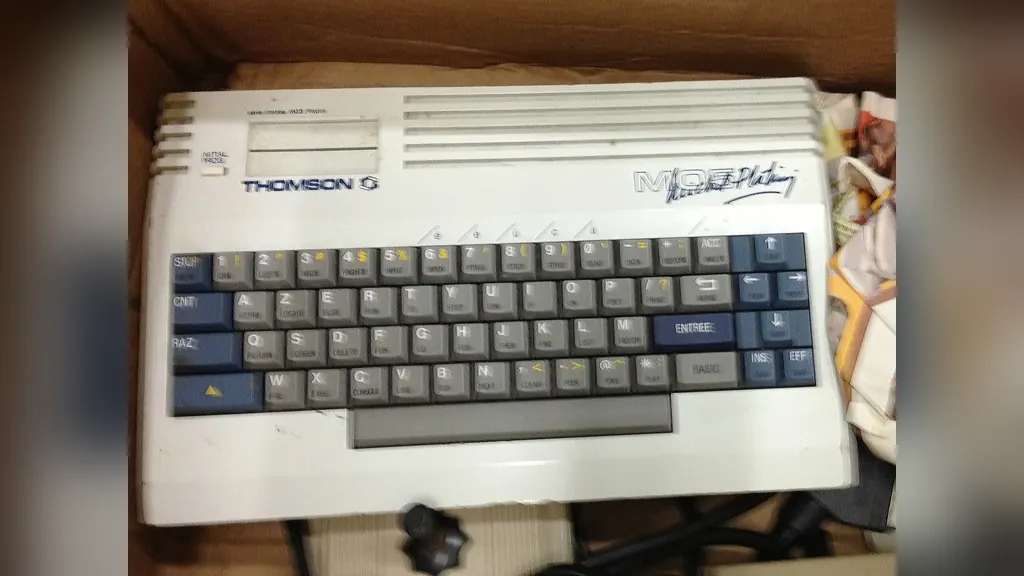
The arrival of the Thomson MO5 in 1984 marked a turning point in the history of European home computers. In a highly competitive market, where machines like the ZX Spectrum and the Commodore 64 dominated the popular imagination, the MO5 emerged not just as a competitor, but also as a tool for social transformation. Its use in French schools ensured that the machine transcended mere entertainment, becoming integrated into the educational and citizenship-building context. To better understand this trajectory, it is interesting to revisit the events of RBC 2014: Relive the Moments. This scenario gave the MO5 a stable user base and a focus on practical applications, shaping the programming experience and the development of educational games.
The Fundamental Specifications of the MO5
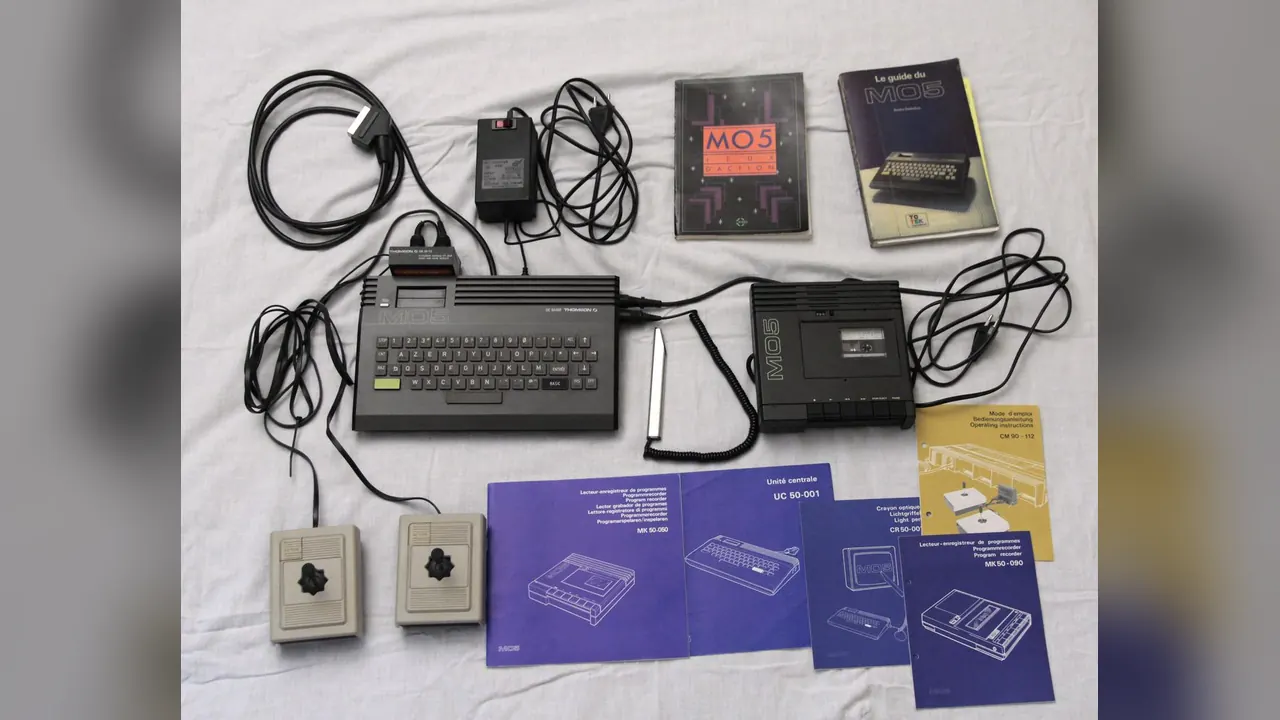
Technically, the MO5 was robust for its time. It operated with a Motorola 6809E processor, running at 1 MHz. In terms of memory, the system featured 32 KB of user-usable RAM, supplemented by 16 KB of VRAM (Video RAM). The operating system was MO5 BASIC 1.0. Graphics were generated by an gate array EFGJ03L, capable of displaying 320×200 pixels. Although the color hardware was limited to 8 colors, it introduced a sophisticated feature: saturation variation. This characteristic allowed the color palette to be richer than mere indexing, distinguishing, for example, between shades of orange and gray, a crucial detail for the visual quality of games.
Audio, meanwhile, was restricted to 1-bit square waves, and file storage was done via cassette tapes read by a proprietary player. For its time, these were engineering details that defined the workflow and the architecture of games and programs.
Evolutions and Connectivity
The life cycle of the MO5 was marked by significant upgrades that elevated its status from a home machine to an advanced platform. In 1985, the Thomson MO5E was released, an optimized version (the “E” for Export), which improved the audio by adding four voices and seven octaves, and incorporated a parallel port and a mechanical keyboard. However, the biggest leap came in 1986 with the launch of the Thomson MO5NR. The “NR” stood for Nanoréseau, a networking standard that transformed the computer. The MO5NR expanded memory to an impressive 128 KB and came equipped with Microsoft Basic 128 1.0. Graphically, the system was revolutionized by the EF9369 chip, allowing the MO5NR to generate up to 4096 colors. This capability allowed for new resolutions and, in some modes, even 16 colors simultaneously, cementing the device as a cutting-edge machine in its generation.
The Universe of Games and the Programming Experience
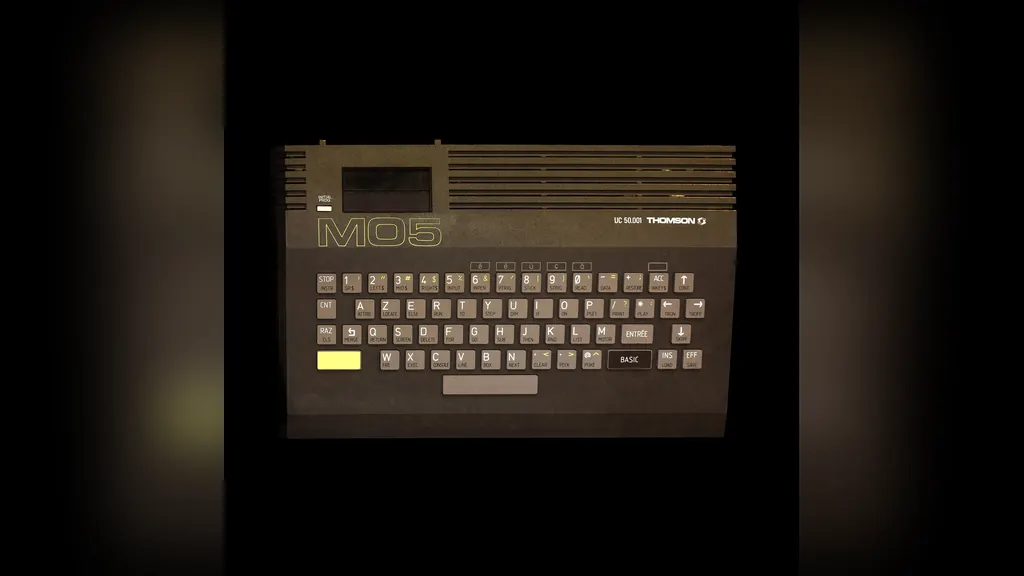
The universe of games on the Thomson MO5 was not just an entertainment catalog; it was a testament to creative ingenuity in the face of technical limitations. For those who lived through the era, the gaming experience was intrinsically linked to the hardware and software that ran it. Although the console was robust for its time, the graphics and sound engine dictated a particular aesthetic. Thus, while the audio was restricted to 1-bit square waves and the visual display was defined by an EFGJ03L gate array, capable of generating graphics at a resolution of 320×200 pixels, the technological complexity reminds us of other revolutions, such as the future of quantum computers.
Limitations as a Catalyst for Creativity
Far from being impediments, the MO5’s restrictions forced developers to become masters of optimization. The video memory was 16 KB, and the Motorola 6809E processor operated at 1 MHz. These specifications required programmers to maximize every processing cycle. Visually, the color palette and saturation system, which allowed variations of 0%, 33%, 66%, and 100% of each RGB tone, demanded sophisticated use of color to create depth and atmosphere, even with the limit of 8 basic colors. Gameplay, whether in narrative adventures, fast arcades, or educational games, relied on intelligent design that compensated for the simple, yet striking, sound of 1-bit square waves.
To expand this experience, the MO5 featured cartridge media and an expansion port. The cartridges were vital, as they carried complete games and were the most portable and robust way to keep the gaming ecosystem alive. They allowed the platform to be constantly updated, maintaining user interest and ensuring that the title library was vast and diverse.
More Than Just Playing: The Programming Experience
A fundamental part of the user experience on the MO5 was programming in BASIC. The operating system, MO5 BASIC 1.0, was not just an environment to start a game, but a creation engine in itself. The ability to program in BASIC meant that the user was simultaneously a consumer and a producer of content. Whether modifying an existing game or creating a playful experiment, code was the enthusiast’s domain. This integration between the hardware and the programming language solidified the MO5 not just as an entertainment device, but as a true educational and creative platform.
Thus, the meeting of the Motorola 6809E’s power, the EFGJ03L’s artistic potential, and BASIC’s flexibility created a rich and multifaceted gaming ecosystem. Revisiting the MO5 is, therefore, revisiting a period when technical limits were not seen as a barrier, but rather as an invitation to imagination and programming.
Selection Criteria: Why These 50 Games Are the Best
For this list of 50 games to carry the weight of a true curated guide and not just a nostalgic look back, we established a rigorous selection methodology. The goal is to go beyond simple remembrance and understand what allowed these titles to transcend the technical limitations of their time. We analyzed each game based on four fundamental pillars, which together ensure that the selected titles are true milestones in home computing.
Selection Criteria
Curating the 50 best games for the Thomson MO5 is an exercise in cultural and historical engineering. The games were not selected merely by their popularity, but by their technical excellence and lasting impact; for those interested in earlier machines, checking out best retro computer games is worthwhile. The criteria guiding this selection are:
- Historical Influence on the Genre: We identified games that not only entertained but also defined new subgenres or established design standards for the home computers of the era.
- Technological Innovation for the Time: Given the MO5’s architecture—with its Motorola 6809E processor, 32 KB of RAM, and sound limited to 1-bit square waves—innovation was a constant challenge. We prioritized titles that managed to maximize graphic and sound potential within these restrictions, turning limitations into artistic resources.
- Critical Acclaim: We sought out titles that were praised by the community and specialized press, demonstrating a high level of polish and programming complexity.
- Replayability and Modern Fun: A great game must withstand the test of time. We evaluated the depth of the gameplay and the timeless appeal, ensuring that the experience of playing today is as rich as it was in 1984.
This multifaceted approach allows us to justify the inclusion of titles that, while technically simple today, represented a leap in ingenuity in 1984, when the MO5 was launched to compete with giants like the Commodore 64 and the ZX Spectrum. Furthermore, we recognize the educational value of the platform, used in French schools and on the “Nanoréseau,” and for this reason, games that combine entertainment with a sense of intellectual challenge were also highly valued.
By applying these filters, the result is not just a catalog, but a map of excellence. Every game on this list is a testament to the creative capacity and ingenuity of the developers in squeezing the most out of a machine with such specific resources, such as the use of the EFGJ03L gate array and operation via MO5 BASIC 1.0. It is a deep dive into the most profound and influential aspects of home computer history.
Glossary
- Motorola 6809E: The machine’s central processing unit (CPU), responsible for executing all system operations and calculations.
- VRAM: Video RAM; memory dedicated exclusively to storing graphical information and colors displayed on the screen.
- gate array: An integrated circuit (chip) responsible for generating and processing graphic signals, defining the display’s resolution and colors.
- MO5 BASIC 1.0: The operating system and programming language that allowed users to interact with the hardware and create content.
- Nanoréseau: A network standard implemented on the MO5NR, transforming the computer from an isolated machine into a connected platform.
Frequently Asked Questions
What is the main difference between the Thomson MO5 and its successor, the MO6?
Although the MO6 is listed as the successor, the material details the evolution of the MO5 through models like the MO5E and MO5NR. The MO5NR, for example, was a significant leap, expanding memory and adding networking features, which represents the technological advancement of the line.
Was the Thomson MO5 used in schools or was it just a home computer?
The MO5 was designed as a home computer but gained a crucial role in the French education system. Its use in schools ensured that the machine was integrated into the context of citizen training, transcending mere entertainment.
What were the main genres of games available for the MO5?
The gaming universe was extremely diverse. In addition to fast arcade games and narrative adventures, the platform was valued for its use in educational games. Developer creativity explored these various genres within technical limitations.
How did the MO5’s architecture (Motorola 6809E) affect game design?
The architecture, with its memory and processing limitations, forced developers to be masters of optimization. This transformed restrictions into artistic resources, demanding intelligent game design that maximized every processing cycle.
Is it possible to run MO5 games on modern computers today?
Preserving the original software and hardware is essential to revive the authentic experience of the era.
Conclusion
The journey through the world of the Thomson MO5 reveals much more than a catalog of games; it is a deep dive into a period of intense and fascinating cultural engineering. Far from being just an entertainment device, the MO5 established itself as a platform for transformation, where learning and creation went hand in hand, a remarkable feat for an era that demanded from the user not only consumption but also the production of content in BASIC. The robustness of the Motorola 6809E processor and the ability to program in BASIC solidified the device as a true engine of development, one that shaped not only games but citizens.
Curating the 50 best titles goes beyond mere nostalgia. It is an exercise in historical engineering that rescues the genius of developers who, faced with limitations such as 1-bit square-wave audio and 16 KB of video memory, managed to transform technical restrictions into artistic features. By analyzing each game through the pillars of historical influence, innovation, and critical acclaim, we understand that the MO5’s gameplay was an ode to optimization, where every processing cycle and every variation in the color palette counted toward the final experience.
Reviving the MO5 is, therefore, revisiting a time when technical limits were not seen as a barrier, but rather as an invitation to imagination and code. This legacy teaches us that the true power of a machine lies in the mind of the person operating it. We now invite you to explore the list and rediscover how a passion for technology can redefine what is possible to create.