
Read this article in: Portuguese (Português) · Spanish (Español)
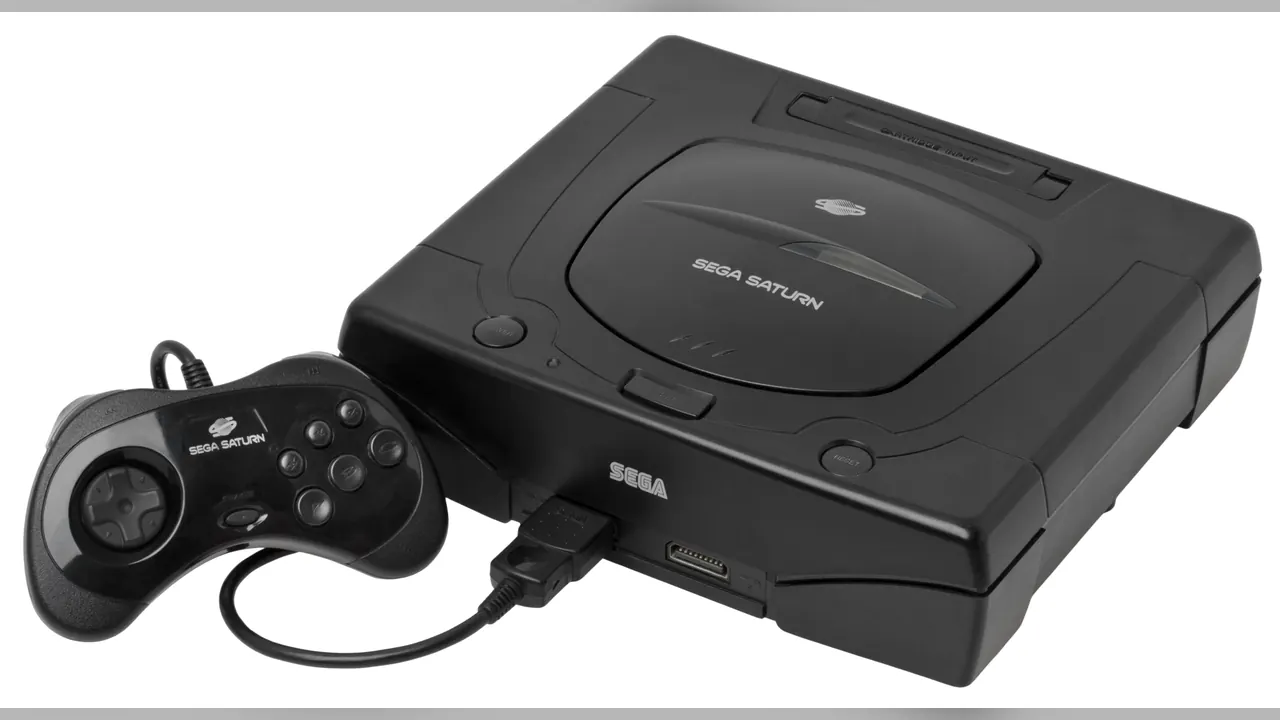
The Sega Saturn is a fifth-generation home video game console that represents one of Sega’s most ambitious and complex attempts to transition from the 2D to the 3D landscape. Released on November 22, 1994, in Japan and in May 1995 in North America, the Saturn succeeded the popular Genesis but faced significant challenges that shaped its destiny. Characterized by its dual-CPU architecture and focus on CD-ROM media, the console was designed to compete directly with growing and powerful competition, such as Sony, in a rapidly and turbulently transforming video game market.
The relevance of the Saturn lies precisely in this technological and commercial clash. Its development, which began in 1992, aimed to deliver an advanced graphical experience, using two Hitachi SH-2 processors operating at 28.6 MHz. Although it sold 9.26 million units worldwide, its success was geographically uneven, with most sales concentrated in Japan. The complexity of its hardware, coupled with questionable strategic decisions, such as the cancellation of the highly anticipated title Sonic X-treme, contributed to its mixed reception and the rapid decline of its market share, culminating in its discontinuation in 1998.
Throughout this article, we will provide a detailed analysis of the console’s trajectory. We will begin by addressing the origin and context of the 3D market, delving into the technical development and the engineering challenges surrounding the Saturn. Next, we will examine the hardware architecture and specifications, before analyzing the launch and the console war. Finally, we will focus on iconic games, such as Virtua Fighter 2, and the commercial decline and lasting legacy of Sega.
Key Points
- Released in 1994, the Saturn used a complex architecture with two Hitachi SH-2 CPUs.
- Sony’s competition, with its focus on 3D and more accessible pricing, was a decisive factor.
- The console sold 9.26 million units globally, with initial success in Japan.
- Its complex design and development difficulty required programming in Assembly.
- Sega reacted to the Saturn’s crisis by planning the next platform, the Katana system.
Sega Saturn Technical Specifications
| Manufacturer | Sega |
|---|---|
| Type | Home video game console |
| Generation | Fifth |
| Release (NA) | May 11, 1995 |
| Release (EU) | July 8, 1995 |
| Predecessor | Sega Genesis |
| Successor | Dreamcast |
| Media | CD-ROM, CD+G, CD+EG, Video CD, Mini CD, Photo CD, e-book |
| Total Sales | 9.26 million |
| Best-Selling Game | Virtua Fighter 2, 1.7 million |
The Origin and Context of the 3D Market

Sega’s trajectory before the Saturn’s release was marked by consolidated success with the Genesis console, which was known in much of the world outside of North America as Mega Drive. This success was amplified by aggressive advertising campaigns and the popularity of the Sonic the Hedgehog series. However, the home entertainment landscape was rapidly changing; to better understand this evolution, it is interesting to look at the history of the Sega Pico. While the Genesis dominated the 2D gaming market, the global industry was undergoing an imperative transition: the migration to three-dimensional (3D) graphics.
This technological shift was, initially, a privilege of high-cost arcade systems. In 1992 and 1993, Sega AM2 introduced Model 1 arcade boards to the market, which featured titles like Virtua Racing and Virtua Fighter. These games, being the first to popularize 3D polygonal graphics, were crucial in demonstrating the potential of this new generation. Although the Model 1 was extremely expensive, Sega sought to bring this technology to the home console, developing two 32-bit projects starting in 1993: the Jupiter (cartridge-based) and the Saturn (CD-based).
The Response to Sony’s Challenge
The development of the Saturn was a process full of speculation, but the competitive context was clear. Sega realized that if 3D technology was limited to inaccessible arcade machines, the company’s home console would be at a disadvantage. The arrival of Sony with the PlayStation, which focused specifically on 3D games and emphasized more accessible pricing, represented a direct threat to Sega’s business model. To better understand this dispute and how other consoles developed, it is interesting to check the history of the Sega VMU console’s development; to compete with this new paradigm, the Saturn’s technical specifications were altered, with the addition of new processors aimed at greater support for polygons and 3D graphics processing.
The console was released in Japan on November 22, 1994, achieving considerable initial success, with over 500,000 units sold by the end of that year. However, the North American scene, starting on May 11, 1995, presented the first major setbacks. Sega launched the Saturn with an initial price of US$ 399.99. This price, combined with the limited variety of games available at launch, put the company at an immediate disadvantage, especially when Sony announced its PlayStation for US$ 299. The price war and the difficulty in producing the system board design left Sega in a vulnerable position.
Market pressure did not cease. At the beginning of 1997, the Saturn was already losing significant ground to the PlayStation and the Nintendo 64. In response to this crisis, Sega management began planning a new platform, the Katana system (future Dreamcast). This aggressive move, although necessary, caused great strain. The rapid replacement cycle that followed the Saturn led to a chain reaction among developers and consumers, resulting in game cancellations and a drastic reduction in the console’s commercial lifespan.
🕒 Technological Evolution and the 3D Battle
- 1992 and 1993 — Sega AM2 releases Model 1 arcade boards, popularizing 3D polygonal graphics.
- Starting in 1993 — Sega develops 32-bit projects, including the Jupiter and the Saturn, to bring 3D to home consoles.
- November 22, 1994 — The Sega Saturn is released in Japan, achieving initial success with over 500,000 units sold.
- May 11, 1995 — The Saturn is released in North America for $399.99, facing competition from the PlayStation.
- Early 1997 — The Saturn is already showing significant market losses to the PlayStation and Nintendo 64.
- Post-1997 — Sega plans the new Katana platform (future Dreamcast) in response to the Saturn crisis.
Technical Development and Engineering Challenges
The development of the Sega Saturn was an extremely complex process, overseen by Hideki Sato, Sega’s director and vice general manager of research and development. The project, codenamed Saturn, began more than two years before its announcement at the Tokyo Toy Show in June 1994, and was executed by the same team that had worked on the System 32 arcade board. To better understand the context of the consoles of that era, it is interesting to look at the history of the Sega Master System. The core architecture was based on two SH-2 (SuperH RISC Engine) CPUs, developed in partnership with the Japanese electronics company Hitachi in 1993. According to Kazuhiro Hamada, head of the Saturn development section, the choice of the SH-2 was made for reasons of cost and efficiency, as the chip possessed a calculation system similar to a DSP (digital signal processor). However, Sega’s ambition was so great that, although the design was largely finalized before the end of 1993, reports on the technical capabilities of Sony’s future PlayStation in early 1994 forced the inclusion of a second video processor (VDP2), aiming to improve 3D texture mapping and 2D performance.
The Pressure of Competition and Hardware Complexity
Sega’s response to the competition’s advance was marked by a relentless search for improvements. The team was not limited to the central processing unit; the system incorporated several auxiliary chips, totaling six processors in addition to the two CPUs. Although the Saturn was a powerful machine for its time, its complex design, which used many “off the shelf” components, made it extremely difficult to fully utilize its potential. The discussion about the architecture was so heated that, publicly, Tom Kalinske, president of Sega of America, argued that “multiprocessing” was essential to bring to homes what the company was developing in arcades. Sega, in a strategic move, considered versions based on CD-ROM or cartridges only, but discarded these ideas due to concerns about the quality and price of cartridge games.
📘 DSP (digital signal processor)
It is a type of processor with a calculation system similar to that found in the SH-2 chip, focused on digital signal processing.
The internal technical challenges were immense. The processing division required extreme care because the two CPUs shared the same bus, which caused problems with simultaneous access to the main RAM. To mitigate this limitation, the use of 4 KB of cache memory for each CPU was essential to maintain performance. The need for code parallelization was a challenging task, forcing developers to squeeze maximum performance out of the hardware. A notable example of this processing management is the game Virtua Fighter, where one CPU was dedicated to managing each character.
Development Cycle Challenges
Third-party software development was initially hindered by a lack of useful software libraries and tools. This forced programmers to code in Assembly language to achieve good performance. During the early stages, programming in Assembly could offer two to five times the speed compared to the C language. In an effort to save costs and time, some programmers chose to use only one CPU. Furthermore, to ensure that high-quality 3D games were available at launch, Sega reorganized its internal studios, asking arcade division developers to create console games, resulting in the formation of new teams, such as Team Andromeda, which was responsible for Panzer Dragoon.
Architecture and Hardware Specifications

The Sega Saturn’s architecture is a testament to Sega’s ambition to create a cutting-edge console during the transition to 3D. The heart of the system lies in its complex configuration of eight processors. At the center, we have two Hitachi SH-2 microprocessors, operating at 28.6 MHz, which together can achieve 56 MIPS. This dual CPU is supported by a series of dedicated controllers: a custom processor with the Yamaha FH1 DSP, responsible for FM synthesis audio and 16-bit pulse encoding at 44.1 kHz; a Motorola 68EC000 sound controller; and the System Control Unit (SCU), which runs with an internal 14.3 MHz DSP. The complexity is complemented by two video display processors (VDP1 and VDP2), which operate at 28.63636 MHz, and are essential for sprite and background manipulation.
Data management is equally sophisticated. The Saturn features 16 Mbit of working memory (RAM), 12 Mbit of video memory (VRAM), 4 Mbit of sound RAM, and 4 Mbit of CD buffer RAM. The storage system also includes a cartridge slot, allowing for memory expansion. In terms of visual output, the console offers a resolution of 320×224 up to 704×224 pixels through the RCA video output, supporting up to 16.78 million colors. Furthermore, the system supports various media types, including CD-ROM, CD+G, CD+EG, Video CD, Mini CD, Photo CD, and e-book, ensuring a wide range of content formats.
Complexity as a Development Challenge
The most defining characteristic of the Saturn is its inherent difficulty. The high performance of the hardware was a double-edged sword. The two SH-2 processors shared the same bus, which prevented simultaneous access to system memory. This limitation required developers to use the 4 KB cache of each CPU extremely efficiently to maintain performance. The need for extreme optimization led to a development environment that, while extremely demanding, was seen by some as “a real machine for coders” who loved “hacking the hardware.”
This technical approach resulted in a unique development style. In games like Virtua Fighter, one processor might be dedicated to each character, while in Nights, one SH-2 was used for 3D environments and the other for 2D objects. The low-level dependency was so great that, in early stages, the lack of usable software libraries forced programmers to work in Assembly language, which, in some cases, resulted in a speed increase of two to five times compared to high-level languages like C. Beyond traditional games, the Saturn also featured the Sega NetLink service, which used a 28.8k modem in the cartridge slot for dial-up multiplayer gaming.
📌 Key Components of the Saturn Architecture
- Two SH-2 Processors Operating at 28.6 MHz
- Yamaha FH1 DSP Processor for FM Audio
- Two Video Display Processors (VDP1 and VDP2)
- 16 Mbit of work memory (RAM)
- Support for multiple media formats (CD-ROM, Photo CD)
Launch and the Console War
The launch of the Sega Saturn was a global event marked by an intense and rapid console war. Sega’s market strategy varied drastically by region. In Japan, the console was released on November 22, 1994, with an initial price of ¥44,800. Its initial success was driven by the title Virtua Fighter, which sold at nearly a one-to-one ratio with the console at launch, selling through the first batch of 200,000 units on the first day. In contrast, the launch in North America on May 11, 1995, and in Europe on July 8, 1995, was characterized by a more aggressive and, at times, disorganized approach.
The arrival in the American market was a real shock. On May 11, 1995, during the first Electronic Entertainment Expo (E3) in Los Angeles, Sega of America revealed the price of US$399, which included a copy of Virtua Fighter. The company claimed high demand, announcing shipments of 30,000 units to retailers such as Toys “R” Us and Babbage’s. This sudden revelation caused great commotion among retailers like Best Buy and Walmart. The strategy of launching before the competition, which had already announced the PlayStation, demonstrated Sega’s urgency to gain an advantage, but the initial impact was mixed.
The Rise of the Competition
The pressure from the competition, especially Sony, became the decisive factor. While Sega was betting on a more mature audience, the PlayStation, with its announced launch price of US$299, quickly began to gain ground. Sony attracted third-party developers with a liberal licensing rate of US$10 and high-quality development tools, allowing for a more efficient order system. In the United Kingdom, for example, the PlayStation surpassed the Saturn in sales by a factor of three by November, after Sony allocated £20 million in marketing during the holiday season, compared to Sega’s £4 million.
The technical and market contrast was evident. Titles such as Ridge Racer (a high-quality port from Namco) contributed to the early success of the PlayStation, while the Daytona USA version for the Saturn was considered inferior to its arcade version. In Spain, Sega reported in January 1996 that the Saturn was selling the PlayStation at a ratio of two to one, although contemporary estimates of this data were disputed. In terms of production, Sega of Japan, by forcing the early launch, ended up limiting third-party games in the West, and the lack of popularity of Virtua Fighter in the West, combined with a scarce release schedule, prevented Sega from capitalizing on the initial timing.
The console war continued to unfold globally. In South Korea, Samsung introduced the console as the Samsung Saturn at the end of 1995. A February 1998 report estimated that, during the period from December 1997 to January 1998, about 500 units of the Saturn were distributed, compared to 300 units of the Nintendo 64 and 200 units of the PlayStation, highlighting the complex and disputed battle for dominance in the fifth-generation console market.
📊 Differences in the Global Launch of the Sega Saturn
| Region | Release Date | Initial Price (Example) | Initial Highlight |
|---|---|---|---|
| Japan | November 22, 1994 | ¥44.800 | Sold out the first batch of 200,000 units |
| North America | May 11, 1995 | US$ 399 | Revealed during E3, causing a stir |
| Europe | July 8, 1995 | Not specified | More aggressive approach |
Iconic games and the Saturn library

The Sega Saturn catalog is undeniably marked by a strong presence of titles originating from the arcade scene, which constitutes a significant part of its library. Games such as Daytona USA, The House of the Dead, Last Bronx, Sega Rally Championship, and the Virtua Cop series were adapted with great fidelity to their original arcade material. In addition to these conversions, the console received high-caliber exclusive titles, such as Panzer Dragoon Saga, Dragon Force, and Guardian Heroes. A highlight for the ability to create original experiences is Fighters Megamix, developed by Sega AM2 specifically for the Saturn, which combined characters from Fighting Vipers and Virtua Fighter, and which received positive reviews. Another example of success and acclaim is Panzer Dragoon Saga, often cited as one of the platform’s most acclaimed games, thanks to its cinematic presentation and unique battle system.
The Sonic Saga and Niche Titles
The Sonic series, although it had a different fate on the Saturn, was not without games. The announcement and subsequent cancellation of Sonic X-treme prevented the console from receiving an exclusive platformer from the franchise. Instead, the Saturn received an enhanced version of Sonic 3D Blast, based on a Genesis-era game, and the racing title Sonic R. Although the character Bug! was seen as a potential mascot, it did not achieve the same success as Sonic. However, the Sonic Team developed Nights into Dreams, a title considered one of the most important on the Saturn. In this game, the player controls a demon-like protagonist, flying through surreal stages, and the focus on free movement and acrobatics demonstrated the intuitive potential of the analog controller, even without the fully three-dimensional environments of competing games.
The Saturn catalog also reveals the geographical complexities of its distribution. Many well-rated titles were exclusive to Japan. For example, the Sakura Wars series, which mixes elements of tactical RPGs, anime scenes, and visual novels, was a huge success in Japan but never received a Western release. This restriction was a result of Sega of America’s policy, which refused to localize Japanese RPGs and other games for fear that they might damage the console’s reputation in North America. Titles like Grandia and Lunar: Silver Star Story Complete, although released on the Saturn, were only found on the PlayStation in the West. Other games, such as Panzer Dragoon Saga, faced distribution issues, with fewer than 20,000 copies sold in North America, an event characterized as an “ignominious farewell” in the region.
Despite the commercial challenges, the Saturn maintained a cult following. Games like Guardian Heroes, Nights Into Dreams, and Shin Megami Tensei: Devil Summoner: Soul Hackers continued to receive positive reviews throughout their lifespan. However, the console was also the site of significant cancellations. Due to hardware limitations and market problems, highly popular titles such as Resident Evil 2, Shenmue, Sonic Adventure, and Virtua Fighter 3 were canceled and subsequently migrated to its successor, the Dreamcast.
Commercial Decline and the Sega Legacy
The life cycle of the Sega Saturn, although marked by undeniable technological ambition, was consumed by intense and relentless global market competition. After considerable initial success in Japan, the pressure intensified drastically, especially with the aggressive arrival of Sony in the console scene. The market contrast became evident when, in 1996, the PlayStation managed to sell 2.9 million units in the United States, more than double the 1.2 million units sold by the Saturn. The rivalry intensified further in 1997, when the PlayStation surpassed the Saturn three to one in the American market, consolidating Sony’s lead, which reached 47% of the console market in August of that year, compared to the Saturn’s 12%.
Business problems were not limited to competition; market saturation and internal challenges contributed to a sharp decline. The drop in demand was directly reflected in shipment figures: between March and September 1997, global Saturn shipments fell from 2.35 million to just 600,000 units. In the United States, shipments dropped from 800,000 to 50,000. This financial deterioration led to serious consequences for Sega; at the end of 1997, 60 employees at Sega of America were laid off. The situation culminated in consolidated financial losses for the company, with a net loss of ¥43.3 billion ($327.8 million) in the fiscal year ending in March 1998.
The End of Production and the Transition to the Dreamcast
The financial crisis and the unsatisfactory performance in Western markets made discontinuation inevitable. Sega announced the end of Saturn production in North America before even consolidating its losses, and the console was discontinued in the region in March 1998. While the Saturn maintained longer support in Japan, where the attach rate reached a peak of 16.71 games per console between June 1996 and August 1998, the reality of the Western market was different. Only seven official games were released in North America in 1998, with Magic Knight Rayearth being the last official title. The decision to abandon the Saturn in the West, motivated by the search for restructuring, created a gap of over a year in the market for American consumers.
Despite the Saturn being considered a commercial failure globally, with total sales of 9.26 million units, its legacy is complex. While performance in the United States was modest (1.8 million units), its installed base in Japan surpassed that of the Nintendo 64, making it Sega’s best-selling console in the country. The end of the Saturn, marked by its discontinuation, was the prelude to the launch of its successor, the Dreamcast. The transition was an act of corporate survival, and the Saturn, despite its difficulties, established a cult niche and demonstrated the intrinsic complexity of the challenge of maintaining a cutting-edge console in a rapidly changing market.
Glossary
- SH-2: A RISC microprocessor type from Hitachi, used in the Saturn for central processing.
- Bus: The data pathway that allows communication between CPUs and RAM.
- Assembly: A low-level programming language that requires extreme code optimization.
- MIPS: A metric that measures processor performance, indicating millions of instructions per second.
Frequently Asked Questions
Why is the Sega Saturn considered a commercial failure, despite having advanced hardware?
The Saturn faced critical challenges, such as a high launch price, a lack of game diversity initially, and competitive pressure. The arrival of the PlayStation, with a lower price and a focus on 3D, disrupted Sega’s market strategy.
What was the main technical difference between the Saturn and the PlayStation?
The Saturn was notable for its complexity, utilizing two SH-2 CPUs and multiple video processors (VDP1 and VDP2). This architecture demanded extreme parallelization, while the PlayStation focused on a more accessible model optimized for 3D graphics.
How did Sega manage to maintain relevance in the video game market after the launch of the Saturn?
In response to declining sales, Sega management began planning a new platform. This aggressive move led to the development of the Katana system, which would be the precursor to the Dreamcast, ensuring the company’s continuity.
Which games are considered the most iconic and well-rated on the Sega Saturn?
Among the notable titles, Virtua Fighter stands out as a major launch success. Other important games include Panzer Dragoon, which was developed by internal Sega teams, demonstrating the platform’s ambition.
What happened to Sonic X-treme and how did it affect the Saturn?
Available information does not detail the fate of Sonic X-treme. However, the rapid replacement cycle following the Saturn resulted in a drastic reduction in the console’s commercial lifespan and game cancellations.
Conclusion
The Sega Saturn emerges from video game history not just as a console, but as a monument to technological ambition. Its architecture, based on two Hitachi SH-2 processors and complemented by various auxiliary chips, was a testament to Sega’s relentless pursuit of leading the transition into the three-dimensional universe. This complexity, while enabling the development of cutting-edge games, also represented an immense challenge. The demand for parallelization and the necessity of Assembly programming to extract maximum performance turned the development cycle into an extremely complex task, forcing both engineering and third-party developers to operate at a rarely seen level of precision.
However, technical complexity was not enough to shield Sega from market pressures. The clash with the PlayStation, which focused on accessibility and the promise of more widespread 3D games, and the Saturn’s high initial price (US$ 399.99) created a significant commercial vulnerability. The rapid succession of releases and the wear caused by this giant rivalry resulted in a drastic reduction in the console’s commercial life. The Saturn is, therefore, a fascinating case study of how technological vanguard, when unaccompanied by a cohesive market strategy, can be consumed by competition.
When analyzing the legacy of the Saturn, we realize that the Sega saga is much broader than just its consoles. It is a story of trial and error, innovation, and resilience. To understand the totality of this cycle, it is essential to delve into the context of the next generation, observing how the company attempted to re-establish itself with the Katana system.


