Read this article in: Portuguese (Português) · Spanish (Español)
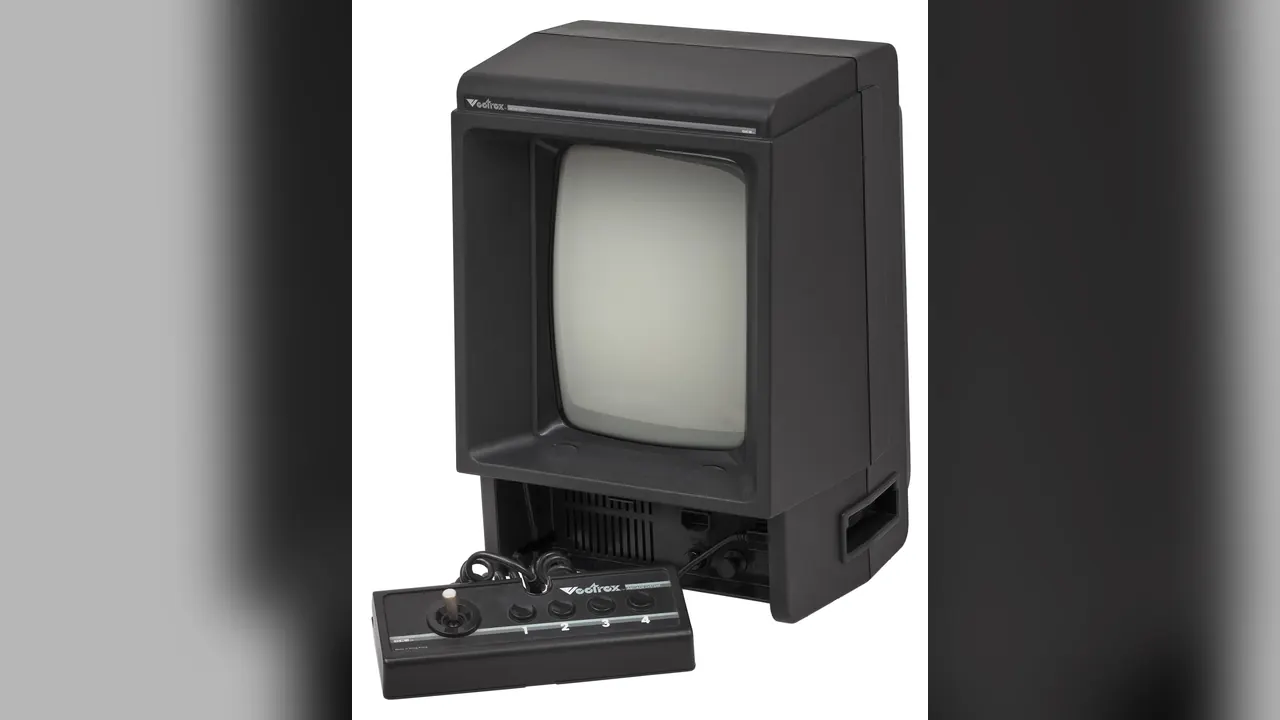
For those looking for the 50 best games for the Vectrex, it is important to understand that this console is not just a collection of titles, but a singular technological landmark. The Vectrex, a vector-based video game machine, represents one of the most fascinating and unusual attempts by the entertainment market. Unlike systems of the time, it did not require a television, relying on an integrated monochrome CRT monitor, and used features such as the light pen and translucent overlays to create unique and highly sophisticated visual experiences. The vector rarity of the Vectrex is the core of its appeal.
The relevance of this system goes beyond its apparent obscurity. Conceived by Smith Engineering, the console was released in the North American market in October 1982 and in Europe and Japan in 1983. Although it was the first machine to incorporate 3D peripherals, such as the 3D Imager, its commercial trajectory was marked by great difficulties. The Vectrex was discontinued in January 1984, during a turbulent period in the video game market, and despite the commercial failure reported by Milton Bradley, it was acclaimed by critics for its software library and unparalleled graphics capabilities.
In this article, we dive into the history of this challenging console. We will begin by exploring the vector revolution, analyzing how the technical design of the Vectrex influenced the creation of its games. Next, we will pay special attention to the game catalog, examining the genres and quality that, despite scarcity, challenged the market. Finally, we will address the legacy of the Vectrex, showing how the community managed to rescue and keep alive the memory of this technological gem.
Key Points
- The Vectrex used vector graphics, controlled by an analog generator, in contrast to raster methods.
- The system employed a 9-inch monochrome display, powered by a vector generator.
- The 3D Imager created a stereoscopic illusion of color and depth using an RGB rotating disk.
- The console was developed by Smith Engineering and released in 1982, being discontinued in 1984.
- The hobbyist community salvaged the system, resulting in the modern release of the Vectrex Mini in 2025.
Vectrex in Summary
| Type | Home video game console |
|---|---|
| Generation | Second generation |
| Developer | Smith Engineering |
| Manufacturer | Milton Bradley Company; General Consumer Electronics |
| Release (NA) | October 1982 |
| Release (EU/JP) | 1983 |
| Media | ROM cartridge |
| CPU | Motorola MC68A09 @ 1.5 MHz |
| Display | 9-inch Cathode Ray Tube (CRT) |
| Output | 2 control ports |
The Vector Revolution: How the Vectrex’s Design Influenced Its Games

The essence of the Vectrex lies in its radically different approach from raster-based consoles. While most competitors used scanning methods (scan lines) to draw images, the Vectrex employed purely vector technology. This technical distinction was not just a feature, but the pillar of the entire gaming experience. The system, developed by Smith Engineering, used a fully analog vector generator, composed of two integrators (X and Y). The main computer, a Motorola MC68A09 operating at 1.5 MHz, did not draw pixels; it controlled the vector generator, which produced voltage ramps. These ramps were used to guide the electron beam across the surface of the cathode ray tube (CRT) monitor, which was, by design, monochromatic and 9 inches. Instead of using sawtooth waves to create a scan pattern, the Vectrex used linear amplifiers to direct the deflection yoke, creating sharp, dynamic lines that were impossible on conventional screens.
This capability for vector manipulation opened doors for interactive innovation, exemplified by the invention of the light pen, also developed by John Ross. The pen was not a mere accessory; it was a sophisticated input device. It contained a photodetector capable of “reading” the bright point of the vector monitor. When placed on the screen, the photodetector powered internal circuits that informed the Vectrex and the software of the tracking event. The system responded by drawing a search pattern similar to a spiderweb to maintain control of the pen’s position, adjusting the pattern’s size according to the user’s speed and movement. This transformed gameplay into an activity of drawing and pointing, allowing users to create and interact with the image in unprecedented ways.
The Leap from 2D Vision to Three Dimensions
The most revolutionary, and perhaps the most unique, element of the Vectrex was the 3D Imager. This device, created by John Ross, transformed black-and-white images, drawn in 2D, into a color stereoscopic experience. The principle was bold: the Imager rotated a disc in front of the viewer. This disc was black for 180 degrees but had transparent wedges in red, green, and blue. Synchronization was key; the Vectrex software controlled the disc’s rotation relative to the frame rate. The system drew six screens: the three images for the right eye and the three for the left eye, alternating them as the disc rotated. This ensured that at any given moment, only one eye saw one of the color images, while the other was blocked by the 180-degree black sector.
The illusion of depth and color was achieved by combining the alternation of filters and the brightness variation of objects. The software adjusted the brightness of distant objects to create a sense of depth (dimming). The high rotation speed forced the brain to interpret the multiple images, coming from different angles, as a single three-dimensional view. The 3D Imager, therefore, was not a mere accessory, but an essential component that allowed the Vectrex to transcend the limitations of its monochrome screen technology, offering a unique visual experience—a concept that would be revisited by later technologies, such as Nintendo’s Virtual Boy in 1995.
The Vectrex Game Catalog: Genres and Quality That Challenged the Market

Although the Vectrex, manufactured by Milton Bradley Company and General Consumer Electronics, faced challenges in the commercial market, the game catalog it offered established a standard of quality that was undeniably revolutionary for the time. The essence of the software summarized the console’s ability to go far beyond what raster-based systems could deliver, which reminds us how constant technological evolution is, just as we see in the discussion about Bomba in the GPU Market. The titles were, for the most part, a demonstration of the potential of the Motorola MC68A09 processor and the 9-inch display, transforming the gaming experience into an unprecedented visual spectacle for the home.
One of the pillars of the catalog was the adaptation of arcade hits. Many of these titles were brought to the console through licensing agreements with Cinematronics, ensuring that players could enjoy arcade successes at home. However, the richness of the software was not limited to game ports. The visual manipulation was so sophisticated that the experience was constantly enhanced by techniques such as color filters and overlays, which simulated the depth and brightness variation of objects—something that contemporary critics recognized as a monumental advance.
The Excellence of Critical Reception
The specialized media reception was extremely positive, even amidst market uncertainties. In 1982, Byte magazine classified the Vectrex as “one of the most notable game machines we have seen this year,” highlighting the screen and the console’s capabilities. Critics were amazed by the technology, stating that the screen “almost has to be seen to be believed; imagine playing games at home (or in the office) using vector graphics with three-dimensional rotation and zoom.” This ability to present vector graphics with three-dimensional rotation and zoom was seen as “unusual and refreshing” in the market.
The quality of the development was so remarkable that in 1983, David H. Ahl, writing for Creative Computing Video & Arcade Games, noted: “Vector graphics really make a difference, and the strong set of games helps immensely.” In addition to the standard titles, the community also created unique experiences, such as the game Clean Sweep. This game had customized editions, like those distributed by Old Mr. Boston, which featured a Mr. Boston sticker and used custom text, such as a top hat control (instead of a vacuum cleaner), demonstrating the level of customization and detail that the hardware allowed.
The Vectrex was not just a console; it was a laboratory of innovation. The combination of advanced hardware—including 1 KB of memory and the use of ROM cartridges—with vector manipulation capability allowed developers to create a level of visual interactivity and realism that, despite its limited commercial reach, cemented the console’s legacy as a singular technological milestone. See also: Vectrex.
Beyond Failure: The Resurrection and Legacy of the Vectrex Community

After the end of commercial production, which occurred on January 27, 1984, the life cycle of the Vectrex did not end; it merely changed platforms. The true legacy of the system was rescued and expanded by the tenacious community of hobbyists and developers. This digital resurrection began in the mid-90s with the emergence of communities of hobbyists who dedicate their time to writing games for ParaJVE, a fundamental emulator. ParaJVE is a complex project, composed of a combination of systems such as MESS (which is included in MAME and, by extension, in RetroArch via libretro), DVE, lr-vex, and Vecx. The longevity of the system is so notable that it has versions on other systems, such as VectrexWii.
The preservation of the Vectrex is not limited to the digital environment. On the physical plane, the community has demonstrated great ingenuity by developing new hardware and solutions that correct original limitations. For example, schematics were created for the “Vectrex Multicart,” allowing multiple games to be compressed into a single cartridge. Furthermore, new peripherals were developed, such as an enhanced light pen, which adds buttons to replace the second controller required in the original version. Another important innovation is the development of a daughterboard that resolves the known audio noise (or buzz) of the system, diverting the original circuitry from the power board, a topic of much discussion in other gaming genres, such as those reported in Choque no Mercado: Kakao.
The Modern Rebirth
The spirit of reinvention reached a new level with the Vectrex Mini project. The official rebirth gained attention on May 21, 2025, when the official Vectrex profile on X (@VectrexOn) posted a new logo created by David Oghia. On July 8, 2025, Oghia formalized the Vectrex Mini project, initiating dialogue with the community in fan groups. The first prototypes were shown at various international events, including Gamescom in Cologne, Germany; Play Expo in Blackpool, UK; PRGE in the United States; Paris Games Week, France; and Crash Live Expo in Kenilworth, UK.
The official launch of the Vectrex Mini occurred on November 3, 2025, through Kickstarter, and concluded on December 2, 2025. The project achieved significant success, raising $1,301,353 from 5,583 backers. The Vectrex Mini is a modern, half-scale reinterpretation of the original 1982 console, replacing the cathode ray tube (CRT) display with its 5-inch AMOLED display. Although delivery was scheduled for September 2026, the development of the Vectrex Mini remains active, proving that the cultural impact and passion for Vectrex continue to generate new and vibrant innovations.
The 28 Best Games for Vectrex
1. 3D Crazy Coaster
Year: 1984 | Genre: Action/Racing
This title offers an exhilarating roller coaster experience, transporting the player to chaotic and dynamic tracks. What sets it apart is the use of the 3D Imager, which gives the game unparalleled visual richness. It is not just a racing game, but a testament to the Vectrex’s ability to create complex and immersive environments. The feeling of speed and danger is kept high, making it one of the most thrilling on the platform.
2. 3D MineStorm
Year: 1983 | Genre: Adventure/Action
MineStorm plunges the player into an underground adventure where survival depends on navigating complex minefields. Thanks to the 3D Imager, the game presents a visually dense and detailed environment. It is one of the best examples of how the Vectrex managed to deliver complex and tense worlds. The combination of three-dimensional graphics with survival mechanics makes this a memorable and challenging title.
3. 3D Narrow Escape
Year: 1984 | Genre: Action/Platform
A high-tension game that tests the player’s reflexes in extremely tight environments. The ‘Narrow Escape’ theme is perfectly executed by the 3D Imager, which creates difficult and challenging paths. It is celebrated for its demanding gameplay and the visual fidelity it achieves on the platform. The title stands out for requiring precision and agility, providing a pure and intense action experience.
4. AnimAction
Year: 1984 | Genre: Action
AnimAction focuses on dynamic and animated action, allowing for a unique interaction with visual elements. The Light Pen is crucial in this title because it enables precise control and manipulation of animated characters. The game is notable for the fluidity of its animations and the way it brings movement to the screen. It demonstrates the versatility of the Vectrex, going beyond simple sprites to create more elaborate visual sequences.
5. Armor Attack
Year: 1982 | Genre: Action/Shooter
This is an early classic that established the combat potential of the platform. Armor Attack offers intense action, challenging the player to defend against constant threats. Its impact lies in its direct and engaging gameplay. It is a fundamental title in the Vectrex library because it demonstrates the console’s ability to handle fast and challenging actions, marking a milestone in its early phase.
6. Art Master
Year: 1983 | Genre: Puzzle/Creativity
Art Master is a unique title that blends the gaming experience with a creative element. Using the Light Pen, players interact with and manipulate visual elements, creating a kind of digital art experience. It stands out because it demands more than just reflexes; it requires precision and an artistic touch. This feature makes it a distinct and memorable entry in the Vectrex catalog.
7. Bedlam
Year: 1983 | Developer: Tom Sloper | Genre: Action
Developed by Tom Sloper, Bedlam is known for its chaotic and extremely intense gameplay. It offers an unpredictable and highly engaging experience. The game’s strength lies in its frantic pace and the challenging nature of its mechanics. It is an excellent example of the high-octane action that the Vectrex console was capable of delivering to its dedicated audience.
8. Berzerk
Year: 1982 | Genre: Action/Survival
Berzerk is a title characterized by its brutal intensity and relentless action. It throws the player into a survival scenario that demands quick and decisive decisions. Its appeal lies in its purity and constant challenge. As one of the older games, it shows the console’s ability to provide a visceral and extremely challenging gaming experience from the start.
9. Blitz! Action Football Blitz! American Football PAL
Year: 1982 | Genre: Sports
This title brings the excitement of American football to the Vectrex. It is a fast-paced sports simulation that emphasizes action and competition. Its unique feature is the translation of gridiron complexity to the limitations of the hardware. It is highly valued for delivering an engaging and competitive sports experience, making it one of the platform’s first major sports titles.
10. Clean Sweep
Year: 1982 | Genre: Arcade
Clean Sweep is a classic arcade-style title, known for its addictive gameplay loop. It demands quick reflexes and strategic thinking to complete. Its simplicity is, paradoxically, what makes it so appealing. It represents the early and robust action offerings of the Vectrex, providing a fun and challenging experience that remains an essential item for collectors.
11. Cosmic Chasm
Year: 1982 | Genre: Space Action
Released in October 1982, Cosmic Chasm is an early milestone for the Vectrex platform. This space action game places the player amidst vast cosmic landscapes, demanding quick reflexes and precision to survive. What makes it special is the way it utilizes the console’s graphical limitations to create a sense of constant depth and danger. The gameplay is straightforward yet challenging, setting a standard for space combat that resonated with arcade fans of the time, proving the Vectrex’s potential in science fiction genres.
12. Fortress of Narzod
Year: 1983 | Genre: Fantasy Adventure
Fortress of Narzod, available since July 1983, transports the player into the depths of a mysterious fortress. This title stands out for its dense atmosphere and its focus on exploration and combat in underground environments. Unlike frantic action games, it requires the player to navigate and solve challenges within the castle. The gothic setting and level design create an immersive experience, turning the Vectrex into a stage for more complex fantasy adventures. It is a notable example of how the platform handled more elaborate narratives.
13. Heads Up Action Soccer Soccer / Football PAL
Year: 1983 | Genre: Sport
Released in September 1983, Heads Up Action Soccer is a celebration of soccer in arcade format. Although the Vectrex was known for its niche games, this title brought the excitement of sports to the platform. It is one of the best examples of how fast action and intuitive controls can create immediate fun. The game is distinguished by its intensity, offering frantic matches that demand constant reaction. For sports fans, it proved that the console could deliver a competitive and fun experience, even with the visual restrictions typical of the era.
14. Hyperchase: Auto Race
Year: 1982 | Genre: Racing
Hyperchase: Auto Race, released in October 1982, is a racing title that captures the adrenaline of futuristic auto racing. This game is one of the first and most iconic examples of racing simulation on the Vectrex. What sets it apart is the sense of speed it manages to convey, even with primitive graphics. The gameplay is challenging, demanding mastery of the track and precision in controls. It stands out as a landmark in introducing high-octane racing to the platform, setting a standard for fast and exciting competition for players.
15. Melody Master
Year: 1984 | Genre: Rhythm
Melody Master, released in February 1984, is a rhythm game that introduced a tactile interaction element to the Vectrex. This title is distinguished by its unique mechanic, which requires the player to use a light pen to touch and hit the musical rhythms. The experience is more than just a game; it is a musical performance. It is one of the best examples of how the platform could be used to create precision and rhythm-based games. Its innovation with the peripheral makes it a memorable title, different from the standard of combat or racing.
16. Mine Storm
Year: 1982 | Genre: Action/Adventure
Mine Storm, released in October 1982, is an action-adventure game that places the player in a dangerous underground environment. The game is notable for its suspenseful atmosphere and the need to manage resources and face threats in a mining setting. The gameplay is intense, mixing exploration with fast combat. It is a title that proves the Vectrex’s ability to go beyond simple space shooting, offering a more enclosed and challenging environment. Its survival and action mechanics make it a favorite among platform enthusiasts.
17. Polar Rescue
Year: 1983 | Genre: Adventure
Released in November 1983, Polar Rescue is an adventure game set in icy and hostile environments. This title is notable for creating a sense of isolation and urgency, where the player must rescue someone under extreme conditions. What sets it apart is the setting, which uses graphical limitations to evoke the cold and danger of the Arctic. The gameplay demands planning and reaction, turning the experience into a test of survival. It is one of the best examples of how the Vectrex managed to deliver engaging and challenging narratives.
18. Pole Position
Year: 1983 | Genre: Racing
Pole Position, available since November 1983, is one of the most respected racing titles on the Vectrex. This game is known for its high difficulty and relentless gameplay, demanding great skill from the player. It stands out for simulating the intensity of a professional race, with tight curves and high speed. The precision and steep learning curve are what make this game one of the best on the platform. It is a classic that has stood the test of time, proving the console’s excellence in offering challenging and highly rewarding racing experiences.
19. Rip Off
Year: 1982 | Genre: Action
Released in October 1982, Rip Off is a frantic action game with direct combat. This title is known for its fast and straightforward gameplay, which hooks the player from the first moment. It stands out for the intensity of the combat, requiring extremely fast reflexes and decision-making under pressure. The simplicity of its design, although it seems basic, is what makes it an arcade classic. It is one of the best examples of how the Vectrex managed to deliver a pure and immediate action experience, ideal for short, intense sessions.
20. Scramble Scramble Wars JP
Year: 1982 | Developer: Paul Allen Newell | Genre: Strategy
Scramble Scramble Wars JP, designed by Paul Allen Newell and released in October 1982, is a title that stands out for its strategic complexity. Focused on the Japanese market, this game demands more than just reflexes; it requires tactical planning and unit management. It is one of the best examples of how the Vectrex could accommodate deeper strategy mechanics. The game is engaging due to its learning curve and the need to anticipate the opponent’s moves. Its reputation is maintained by offering an intense and highly rewarding combat and strategy experience.
21. Solar Quest
Year: 1982 | Genre: Space Action
Released in October 1982, Solar Quest is a title that captures the essence of space action on the Vectrex platform. This game places the player in an intense combat scenario, requiring precision and quick reflexes to survive cosmic threats. Although it has no known developer, its gameplay is a landmark for offering an engaging and challenging shooting experience. What sets it apart is the way it uses the technical limitations of the Vectrex to create a dynamic and dangerous environment, making every game an epic battle against the forces of the vacuum.
22. Space Wars
Year: 1982 | Genre: Space Combat
Space Wars, released in October 1982, is a classic example of the adrenaline rush that the Vectrex provided. The game focuses on intense space confrontations, where the player must navigate battlefields filled with enemies. Its excellence lies in its direct gameplay and high difficulty, which rewards player skill. It stands out by offering a visceral and immediate combat experience, with no frills. For shooter game fans, Space Wars proved that graphical simplicity could hide surprising tactical depth, ensuring hours of intense fun.
23. Spike
Year: 1983 | Developer: Tom Sloper | Genre: Action
Created by Tom Sloper and released in October 1983, Spike is a title that stands out for its unique and challenging approach. The game features an action mechanic that demands not only quick reflexes but also strategy to evade and attack targets. The presence of designer Tom Sloper ensures a level of polish and complexity that elevates the experience. Spike is one of the best examples of how the Vectrex, with its distinct aesthetic, could deliver a high-difficulty game. Its gameplay is a constant test of skill, making it a favorite among experienced players.
24. Spinball Flipper / Pinball PAL
Year: 1983 | Genre: Pinball
Released in July 1983, Spinball Flipper / Pinball PAL broke away from the platform’s traditional shooting theme by introducing pinball mechanics. This game is notable for adapting a pinball genre to the console format, demanding precision and timing. What makes it special is the variety of gameplay it offers, transforming player control into a pinball simulation. Its inclusion in the Vectrex library is a major highlight, proving the versatility of the machine and offering a fun, chaotic break from space combat games.
25. Star Castle
Year: 1983 | Genre: Space Adventure
Star Castle, released in October 1983, is a title that established itself as a memorable challenge in the Vectrex’s space game line. The game presents a star castle setting, mixing action elements with increasing difficulty progression. Its strength lies in its relentless difficulty and the feeling of always being under threat. It is considered one of the best for its ability to keep the player engaged through increasingly intense levels. Star Castle stands out for its epic atmosphere and design, which demands a high level of concentration and skill to overcome.
26. Star Trek: The Motion Picture Star Ship PAL Harmagedon JP
Year: 1982 | Genre: Sci-Fi
Released in October 1982, this title capitalizes on the popularity of the Star Trek franchise, transporting the player to the universe of the United Federation of Planets. The game is a space shooter that aims to replicate the intensity of galactic battles. What makes it special is its faithfulness to the theme and its high production quality for the time. Although it is a shooter, it stands out by immersing the player in a high-stakes narrative, typical of the movies. It is a landmark for bringing such a respected intellectual property to the console gaming scene.
27. Starhawk
Year: 1982 | Genre: Space Combat
Starhawk, released in October 1982, is a space combat title that established itself as one of the most intense on the Vectrex. The game is known for its extremely challenging gameplay and frantic pace. It demands quick reflexes and excellent resource management for the player to survive waves of enemies. What makes it one of the best is its ability to provide a constant and relentless combat experience. Starhawk stands out as a test of pure skill, keeping the player in a state of maximum adrenaline from beginning to end.
28. Web Wars Web Warp PAL
Year: 1983 | Genre: Arcade Action
Released in September 1983, Web Wars Web Warp PAL is a title that brings a modern and fast theme to the Vectrex. The game is an action arcade that requires agility and precision to navigate the digital environment. It stands out for its fast pace and the feeling of controlled chaos. Although it is a niche game, it is appreciated for its intense gameplay and for challenging the player with complex movement patterns. Web Wars is an example of how the Vectrex managed to offer dynamic and frantic experiences, keeping the fanbase engaged with new challenges.
Glossary
- Raster: A standard scanning method where an image is drawn line by line, using pixels.
- CRT: Cathode ray tube, the type of monitor used to display vector graphics.
- Light Pen: A sophisticated input device that contains a photodetector to ‘read’ the bright spot on the monitor.
- 3D Imager: A device that creates a stereoscopic illusion of color and depth by rotating an RGB disc.
- Dimming: A technique for adjusting the brightness of objects in software to simulate a sense of depth.
Frequently Asked Questions
What is a vector graphics console and how does the Vectrex differ from raster consoles?
Vector consoles draw images using lines (vectors) controlled by an analog generator, rather than scanning pixels. The Vectrex used this technical distinction to create crisp and dynamic lines, which was impossible on conventional scanning-based screens.
Why did the Vectrex, despite its innovation, fail commercially in the early 80s?
Although the console was highly praised by critics, it faced challenges in the commercial market. Its advanced technology, which required sophisticated hardware and a unique display, limited its consumer reach compared to other systems of the time.
How is it possible to play Vectrex games today, since the console was discontinued?
The system’s legacy is maintained by a dedicated community. Games are preserved and played digitally through complex emulators, such as ParaJVE. Furthermore, the community develops physical solutions, like the Vectrex Mini, which are modern reinterpretations.
What were the most innovative peripherals of the Vectrex, and how did they work?
The Light Pen was a sophisticated input device that contained a photodetector capable of “reading” the bright point of the vector monitor. The 3D Imager, an essential component, used a rotating disk with primary color vanes to create the illusion of depth and color.
What is the importance of the hobbyist community for the survival of the Vectrex?
The community is vital to the system’s longevity. They maintain digital preservation through emulators and, physically, demonstrate ingenuity by developing new hardware, such as the Multicart, and enhanced peripherals.
Conclusion
The legacy of the Vectrex transcends the limitations of its commercial production. Although the system faced market challenges, its essence—pure vector manipulation, the sophisticated light pen, and the revolutionary 3D Imager—established an undeniable standard of excellence. The ability to transform black-and-white images into colorful stereoscopic experiences, through the alternation of filters and brightness control, proved that the console was more a laboratory of innovation than just an entertainment device. The critical reception at the time, which classified the Vectrex as a remarkable gaming machine, attests to the monumental impact this hardware, powered by the Motorola MC68A09, had on the industry.
Despite production ending on January 27, 1984, the life cycle of the Vectrex did not end. Its true spirit was rescued and expanded by the tenacious hobbyist community. Through emulators like ParaJVE, the vector rarity was digitally resurrected, allowing new generations to interact with this singular technological milestone. The Vectrex was not just a console; it was a bold experiment that challenged the conventions of gaming and paved the way for the relentless search for new visual frontiers.
When contemplating the technical complexity and the passion of the community that keeps it alive, it is clear that the history of the Vectrex is a powerful reminder: innovation, even if niche, always finds its audience. Why not dive into ParaJVE and experience the purity of vector graphics for yourself?