Read this article in: Portuguese (Português) · Spanish (Español)
A serial port, or serial interface, is much more than a simple connector; it represents a fundamental milestone in the history of computing, being the technology responsible for connecting various essential peripherals to PCs for decades, such as modems, mice, and some printers. Although the invention of a communication interface is a complex process involving the evolution of standards, the RS-232 standard is the name that solidified and shaped the way data was transferred sequentially, bit by bit. This communication, which allows the exchange of information between machines and equipment, is the basis of a technological era that, despite undergoing transformations, left a lasting legacy in how we interact with hardware.
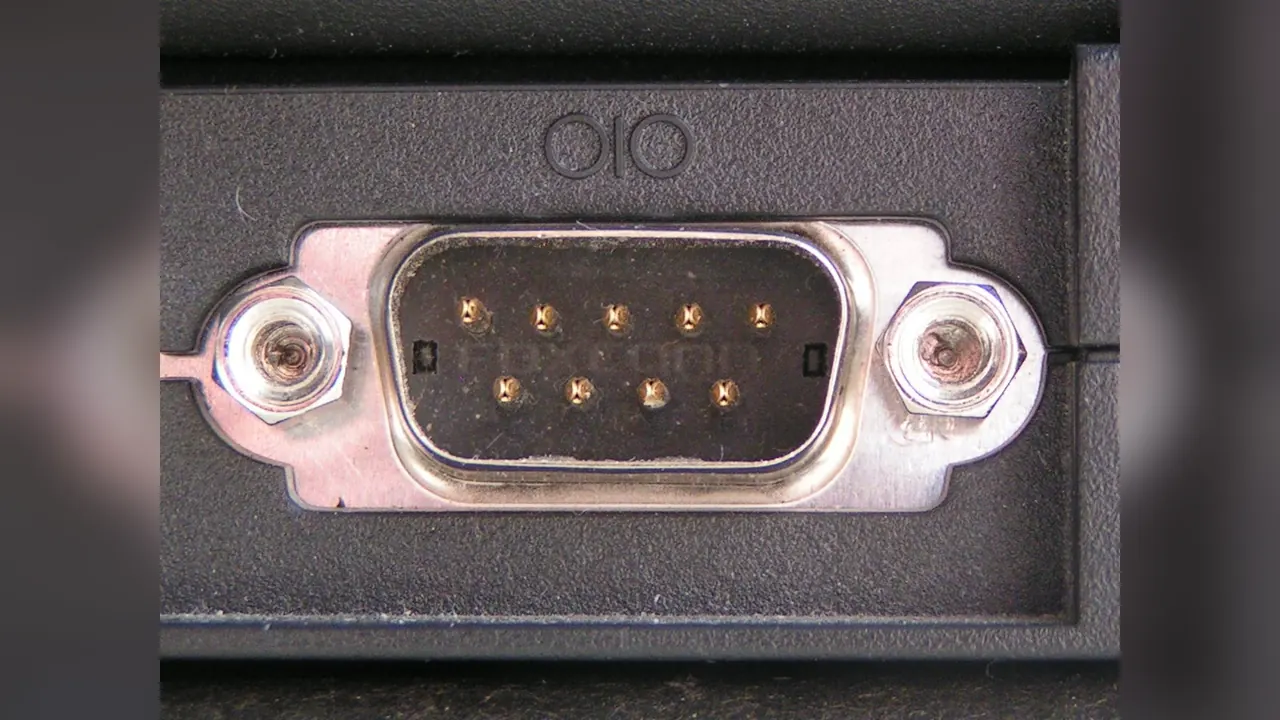
The relevance of the serial interface is proven by its trajectory and the specifications that defined it. The RS-232 standard, in its initial conception, was defined for a communication that used up to 25 wires. However, during development, the need for simplification was crucial. It was IBM who, when developing the IBM-PC, reduced the need for pins to only 9, although the DB25 connector remained in use because it was a standard of the time. This evolution demonstrates the constant tension between technical complexity and the practical need for standardization in the computer market.
In this article, we will take a detailed journey to unravel the history behind this essential communication. We will begin by addressing the need for standards in mass communication, to then delve into the birth of RS-232 and how it works in bit-by-bit transmission. We will analyze the transition from initial complexity to standardization, and finally, we will examine the legacy of the interface, from the age of modems to its role in the current technological landscape. Get ready to understand how this port shaped the evolution of PCs.
Key Points
- Serial communication transfers data sequentially, one bit at a time, requiring precision.
- The RS-232 standard was initially defined to use 25 wires, which was complex.
- IBM promoted a technical optimization, reducing the need from 25 to 9 pins.
- The serial interface is vital for connecting peripherals such as modems, mice, and printers.
- Market inertia caused the DB25 connector (25 pins) to persist after simplification.
The need for standards: The problem of mass communication

Before computing became the universal machine we know, the landscape was largely a battleground of interfaces. Peripheral equipment—modems, printers, mice, and scanners—were mostly technological islands. They existed, but they spoke different dialects. Mass communication, or the ability of a central computer to communicate reliably and standardized with a variety of external devices, was a monumental challenge. Without an established “common language,” connection was an act of luck, not engineering. One device might work perfectly on one machine, but when transferred to another model, communication would fail, leading to frustration and limitations in development.
The solution to this cacophony of connections was not a single event, but rather a process of trial and error that culminated in the need for rigorous standards. Serial interface, which we know today as RS-232, was born precisely to impose order on this chaos. It is an essential communication port that allows data transfer sequentially. Instead of sending large blocks of information simultaneously, the serial interface operates by transferring bits in a queue, one data bit at a time. This methodology, although it seems simple, required an extremely precise communication protocol to ensure the receiver interpreted the sequence correctly.
📘 Serial Interface
It is a communication port that allows data to be transferred sequentially, sending bits one by one.
Initial Complexity and the Pin Dilemma
In the beginning, the RS-232 standard was defined with considerable complexity, requiring the use of 25 different wires for communication. Although this number of pins was a reflection of the technology of the time, the search for efficiency and miniaturization soon arose. IBM, when developing the IBM-PC design, demonstrated that the number of pins could be drastically reduced. The company determined that only 9 pins would be sufficient to perform communication effectively.
This is the core of the standardization problem: the tension between technical optimization and market inertia. Despite the clarity and efficiency demonstrated by the 9-pin design, the DB25 connector, which used the original 25 pins, remained an established standard on many computers. This coexistence of standards—the ideal of 9 pins versus the reality of DB25—perfectly illustrates the challenge the industry faced. Technology needed a universal standard, but complexity and resistance to change created a transitional period where communication was, at times, a compromise between what was technically ideal and what was commercially acceptable.
The Birth of RS-232: IBM and Connector Standardization

The search for a common language in machine communication was not a linear process, but rather a complex negotiation between engineering and market needs. It is in this context that the RS-232 standard emerged, a specification that not only defines how data is exchanged but also establishes the physical form of the connectors that shaped the PC era. Although the serial interface is today associated with devices like modems, mice, and printers, its birth is intrinsically linked to the need for high-complexity standardization.
Initially, the RS-232 standard was defined for a considerable level of complexity. The original specification required the use of 25 distinct wires to ensure robust communication between equipment. This number of pins reflected the technical sophistication necessary for data transmission in an environment where uniformity was still an aspiration, not a reality. Transmission, as is known, occurs bit by bit, in sequence, requiring an extremely rigorous set of rules to ensure the signal was interpreted correctly by both sides of the connection.
IBM’s Intervention and Technical Optimization
The crucial moment in the history of the serial interface occurs with IBM’s entry into the development of the IBM-PC. When designing this seminal equipment, the corporation not only adopted the RS-232 standard but also promoted a significant technical optimization. IBM defined that the number of pins required for communication could be drastically reduced, going from 25 to only 9. This reduction represented a notable technical advance, promising greater efficiency and less physical complexity for the new computers.
However, the history of standardization is often marked by contradictions. Despite the clear technical advantage offered by the reduction to nine pins, the market did not abandon the original format. Computers continued to use the DB25 connector, the 25-pin format, because it was the established and current standard. To better understand the evolution of these connectors, check out the complete history of who invented the PS/2 port. This persistence demonstrates market inertia, where the cost and familiarity of the old standard often outweighed the optimization gains provided by the new specification.
Thus, the birth of the serial interface is a fascinating case study: RS-232 was conceived with high complexity but was refined by IBM. The attempt at simplification, by reducing the number of pins to nine, illustrates the constant tension between the pursuit of maximum technical efficiency and the reality of the stability and mass adoption that the market demands.
📊 Evolution of Serial Interface Connectors
| Standard/Connector | Number of Pins | Context of Use |
|---|---|---|
| Original RS-232 | 25 | Initial requirement for robust communication |
| IBM Optimization | 9 | Proposal for greater efficiency in the IBM-PC |
| Maintained Connector | 25 | DB25, the established and current market standard |
How The Serial Port Works: Bit-by-Bit Transmission
The essence of the serial port lies in its methodical way of moving data. Unlike other forms of communication, the serial interface operates by transferring information in a queue, meaning one data bit at a time. To a layperson, this means data is sent in a continuous sequence, one after another, as if being unloaded on an assembly line. This sequential approach is what defines the “bit-by-bit” mechanism of the communication.
The Difference Between Serial and Parallel
To understand serial operation, it is useful to briefly compare it to the parallel model. While parallel communication sends multiple data bits simultaneously—using several pins to carry a block of information at once—serial communication restricts sending to a single data channel at a time. In practical terms, serial requires a very precise clock and synchronization mechanism to ensure the receiver understands the exact moment each bit is being transmitted. It is this sequential precision that allows devices like modems, mice, and printers to communicate reliably with the computer.
🧪 The Evolution of Connectors: From Excess to Simplification
The RS-232 standard was initially designed to use 25 wires. However, when IBM implemented the standard in the IBM-PC, the requirement was reduced, and only 9 pins were sufficient for practical communication.
The physical mechanism of this transmission involves dedicated pins that represent electrical signals. Although the detailed functioning of the signals is complex, the role of the pins is essential: they are the channels through which the information travels. Each bit is an electrical signal (usually representing a 0 or a 1) that is sent through one of these channels. The reception and decoding of these signals allow the computer to interpret the sequence of voltages as readable data, whether it is a character, a number, or a command.
The history of serial port standardization reveals a fascinating dilemma between technical complexity and practicality. The RS-232 standard was initially conceived for a communication that required the use of 25 different wires. However, when IBM used this standard in its IBM-PC design, the communication requirement was reduced, and it was determined that only 9 pins would be necessary for operation. It is interesting to note that as technology advanced, other standards also underwent processes of creation and simplification, such as the history of the PS/2 port and its peripherals. Despite this technical simplification, the DB25 connector, which used 25 pins, remained in use on computers for a long period, demonstrating how market inertia and established standards can sometimes persist even after technological evolution.
The serial interface, therefore, is a system that balances the precision of sequential transmission with the historical complexity of its connectors, and it has been fundamental for connecting various hardware devices, such as USB drives, scanners, and certain types of printers, to this day.
From Complexity to Standard: Pin Reduction and Evolution

The history of the serial interface is not just a story of how data was moved, but also a fascinating case study on the tension between technical optimization and market inertia. The RS-232 standard, when conceived, was intrinsically complex. Initially, it was defined for a communication that required the use of 25 different wires, a number that reflects the ambition and complexity of the original design of the time.
Simplification Driven by IBM
However, the technological landscape underwent a crucial turning point with IBM’s entry into the development of the IBM-PC. This new phase of engineering brought with it the need to refine and simplify the system. IBM, by using the RS-232 standard in its design, established that it was possible and, consequently, necessary, to reduce the physical complexity of the system. This optimization allowed communication to be carried out with only 9 pins.
🤔 Did You Know?
Did you know? The transition of the serial standard showed a dilemma: although engineering could simplify from 25 to 9 pins, the market often kept the more complex connector (DB25) due to inertia.
This reduction in pins represents a significant advance in the practicality of the interface, demonstrating that the standard, although robust, was subject to revisions and improvements based on the practical needs of mass computing. The ability to reduce physical requirements while maintaining serial functionality is a testament to the continuous evolution of engineering.
Despite the clear technical simplification achieved by IBM—the transition from 25 wires to only 9—the market showed remarkable resistance to change. Instead of fully migrating to a new connector that reflected the efficiency of 9 pins, the DB25 connector, which was the standard established at the time, maintained its persistence in many manufactured computers. This persistence of the DB25, even after the theoretical reduction in the need for pins, perfectly illustrates the historical dilemma: the strength of an established standard, no matter how complex, often outweighs the pursuit of maximum technical efficiency.
In summary, the trajectory of RS-232 is an eloquent example of how standardization works. It began with high complexity, was refined for greater practicality by IBM, but its historical adoption, marked by the maintenance of the DB25 connector, shows that market reality, with its own forces of inertia, is as powerful a factor as innovation itself.
The Interface’s Legacy: From Modem to Technological Past
The impact of the serial port, or RS-232, transcends mere data transmission technique; it represents a fundamental milestone in the growth and proliferation of personal computers. The serial interface was the backbone of communication with various peripherals essential for the work and leisure environment of the time. Equipment such as modems, which allowed remote communication, mice, scanners, and certain printers depended intrinsically on this port to function. By standardizing the method of queuing bits—one data bit at a time—RS-232 ensured that these devices could interact reliably with the computer’s core, accelerating the adoption curve and the diversification of the PC market.
The interface’s journey, however, is a fascinating study of the tension between theoretical standards and practical necessity. The RS-232 standard was initially conceived for complex communication that required the use of 25 different wires. This initial complexity, although robust in terms of sequential precision, created manufacturing and cost challenges. The historical turning point occurred with the development of the IBM-PC. By adapting and refining the standard for this project, IBM demonstrated that it was possible to drastically reduce physical complexity, defining that only 9 pins would be necessary for functional communication.
This reduction in pins illustrates a classic engineering dilemma: technical efficiency versus market inertia. Despite the simplification achieved, the DB25 connector, which used the greater number of pins, remained in use for a long time on the computers of the era. To better understand the evolution of interfaces, it is interesting to check Who invented the VGA port?. The popularity and investment already made in the original standard created notable resistance to the immediate adoption of the simplified version. Thus, the serial port established itself as an extremely functional and reliable technology, but also as an example of how the market can, at times, dictate the pace of technological evolution, even after more optimized solutions exist.
The Transition to the Future
Although the serial port was indispensable for the first generation of PCs and enabled a vast range of crucial peripherals, the technological landscape inevitably demanded an evolution. The inherent limitation of sequential transmission and the volume of pins required, even after IBM’s optimization, made the system less practical for the growing demands of the century. The need for faster, more robust interfaces with less reliance on dedicated pins drove the search for alternatives. This search culminated in the rise of more modern interfaces, such as USB, which represented the next evolutionary leap, overcoming the physical and speed restrictions imposed by the serial port’s legacy.
Glossary
- Serial interface: A method of data transfer in sequence, sending bits one by one, in a queue.
- RS-232: The standard that defines the rules and the way data is exchanged in serial communication.
- Bits: The smallest units of data, which are electrical signals (0 or 1) transmitted sequentially.
- Parallel Communication: A method that sends multiple bits of data simultaneously, using several transmission channels at the same time.
- DB25: The name of the connector that used the original 25 pins, which was a historically established standard.
- Pin: The physical conductor of a connector that represents an electrical signal for data transmission.
Frequently Asked Questions
What is the main difference between a serial port and a parallel port?
Serial communication operates by sending data bits in a queue, one by one, using a single channel. In contrast, parallel communication sends multiple data bits simultaneously, using several pins to carry a block of information at the same time.
Is the serial port still used in modern computers?
Yes, the serial interface, such as RS-232, continues to be used for communication with various peripherals. It is essential for connecting specific hardware equipment, ensuring reliable data exchange.
Why did the RS-232 standard change from 25 pins to 9 pins?
This reduction was a significant technical advance, driven by IBM in the development of the IBM-PC. The optimization demonstrated that it was possible to drastically decrease the physical complexity of the system, increasing communication efficiency.
What is a serial interface and what is it used for?
It is a communication system that allows data to be transferred sequentially, sending bits in a queue. It serves as an essential port for external devices, such as modems, scanners, and printers, to interact with the computer’s core.
What technology replaced the serial port in most current PCs?
The evolution of computing led to the search for more efficient and miniaturized interfaces. The replacement occurred with the introduction of new standards that offer greater practicality and less physical complexity for connecting devices.
Conclusion
The history of the serial port is more than just the chronology of a connector; it is a fascinating study of the imposition of order in a technological battlefield. Before RS-232, communication between peripherals and the computer was a cacophony of dialects, where each device was an isolated technological island. The serial interface, by operating bit-by-bit data transfer, emerged as the common language needed to transform chaos into a functional system, allowing modems, printers, and mice to converse with the system core.
The dilemma of standardization reaches its peak in the tension between engineering and the market. Although the original specification required the complexity of 25 pins (the DB25), IBM demonstrated a remarkable advancement by optimizing the design of the IBM-PC, reducing the requirement to only 9 pins. However, market inertia kept the 25-pin format in use, illustrating how commercial stability sometimes supersedes technical efficiency. This event is the core of the saga: the pursuit of maximum simplicity collided with the reality of mass adoption.
The serial port, therefore, is a monument to industrial negotiation. It is not just a means of data transmission, but proof that technology, to be universal, requires consensus. By reflecting on the struggle between the ideal of 9 pins and the reality of the DB25, we are invited to ask: at what point does market practicality become a creative limitation on innovation?