
Read this article in: Portuguese (Português) · Spanish (Español)
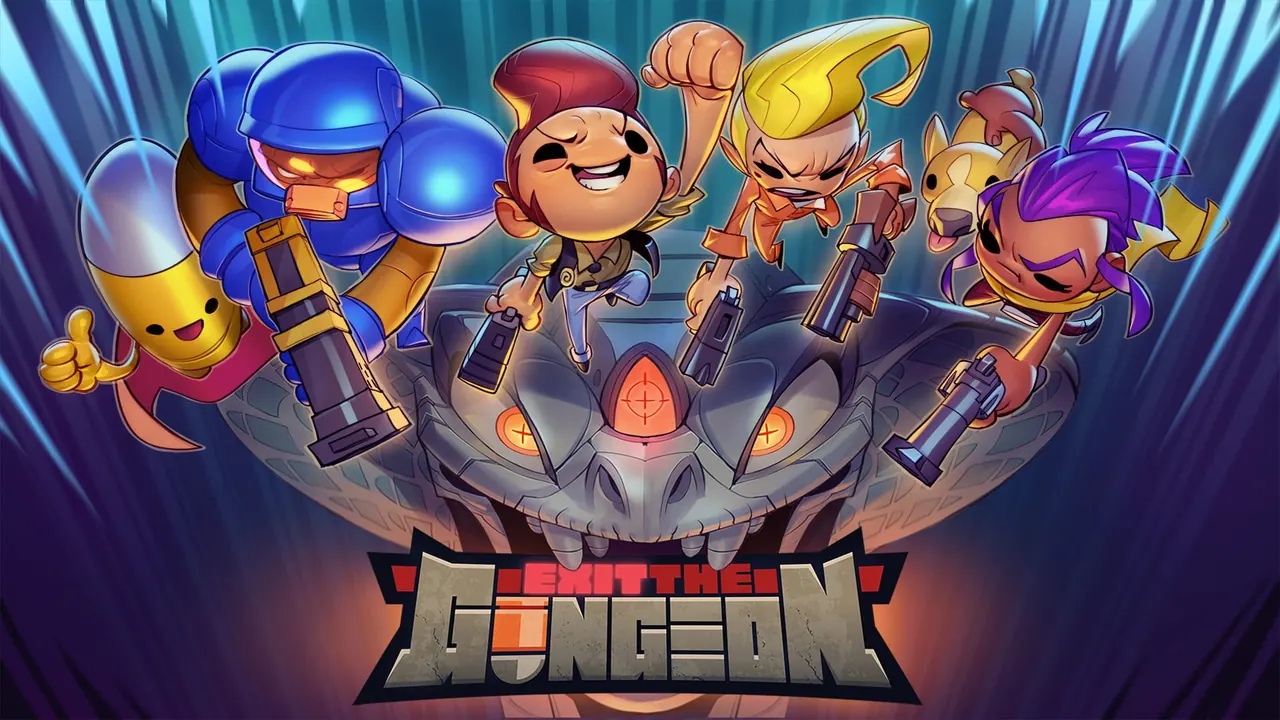
For those looking to know who created Exit the Gungeon, the answer points to a collaboration of studios specializing in action games. The title is a co-development between the teams Dodge Roll and Singlecore Games, and its publication was handled by Devolver Digital. The game quickly established itself in the indie scene, captivating players with its unique formula. It is classified as a platformer game and belongs to the “bullet hell” genre, a style that requires precision and quick reflexes to survive the intense flow of enemy projectiles.
The relevance of Exit the Gungeon is not measured only by its challenging genre, but by its longevity and reach. The game premiered on iOS through Apple Arcade on September 19, 2019, and shortly after, its expansion was massive. It was released on multiple platforms, including macOS, Windows, Nintendo Switch, PlayStation 4, and Xbox One. This process of adaptation and release across different operating systems and consoles demonstrates the developers’ commitment to bringing the Gungeoneers experience to the largest possible number of players.
In this article, we will dive into the complete history behind this “bullet hell” genre phenomenon. We will explore the team behind the Gungeon, the origin of the idea, and what makes the gameplay so addictive. We will cover the challenging mechanics and the role of technical development in the production. Furthermore, we will trace the release history, the process of expanding to various platforms, and finally, provide a detailed analysis of the game’s critical reception and lasting legacy in the world of independent video games.
Key Points
- The game combines the bullet hell genre with roguelike elements, requiring constant dodging of projectiles.
- Dodge Roll and Singlecore Games are the developers, responsible for the gameplay engineering and complex mechanics.
- Devolver Digital acted as the publisher, being crucial for the strategic positioning and global success of the title.
- Central mechanics include the dodge roll, the Underbreach system (refueling point), and weapon transformation (‘blessing’).
- The game was released on multiple platforms, including Windows, macOS, iOS, Switch, PS4, Xbox One, and Android.
Exit the Gungeon in Summary
| Developers | Dodge Roll; Singlecore Games |
|---|---|
| Publisher | Devolver Digital |
| Genres | Bullet hell, platform |
| Platforms | Windows; macOS; iOS; Switch; PlayStation 4; Xbox One |
| Game Mode | Single-player |
| Release | iOS (Apple Arcade); September 19, 2019; Mac, Windows, Switch; March 17, 2020; PS4, Xbox One; November 13, 2020; Android, iOS; August 14, 2025 |
Who Created Exit the Gungeon? The Team Behind the Gungeon
To understand the success of Exit the Gungeon, it is essential to look at the synergy between the studios that created it and the company responsible for bringing it to a global audience. Far from being the work of a single creator, the title is the result of specialized collaboration that combined creative vision, technical excellence, and deep knowledge of game marketing. The game’s development involved the studios Dodge Roll and Singlecore Games, while Devolver Digital assumed the crucial role of publisher, ensuring that the work reached a massive and diverse audience. This development complexity is not exclusive to action games; even simulation titles, such as the creation story of Microsoft Flight Simulator, require a vast history of engineering and collaboration.
The Creative Engine: Dodge Roll and Singlecore Games
The studios Dodge Roll and Singlecore Games are responsible for the engineering and the soul of Exit the Gungeon. They were the architects of a title that not only belongs to the bullet hell genre but also incorporates complex roguelike elements. The combined work of these developers was not limited to creating a challenging game; they built a robust gameplay ecosystem. The mechanics of dodging bullets, the Underbreach system, where players can switch Gungeoneers and buy items, and the weapon transformation system are examples of the technical depth they implemented.
The developers’ dedication allowed the game to be released on multiple platforms, solidifying its presence on systems such as Windows, macOS, iOS, Nintendo Switch, PlayStation 4, and Xbox One. This technical reach and the maintenance of a cohesive game design across so many platforms attest to Dodge Roll and Singlecore Games’ ability to deliver a high-quality experience while remaining faithful to the challenge of the “gungeon.”
The Market Force: Devolver Digital
If the studios were the builders, Devolver Digital was the catalyst for its success. As a publisher, Devolver’s role is vital, as it not only finances the project but also strategically positions it in the market. Devolver Digital’s expertise in launching independent and niche titles ensured that Exit the Gungeon was seen not just as another action game, but as a cultural event within the gaming community. The publisher is responsible for transforming the technical and artistic potential of the developers into a global sales phenomenon, exponentially increasing the game’s visibility and reach.
In summary, the success of Exit the Gungeon is a case study in industrial collaboration. Dodge Roll and Singlecore Games brought the expertise needed to create a challenging and technically complex addiction, utilizing mechanics such as the dodge roll and roguelike progression. Devolver Digital, in turn, provided the necessary launch platform and marketing support for this digital work of art to reach players across all major systems, from iOS on September 19, 2019, to subsequent releases on other platforms over the years.
The Origin of the Idea and the Bullet Hell Genre
To understand the essence of Exit the Gungeon, one must delve into two interconnected concepts: the “Gungeon” setting and the game genre known as bullet hell. Simply put, the game is a 2D bullet hell platform, where the player takes on the role of one of the characters, the Gungeoneers. The central objective, and the game’s narrative engine, is escape: the Gungeoneers must flee a collapsing Gungeon. This setting is not merely a stage, but a constant challenge system, where every level and every movement counts toward survival.
The Bullet Hell Challenge
The bullet hell genre (or danmaku) is characterized by intense and chaotic patterns of gunfire. Unlike traditional shooting games where the focus is solely on combat, survival in this genre depends predominantly on evasion. Players don’t just shoot; they must constantly maneuver, dodging hordes of enemy projectiles. In Exit the Gungeon, this mechanic is applied intensely, forcing players to develop precise movement mastery. This level of excellence and recognition of extraordinary feats even echoes in historical contexts, such as the study of the Medal of Honor.
The gameplay is structured around a series of combat encounters. The Gungeoneers travel in an elevator, being attacked by weapon-themed enemies that appear around them. The combat is dynamic and based on random weapon transformation, a system the game calls a “blessing.” This mechanism is crucial: the more enemies the player manages to eliminate in sequence without taking damage, the higher the probability that the next weapon transformation will be into a more powerful form. Furthermore, progress is not gained merely through brute force; players collect an in-game currency, Hegemony Credits, which are obtained by defeating bosses and are used to unlock new types of weapons, which can, in turn, be randomly transformed.
The Roguelike Structure and Survival
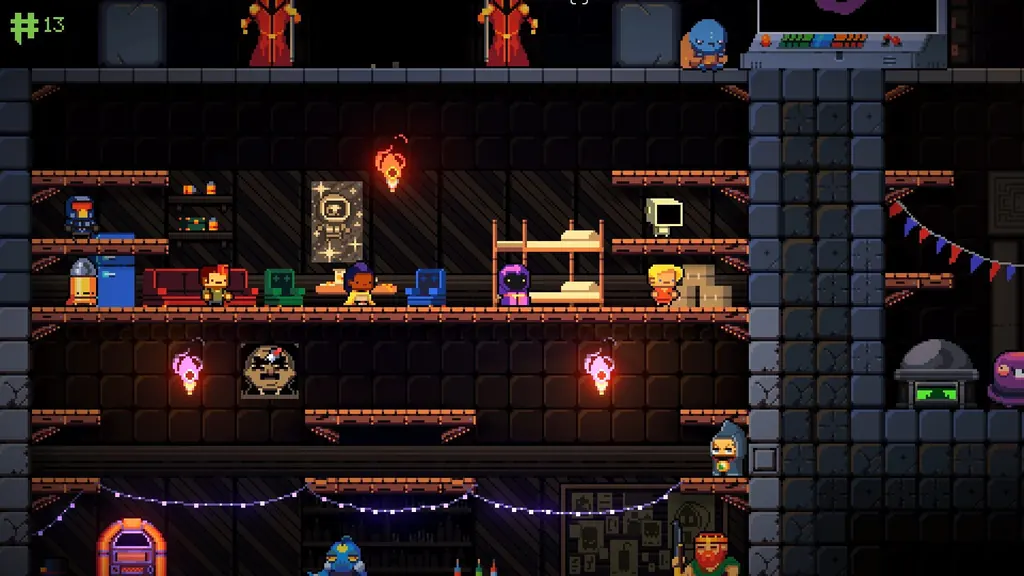
The challenge of escaping the Gungeon is reinforced by a roguelike structure. When the player fails, they don’t simply stop; they are sent back to a safe area called Underbreach. This location functions as a resource and strategy hub. In the Underbreach, the player can switch between available Gungeoneers, interact with non-playable characters, or, more tactically, use Hegemony Credits to buy items and weapons that can be found randomly during the run. This combination of high-intensity combat, resource management, and the constant threat of the Gungeon’s collapse gives the title an addictive and deeply challenging pace.
The fluidity between the frantic action of dodging projectiles in combat and the strategic pause of the Underbreach ensures that, even after several frustrating attempts, the player always has a new objective: the next weapon transformation, a new character to test, or the next passage through the elevator toward the much-needed exit from the Gungeon.
Gameplay: Mechanics and the Challenge of the Gungeoneers
Exit the Gungeon establishes itself as a vibrant and chaotic 2D platformer, set in the bullet hell genre. The player’s central objective is simple but extremely challenging: escape the ruined Gungeon. To do this, the player takes on the role of one of four playable characters, known as Gungeoneers. Each of these adventurers possesses a unique set of levels and characteristics, lending a layer of replayability and tactical depth to the combat experience.
Combat Mechanics and Progression
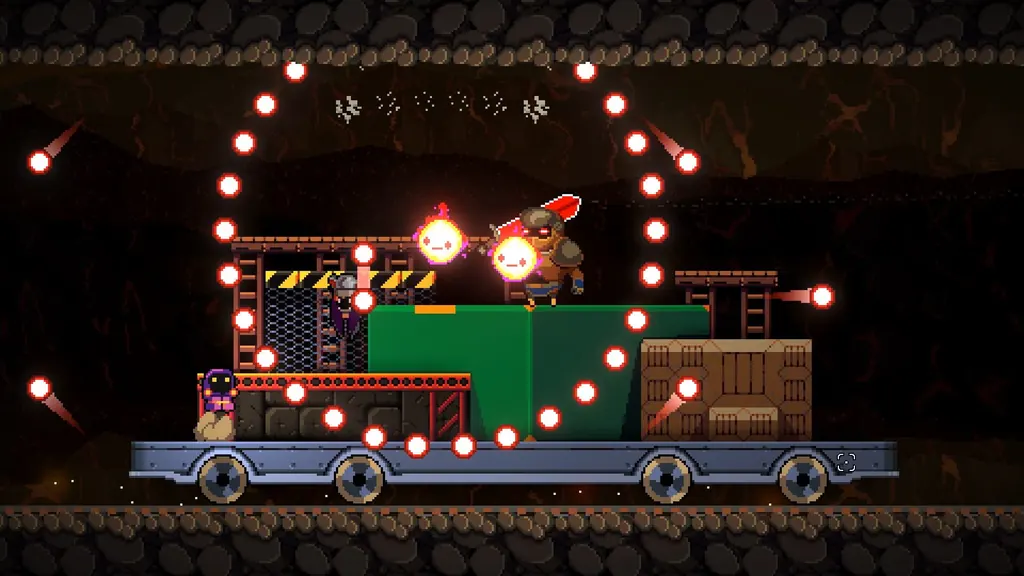
The heart of the gameplay lies in the intense and unpredictable combat. The Gungeoneers are confronted by weapon-themed enemies that appear around them. The main offensive tool is a weapon that undergoes a random transformation over time—a system the game calls a “blessing.” This mechanism not only ensures variety but also requires the player to constantly adapt to different types of weaponry. The system rewards mastery and persistence: the more enemies the player manages to eliminate in sequence without taking damage, the higher the chance that the next transformation of their weapon will be into a more powerful form.
Progression and the development of the arsenal depend on a resource collection system. By defeating bosses, players obtain a in-game currency called Hegemony Credits. These credits are crucial because they allow players to unlock new weapons and transformation types. Once unlocked, the game can randomly transform the player’s weapon into this new format, ensuring that the arsenal never becomes predictable.
Survival and the Roguelike Cycle
To navigate the danger of the Gungeon, movement is as vital as shooting. Players use the dodge roll (evasive roll) or jump to evade enemy attacks. This movement is crucial, as it allows the character to be immune to losing health points while airborne. This combination of frantic combat and evasion mechanics defines the game’s dizzying pace.
The game structure operates under a roguelike model. If the player fails and dies, they are not permanently eliminated. Instead, they are sent back to a safe area, known as Underbreach. This location serves as a strategic and planning pause point. In the Underbreach, the player can interact with non-playable characters (NPCs), switch between different Gungeoneers, and, most importantly, spend accumulated Hegemony Credits to buy new weapons and items that can be found randomly during the game. This cycle—exploring, fighting, and then using the Underbreach to prepare for the next attempt—is what guarantees the depth and high replayability of Exit the Gungeon.
Technical Development and Production Challenges
The process of creating a game like Exit the Gungeon is a complex engineering feat, requiring the studios Dodge Roll and Singlecore Games to master the technical challenges inherent to the bullet hell genre. This genre, by nature, imposes one of the greatest demands on graphical performance and real-time processing in the gaming industry: managing hundreds of simultaneous projectiles, each with its own trajectories and collisions. The team had to build an engine capable not only of generating intense visual chaos but also of maintaining the stability and fluidity of the *framerate* even under this information overload.
The Technical Complexity of Frantic Combat
The main production challenge was not merely creating chaotic shooting patterns, but developing a collision and projectile tracking system that was simultaneously unpredictable and predictable enough for the player to learn and adapt to. In an environment where movement is as vital as shooting, the game required extremely precise physics. Every bullet, whether an enemy attack or a resource obtained by the player, had to be calculated in real time, requiring a delicate technical balance between the feeling of extreme danger and ensuring that the player’s progression was always rewarding.
To ensure the difficulty was challenging but never frustrating in terms of technical execution, the developers had to implement a sophisticated system of *hit detection* and state management. This meant that, in addition to designing the attack patterns, they had to code the mathematics behind how the character interacts with the environment and the flow of bullets, ensuring that the gameplay was challenging without ever collapsing under the weight of its own visual resources.
Adaptation and Multiplatform Reach
The game’s technical success was proven by its ability to transition across a vast array of platforms. The developers’ dedication to bringing Gungeon to a global audience resulted in a meticulous and comprehensive release schedule. The game debuted on September 19, 2019, through Apple Arcade for iOS. Next, the expansion to the computer ecosystem occurred on March 17, 2020, reaching macOS, Windows, and Nintendo Switch. Console consolidation was marked by the release on November 13, 2020, available for PlayStation 4 and Xbox One.
This need for optimization and portability across such diverse systems—from the processing power of a next-gen console to the resources of a mobile device—represents the peak of the production challenge. The fact that there was a separate release for Android and iOS on August 14, 2025, demonstrates the continuous engineering required to maintain the fidelity of the gaming experience, regardless of the hardware the player was using. In summary, the game’s success is a testament to the technical mastery of Dodge Roll and Singlecore Games in transforming a concept of chaotic combat into a playable and technically robust experience across multiple screens.
Release and Expansion to Multiple Platforms
The success of a niche game with high technical complexity like Exit the Gungeon is not measured only by the quality of its gameplay, but also by its adaptability and reach. The title’s release journey, developed by Dodge Roll and Singlecore Games and published by Devolver Digital, is a case study in the ambition of bringing a challenging *bullet hell* title to as many platforms as possible. The release timeline not only shows the growth in the game’s popularity but also the immense technical challenge of maintaining the fluidity and complexity of the shooting patterns across such diverse systems.
Initial Expansion and Multiplatform Reach
The official debut of the game marked a start focused on the mobile ecosystem. The title was initially released on September 19, 2019, available to iOS users through Apple Arcade. This first release established the standard for chaotic and frantic gameplay that would later captivate players. In a rapid expansion pace, the developers quickly brought Gungeon to major computing systems. On March 17, 2020, the game arrived on Mac, Windows, and Nintendo Switch platforms, significantly expanding its player base and proving the portability of its intense mechanics.
The commitment to bring the title to the console audience was solidified in November 2020, with the release for PS4 and Xbox One. This series of successive launches—from mobile to next-generation consoles—is a testament to how robust and optimized the game’s code needed to be. The technical challenge was immense: ensuring that the collision system, projectile tracking, and roguelike structure functioned perfectly, regardless of the device’s processing power or architecture.
The Commitment to Longevity and Android
The release strategy, however, demonstrates a long-term view of market reach. Although consoles and PCs had already been dominated, support for the Android system was crucial for reaching the totality of mobile users. This release was scheduled for August 14, 2025. Mentioning such a distant, yet planned, date not only adds historical depth to the article but underscores the development team’s long-term planning, ensuring that the Gungeon experience was accessible on any modern device.
In summary, the technical success of Exit the Gungeon lies in its ability to transition across a vast range of platforms: from iOS, through Mac, Windows, Switch, PS4, and Xbox One, to Android. This synergy of releases not only guaranteed the game’s commercial success but also established a standard of complex engineering, proving that the challenge of escaping the Gungeon is an engineering feat that transcends the limitations of any hardware.
Critical Reception, Sales, and the Game’s Legacy
The trajectory of Exit the Gungeon is not defined by unanimous critical consensus, but rather by a cultural impact and longevity that solidified its status as a seminal title in the indie action scene. In terms of immediate reception, the game received reviews considered mixed or average on score aggregators like Metacritic, and OpenCritic pointed to fair approval, being recommended by 45% of critics. However, analyzing these scores in isolation would ignore the title’s true value: its ability to keep players engaged and the constant dialogue surrounding the bullet hell genre.
Analysis of Criticism and the Debate Surrounding Design
Specialized reviews reflected this “personal taste” nature that often accompanies niche and highly difficult games. Some critics pointed out aspects that, while not diminishing the title’s value, generated debate. For example, journalist Nic Vargus, from IGN, criticized the constant weapon switching, but acknowledged that the chaotic nature of each round made the game fun. In a more detailed analysis, Jon Mundy, from Nintendo Life, gave the game a score of 7/10, classifying it as a challenging action-platformer, but emphasizing that it lacked the “free imagination and tempting sense of adventure” that its predecessor possessed. On the other hand, Shacknews was more balanced, noting that the game was shorter than its predecessor and had less exploration, but praised the combat in terms of difficulty, considering it comparable and recognizing the arcade-style gameplay.
Despite these minor reservations regarding scope or narrative progression, the true legacy of Exit the Gungeon resides in its impeccable execution of the core gameplay. It proved that the success of a niche game with technical complexity is not measured only by platforms or an average score, but by its ability to generate a highly refined and addictive challenge. The title established a new design paradigm for the genre, proving that unpredictability and mastery in chaotic combat can sustain a deep and lasting gaming experience.
Therefore, the status of Exit the Gungeon transcended the cold analysis of critics. It became a title that defines a “modern classic” in the indie universe. Its resilience and the way it kept the community engaged, despite criticism about brevity or mechanical repetition, attest that the heart of the game—the relentless combat and the roguelike system—is, in itself, an achievement in entertainment engineering. The game didn’t just survive time; it cemented its place as a mandatory reference for any bullet hell enthusiast, a genre that has also flourished in titles like the Enter the Gungeon universe.
Frequently Asked Questions
What is the genre of Exit the Gungeon and what does ‘bullet hell’ mean?
Exit the Gungeon is a 2D platformer classified as bullet hell. This genre is characterized by intense and chaotic bullet patterns, where survival depends predominantly on constant dodging and maneuvering, and not just direct combat.
Who are the developers of Exit the Gungeon and what was the role of Devolver Digital?
The developers are the studios Dodge Roll and Singlecore Games, responsible for the engineering and mechanics. Devolver Digital was the publisher, whose role was to catalyze success, providing marketing support and positioning the game for a massive and diverse audience.
Is the game difficult? What is the learning curve for players?
Yes, the game is extremely challenging, requiring mastery of movement and precise dodging. The learning curve is maintained by a reward system: the more enemies the player eliminates without taking damage, the higher the chance of a more powerful weapon transformation.
Is Exit the Gungeon a spin-off? What is its relationship with Enter the Gungeon?
The provided article does not contain information regarding the relationship between Exit the Gungeon and any other title, such as Enter the Gungeon. The text focuses only on the synergy between the development studios and the publisher for the game’s success.
On which platforms was the game released, and what was the most recent release?
The game was released on several platforms, including Windows, macOS, iOS, Nintendo Switch, PlayStation 4, Xbox One, and Android. The most recent release mentioned in the text is on Android and iOS, on August 14, 2025.
Conclusion
The success of Exit the Gungeon lies in the complex fusion of high-intensity combat mechanics and an addictive progression structure. More than just a simple shooter, it is a case study in gameplay design, where survival in the chaotic “bullet hell” requires not only quick reflexes but also strategic planning. The gameplay alternates between frantic projectile dodging and tactical pausing in the Underbreach, allowing players to manage resources and use random weapon transformations, the so-called “blessing,” as a source of challenge.
This technical mastery was the result of the collaboration between the studios Dodge Roll and Singlecore Games, responsible for engineering the challenge, and Devolver Digital, which acted as a catalyst for global success. The publisher not only ensured the title’s reach on multiple platforms but also positioned the game as a cultural event within the gaming community. Thus, the success is a direct reflection of how digital art can be combined with ideal market support.
Ultimately, Exit the Gungeon teaches us that the true addiction of a game does not lie only in the challenge of dodging bullets, but in the constant promise of a new feature, a new character, or a new power. If you are looking for an experience that demands mastery in every move and rewards persistence, it is time to dive into the ruins and discover what it takes to finally escape the Gungeon.