
Read this article in: Portuguese (Português) · Spanish (Español)
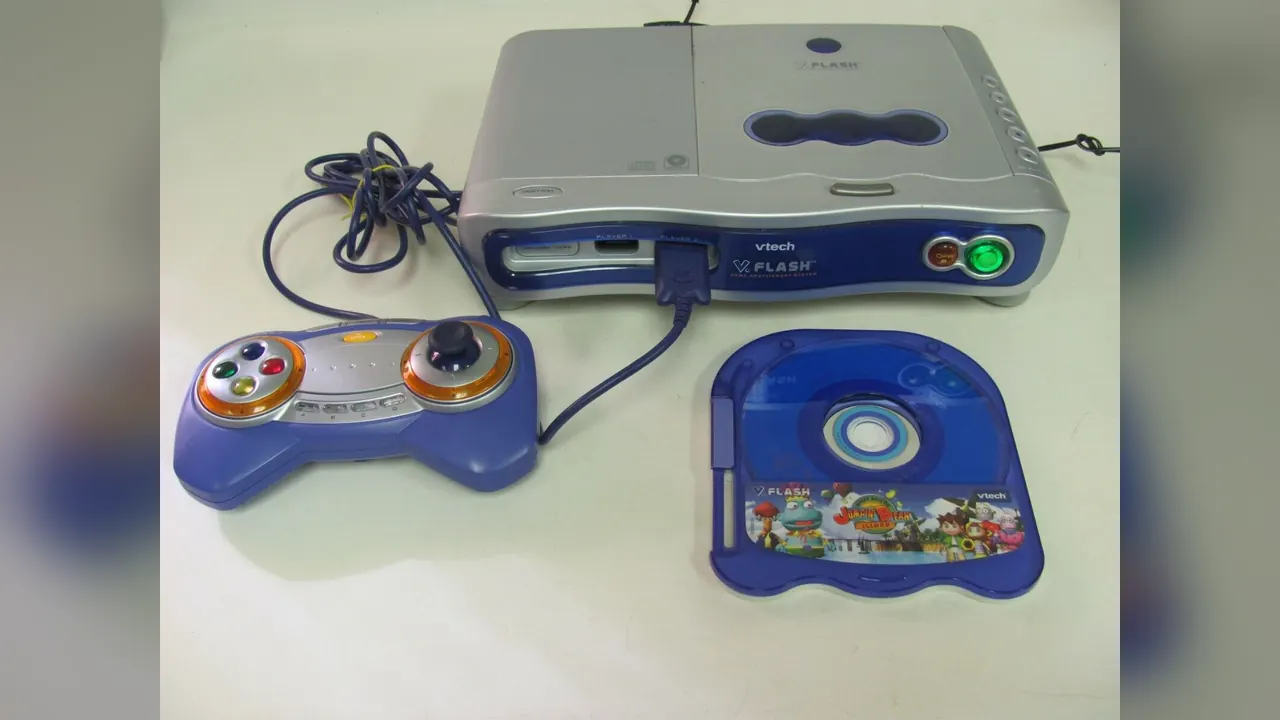
V.Flash was an educational seventh-generation video game system that marked a specific chapter in the history of home consoles aimed at children. Developed by VTech and Koto Laboratory, it emerged as a *spin-off* of the popular V.Smile series, differentiating itself from its predecessor by its ability to use three-dimensional graphics. Launched in September 2006, the system was designed for children aged 6 to 10 and represented a technological and gameplay evolution in the electronic toy market, seeking to bring the experience of more complex games into the educational environment.
The relevance of V.Flash in the educational technology market is evidenced by its positioning during a period of rapid hardware evolution. It is a seventh-generation console, equipped with an LSI Logic ARM9 processor, and was officially launched in September 2006. With an introductory price of $100, V.Flash competed in a niche market that valued the fusion of learning and entertainment. Although it was succeeded by InnoTV, it consolidated the model of the educational console that used innovative media, such as the custom “V.Discs.”
In this article, we will provide an in-depth analysis of the development and legacy of V.Flash. We will cover everything from the origin and context of the educational market to the technical challenges that shaped its design. We will explore the console’s architecture and specifications, the global marketing strategy, the innovative format of the V.Discs, and finally, analyze the critical reception, sales, and lasting impact of V.Flash on the toy and digital entertainment industry.
Key Points
- V.Flash was a seventh-generation educational console, developed by VTech in 2006.
- It featured an LSI Logic ARM9 processor and was capable of rendering up to 1.5 million polygons per second.
- The target audience was children aged 5 to 10, seeking cognitive development.
- It utilized V.Discs, custom CDs-ROM encased in plastic for protection and content.
- Launched for $100, the console was an ecosystem that combined learning with high 3D performance.
V.Flash Technical Specifications
| Manufacturer | VTech |
|---|---|
| Developer | VTech; Koto Laboratory |
| Type | Educational home video game console |
| Generation | Seventh |
| Release Date | September 2006 |
| Media | Custom encased “V.Discs” CD-ROM |
| Target Audience | Children aged 5 to 10 |
| Predecessor | V.Smile |
| Successor | InnoTV |
Origin and Context of the Educational Market

The landscape of electronic toys and games in the early 2000s was marked by an obvious dichotomy: on one side, the market for traditional toys, and on the other, highly complex video game consoles. For children, especially those aged 5 to 10, there was a gap in products that could balance advanced entertainment with rigorous pedagogical focus. Parents sought devices that were not merely toys, but tools that promoted cognitive development, without, however, presenting the learning curve and technical complexity of an adult console—a topic that relates to the rich history of video game consoles.
The Need for an Educational Technological Leap
It was in this market vacuum that VTech, in collaboration with Koto Laboratory, identified a development opportunity. The V.Flash console was conceived precisely to fill this gap. It needed to be significantly more advanced than its predecessor, the V.Smile, raising the technological standard of educational toys without sacrificing the learning character that the target audience demanded. The objective was clear: to offer a system that looked like a modern console but maintained a focus on child development, following the trajectory of innovation that shaped the history of handhelds.
To realize this vision, the V.Flash was equipped with an ARM9 processor from LSI Logic and graphics capable of rendering up to 1.5 million polygons per second, a processing power directly comparable to fifth-generation video game consoles, such as the PlayStation. This technical capability was crucial, as it allowed the device to be “3D Capable” and utilize a joystick input, elevating the gaming experience to a level never before seen in a toy of this category. The system was sold with an introductory price of $100, marking an ambitious market positioning.
The Media and Learning Ecosystem
The V.Flash’s differential also resided in its media format. Unlike most consoles of the time, it used “V.Discs,” which were 12 cm CDs encased in plastic. This protective design, besides being a measure against physical damage, also had an appeal of security against piracy. Curiously, the system was so versatile that, besides running educational content, it could reproduce audio CDs and CD-Rs recorded by the user, thanks to the provided disc adapter.
Thus, the V.Flash was not just a console, but an ecosystem of entertainment and learning. It combined the technical robustness of an advanced console with content curation and a focus on the development of children aged 5 to 10, solidifying its place as an essential transitional product between the simple electronic toy and the highly complex video game of the turn of the millennium, and which is part of the vast history of console development.
From Conception to Project: Technical Challenges and the Team
The transition from V.Smile to V.Flash represented more than just a simple model update; it was a generational and technological leap that redefined the standard for educational consoles. While the previous generation had already established a market niche, the V.Flash aimed to challenge the technical limitations of the time by shifting the focus to three-dimensional (3D) graphics. This advancement was crucial because it allowed developers to create more immersive and visually complex learning experiences for the target audience: children aged 5 to 10.
Engineering and Processing Challenges
To deliver this graphical promise, the project faced significant engineering challenges. VTech, in collaboration with Koto Laboratory, had to integrate cutting-edge technology, such as the LSI Logic ARM9 processor, into a consumer product aimed at the child’s world. The use of a 32-bit processor and the ability to render up to 1.5 million polygons per second placed the V.Flash at a performance level comparable to fifth-generation consoles—a remarkable feat for the category. The challenge was balancing this raw power—necessary for 3D fluidity—with the need to keep the device accessible and, above all, pedagogically functional.
The hardware and software planning had to be meticulous to ensure that high graphical performance did not compromise the educational objective. The system, launched in September 2006, was a complete ecosystem, utilizing not only the custom “V.Discs” CD-ROM as the primary media but also a memory card to save game progress. The architecture required sophisticated data flow control, which guided the user through learning challenges without sacrificing the visual experience.
Global Content Production
Beyond the technical complexity, the project required vast content logistics. Game development was not an isolated effort; it involved partnerships with prestigious institutions, such as the Princeton Review, which contributed educational content for various titles. The distribution of the V.Flash was also a multinational undertaking. Although the focus was the American market, the games were released in several territories, including the United Kingdom, Spain, France, Germany, and Mexico. This regional strategy demonstrates the scale and rigor of the conception process, adapting content and technical *know-how* for multiple cultures and markets.
In summary, the V.Flash was not just a seventh-generation console; it was a project that successfully channeled the processing power of the ARM9 and the rendering capacity of 1.5 million polygons per second toward a specific purpose: creating a sophisticated digital learning experience, thereby establishing a new standard of technical demand for the electronic toy market.
Console Architecture and Technical Specifications
The V.Flash, developed by VTech and manufactured by the company itself, established itself as a seventh-generation educational video game console. Its processing power was central to its technical differential. At the heart of the system was an ARM9 processor from LSI Logic, responsible for sustaining graphical complexity and the processing of educational content. Graphically, the console was capable of rendering up to 1.5 million polygons per second, a capacity that positioned it technologically ahead of many competitors of the time and guaranteed the 3D Capable experience promised to users. Complementing this raw power, the system utilized a joystick controller for data input and a dedicated memory card for internal storage, ensuring the persistence of game data and settings.
The V.Discs Media System
The most distinctive and technically complex aspect of the V.Flash was its media system. While other consoles of the era frequently used formats like UMDs or memory cartridges, the V.Flash used the so-called V.Discs. These were not standard CDs; they were customized CDs-ROM encased in plastic with a 12 cm diameter. This packaging not only protected the disc from physical damage but also created a barrier against piracy. Although the protection was physical, the disc itself operated under the ISO 9660 file system, and notably, it lacked advanced copy protection mechanisms, which facilitated the creation of disc images from the media. This technical openness allowed the V.Flash to not be restricted only to games: the console could play audio CDs and even user-recorded CD-Rs, provided the supplied adapter was connected.
From a data architecture standpoint, the V.Flash was a multimedia ecosystem. Support for the flexible disc format, combined with the operating system, required the manipulation of various file types. Developers needed to manage specific formats for different types of content, such as map or scene files in .mjp, programming or game logic files in .ptx, and sound and audio files in .snd. This versatility of file formats, coupled with the ability to read external media, established the V.Flash not just as a game player, but as a highly adaptable educational content platform, capable of beginning its life cycle in September 2006 and operating until 2007.
Launch and Global Marketing Strategy
The unveiling of the V.Flash was meticulously planned by VTech, culminating in a highly visible event in the toy and technology sector. The console was revealed to the public and press during the London Toy Fair in 2006. This international stage not only served as a display point but also as a strategic announcement of the generational leap the product represented. The reveal was crucial for repositioning VTech in the market, signaling that the V.Flash was not merely a successor to the V.Smile, but a device capable of integrating high graphical performance with rigorous learning content.
Commercial Launch and Initial Positioning
Following the exhibition, the V.Flash was officially launched in September 2006. The commercial strategy was direct and assertive: the system was made available to consumers at an introductory price of $100. This initial value solidified the V.Flash as a seventh-generation educational home video game console. VTech, which was both the developer and manufacturer of the product, ensured total control over the user experience. The system was powered by a new media format, the V.Discs, customized CD-ROM casings that contained the learning content. This combination of advanced hardware—equipped with the LSI Logic ARM9 processor and 3D graphics—and a proprietary media ecosystem ensured that the V.Flash was perceived as a complete system, and not just a toy.
The global marketing strategy was designed to move beyond the traditional focus on children (ages 5 to 10), targeting the actual purchasing decision-makers: parents and educators. By directing communication to these groups, VTech managed to frame the V.Flash not just as entertainment, but as a valuable educational tool. This sophisticated approach was essential for sustaining the console’s high perceived value. Distribution was planned to reach major Western markets, ensuring sales reach in crucial regions such as the United States, United Kingdom, Spain, France, and Germany. This broad geographical coverage not only increased market reach but also validated the V.Flash as an international-scale product.
In summary, the launch of the V.Flash in September 2006 represented the consolidation of an ambitious technological project. The combination of a prestigious reveal event, an accessible entry price of $100, and a marketing strategy focused on parental and educational authority allowed VTech to establish the V.Flash as a milestone in the history of educational consoles. Although the sales cycle ended in 2007, the launch not only set the standard for the seventh generation of electronic toys but also paved the way for subsequent line successors, such as the InnoTV.
Game Catalog and the Innovative V.Disc Format
Despite the ambitious technological leap represented by the V.Flash, the game catalog and content ecosystem faced significant challenges related to sales performance. Unlike the success of its predecessor, the V.Smile, the V.Flash did not achieve such wide market penetration. This sales restriction, however, did not halt development but instead directed content efforts toward a highly specialized and innovative distribution format: the V.Discs.
The Innovative V.Discs Format
The most distinctive aspect of the V.Flash and the core of its content distribution was the proprietary media system, the V.Discs. These were not mere cartridges; they were encapsulated and adapted CD-ROM discs, specifically designed to protect and distribute digital content. This media architecture not only guaranteed the integrity of the material but also established the V.Discs as the primary means of distributing games and educational programs for the console.
The focus of the game catalog strictly followed VTech’s educational mission. The developed titles aimed to stimulate learning in various areas, involving renowned institutions like The Princeton Review, which collaborated on developing educational content for some of the games. Compatibility with the V.Smile was an important point of connection, ensuring content progression for users already familiar with the VTech product line.
In terms of catalog, the V.Flash had a total of ten known launch titles. The distribution of these games was geographically segmented. The titles were released in several countries, including the United States, United Kingdom, Spain, France, and Germany. However, the launch of some games was regionalized. For example, while the title Bratz Fashion Pixiez: The Secret Necklace was not released in the United Kingdom and Germany, the game Multisports/Defis Sports was exclusive to Germany and France. In other cases, such as Scooby-Doo!: Ancient Adventure, the exclusion of markets like Germany was also noted. Furthermore, specific titles, such as Bratz Fashion Pixiez: The Secret Necklace and Cars: In the Fast Lane, had an additional release in Mexico.
In summary, the V.Discs not only solved the logistical challenge of distributing high-quality content but also solidified the V.Flash as a multimedia ecosystem. Although the catalog was limited compared to the potential of the hardware, the innovation in the media format and the thematic focus on education and entertainment ensured the continuity of the VTech learning product line.
Critical Reception, Sales, and the Legacy in the Toy Industry
Despite representing a notable technological leap, the V.Flash faced a more complex commercial reality. While specialized critics praised the console for improving the already established V.Smile, sales performance did not match the technical enthusiasm. This disparity between quality recognition and market response created a significant challenge for VTech. The console, launched in September 2006, was an ambitious piece of equipment, but its commercial success was harder to achieve than expected, resulting in a shorter life cycle than ideal for a product of its generation.
The Slowdown and Focus on the V.Smile Line
The more modest sales performance led to a rapid strategic reevaluation by VTech. The product life cycle was discontinued in 2007. This discontinuation forced the company to reorient its market focus. Instead of trying to sustain the V.Flash as an autonomous product, VTech began channeling its efforts and technological legacy back to the V.Smile line, which represented the foundation of its educational success. This move was crucial for maintaining brand continuity and the relationship with the original target audience.
The content market also reflected this distribution complexity. Although ten titles were known to launch, the catalog was not uniform globally. The games were released in various markets, including the United States, the United Kingdom, Spain, France, and Germany. However, distribution was highly segmented: titles like Bratz Fashion Pixiez: The Secret Necklace did not reach the United Kingdom or Germany, and Multisports/Defis Sports was exclusive to Germany and France. In terms of educational content, the involvement of institutions like The Princeton Review in some games reinforced VTech’s focus, but also highlighted the difficulty in creating a fully cohesive and universally distributed content ecosystem.
The Legacy as a Turning Point
Even in the face of sales difficulties and rapid discontinuation, the V.Flash guaranteed an undeniable legacy in VTech’s trajectory. It was not merely a seventh-generation console; it established itself as a crucial technological turning point within the V.Smile line. The ARM9 processing power and 1.5 million polygon rendering capacity, although not fully capitalized in sales, solidified the technical foundation for future projects.
The V.Flash, therefore, fulfilled its mission of advancing the level of multimedia sophistication of VTech’s educational consoles. By establishing a new standard of technical and content requirements, it paved the way for more robust and efficient successors. This technological advance was fundamental for the development of subsequent platforms, such as the InnoTV, ensuring that VTech maintained its position at the forefront of the educational toy market.
Frequently Asked Questions
What was the V.Flash and who was its target audience?
The V.Flash was a seventh-generation educational video game console, created to fill the gap between simple toys and complex consoles. It was designed specifically for children aged 5 to 10, aiming to promote advanced cognitive development.
How was the V.Flash different from its predecessor, the V.Smile?
The V.Flash represented a significant generational and technological leap compared to the V.Smile. It raised the standard of educational toys by shifting the focus to three-dimensional (3D) graphics, utilizing much superior and more immersive processing power.
What was the V.Flash’s main technical innovation compared to its time?
The main technical innovation was the integration of an LSI Logic ARM9 processor and the ability to render up to 1.5 million polygons per second. This power placed it on a level comparable to fifth-generation consoles, ensuring a 3D Capable experience.
What were the V.Discs and how did they work on the console?
The V.Discs were customized CD-ROMs, encased in plastic, serving both for physical protection and anti-piracy security. In addition to running educational content, the console was versatile enough to play audio CDs and user-recorded CD-Rs.
Why was the V.Flash discontinued by VTech shortly after its launch?
The provided text details the product’s life cycle, mentioning that it was launched in September 2006 and operated until 2007. However, the content does not specify the reason or technical cause for the V.Flash’s discontinuation by VTech.
Conclusion
The V.Flash transcended the definition of a mere electronic toy, establishing itself as a milestone in the history of educational consoles. Its architecture represented a generational leap by channeling the processing power of the ARM9 processor and the ability to render up to 1.5 million polygons per second toward a singular purpose: child cognitive development. By merging the technical robustness of a fifth-generation console with a pedagogical rigor aimed at children aged 5 to 10, the system not only filled a market gap but redefined what was possible in terms of digital entertainment and learning.
The differential of this ecosystem was remarkable. Beyond the 3D graphics power and the use of a joystick, the system was supported by the exclusive “V.Discs,” customized and encased CDs that guaranteed security against damage and piracy. This versatility—which allowed it to run educational content, but also play audio and recorded CD-Rs—transformed the V.Flash into a hub of media and learning. It proved that high technical performance could, and should, serve a deeply human purpose: the growth of the child.
Thus, the V.Flash was not merely a transitional product, but a model for how advanced technology can be applied intentionally and pedagogically. Its trajectory reminds us that true technological advances are not only measured in polygons per second, but in the ability to transform human potential. Analyzing these pioneering efforts, it is evident that the future of educational technology lies in the continuous fusion between processing power and the curation of meaningful content.