
Read this article in: Portuguese (Português) · Spanish (Español)
The highly anticipated title Grand Theft Auto VI is about to arrive on console platforms, promising to be a visual spectacle that redefines the standard for open-world games. Developed by Rockstar Games and Rockstar North, and set to release on November 19, 2026, the game will transport us to the vast fictional state of Leonida, including the iconic Vice City. Although the gameplay experience is rich, combining elements of shooting, racing, and adventure in a universe following criminals Jason Duval and Lucia Caminos, players seeking maximum fluidity face a technical challenge: the frame rate limitation on consoles.
The Challenge of 30fps and the Desire for 60fps
Grand Theft Auto VI is recognized for its impressive visual fidelity. The level of detail and world simulation that Rockstar managed to incorporate into its work are considered a milestone for the PlayStation 5 and Xbox Series X|S console generation. However, to maintain this extremely high graphical quality and complex level of simulation, Rockstar had to implement a technical limitation: the game is capped at 30 frames per second (fps). This rate, while excellent for such an ambitious game, is often considered insufficient by the most demanding players, who crave the fluidity of 60 fps.
Increasing the frame rate is the wish of many enthusiasts. However, the current console hardware, by itself, is not capable of sustaining 60 fps while maintaining the same visual quality and level of simulation that was promised. This gap between the community’s desire and the hardware limit is what drives the development of external and complex methods to try to “double” the frame rate.
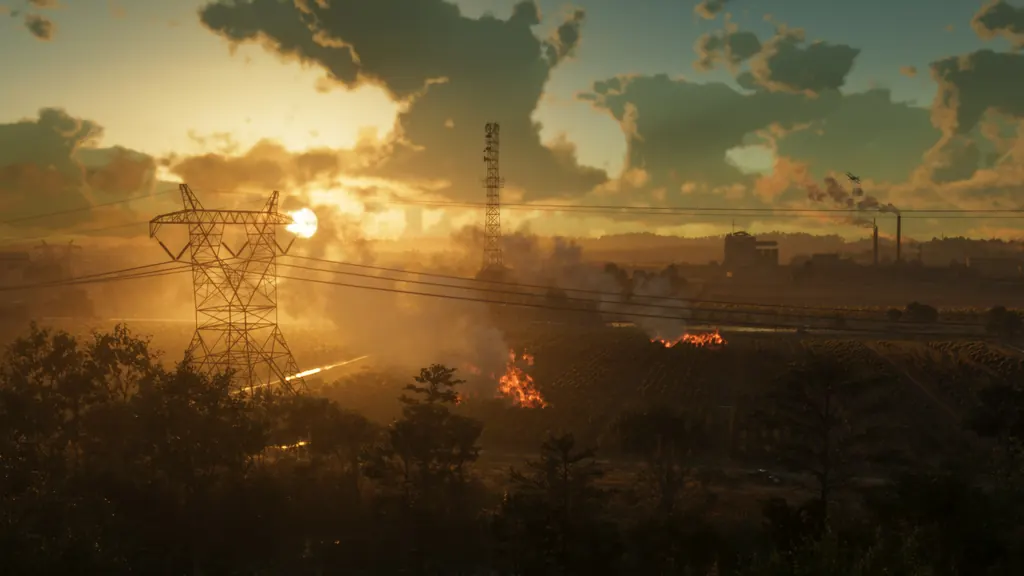
What Is Frame Generation and the Technical Process
To overcome the 30 fps limitation, players are turning to frame generation technologies (frame generation). The concept behind this technology is to use advanced methods to create intermediate frames that were not originally captured by the console. One such approach is exemplified by tools like Veyra, an open-source video enhancer that seeks to inject new frames into the gameplay.
It is essential to understand that this is not a simple process. It requires a complex technological chain that transforms the console into a data source for an external computer. The process requires the game image to be captured in real time and then sent to a powerful PC that does the heavy lifting of filling in the visual gaps, simulating 60 fps fluidity.
Hardware Requirements: Capture, GPU, and HDMI 2.1 Connections
Due to the intricate nature of frame generation, hardware requirements are extremely rigorous. The player cannot rely solely on the console, needing to assemble a robust workstation. First, a capture card capable of receiving the game signal in 4K via the HDMI 2.1 standard is essential. Brands like Elgato are examples of manufacturers that provide this type of equipment.
This capture signal must be connected to the PC using a certified USB-C 3.2 data cable, which in turn needs to be connected to a motherboard with true (True) support for USB 3.2 Gen 2. Furthermore, processing power cannot be underestimated. The creators of these solutions recommend using a relatively powerful graphics card (GPU), such as Nvidia’s RTX-40 models or newer. This is because frame generation processing depends on the GPU’s Tensor cores, which are specifically designed for artificial intelligence (AI) tasks and advanced processing.
To complete the setup, an OLED monitor is strongly recommended, ensuring that the user can appreciate the best possible image quality when receiving the enhanced signal.

Context: GTA VI and the Technologies Behind the Challenge
Grand Theft Auto VI is an open-world action-adventure title, developed by Rockstar Games and Rockstar North. The game is set in the fictional state of Leonida, a region that encompasses Vice City and its surroundings. It allows players to switch between two criminal protagonists, Jason Duval and Lucia Caminos, as they embark on a state conspiracy after a botched heist. The gameplay mechanics mix third-person combat, driving, and free exploration, in addition to optional activities like fishing and street racing.
Behind this technical complexity are fundamental technologies. The HDMI standard, for example, is a proprietary digital interface used to transmit high-quality video and audio signals between various devices, such as consoles and monitors. Nvidia, a multinational corporation based in Santa Clara, California, is a driving force in technology, developing GPUs, SoCs, and APIs for areas ranging from gaming to artificial intelligence and high-performance computing. It is this combination of graphical power, cutting-edge connectivity, and AI processing capability that makes the challenge of achieving 60 fps in GTA VI such a technically monumental feat.