
Read this article in: Portuguese (Português) · Spanish (Español)
The Game Boy Micro is a portable console that marked the peak of the Game Boy line, representing an attempt at miniaturization and modernization in an already saturated electronics market. Developed and manufactured by Nintendo, this device was released as a reduced and sophisticated version of the Game Boy Advance. Its development history was not limited to just a hardware project; it was a strategic effort to meet a niche of “image-conscious” consumers who valued compact design and high portability. Although it was the last console in this series, it represented a turning point in Nintendo’s trajectory, preparing the ground for its successors.
The relevance of the Game Boy Micro is demonstrated by details such as its internal codename, Oxygen, and its official announcement, made at E3 on May 17, 2005. Although it was launched globally on specific dates—such as September 13, 2005, in Japan—the system was designed to be compatible only with Game Boy Advance Game Paks, and did not maintain backward compatibility with the Game Boy or Game Boy Color models. Despite selling a total of 2.42 million units during its lifespan, its sales performance did not meet the company’s internal expectations, making its legacy a fascinating case study in niche marketing and technology.
In this article, we will dive deep into the complete history of this console. We will analyze everything from the conception of the idea in the context of the portable market to the technical development, exploring the architecture and hardware specifications. We will address the global marketing strategy, the launch challenges, and finally, analyze the critical reception, sales performance, and lasting legacy that the Game Boy Micro left on the art of portable electronic miniaturization.
Key Points
- Developed under the codename ‘Oxy’, the Micro was an engineering project by Nintendo Research & Engineering.
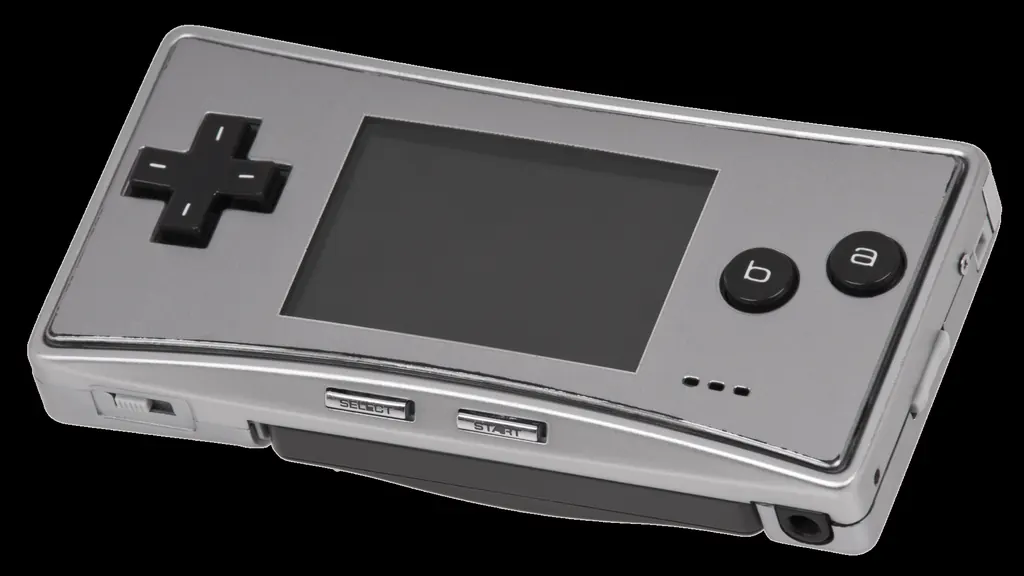
- It had a metallic body and a premium design, positioning it as a lifestyle item, not just a toy.
- Technically, it was sixth generation, operating with an ARM7TDMI @ 16.78 MHz processor and 288 KB of RAM.
- The launch was global and staggered in 2005, starting in Japan (9/13) and reaching Europe (11/4).
- It sold a total of 2.42 million units during its lifespan, being discontinued in 2008.
Technical Specifications for the Game Boy Micro
| Manufacturer | Nintendo |
|---|---|
| Developer | Nintendo Research & Engineering |
| Type | Portable console |
| Generation | Sixth |
| Release | September 13, 2005 (JP); September 19, 2005 (NA); October 1, 2005 (CHN); November 3, 2005 (AU); November 4, 2005 (EU) |
| Processor | ARM7TDMI @ 16.78 MHz |
| Memory | 288 KB RAM, 98 KB Video RAM |
| Predecessor | Game Boy Color |
| Successor | Nintendo DS |
| Media | Game Boy Advance Game Pak |
The Origin of the Idea: The Portable Market Context

The quest for a new format for the Game Boy Micro was not an isolated move, but rather the result of deep and continuous questioning about the future of the portable electronics market. In the early 2000s, the technological landscape was rapidly changing, and Nintendo, a leader for decades in the portable console segment, realized that the market was becoming saturated. To remain relevant and attract a more demanding audience, the company needed to rethink not only the processing power, but fundamentally the aesthetic and user experience of its product.
The Imperative of Miniaturization and Design
The idea of a smaller, more sophisticated device began being discussed internally starting in 2004. According to George Harrison, vice-president of Nintendo of America, the development of the Game Boy was seen as a “continuous process of invention.” Under the internal codename Oxy, Nintendo Research & Engineering dedicated efforts to discovering the limits of miniaturization. The challenge was to create a console that maintained classic nostalgia and gameplay, but that suited the taste of consumers who were increasingly “image-conscious.”
This new design focus was crucial. Instead of continuing to increase the hardware size, the strategy adopted a metallic body, a material that, according to Satoru Iwata, was an unusual departure for the Nintendo brand, but which gave the product a premium and modern look. The goal was to differentiate the Micro from traditional models, positioning it as a *lifestyle* item and not just an electronic toy.
Market Positioning and the Strategic Launch
The modernization was not limited to the format. The Game Boy Micro, in fact, represented a technological leap in its time, being developed for the sixth generation, with an ARM7TDMI @ 16.78 MHz processor and an advanced architecture. It was a direct successor to the Game Boy Color and a predecessor to the Nintendo DS. However, the most revolutionary aspect was its market positioning. The console was officially announced by Reggie Fils-Aimé, vice president of sales and marketing for Nintendo of America, at E3 on May 17, 2005.
This announcement marked the beginning of a meticulously planned global campaign. The launch was staggered across different regions, starting in Japan on September 13, 2005, followed by North America on September 19, 2005, and other key regions, such as Australia (November 3, 2005) and Europe (November 4, 2005). The introductory price of US$99.99 reflected this ambition for premium product positioning.
In summary, the Game Boy Micro was Nintendo’s answer to the growing demand for compact and elegant portable technology. It not only kept the Game Boy series tradition alive but elevated it, showing that nostalgia could coexist with cutting-edge design, perfectly catering to the modern consumer who values both functionality and the aesthetics of their device.
Technical Development and the Codename Oxygen

The development of the Game Boy Micro was an exercise in engineering and strategic vision, marking a deep learning curve about the limits of miniaturization in portable consoles. Discussions about a smaller model began to take shape in 2004. According to George Harrison, Vice President of Nintendo of America, the company viewed the development of the Game Boy not as a linear process, but rather as a “continuous process of invention.” This mindset was crucial, as it forced Nintendo Research & Engineering to radically rethink the console’s traditional format.
The Challenge of Miniaturization and the Codename “Oxy”
The technical challenge was immense: how to reduce a complex system, based on robust architectures like the Game Boy Advance, into an ultra-compact format. It was under the codename “Oxy” that Nintendo attempted various approaches to shrink the device. One of the most notable design decisions was the adoption of a metal casing, a finish that, according to the company president, Satoru Iwata, was considered unusual for the brand. This aesthetic and material choice reinforced the project’s technical ambition, showing that modernization went beyond mere size reduction.
The climax of this development phase occurred on May 17, 2005, when the product was publicly announced by Reggie Fils-Aimé, Vice President of Sales and Marketing for Nintendo of America, during the Electronic Entertainment Expo (E3) press conference. The Game Boy Micro was presented as the pinnacle of this engineering journey. Technically, it was a sixth-generation device, maintaining compatibility with the Game Boy Advance Game Pak, and operated with an on-chip system that included an ARM7TDMI CPU running at 16.78 MHz, in addition to 288 KB of RAM and 98 KB of Video RAM.
The global launch strategy was meticulously planned, reflecting the device’s importance. The console launched on September 13, 2005, in Japan, followed by September 19, 2005, in North America. Other important launch dates included October 1, 2005, in China (where it was sold as iQue Game Boy Micro) and November 4, 2005, in Europe. Despite being a sales success, with 2.42 million units shipped, the Game Boy Micro’s life cycle was relatively short, being discontinued in 2008.
Architecture and Hardware Specifications
Miniaturizing a video game console is an engineering feat that requires not only size reduction but also the maintenance of complex functionalities. The Game Boy Micro is not just a smaller model; it represents a deep exercise in reverse engineering and hardware optimization. Its architecture managed to condense the experience of robust consoles, such as the Game Boy Advance SP, into an ultra-compact format. Analyzing its technical specifications reveals the level of sophistication required for such a small device to still deliver a complete gaming experience.
Architecture and Technical Components
At the heart of the Game Boy Micro, we find a 32-bit processor: the ARM7TDMI, operating at a frequency of 16.78 MHz. This processor, although more modest than those of previous generations, was the engine capable of running games using Game Boy Advance Game Pak cartridges. Regarding memory, the system features 288 KB of RAM and 98 KB of VRAM, resources that are remarkably efficient in such a small device. It is important to note that, despite its capacity, the console is not compatible with original Game Boy or Game Boy Color games due to design changes that necessitated the absence of internal hardware required for backward compatibility.
The physical design is also a technical highlight. The console measures 50 x 101 x 17.2 mm, a format reminiscent of a standard credit card. To significantly improve the user experience, a backlit screen was implemented, featuring the crucial ability to adjust brightness. This functionality was not only an aesthetic but a practical advancement, allowing the user to adapt the device to different lighting conditions. Furthermore, to ensure durability and finish, the device incorporates several internal metal plates.
Usability was enhanced with intelligent design details. The side control features a dual-sided lever that not only adjusts the volume but, when activated while holding the left shoulder button, allows control of the screen brightness across five distinct levels. Customization was incorporated through a removable front, called a *faceplate*, which could be swapped out and used to customize the console’s look—a selling point that added value to the final product. Weighing only 80 grams, the Game Boy Micro consolidated the concept of an elegant and highly functional portable system.
Launch and Global Marketing Strategy

The launch of the Game Boy Micro was more than just releasing a product onto the market; it was the culmination of a global campaign meticulously planned by Nintendo. Following the official announcement at E3, the marketing strategy was designed to position the device as both a collector’s item and a technological leap, despite its focus on miniaturization. To mitigate the risk of saturation in an already mature electronics market, Nintendo bet on a combination of aesthetic appeal and exclusivity. The device was presented not merely as a console, but as a sophisticated piece of design, offering a color palette that went beyond the basic, including black, blue, purple, and silver.
Global Launch Logistics
Implementing the Game Boy Micro in different markets required complex logistical coordination. The launch was staggered by region, ensuring a growing impact. Japan was the starting point, with the official launch on September 13, 2005. Initial success was immediate: the console sold over 170,000 units in just a few days of sales in Japan. Next, the North American market received the device on September 19, 2005, although the process was turbulent, with several stores delaying the commercial availability date until September 26 or even September 30, 2005. The global strategy continued through October and November, with launches confirmed for China on October 1, 2005, and finally, for Australia on November 3 and Europe on November 4, 2005.
In terms of pricing, the Game Boy Micro launched with an introductory price of US$99.99 (equivalent to $160 in 2025). This entry value, combined with the variety of limited editions, reinforced the device’s premium status. Beyond the standard colors, Nintendo successfully capitalized on the power of nostalgia and collecting by releasing special editions, such as the themed versions of Famicom and Final Fantasy IV. This variety not only served specific fan niches but also maintained consumer interest after the initial peak of sales.
Despite the difficulty in maintaining sales momentum compared to consoles from previous generations, the Game Boy Micro managed to sell a total of 2.42 million units during its lifespan. The system, which utilized a Game Boy Advance game cartridge, was discontinued in 2008. The sales history and the success of units sold in specific regions, such as Japan early in its cycle, prove that although the model was a niche market, it established a lasting legacy of miniaturization and elegant design in the portable landscape.
Critical Reception, Sales, and the Legacy of Miniaturization
Despite the immense engineering effort behind its conception, the commercial performance of the Game Boy Micro was modest, and the console failed to meet the sales goals set by Nintendo. In terms of numbers, the system sold a total of 2.42 million units during its lifespan, according to data from a 2007 earnings report. This volume placed it in a negative spotlight, being classified as the eighth best-selling portable console of all time, according to the GamePro website. The launch price, US$99, was significant, especially when compared to the Game Boy Advance SP, which cost US$79, and even though it was cheaper than the functional Nintendo DS, many consumers questioned its viability, wondering why Nintendo released such a small model when the GBA SP was already considered sufficient.
Mixed Reception: Praise and Criticism
Criticism of the Game Boy Micro was markedly polarized. On one hand, enthusiasts undeniably praised the modernized design. The console recovered the horizontal aspect, a format that many consumers preferred over the vertical aspect used in previous models. Furthermore, the system was praised for its backlight screen superior to the GBA SP. Thanks to a finer *dot pitch* and adjustable brightness, the display’s visibility and sharpness were considered superior, and the Micro maintained a refresh rate of 60Hz, a crucial technical point compared to the GBA SP, which operated at 50Hz.
However, the reduced size, which was the console’s major engineering feature, was also the source of severe criticism. Many players lamented the loss of Game Boy Advance functionalities, such as the need to acquire two separate link cables (GBM-GBM and GBM-GBA) for full multiplayer gameplay. Another major disappointment was the lack of backward compatibility with Game Boy or Game Boy Color games. Additionally, the North American launch was hampered by logistical problems, with stores delaying stock after the official launch on September 19, 2005.
The Legacy of Miniaturization
Despite its sales performance and the technical issues pointed out—such as the smaller power port, incompatible with chargers for other Nintendo handhelds—the Game Boy Micro cannot be seen merely as a failure. It represents a crucial milestone in the history of portable technology. The concept of miniaturization, despite implementation flaws, proved to be a viable and desirable path for the market. The success in bringing a highly compact console, with an advanced screen and improved design, paved the way for the next generation of portable devices. The Game Boy Micro, therefore, did not just close a cycle, but paved the technical and conceptual way for the success of its successors, notably the Nintendo DS.
Frequently Asked Questions
Was the Game Boy Micro compatible with original Game Boy games?
No, the console was not compatible with original Game Boy or Game Boy Color games. This was due to design changes and hardware optimizations that meant the absence of internal components necessary to guarantee backward compatibility with previous models.
What was the internal codename used during the development phase of the Game Boy Micro?
The internal codename used by Nintendo Research & Engineering during development was ‘Oxy’. Under this codename, the company dedicated efforts to exploring the limits of miniaturization, seeking to create a smaller and more sophisticated device for the portable electronics market.
Why did the Game Boy Micro not sell as well as Nintendo expected?
The text indicates that despite the immense engineering effort and premium positioning, the commercial performance of the Game Boy Micro was modest. It failed to meet the sales goals established by Nintendo, although it sold a total of 2.42 million units during its lifespan.
What were the main design differences between the Game Boy Micro and the Game Boy Advance SP?
The main differences lay in the aesthetic appeal and miniaturization engineering. The Micro adopted a metal body, giving it a premium look. Furthermore, it incorporated advanced features such as a backlit screen with brightness adjustment and multifunctional side controls.
Was the Game Boy Micro the last console in the Game Boy line?
No. The Game Boy Micro was a direct successor to the Game Boy Color and, at the same time, a predecessor to the Nintendo DS. Its life cycle was relatively short, being discontinued in 2008, but the technological succession line continued with the Nintendo DS.
Conclusion
The development of the Game Boy Micro transcends the mere history of a portable console; it represents a deep study of reverse engineering and a strategic response to the saturation of the electronics market in the early 2000s. Nintendo, when facing the imperative of miniaturization, not only optimized the hardware—which included an ARM7TDMI processor operating at 16.78 MHz and 288 KB of RAM—but also redefined the concept of a product. The adoption of a metal body, a significant aesthetic deviation, transformed the device from a mere electronic toy into a *lifestyle* item, elevating the perceived value of its legacy.
This leap was crowned by a meticulously planned global launch, announced at E3 on May 17, 2005, and rolled out to different regions starting that year in September. The Micro therefore achieved a remarkable feat: keeping the playable tradition of the Game Boy alive while incorporating the technical sophistication and premium finish demanded by the modern consumer. It was proof that nostalgia, when combined with a cutting-edge design vision, can be extremely commercially viable.
The Game Boy Micro remains, thus, a milestone that teaches that innovation does not reside only in increasing processing power, but in the ability to recontextualize the user experience. Analyzing this console reminds us that the true power of a product lies in how its story is told and how it fits into the daily life of the person carrying it.