
Read this article in: Portuguese (Português) · Spanish (Español)
Defeating the great antagonist of Diablo IV requires a rigorous combination of tactical planning, knowledge of the enemy’s weaknesses, and optimizing your class’s abilities. To succeed in this epic challenge, it is essential that the player understands the series’ combat cycle: obtaining progressively stronger equipment to overcome increasingly difficult adversaries. Success is not just about raw power, but about the synergy between your character and the Santuário environment, ensuring you are prepared to face the height of evil, whether in procedural dungeons or direct confrontations.
The strategic depth of Diablo IV, developed and published by Blizzard Entertainment, is a reflection of its long history and evolution. Since its release on June 5, 2023, the game has set a standard of gameplay that continues to be refined, featuring a roster of eight playable classes, such as the Barbarian, Sorcerer, and Necromancer. This wealth of options ensures that the content remains fresh, as evidenced by the first expansion pack, Vessel of Hatred, which launched in October 2024, keeping the community engaged in the search for new challenges and progress.
In this comprehensive guide, we will break down every aspect needed for you to become a true demon hunter. We will cover the context of Diablo and its role in Santuário, moving through Ideal Preparation, detailing classes, equipment, and builds. You will learn how to locate the right moment to confront the Archdemon, understand the attack patterns and phases of the fight, and receive a Step-by-Step Strategy for victory, concluding with advanced optimization tips and what to expect in terms of rewards and progression after the defeat.
Key Points
- Diablo is a Prime Archdemon, representing pure evil and posing an existential threat to the collapse of Santuário.
- The game features a non-linear open world, encompassing seven distinct regions, such as Scosglen and Nahantu.
- Progression requires optimizing attributes such as Attack, Critical Chance, Elemental Resistance, and Defense.
- Players must manage three crucial attributes: Angelic Power, Demonic Power, and Ancestral Power.
- Combat is tactically complex, requiring adaptation to multiple phases and anticipation of the boss’s attack patterns.
Who is Diablo and what is his role in Santuário

The threat hanging over Santuário is of cosmic proportions. The setting of Diablo IV, set fifty years after the events of Diablo III: Reaper of Souls, is a fragile world. After the depletion of angelic and demonic forces in previous eras, the continent of Santuário has become a convergence point for forces seeking absolute dominion. In this context of decay and unbalanced power, players will not face just one villain, but the manifestation of an ancient and colossal evil.
Who is Diablo and his arcane nature
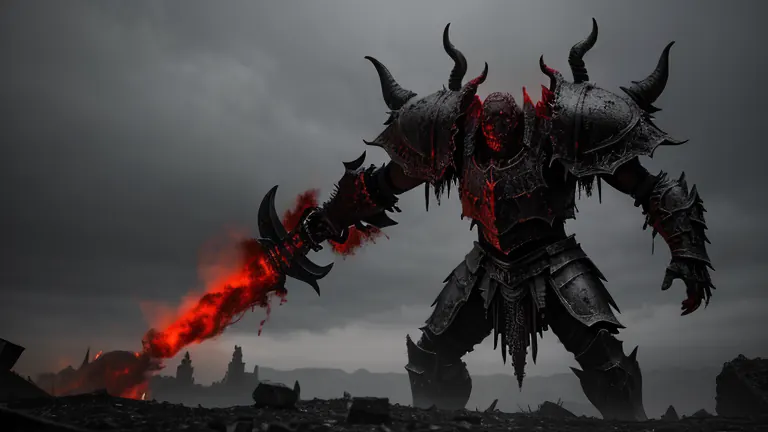
Diablo, the Lord of Hell, is not merely a high-level antagonist; he is one of the Prime Archdemons, an entity whose existence defines the conflict between the Upper Heavens and the Burning Hells. He represents the very essence of pure evil and chaotic power emanating from the heart of the Abyss. His power transcends lesser threats, placing him at the pinnacle of the demonic hierarchy. While the recent plot focuses on the ascent of Lilith, daughter of Mephisto, and her attempt to manipulate the power of the Prime Evils, Diablo personifies the primary and undeniable force of evil that seeks to consume life and the very structure of Santuário.
His role, therefore, is not just that of a boss battle, but that of a symbol. He is the personification of the force opposite to order, the apex of corruption that the Nephalem world—the hybrid race between angel and demon—tried, and failed, to contain. The scale of Diablo’s power demands an unprecedented level of preparation and strategy, elevating the confrontation to an existential level for the protagonists.
The Threat to the Pillars of Santuário
The importance of defeating Diablo lies in understanding the imbalance he represents. Santuário was, in its origin, a refuge created by Lilith and the angel Inarius to escape the eternal conflict between the High Heavens and the Burning Hells. However, the presence of Archdemons like Diablo threatens to dismantle this millennia-old truce. He does not merely seek the power of a kingdom or a nation; he desires the total collapse of reality, allowing the darkness of Hell to spread unchecked.
By confronting Diablo, the player is actually attempting to stabilize the very fabric of reality. It is a challenge that requires the demon hunter not only to master combat in terms of offensive and defensive attributes but also to understand the depth of the mythology surrounding him. The fight against him is the ultimate test of Nephalem power and the climax of the journey to safeguard what remains of Santuário from the dawn of evil.
Ideal Preparation: Classes, Equipment, and Builds
Preparing to face an Archdemon like Diablo requires more than just good gear; it requires a deep understanding of the synergy between your class, your attributes, and the combat environment. The core of the Diablo IV experience revolves around the progression of increasingly powerful equipment, and it is in optimizing these items and skills that the secret to dealing the sustained damage and area control (AoE) needed to survive the confrontation with the Great Antagonist lies.
Class Selection and Customization
The game presents a vast range of options, and class selection should be guided by the combat style that best suits your strategy. The eight available classes offer distinct power niches, and each must be customized through skill trees to maximize its potential in high-level combat. For example, the Sorcerer is an elemental mage who wields fire, ice, and lightning, ideal for explosive area damage. The Druid, with its ability to metamorphose between human, werewolf, and wild bear forms, combines earth magic with brute strength. For builds more focused on control and dark magic, the Warlock, which utilizes hellfire power and summoned demons, or the Necromancer, which employs black magic to summon and attack, are powerful choices. Other notable options include the Barbarian, which alternates between weapons in combat, the Rogue, an agile fighter in melee or ranged combat, the Spiritborn, which summons four spiritual guardians (Centipede, Eagle, Gorilla, and Jaguar), and the Paladin, which chooses among four oaths of playstyle.
Maximizing Attributes and Equipment
Your character’s power is not determined solely by item rarity, but by how you distribute your attributes. Optimization requires special attention to three primary combat attributes: Attack and Critical Chance (which increase raw damage), and defensive statistics, such as Elemental Resistance and Defense. Furthermore, Diablo IV introduced three crucial attributes for sustainability against elite bosses: Angelic Power, which alters the duration of beneficial effects; Demonic Power, which affects the duration of negative effects, and Ancestral Power, which increases the chance of applying effects to other entities. Equipment with unique effects is vital, as they alter parameters beyond simple statistics, allowing the player to create complex and sustainable synergies.
For a confrontation against an elite boss, the build focus must always be on resilience and consistent damage. It’s not enough just to deal high damage; you must survive the Archdemon’s attack phases. Therefore, equipment must be customized not only to increase attack damage but also to mitigate incoming damage and extend the duration of positive effects, maintaining a high combat pace, which is essential to defeating the Lord of Hell.
Location and Timing of the Confrontation with the Archdemon

The confrontation with Diablo, the Lord of Hell, is not restricted to a single location or a single dungeon event. On the contrary, the threat he represents is a force that permeates the entire fabric of Santuário’s reality, the vast and dynamic setting where the story unfolds. The game was conceived as an open-world environment, meaning that the journey to weaken the Archdemon is inherently non-linear. Players are invited to traverse seven distinct regions, each with a unique atmosphere, from the snowy mountains of the Fractured Peaks, through the coastal and forested areas of Scosglen, to the swamps of Hawezar and the lush jungles of Nahantu. This design ensures that the player can complete each region in the order that best suits their strategy, and there are no loading screens when traveling between these areas.
Geography and Progression in Santuário
Santuário’s very nature reinforces the idea that power against Diablo must be built comprehensively. The regions also include the arid, cannibalism-marked plains of the Dry Steppes, the devastated desert of Kehjistan, the oceanic landscapes of Skovos, as well as Hell, which serves as a complementary combat area with procedurally generated dungeons. It is crucial to understand that Santuário is a fixed location, differentiating it from randomly generated dungeons. This vast tapestry of biomes—ranging from large settlements with dense populations to wild zones that convey a sense of desolation—requires the player to explore and strengthen themselves in multiple environments. Progression is not marked by a single linear narrative arc, but by achieving milestones in different locations, unlocking interactions and areas that would otherwise be restricted.
The Ideal Timing for the Confrontation
Although the game is non-linear, the narrative climax with Diablo is the convergence point of all this collected power. The ideal moment for the confrontation is not determined by a specific level, but by the feeling of mastery over Santuário’s reality itself. The player must feel that they have explored the diversity of threats—ranging from combat against monster families defined by their theme and fighting style to the exploration of different biomes—and that they have reached the necessary level of strength to face a being of cosmic magnitude.
The open-world architecture allows the player to face challenges in any order, ensuring that preparation for the Archdemon is a constant process. Mastery, therefore, lies in understanding the synergy between the various regions and different types of threats. The goal is for the player to reach the confrontation point not only with powerful equipment but also with the tactical knowledge acquired in each biome—whether it is the controlled environment of a dungeon in Hell, or the tactical freedom of an open area like Skovos. The confrontation is the peak of a journey of geographical discovery and constant progression in Santuário.
Attack Patterns and Fight Phases
The confrontation with Diablo, the Lord of Hell, is not a test of pure brute force, but rather a complex tactical evaluation that requires the player to master the art of adaptation. The combat mechanics are designed to force the use of all available skills, transforming the battlefield into a constant cycle of offense and defense. To survive the Archdemon’s various phases, it is crucial to understand that every change in its behavior signals a new threat, requiring the player to shift their focus of attributes and skills.
Recognizing Combat Phases
Fights against elite bosses like Diablo are structured into distinct phases, each with a unique attack pattern. While the attacks may vary, the principle is clear: the threat progressively intensifies. In an initial phase, the Archdemon tends to use area-of-effect (AoE) attacks, forcing the player to maintain distance and use mobility skills. This is where map knowledge and resource management become paramount.
As time passes, the combat mechanics evolve. In intermediate phases, Diablo may increase the pressure by summoning creatures or minions, requiring the player to use crowd control skills and maintain focus on secondary targets. This is when class synergy becomes vital. The player must pay attention to visual and auditory signals—a specific glow, a distinct roar—that indicate the start of a high-damage attack or the preparation of a new summoning. Ignoring these signs can result in fatal damage.
Mastering Attributes and Defense
The key to survival lies in the observation and correct application of attributes. The Diablo IV combat system introduced crucial attributes that must be managed during combat: Angelic Power, which alters the duration of beneficial effects, and Demonic Power, which affects negative effects. The player must monitor these indicators to know when it is safe to cast a high-cost ability or when it is necessary to use a magical defense.
The elevated isometric view, characteristic of the game, allows the player to maintain constant spatial awareness. By observing Diablo’s positioning and attack patterns, it is possible to predict the trajectory of major attacks. It is crucial that the player does not merely react to incoming damage but anticipates the boss’s movements. The ability to alternate between damage attacks and defenses, utilizing offensive attributes (such as attack and critical chance) in conjunction with defensive resilience (elemental resistances and defense), is what defines successful combat.
In summary, combat against Diablo is a ballet of mechanics. It requires the player not only to memorize attack patterns—such as area attacks or damage peaks—but also to use knowledge of their attributes to mitigate damage and maintain constant offense, ensuring that the synergy of their abilities prevails over the Archdemon’s brute force.
Step-by-Step Strategy for Victory

The final confrontation against Diablo is not merely a test of brute power, but a complex tactical evaluation. Considering that the combat is described as a “ballet of mechanics” and that the game requires constant spatial awareness in the elevated isometric view, victory depends on the group’s synergy and discipline. To maximize damage while minimizing the risk of being overwhelmed by the Archdemon’s mechanics, it is essential that the team adopts a coordinated strategy, where each member plays a specific tactical role. The key is transforming the combat into an effort of constant control and damage.
Step-by-Step Strategy for Victory
To effectively face the Lord of Hell, follow these tactical steps, always prioritizing movement and group coordination:
- Maintain Ideal Distance (Kiting): Never allow prolonged close combat. Use movement abilities to keep Diablo at a distance. This not only preserves your resilience but also forces the Archdemon to expend energy on ranged abilities, which are more predictable to counterattack.
- Prioritize Crowd Control (CC): The main focus must be keeping Diablo occupied and predictable. Use Crowd Control (CC) abilities in sequence, ensuring that he is constantly affected by slowing, immobilization, or interruption. This prevents him from executing his most devastating attacks and allows the group to breathe.
- Coordinated Damage Distribution: Avoid letting a single character absorb all the damage. Group members must alternate damage types (fire, ice, electricity, etc.) in a coordinated cycle. This distribution ensures that the boss’s resistance patterns are exploited and that the damage is constant, without peaks and valleys.
- Utilizing Class Synergies: Remember that power in Diablo IV resides in synergy. If one character applies a status effect (like bleeding or poison), the others must have abilities that capitalize on that status. For example, a Druida can prepare the field with nature magic, while a Warlock finishes with hell magic.
- Resource Management and Defense: Instead of spending all resources on a single attack, utilize attributes like Angelic Power and Demonic Power strategically. Use defensive resources (elemental resistance and defense) during peak boss damage, and not proactively.
- Adapting to Combat Phases: Combat against an elite boss is structured in distinct phases. As soon as Diablo changes his attack pattern, the group must stop and observe. Identifying the attack pattern of the new phase is crucial for knowing what type of CC or defense is most effective at the moment.
The Importance of Group Coordination
In a non-linear, high-risk combat environment, communication is the most powerful attribute. If the group can maintain distance, use CC to disorganize the Archdemon, and distribute damage in a coordinated way, the confrontation becomes a tactical exercise of survival and precision, and not just a test of brute force.
Advanced Tips and Build Optimization
Build optimization in Diablo IV transcends mere combination of skills; it is a meticulous process that requires understanding how attributes and equipment interact to create a cohesive power synergy. To reach the level of excellence required to defeat Diablo, the player must treat the character as a system where every piece—be it a rune, a gem, or a passive attribute—must amplify the effect of the others. The focus must always be on maximizing damage potential and minimizing time exposed to combat.
The Synergy of Advanced Attributes
The game introduced crucial attributes that define a character’s performance ceiling: Angelic Power, Demonic Power, and Ancestral Power. Understanding the role of each is vital for build planning. Angelic Power, for example, alters the duration of beneficial effects, while Demonic Power does the opposite, modifying negative effects. High-level builds generally seek a tactical balance between these two powers, ensuring that the character not only deals massive damage but also maintains defensive and utility sustain. Ancestral Power, by increasing the chance of applying effects to other entities, is an Area of Effect (AoE) damage catalyst and must be prioritized in builds that depend on status multipliers.
Equipment and passive skills are the engine of this optimization. Remember that the rarest items do not only increase basic parameters like attack or critical chance, but they also carry unique effects that can alter more than just numbers. Class synergy, such as the Druid’s ability to shapeshift or the Sorcerer’s versatility with elemental magic (fire, ice, and lightning), must be enhanced through equipment that not only supports but demands the combined use of these abilities. Studying the talent tree is, therefore, an exercise in combat engineering, where every node must be chosen to close a mechanical gap or boost an already dominant attribute.
Tactical Optimization and Resource Management
In a non-linear, high-risk combat environment, resource management is as important as raw damage. Instead of relying on a single type of attack, optimized builds utilize coordinated damage distribution, ensuring that power is not concentrated in a single moment, but rather in a constant flow of threat. Furthermore, knowledge of positioning (the elevated isometric viewpoint) must be used to maintain ideal distance (Kiting), forcing the boss to react to the player, rather than the other way around. Combat against an Archdemon is a ballet of mechanics, and the player must be the maestro who dictates the rhythm and points of pressure.
For maximum refinement, the player must always seek to maximize the synergy between equipment and class. This means that if you choose a class like the Warlock, which utilizes the power of hellfire and summoned demons, the equipment must provide bonuses that enhance these elements, and not just increase generic damage. Build progression is not linear; it requires the player to test and adjust the *mix* of skills until the character can not only survive, but can maintain constant combat pressure, minimizing the time of uncertainty and the risk of catastrophic failure.
Rewards and Progression After Defeat
The Arsenal of Rewards and the Progression Cycle
The defeat of an antagonist of magnitude like Diablo is not just a narrative milestone, but a power catalyst for your character. The rewards obtained after the final confrontation are crucial, as they provide the material foundations and experience necessary for the player not only to advance in the story of Sanctuary, but also to raise the performance ceiling of their *build* in future challenges. The reward system of Diablo IV is built around the rarity and utility of acquired items.
The primary focus of loot resides in equipment and weapons. Sources indicate that items follow a system of increasing rarity, which is a general indicator of the power they confer. The rarest equipment is particularly valuable because it not only increases basic character parameters but also possesses unique effects that alter the game in complex ways, going beyond mere attack or defense statistics. These items are not merely consumables; they are the backbone of build optimization, determining the player’s synergy and damage potential.
Materials and Power Management
In addition to high-level equipment, confronting the Archdemon guarantees a constant flow of rare materials and experience resources. It is important to note, however, how the game balances the power economy. Although the player has access to crafting and trading systems, these are intentionally limited. Crafting and trading are restricted to resources that are not the most powerful items in the game. This ensures that top-tier equipment remains a high-value prize, reinforcing the sense of accomplishment after a tactical and intense fight.
Looking toward the progression horizon, the content cycle in Diablo IV incorporates the concept of limited seasons. This mechanism is vital for the game’s longevity, as it ensures that the effort invested in defeating Diablo is not an endpoint, but rather a springboard. Each season brings specific items, characters, and events, keeping the challenge constantly renewed. Thus, the resources and power accumulated after confronting the great villain prepare the player to face even more complex narrative and mechanical challenges, ensuring that the journey in Sanctuary is continuous and constantly improving.
Frequently Asked Questions
What is the best class to face Diablo in Diablo IV?
There is no single ‘best’ class; the choice should be guided by your combat style. The eight classes (such as Sorcerer, Druid, and Warlock) offer distinct power niches. The ideal approach is to customize the chosen class, maximizing its skill trees to create efficient combat synergy.
Is it mandatory to defeat Diablo to progress in the main story?
Although the confrontation is the narrative climax and the ultimate test for the Nephalem, progression in Sanctuary is intrinsically non-linear. The Archdemon’s threat permeates the entire fabric of reality, and the objective is to stabilize the continent, requiring the player to strengthen themselves in various regions.
What equipment is recommended for fighting high-level bosses?
Equipment should focus on resilience and consistent damage. It is vital to optimize not only raw damage (Attack and Critical Chance), but also defenses and sustainability attributes, such as Angelic Power and Demonic Power, to survive the attack phases.
How should I manage ability cooldowns during a fight against Diablo?
Management must be tactical and anticipatory. It is crucial to observe the visual and auditory signs of the boss and monitor the indicators of Angelic Power and Demonic Power. This allows you to know when it is safe to use high-cost abilities or when it is necessary to focus on magical defenses.
Is fighting Diablo better played in solo or group mode?
The game is designed to be played in Multiplayer mode, and the combat requires the player to master the art of adaptation. Regardless of the mode, the tactical focus is always on synergy and resource management, requiring the player to be attentive to the multiple threats and phases of the Archdemon.
Conclusion
The confrontation with Diablo, the Lord of Hell, transcends the mere challenge of a dungeon boss; it represents an existential struggle for the very stability of Santuário. The magnitude of evil he personifies requires the demon hunter to understand that the goal is not merely to accumulate power, but rather to stabilize the fabric of reality against total collapse. The vastness of Santuário, with its seven distinct regions, reinforces that the journey to weaken the Archdemon is non-linear, requiring the player to master every biome and every nuance of the mythology at their own pace.
To triumph over such a threat, preparation must be equally complex. It is not enough to simply have the rarest equipment; it is crucial to master the synergy between class choice (such as the Sorcerer or the Warlock), the optimization of primary attributes, and the strategic use of unique resources like Angelic Power and Demonic Power. Victory against the Great Antagonist therefore depends on tactical resilience: maintaining consistent damage while mitigating the destructive power of the Archdemon’s attack phases. It is the combination of mythological knowledge, combat mastery, and build planning that will define the fate of Santuário.
Thus, fighting the Lord of Hell is the ultimate test of Nephalem power. The journey is vast, challenging, and deeply rewarding, requiring the player not only to advance through maps but to delve into the very nature of the conflict. Now that you have understood the depth of the threat and the complexity of combat strategies, it is time to put your knowledge into practice and face the Abyss.