Read this article in: Portuguese (Português) · Spanish (Español)
To understand the origin of a galactic empire of epic proportions, one must know that Stellaris is a grand strategy 4X game developed by Paradox Development Studio and published by Paradox Interactive. The game casts the player as an interstellar civilization, tasked with a journey of exploration, colonization, and management across a vast, procedural galaxy. Far from being just a strategy game, it is a complex system that blends diplomacy, trade, and warfare, requiring the player to lead a civilization from its early stages of space discovery.
The success and depth of Stellaris are no accident. It benefits from robust development, utilizing the well-known Clausewitz Engine, an engine the studio has employed since 2007 in previous titles. The game’s relevance is marked by its release on various platforms, such as Windows, OS X, and Linux on May 9, 2016, and its adaptation for consoles, arriving on PlayStation 4 and Xbox One on February 26, 2019. This development and reception trajectory has cemented it as a milestone in the genre, earning praise from critics who have called it a potential “milestone in 4X game development and grand strategy design.”
In this article, we will dive into the story behind the creation of this galactic universe. We will analyze who is behind the empire, from the developers and designers to the conceptual inspirations that brought its vast scope to life. We will explore the technical development, understand the immersive gameplay that balances exploration, diplomacy, and conflict, and finally, we will assess its impact and legacy on the grand strategy gaming scene.
Key Points
- It is a 4X strategy game, combining eXplore, eXpand, eXploit, and eXterminate on a galactic scale.
- The development uses the Clausewitz Engine, a robust engine adapted from terrestrial grand strategy games.
- The campaign takes place in a procedurally generated galaxy, set to begin on January 1, 2200 AD.
- The power of an empire is assessed by three interconnected vectors: military strength, technological progress, and economic power.
- The game features a continuous life cycle, with major mechanical updates, such as versions 2.0 and 3.5.
Stellaris in summary
| Developer | Paradox Development Studio |
|---|---|
| Publisher | Paradox Interactive |
| Directors | Henrik Fåhraeus; Martin “Wiz” Anward (Post-release); Daniel “grekulf” Moregård (Post-release); Stephen “Eladrin” Muray (Post-release, current) |
| Producers | Rikard “Åslund” Jansson; Anna Norrevik |
| Designers | Henrik Fåhraeus; Joakim Andreasson; Daniel Moregård; Johan Andersson |
| Artist | Fredrik Toll |
| Composers | Andreas Waldetoft; Bert Meyer |
| Engine | Clausewitz Engine |
| Platforms | Linux; macOS; Microsoft Windows; PlayStation 4; Xbox One |
| Release | Windows, OS X, Linux; May 9, 2016; PlayStation 4, Xbox One; February 26, 2019 |
| Genres | 4X, Grand strategy |
| Modes | Single-player, Multiplayer |
Who is Behind the Empire: The Development Team
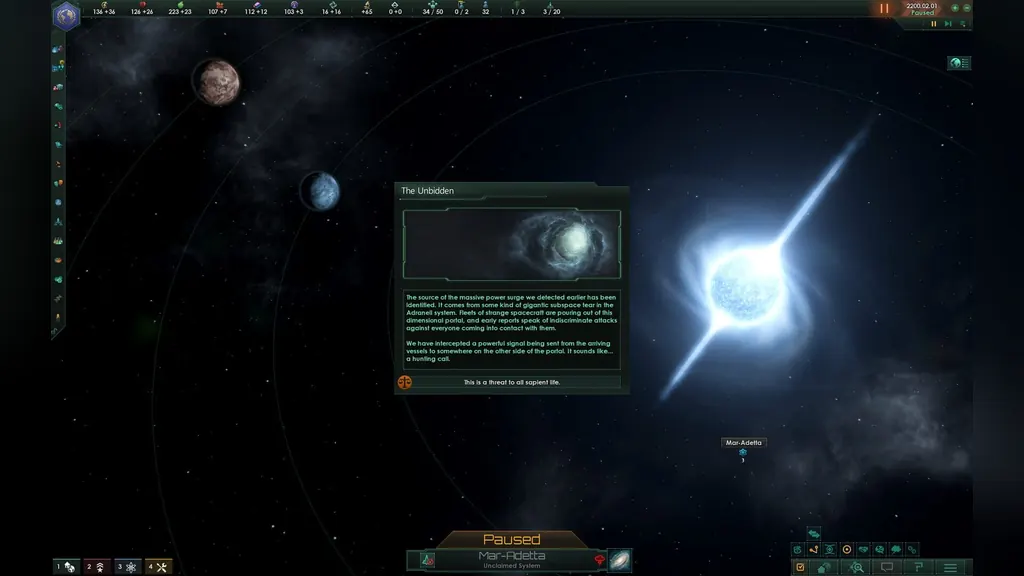
The universe of Stellaris did not arise by chance; it is the result of a complex synergy between creative vision and corporate structure. The game was developed by the studio Paradox Development Studio (PDS Green) and published by Paradox Interactive. This division is crucial: while Paradox Interactive handles distribution and global reach, Paradox Development Studio is the creative engine behind the gameplay and content. The original concept for the game, presented at Gamescom in August 2015, was shaped by a vision that sought to blend the best elements of several classic titles in the genre. Director Henrik Fåhraeus described its main influences as a tripod: one-third from Star Control 2, one-third from Master of Orion 2, and one-third from Europa Universalis IV, with the goal of creating a galactic strategy with a particular focus on exploration and expansion.
Creative and Technical Architecture
The team behind Stellaris is composed of multidisciplinary talents. In addition to Henrik Fåhraeus, the design staff includes names such as Joakim Andreasson, Daniel Moregård, and Johan Andersson. The team also features producers like Rikard “Åslund” Jansson and Anna Norrevik, who oversee the development and expansion of content. On the artistic side, Fredrik Toll is responsible for the art, and the soundscape is built by Andreas Waldetoft and Bert Meyer. Technically, the game uses the Clausewitz Engine, the same engine the studio has used since the release of Europa Universalis III in 2007. If you are interested in epic narratives in games, you can check out the epic story of Final Fantasy. This engine, although adapted with improvements such as the use of physically based rendering (PBR), ensures a robust foundation for the epic scale of the galactic empire. The first release for Windows, OS X, and Linux occurred on May 9, 2016.
Post-Launch Commitment
The success and depth of Stellaris were solidified by the team’s continued commitment after the launch. Development didn’t stop after 2016; it became a continuous cycle of refinement and expansion. Immediately after the launch, a major patch on May 24 improved the AI and added a playable race. The game’s evolution is marked by significant updates, such as version 2.0 (Cherryh), released in February 2018, which revolutionized many mechanics. In May 2018, version 2.1 (Niven) revitalized the core gameplay loop and introduced quality-of-life features. Later, in December, version 2.2 (Le Guin) was released, overhauling planetary organization. The refinement process continued up to 3.5 in September 2022. Furthermore, the game was ported to consoles, arriving on PlayStation 4 and Xbox One on February 26, 2019, and later on Xbox Series X/S on March 25, 2021. This constant dedication from the team to update, expand, and port the galactic universe is what cemented Stellaris’s legacy.
🕒 Stellaris Evolution and Releases
- August 2015 — Original game concept presented at Gamescom.
- May 9, 2016 — First release for Windows, OS X, and Linux.
- May 24, 2016 — Major patch improving AI and adding a playable race.
- February 2018 — Release of version 2.0 (Cherryh), revolutionizing mechanics.
- May 2018 — Version 2.1 (Niven) revitalized the core gameplay loop.
- September 2022 — The refinement process continued up to version 3.5.
- February 26, 2019 — Ported to PlayStation 4 and Xbox One.
- March 25, 2021 — Ported to Xbox Series X/S.
The Genesis of the Idea: Inspirations and the 4X Concept
To understand the ambition behind a title like Stellaris, it is essential to delve into the concept that defines it: the 4X genre. In its essence, a 4X game encompasses four pillars of gameplay—eXplore, eXpand, eXploit, and eXterminate (or Conflict)—which, when combined on a galactic scale, promise an epic-sized civilization management experience. If you enjoy deep visual narratives, you might check out the story behind Ori. The central concept of Stellaris is to transport the player to a procedurally generated galaxy, where the campaign start date is fixed to January 1, 2200 AD. In this universe, players take on the role of a single civilization, or empire, whose primary goal is to colonize, expand its economy, and ultimately overcome or confront rival civilizations.
The Architecture of the Galactic Empire
The world of Stellaris is not a static map; it is a complex ecosystem. Gameplay unfolds on a galaxy map where star systems are treated as two-dimensional blocks. Each star has its own class (such as B, A, or F), and the orbiting planets vary drastically in type and temperature, potentially being habitable or not. Movement between these systems is only possible through a network of superluminal routes called hyperlanes. The power of an empire is assessed by three interconnected factors: military strength, technological progress, and economic power. This triad of variables allows players to choose whether to specialize in a single area or seek a delicate balance among the three pillars.
📘 4X Genre
A 4X game combines four pillars of gameplay: eXplore, eXpand, eXploit, and eXterminate (or Conflict), promising civilization management on a galactic scale.
The depth of the game is reinforced by the level of customization the player receives. The empire can be defined by unique traits, such as its origin (which narrates the pre-superlunar history), its ethics (chosen from one of eight parameters), and its civics, which structure the government and society. Life in the galaxy is sustained by a complex economy based on six main resources: energy credits, minerals, food, consumer goods, alloys, and trade. Furthermore, the population consists of citizens, each assigned a role (worker, specialist, or elite) in buildings that provide specific resources and bonuses. This interdependence between resources, roles, and governmental structures is what gives the game its strategic weight.
The Evolution of Conflict and Civilization
Stellaris‘s ambition to be a landmark in the 4X genre is evident in its ability to generate crises and evolve the game itself. The game begins with a development cycle divided into 100-year segments (early-game, mid-game, and end-game), but the peak of complexity lies in the “Galactic Crisis” events. These crises, which can be triggered mid-to-late game, raise the level of challenge, either through invasions by hostile creatures or the awakening of artificial intelligences. Beyond that, an empire’s life cycle is not linear. Players can follow various “paths of ascension,” such as advanced genetic engineering or cybernetics, radically altering the nature of their civilization. This progression, coupled with the constant threat of a collapsing universe, has solidified the title as a strategy giant, where the challenge lies not just in winning, but in surviving and redefining the very concept of civilization.
Technical Development: From the Clausewitz Engine to the Challenges
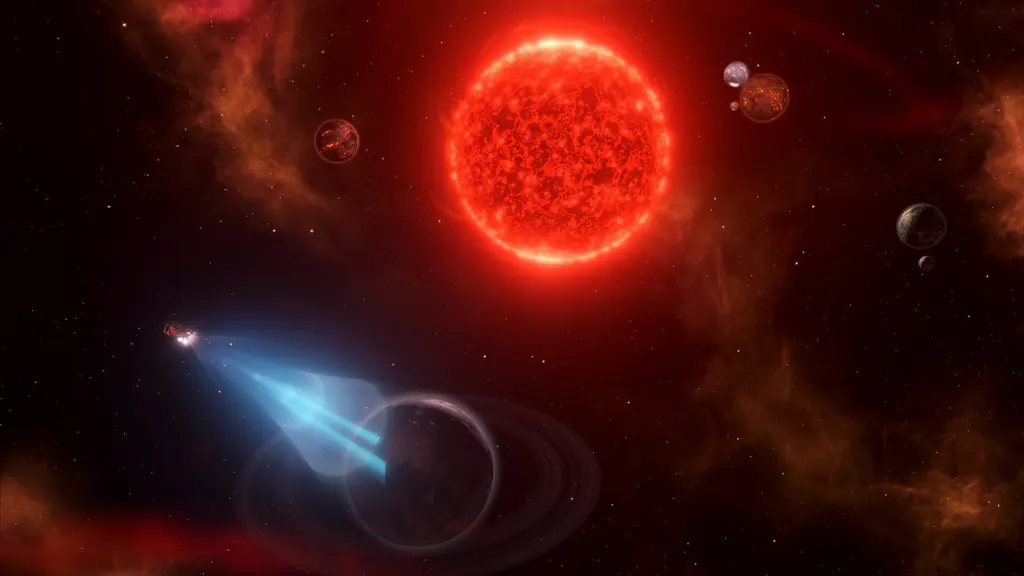
The technical heart of Stellaris lies in a robust and tested game engine: the Clausewitz Engine. This engine was not built from scratch for the galactic universe; it is a direct evolution of technology already used by the Paradox Development Studio, being the same engine employed since Europa Universalis III in 2007. This solid technical foundation was crucial, as it allowed Paradox to transfer the grand strategy concept to a cosmic scale without having to reinvent the wheel. However, taking an engine originally designed for terrestrial geopolitics to the vast reaches of space required significant modifications. Among these adaptations, notable is the implementation of modern techniques such as Physical Based Rendering (PBR), ensuring a level of visual detail appropriate for a galactic empire.
Adapting the Cosmic Scale
The technical challenge of Stellaris is not just the engine itself, but how it handles scale. The game needed to be restructured to support exploration, diplomacy, and conflicts on an interstellar level while maintaining strategic depth. Development, which began with the presentation at Gamescom in August 2015, was a process of constant refinement. After the public release on May 9, 2016, the team dedicated itself to a series of updates and patches that proved the resilience and scalability of the Clausewitz Engine.
The game’s lifecycle was marked by major mechanical overhauls, named after science fiction writers. For example, patch 2.0, titled “Cherryh,” released in February 2018, revitalized a large number of game mechanics. This was followed by significant improvements like patch 2.1 (“Niven”) in May, which enhanced the core gameplay loop, and 2.2 (“Le Guin”) in December, which reformed planetary organization. Stability and the ability to absorb new systems were proven with the release of patch 3.0 (“Dick”) in April 2021, and more recently, with 3.5 in September 2022.
Continuous Evolution and Platforms
This technical and content evolution did not stop at PC. Paradox kept the engine adapted for new formats, porting the game to consoles. The versions for PlayStation 4 and Xbox One were released on February 26, 2019, and an optimized version for Xbox Series X/S arrived on March 25, 2021. The Clausewitz Engine thus demonstrated not only its capacity to manage the complexity of a constantly expanding 4X universe but also its adaptability across various platforms, ensuring that the saga of the galactic empire could be experienced on multiple screens.
📌 Clausewitz Engine Evolution and Adaptation
- Based on the Europa Universalis III engine (since 2007).
- Adapted for cosmic scale, maintaining strategic depth.
- Incorporated modern visual techniques like PBR.
- Successfully ported to consoles (PS4, Xbox One, Series X/S).
Immersive Gameplay: Exploration, Diplomacy, and Galactic Warfare
The core gameplay of Stellaris is an epic cycle of civilizational life, unfolded across a vast, procedurally generated galaxy. The player takes on the role of an interstellar empire, with the goal not only of exploring but also of claiming star systems and colonizing habitable planets, all while expanding its economy to overcome galactic rivalries. The setting consists of star systems, which function like blocks on a galaxy map. Each star has specific classes (such as B, A, or F) and orbits planets of various types and sizes, some habitable and others not. Navigation between these systems is only possible through a network of routes called hyperlanes, establishing the first logistical and conquest challenge for the empire.
The Engine of Civilization
To maintain and expand this empire, the player must manage a complex economy, sustained by six main resources: energy credits, minerals, food, consumer goods, alloys, and trade. Additionally, strategic resources are used, which are essential for developing edicts, defenses, and advanced weaponry. Society is structured on habitable planets, where the population is divided into classes—laborer, specialist, or elite—each occupying a job that consumes and produces resources based on the buildings and districts (such as energy or industrial ones) present on the planet. An empire’s power is assessed across three crucial vectors: military strength, determined by the star fleet; technological progress, measured by the rarity and quantity of discoveries; and economic power, derived from resource production. Progression is guided by the Traditions and Edicts system, which are unlocked through the accumulation of Unity, a resource that strengthens internal factions.
Galactic Evolution and Destiny
The challenge of Stellaris is dynamic, beginning on January 1, 2200, and following a 300-year narrative arc. The depth of gameplay is enhanced by the empire’s customization capabilities: the player can choose or create a unique civilization, defining its Ethics, Civics, and even its form of government. The narrative is not static, as the game can be driven by Galactic Crises, which range from mid-game events, such as crusades by raiding empires, to end-game events, like the awakening of hostile AIs. This level of emergent gameplay allows the player to become a crisis faction themselves by researching dangerous technologies, such as converting stars into black holes. At the game’s peak, the empire can choose from various Ascension Paths, such as advanced genetic engineering or mind uploading into a cybernetic body, radically determining the species’ future.
This interconnection between resource management, technological evolution, large-scale conflicts, and moments of crisis ensures that the game is a complex and profound reflection of an empire’s life cycle, where success depends on a constant balance between internal development and projecting power across the vast universe.
📊 Pillars of an Empire in Stellaris
| Power Vector | What it measures | Source of Evaluation |
|---|---|---|
| Military Strength | Combat capability | Starship fleet |
| Technological Progress | Level of scientific development | Rarity and quantity of discoveries |
| Economic Power | Ability to sustain civilization | Resource production |
Release and evolution: From early versions to legacy
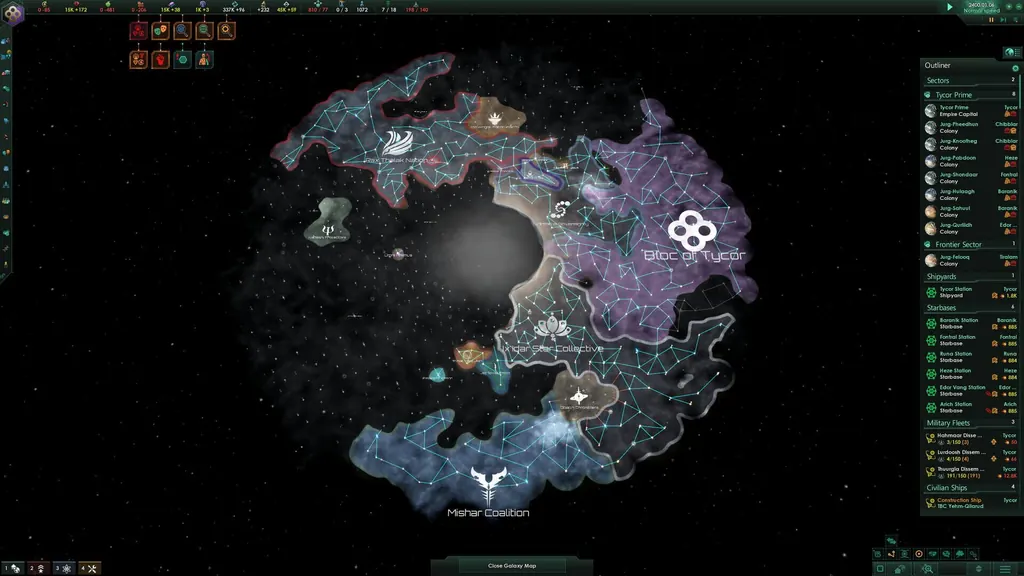
The life cycle of Stellaris is a case study in post-launch support. Its debut to the public was on May 9, 2016, initially arriving on PC platforms (Windows, OS X, and Linux). However, the development did not stop at the computer. The title was ported to consoles, marking the release of Stellaris: Console Edition for PlayStation 4 and Xbox One on February 26, 2019. Subsequently, an optimized version for Xbox Series X/S was released on March 25, 2021, expanding the reach of the galactic empire across several hardware generations.
Constant Evolution: Patches and Expansions
Stellaris’s true legacy lies in its capacity for continuous evolution. Shortly after its initial release, the game received a significant patch on May 24, which brought crucial improvements to the artificial intelligence and added an extra playable race. This support trajectory was marked by major mechanical overhauls, named after science fiction writers, ensuring the game never stagnated. If you enjoy iconic machinery and its development, you can check out the history of Neo Geo. Version 2.0, in February 2018 (named after Cherryh), was a milestone, revamping a significant portion of the game mechanics, even for those who didn’t own the corresponding “Apocalypse” DLC.
The following years solidified this trend of improvement. Patch 2.1 (Niven), released in May, along with the “Distant Stars” DLC, enhanced the core gameplay loop and introduced quality-of-life improvements. In December, version 2.2 (Le Guin) overhauled planetary organization, accompanied by the “Megacorp” DLC. Development continued at a rapid pace, culminating with patch 3.0 (Dick) in April 2021, coinciding with the release of the “Nemesis” DLC, and 3.5 in September 2022.
This synergy between free patches and paid content kept the universe vibrant. In addition to major updates, the game received numerous species packs and story packs, each adding new events, origins, empire types, and traits. The first was the Plantoids Species Pack, released on August 4, 2016, and the most recent, Astral Planes, on November 16, 2023, attests to Paradox Development Studio’s commitment to keeping the galactic ecosystem constantly moving. This robustness in the product life cycle has transformed Stellaris into a title that not only defines a genre but continuously redefines it.
Critical Reception and Impact on the 4X Genre
The success of Stellaris cannot be analyzed solely through the lens of its mechanical complexity; it is equally defined by its commercial impact and the critical reception that solidified its status in the grand strategy genre. Since its launch, the title has demonstrated overwhelming market traction, setting significant records for the developer Paradox Interactive. The sales force was immediate and monumental: less than 24 hours after its release on May 9, 2016, Paradox Interactive announced that Stellaris had sold over 200,000 units. This achievement not only broke the revenue record for any previous Paradox Interactive title in a similar timeframe but also established the game as the fastest-selling title for Paradox Development Studio.
Sales figures continued to prove the game’s popularity. On June 21, 2016, units sold surpassed 500,000, and the total reach of online players hit a new record high on May 12, 2020, when sales exceeded the impressive mark of 3 million units. These numbers not only guaranteed the game’s financial success but also validated the title’s ambition to be a landmark in the 4X genre, attracting a massive and engaged audience.
Critical Reception and Genre Impact
In terms of specialized critical reviews, Stellaris received ratings described as “generally favorable,” as compiled in review aggregators like Metacritic. Critics tend to highlight strong points that resonate with the large-scale gameplay experience. One of the most frequent compliments was the game’s interface and design, which were considered accessible without ever sacrificing depth. The game’s start was particularly praised, described as highly immersive and almost RPG-like, being deeply influenced by the player species’ design choices. Furthermore, the novelty of the end-game crisis events was a point of recognition from both the community and critics.
Nevertheless, critical analysis also points to areas for improvement. Some more mixed reviews indicated that the mid-game could be less satisfying. The most common reservations revolved around a diplomatic system considered overly simple and an artificial intelligence (AI) that was sometimes passive—typical challenges for grand strategy titles with such vast scope. However, the general consensus is that the combination of a robust technical foundation, continuous evolution, and the ability to generate epic narratives has given the title a prominent place and recognition as one of the highest and most representative points in the modern video game 4X genre.
Glossary
- 4X: A strategy genre that combines four pillars: eXplore, eXpand, eXploit, and eXterminate.
- Clausewitz Engine: The robust game engine used by Paradox, adapted to manage the complexity of an interstellar universe.
- Hyperlanes: Superluminal routes necessary for empires to move and conquer star systems on a galactic map.
- Civics: Governmental and social structures that define how the empire is organized and develops.
Frequently Asked Questions
What is a 4X game, and how does Stellaris fit into this genre?
A 4X game encompasses four pillars of gameplay: eXplore, eXpand, eXploit, and eXterminate. Stellaris fits in by transporting the player to a procedurally generated galaxy where they must colonize star systems, expand economically, and confront rival civilizations on an epic scale.
What is the difference between Stellaris and other space strategy games?
Its depth lies in the interconnection of its systems. The game requires managing not only the stellar fleet but also a complex economy based on six resources and a society structured by classes (laborer, specialist, elite) on habitable planets.
Is the game difficult for a beginner to learn?
Due to its complexity, which ranges from resource management to defining ethics and civics, the game demands dedication. However, continuous development and updates aim to improve the gameplay, making the learning curve a rewarding challenge.
What are the best expansions (DLCs) to enhance the Stellaris experience?
The game is characterized by a constant development cycle, with major mechanical patches that solidify its content. The experience is continuously improved by these updates, which revise and add functionalities, ensuring that the galactic universe remains vast and challenging.
What happened to the Stellaris universe after the base game’s release?
Development was a continuous cycle of refinement and expansion. After the initial release, the team launched major patches, such as versions 2.0 and 2.1, which revolutionized mechanics. The game was also adapted for consoles, reaching PlayStation 4 and Xbox One in 2019.
Conclusion
Stellaris’s trajectory is a testament to how creative ambition, when combined with a solid technical foundation, can generate simulation experiences of epic proportions. The title is not just an entertainment product, but a complex ecosystem that blends the best of 4X genre classics, such as Star Control 2, Master of Orion 2, and Europa Universalis IV. This synergy, developed by Paradox Development Studio, allowed the game to be more than a static map; it became a true engine of civilizations, where the power of an empire is balanced between military might, technological advancement, and economy.
Stellaris’s success and depth thus lie in its capacity for constant refinement. By utilizing the Clausewitz Engine, an engine tested since 2007 and adapted for galactic scale, Paradox has managed to build a universe that demands from the player not only exploration and expansion, but also the meticulous management of resources, complex governments, and survival amidst Galactic Crises. This continuous development cycle, which included major updates and porting to multiple platforms, cemented the title as a strategy giant, where the challenge is always to redefine the very concept of civilization.
Ultimately, Stellaris proves that modern grand strategy is a dynamic laboratory of systems. For anyone drawn to the challenge of commanding an empire across centuries and stars, this is the perfect starting point to dive into the grandeur of the cosmos.