Read this article in: Portuguese (Português) · Spanish (Español)
The AMD Ryzen Threadripper 3990X is a high-performance processor, specifically designed for professional workloads and workstations. This processor is equipped with a robust architecture, featuring 64 cores and 128 threads. With a base clock speed of 2.9 GHz and a massive 256 MB L3 cache, it was released on February 7, 2020, and has an MSRP of US $3990. Its technical specifications position it in the HEDT (High-End Desktop) segment, offering an advanced configuration of 8 × CCD and 1 × I/OD, ideal for those who demand maximum parallel processing.
The relevance of the 3990X lies precisely in its massive processing capability, which is essential for engineering, 3D rendering, and complex data analysis. Having 64 cores and 128 threads is no minor detail; it represents a leap in computational power that surpasses the limits of common consumer processors. The Zen 2 architecture, used in this model, allowed AMD to set a new standard in workstations, establishing Threadripper as a benchmark platform for the professional market, making it crucial for architects, developers, and data scientists who rely on unmatched performance.
In this article, we will dive into the complete specifications of this AMD giant. We will detail the Zen 2 architecture and the chiplet design concept that boosts performance. We will analyze the technical specifications, from the detailing of its cores to advanced memory interface support. Furthermore, we will provide an overview of its practical performance in heavy workloads, such as rendering and simulation, comparing it with previous generations and HEDT competitors so you understand exactly if the 3990X is the power your workstation requires.
Key Highlights
- High-performance processor (HEDT) with 64 cores and 128 threads for extreme multitasking.
- Features a massive 256 MB L3 cache, optimizing fast access to large volumes of data.
- Supports 64 lanes of PCIe 4.0, essential for connecting multiple accelerators and GPUs.
- Optimized for parallel processing in professional workloads, such as 3D rendering.
- Operates with DDR4 memory in quad-channel mode, ensuring high data bandwidth.
Ryzen Threadripper 3990X Overview: A Workstation Giant
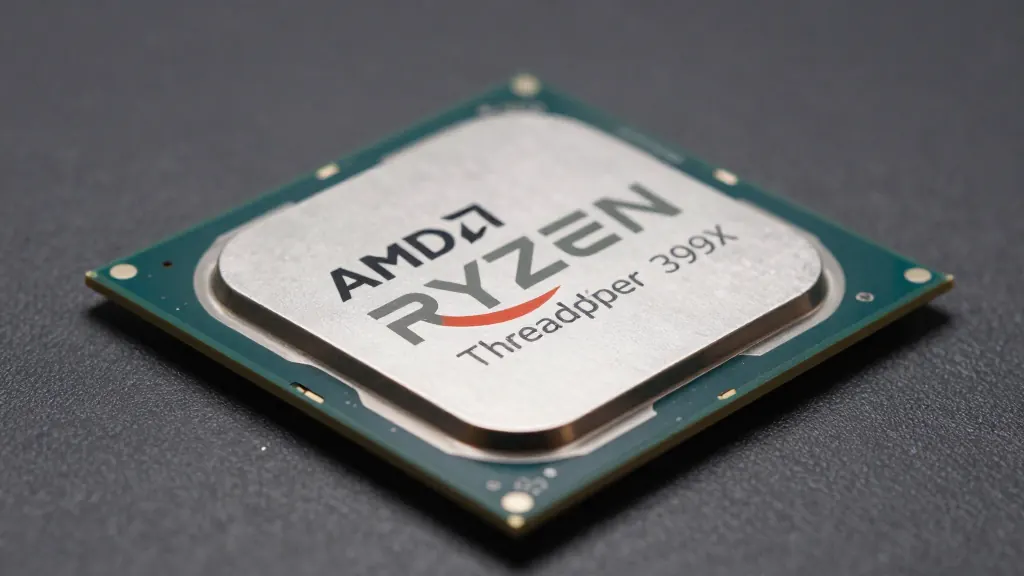
The AMD Ryzen Threadripper 3990X is no ordinary processor; it is a high-performance component positioned in the HEDT (High-End Desktop) segment and, most notably, for professional workstations. Its design is meticulously geared toward massive parallel processing, making it an ideal engine for workloads demanding extreme multitasking, such as complex 3D rendering, scientific simulations, and large-scale data analysis. If you want to learn more about robust processors for professional environments, you can check out the guide on the AMD Ryzen Threadripper 1900X: complete specifications. It is crucial to understand that the primary focus of this processor is not gaming performance, but rather the ability to process multiple workflows simultaneously.
The Power of Architecture for the Professional Workflow
To ensure this level of computing power, the 3990X was built with robust specifications and a connectivity ecosystem designed for the professional. The processor features an impressive 64 cores and 128 threads, supporting a total L3 cache of 256 MB. Furthermore, memory support is a key differentiator: it operates in quad-channel mode with DDR4-3200 memory. In terms of peripheral expansion, the 3990X guarantees 64 PCIe 4.0 lanes, which are essential for efficiently connecting multiple graphics cards or compute accelerators. Its socket, the sTRX4, was designed to support this complexity and scale.
These technical attributes elevate the 3990X to a category where performance is measured not just by clock speed, but by the ability to maintain a constant flow of data and processing across multiple fronts. It was launched on February 7, 2020, with an MSRP of US $3990, establishing itself as a giant designed to raise the standard of productivity in corporate and creative environments. It is worth noting that, in its architecture, the 3990X lacks integrated graphics, reinforcing its identity as a dedicated computing engine, not an entertainment system.
In summary, the Threadripper 3990X is the choice for the user who demands the maximum number of cores and bandwidth possible. Its combination of 64 cores, massive cache, and support for a high number of PCIe 4.0 lanes positions it as the leading processor for engineering, data science, and any application requiring uncompromising parallel processing.
📌 Key Specifications of the Threadripper 3990X
- 64 cores and 128 threads for massive parallel processing.
- Impressive total L3 cache of 256 MB.
- DDR4-3200 quad-channel memory support.
- 64 PCIe 4.0 lanes for peripheral expansion.
- sTRX4 socket, designed for high complexity and scale.
Zen 2 architecture and chiplet design
The massive processing power of the AMD Ryzen Threadripper 3990X is built upon an advanced and modular architecture known as chiplets, implemented in the Zen 2 generation. Instead of building a single, gigantic silicon block, AMD divided the processor’s functions into smaller, specialized components—the chiplets. This strategy not only optimizes manufacturing but also allows the processor to achieve a core count and I/O bandwidth that would be impossible with a single die. To better understand this evolution in powerful processors, check out the guide on high-performance workstation specifications. This approach is what allows the 3990X to be a true giant for workstations.
Zen 2 Modularity: CCDs and I/O Die
At the heart of this architecture is the functional division into Compute Die (CCD) and I/O Die. The CCD is the component responsible for core processing, where the CPU cores are located. The 3990X is notable for its configuration of 8 CCDs, each dedicated to a set of cores. This modular distribution is crucial because it ensures that intensive processing can be scaled across multiple computing blocks. Complementing the CCDs is the I/O Die (Input/Output Die). This component is responsible for all external connections, such as memory management and PCIe lanes, isolating these complex functions from the processing core.
📘 Chiplets
It is a design strategy where a processor’s functions are divided into smaller, specialized components. This optimizes manufacturing and allows for high core count and bandwidth.
This physical and functional division, utilizing the TSMC 7FF manufacturing process, is what allows the 3990X to boast a robust set of specifications. In terms of connectivity, the processor is equipped with 64 PCIe 4.0 lanes, a bandwidth essential for connecting multiple high-demand devices, such as graphics cards and accelerators. Furthermore, regarding memory, it supports quad-channel mode with DDR4-3200. The combination of 8 CCDs and 1 I/O Die, resulting in 64 cores and 128 threads, establishes the Threadripper 3990X as a component of extremely high computational power, launched on February 7, 2020.
Technical Details: Cores, Cache, and Memory Interfaces
| Model | Ryzen Threadripper 3990X |
|---|---|
| Cores / Threads | 16 × 4 |
| Cores (threads) | 64 (128) |
| Base Clock | 2.9 GHz |
| Boost Clock | Not specified |
| L3 Cache (total) | 256 MB |
| TDP | Not specified |
| Chiplets | 8 × CCD 1 × I/OD |
| Release Date | February 7, 2020 |
| MSRP | US $3990 |
Processing and Connectivity Specifications
The AMD Ryzen Threadripper 3990X is a piece of precision engineering, and its raw specifications define its ability to handle the most demanding workloads in the professional market. In terms of processing power, the processor is equipped with a total of 64 physical cores and 128 threads. This massive core configuration ensures that parallel tasks—such as complex 3D rendering, Computational Fluid Dynamics (CFD) simulations, or large database analysis—can be distributed efficiently, maximizing the utilization of every available core. If you want to learn more about high-performance processors, check out the guide on the AMD Ryzen Threadripper 2970WX for Professional Workstations. Complementing this raw power, it features a total L3 cache of 256 MB, a considerable volume that allows the processor to keep large amounts of data readily accessible, reducing latency and optimizing the workflow in applications that require constant data access.
Regarding clock speeds, the 3990X features a base clock frequency of 2.9 GHz, providing solid and consistent performance under continuous load operation. However, to ensure performance peaks in specific tasks, it can boost its operating frequency up to 3.2 GHz (Boost). This combination of a robust base clock and a significant boost ensures that, even in mixed workloads, the processor can deliver the maximum possible speed without compromising operational stability over long periods.
Memory and Bandwidth
For a processor with these characteristics to function at its maximum capacity, a robust memory and connectivity ecosystem is vital. The Ryzen Threadripper 3990X is designed to operate on DDR4 memory in quad-channel mode. Quad-channel support is a critical differentiator in workstations because it doubles the data bandwidth compared to standard single or dual-channel configurations, allowing a massive amount of data to reach the cores simultaneously and quickly. This is fundamental for performance in scientific and engineering applications.
Beyond memory, expansion capability and connectivity are crucial points for the modern professional. The processor offers robust support for 64 PCIe 3.0 lanes. This vast amount of expansion slots allows the user to connect multiple high-demand devices simultaneously, such as several Graphics Processing Units (GPUs) for cluster rendering, multiple ultra-fast NVMe storage drives, or various I/O peripherals. The availability of 64 PCIe 3.0 lanes is not just a number; it represents the guarantee that the system will not be bottlenecked by communication limitations, allowing the professional to utilize the full set of peripherals required by their heaviest workflow.
📊 Key Specifications Summary for the Ryzen Threadripper 3990X
| Feature | Value | Detail/Impact |
|---|---|---|
| Cores/Threads | 64 cores / 128 threads | Ideal for parallel tasks (rendering, simulations). |
| L3 Cache | 256 MB | Large volume for fast data access, reducing latency. |
| Clock Frequency | Base: 2.9 GHz / Boost: 3.2 GHz | A combination that ensures stable performance and speed peaks. |
| Memory | DDR4 Quad-Channel | Doubles the data bandwidth, crucial for scientific applications. |
| PCIe Connectivity | 64 PCIe 3.0 Lanes | Robust support for multiple high-demand devices (GPUs, NVMe). |
Performance in heavy workloads: rendering and simulation
Performance in heavy workloads: rendering and simulation
The true power of the AMD Ryzen Threadripper 3990X, a processor based on the Zen 2 architecture of the 3000 series, is not manifested only in a high clock speed, but in its massive and parallel processing capability. With its 64 cores and 128 threads, the 3990X is a computing engine designed to optimize tasks that require intense multithreading. In this professional segment, performance is not measured by a single number, but by the ability to maintain a constant flow of data and processing across multiple work fronts simultaneously.
🧪 How Parallelism Accelerates Professional Work
In 3D rendering, software like V-Ray or Blender uses the computational power of multiple cores to process complex scenes, reducing time from days to hours. In scientific simulations, distributing tasks across 64 cores ensures faster and more robust data analysis.
The power of parallel processing
The fundamental concept behind the professional use of the 3990X is linear scalability. In applications that can distribute the workload across many cores—a scenario known as parallel processing—the completion time is directly proportional to the number of cores used. The more cores the software can access, the less time is spent executing the task, resulting in a dramatic increase in productivity.
This feature makes it indispensable in various fields of engineering and content creation. In 3D rendering, software like V-Ray or Blender uses the computational power of multiple cores to process complex scenes, reducing time from days to hours. Similarly, in scientific simulations—which involve matrix calculations and physical modeling—distributing tasks across 64 cores ensures faster and more robust data analysis.
Other critical use cases include editing ultra-high-resolution video, such as 8K, where processing multiple streams and video encoding greatly benefit from constant bandwidth and processing power. Furthermore, in virtualization environments, where multiple virtual machines (VMs) need to operate simultaneously, the 3990X offers the necessary number of cores and resources to ensure consistent isolation and performance for every guest operating system.
In summary, the Threadripper 3990X is not just a high-core-count processor; it is a precision engineering platform. Its combination of 64 cores, supported by robust connectivity and the Zen 2 architecture, positions it as the ideal choice for professionals who demand maximum parallelism and minimal wait time in their heaviest workloads.
Comparison with Previous Generations and HEDT Competitors

The trajectory of the AMD Ryzen Threadripper 3990X is a case study in HEDT (High-End Desktop) platform scalability and evolution. Launched on February 7, 2020, the 3990X represented a significant leap over previous generations, especially the 2000 series (based on Zen+). While the 2000 series processors used the TR4 socket and the GlobalFoundries 12LP (14LP+) process, the 3990X, based on the Zen 2 architecture and manufactured with the TSMC 7FF process, drastically increased transistor density and efficiency. This transition was not merely a core count increase, but a redefinition of massive processing capability.
Platform Evolution and Data Bandwidth
A technical comparison across generations reveals fundamental leaps in connectivity. The Threadripper 2000 processors, for example, supported quad-channel mode with DDR4-2933 and 64 lanes of PCIe 3.0. The 3990X maintained a focus on bandwidth, but the most notable advancement came with the 5000 series. The 5000 series processors, based on Zen 3, migrated to the sWRX8 socket, supporting octa-channel mode with DDR4-3200 and, crucially, doubling connectivity with 128 lanes of PCIe 4.0. This progression from 64 to 128 lanes of PCIe 4.0 is a direct indicator of the growing demand for bandwidth in ultra-heavy workloads, such as simulations and 8K rendering.
While the 3990X is a giant with its 64 cores, its historical position is marked by the transition of manufacturing processes. The shift from GlobalFoundries 12LP (14LP+) to TSMC 7FF, used in the 3990X and later refined in the 5000 series, demonstrates AMD’s trend toward optimizing power consumption and increasing transistor density. This process improvement, alongside the increase in memory channels (from quad to octa), allowed platforms to become more efficient at maintaining a constant flow of data and processing across multiple fronts.
In summary, the Threadripper 3990X not only surpassed the 2000 series in architecture and launch date in 2020, but it also set the standard for high core counts that would be improved in terms of connectivity and efficiency by subsequent generations. The constant evolution—from DDR4-2933 and PCIe 3.0 in the 2000 series, through the 3990X, to the DDR4-3200 and PCIe 4.0 of the 5000 series—illustrates the continuous need for greater bandwidth and energy efficiency to support the increasing pace of professional applications.
Platform Requirements and Power Consumption
For the AMD Ryzen Threadripper 3990X to reach its maximum potential in professional environments, sheer processing power is not enough. A fully optimized platform ecosystem is necessary to support a constant flow of data and high energy demands. The core of this support lies in the choice of the motherboard, which must be designed for the Socket TR4. This chipset is not a trivial component; it is the data traffic manager that ensures the processor has access to all necessary resources for heavy workloads.
Motherboard Connectivity and Architecture
Connectivity is a critical differentiator. The 3990X, by its nature as a HEDT (High-End Desktop) platform, demands a robust expansion infrastructure. Motherboards compatible with the Threadripper series support a vast number of PCIe 3.0 lanes, totaling 64 lanes. It is crucial to note that even with this massive capacity, 4 of these lanes are reserved exclusively for communication with the chipset. This lane allocation ensures efficient communication among various peripherals and memory modules, which is fundamental for maintaining data integrity and bandwidth in extreme multitasking scenarios.
In addition to the PCIe lanes, the RAM also requires special attention. The TR4 platform supports DDR4 memory modules, and to optimize performance in simulations or rendering, it is vital that the motherboard supports quad-channel mode, ensuring that the memory can keep pace with the processing speed of the 64 cores.
Thermal and Power Management
The second precision engineering requirement is power management. With a Thermal Design Power (TDP) of 125W, the 3990X generates a significant amount of heat. Ignoring this detail can lead to thermal throttling, where the processor automatically reduces its frequency to prevent damage, resulting in a drastic drop in performance.
Therefore, it is imperative that the system be accompanied by a robust and highly efficient cooling system. It’s not enough just to keep the processor cool at rest; the cooling system must be capable of continuously dissipating heat during prolonged periods of peak processing. Concurrently, the power supply unit (PSU) must be high-power and high-quality. Electrical stability is as important as thermal dissipation. An adequate power supply ensures that all components—processor, memory, and graphics cards—receive clean and sufficient power to operate at their maximum capacity for long periods, maintaining stable and predictable performance, which is the pillar of professional work.
Glossary
- HEDT: Acronym for High-End Desktop, indicating a very high-performance processor aimed at professional workstations.
- Workstation: Professional workstation, a computer optimized for heavy tasks such as rendering and complex simulations.
- Chiplets: A design strategy that divides the processor into smaller, specialized components, optimizing manufacturing and performance.
- CCD: Compute Die, the component responsible for core processing, where the CPU cores are located.
- I/O Die: Input/Output Die, the component that manages all external connections, such as memory and PCIe lanes.
- Quad-channel: A memory mode that increases data bandwidth, allowing more information to reach the cores simultaneously.
Frequently Asked Questions
Is the Ryzen Threadripper 3990X good for gaming?
Although it is an extremely powerful processor, it is not primarily designed for gaming. Its focus is massive parallel processing, ideal for workstations. However, its high core count and bandwidth ensure excellent performance in tasks that require multitasking and constant processing.
What is the performance difference between the 3990X and more recent models?
The main difference lies in the evolution of the architecture and transistor density. More recent models generally bring improvements in efficiency and greater connectivity capacity, such as more PCIe lanes. The 3990X set a standard for massive processing that is still a benchmark in its category.
What type of RAM is ideal for running the 3990X?
It is essential to use DDR4 memory, as the processor is optimized to operate in quad-channel mode. This operating mode is crucial because it doubles the data bandwidth, which is vital for scientific and engineering applications that require a constant flow of information.
Do I need a special motherboard to use the 3990X?
Yes, it is absolutely necessary. Due to its high-complexity specifications, such as support for 64 PCIe lanes and its modular architecture, the 3990X requires a specialized motherboard that supports its socket and the necessary data bandwidth to operate at its maximum potential.
Is the power consumption (TDP) of the 3990X an issue in a modern PC?
As a high-performance processor designed for extreme workloads, it has a robust TDP. This high power consumption is inherent to its massive processing power. It is expected that the cooling system must be equally robust to maintain stability during long periods of intensive use.
Conclusion
The AMD Ryzen Threadripper 3990X transcends the definition of a mere processor; it is, in fact, a high-level computing engine, meticulously designed to raise the standard of productivity in workstation environments. With its 64 cores and 128 threads, the 3990X is the definitive choice for workloads demanding massive parallel processing, such as complex 3D rendering, scientific simulations, and large-volume data analysis. Its advantage lies in its ability to maintain a constant and robust processing flow, supported by a total of 256 MB of L3 cache and crucial support for DDR4 memory in quad-channel mode.
This robustness is no accident. The Zen 2 modular architecture, which divides functions into CCDs and the I/O Die, allows the processor to achieve unparalleled scalability and I/O bandwidth, guaranteeing 64 PCIe 4.0 lanes. This vast connectivity is what allows professionals to connect and utilize multiple compute accelerators and graphics cards without communication bottlenecks, optimizing performance across every workflow front. The 3990X, therefore, is measured not just by its clock frequency, but by its capacity to manage complexity and continuous data flow.
Ultimately, the Threadripper 3990X establishes itself as a precision engineering component, intended for users who do not accept compromises in their most demanding workflows. If your project depends on maximum processing capacity and bandwidth, it is time to evaluate how this power can redefine the limits of your productivity.