
Read this article in: Portuguese (Português) · Spanish (Español)
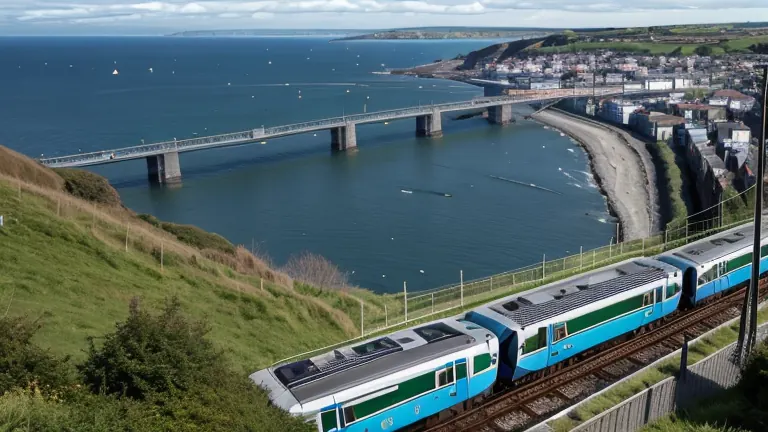
The DART (Dublin Area Rapid Transit) is more than just a simple means of transportation; it is a vital artery that pulses along the coast of Dublin Bay, in Ireland. To understand who created the DART, one must look at the context of Dublin’s growth and modernization. The system was designed to meet the growing demand for mobility in the region, connecting high-density suburban areas to the urban center. Its conception was not an isolated event, but rather a planned response to the needs of an expanding population, ensuring that the movement of people was efficient and robust.
The historical relevance of the DART is proven by its operational data. The system began operations in 1984, when it was managed by Córas Iompair Éireann (CIE), the entity that gave rise to the current operator, Iarnród Éireann. With an extension spanning from Greystones, in Wicklow County, to Malahide, in Dublin County, the DART covers a significant route passing through 30 stations. Powered by a 1500V DC catenary, it represents an engineering feat that sustains the mobility of thousands of people daily.
In this article, we will delve into the fascinating trajectory of this train that revolutionized transportation in Dublin. We will analyze the historical context that generated the need for a modern system, identify who was responsible for its development, and how the DART was designed and implemented in practice. Furthermore, we will address the detailed operation and architecture that make the DART so effective, concluding with a look at its evolution and the lasting legacy it has left for urban mobility in Ireland.
Key Points
- Launched in 1984, the DART is a rapid transit system dedicated to connecting the coast of Dublin to the urban center.
- It has an extension of 33 km and serves 30 stations on a single line, covering the Trans-Dublin route.
- It is a broad gauge railway system, ensuring high capacity and operational stability.
- The operation is powered by a 1500V DC catenary system, integrating with the national railway network.
- Currently, the system is managed by Iarnród Éireann (IE), the successor to Córas Iompair Éireann (CIE).
DART in Summary
| Location | Dublin, Ireland |
|---|---|
| Type of Transport | Metro |
| Operator | Iarnród Éireann |
| Start of Operations | 1984 |
| Number of Lines | 1 |
| Number of Stations | 30 |
| System Length | 33 |
| Gauge | Broad |
The Historical Context and the Need for a New Transportation System

The urban and population growth of Dublin, in Ireland, throughout the 20th century, created a complex and growing mobility issue. As the population expanded and economic life developed beyond the city’s central limits, the existing transportation system began to show signs of exhaustion. Downtown Dublin, a hub of economic and cultural attraction, progressively became isolated from its coastal expansion areas and suburbs. The direct consequence was a dramatic increase in traffic congestion, making daily commuting a logistical and social challenge.
The Need for an Efficient Coastal Connection
The main mobility challenge in Dublin was not just the volume of people, but the geography of the city itself. Human development spread along Dublin Bay, creating a critical need to connect residential and commercial areas located on the coast, such as Malahide and Howth, directly to the urban core. The transportation system required a route that was not only high-capacity but also fast and reliable, bypassing the bottlenecks created by conventional land routes. It was imperative to have a system that could integrate the flow of passengers between the center and the most distant points of the coast, enabling the daily commute of thousands of people.
It was in this context of demographic and geographical pressure that the creation of a dedicated, railway-based rapid transit system became not just desirable, but essential. The solution needed to be robust enough to support Dublin’s continuous growth and, at the same time, elegant enough to operate along the coastal landscape.
The Birth of a Vital Artery
This need resulted in the planning of the Dublin Area Rapid Transit (DART). Designed to solve the problem of connecting the center to the coast, the DART was launched in 1984. Since its inception, the system has assumed the mission of being a dedicated transport artery that runs the Trans-Dublin route, extending for a total of 33 kilometers. Its operation covers a vast area, connecting important points like Greystones, in County Wicklow, to Howth and Malahide, in County Dublin. To fulfill this large-scale mission, the DART was designed to support an intense flow of passengers, passing through 30 stations and utilizing a broad gauge, characteristics that attest to the ambition and depth of its impact on Dublin’s infrastructure. Initially operated by Córas Iompair Éireann (CIE), today a subsidiary of Iarnród Éireann (IE), the DART has consolidated itself as a pillar of urban mobility, proving to be the ideal mechanism to mitigate growing congestion and redefine the way Dublin moved.
Who Was Responsible for the Creation and Development of the DART

The conception and development of the DART (Dublin Area Rapid Transit) were not the result of a single actor, but rather a process of state planning and engineering, responding to increasing mobility pressure in the Dublin metropolitan area. The project, which culminated in the construction of a dedicated railway line, was made possible by entities representing Ireland’s transport infrastructure. The central organization responsible for this undertaking was Córas Iompair Éireann (CIE).
The Planning and Operating Structure
CIE was the entity that initially administered the system. Its role was crucial, as it not only planned the route but also supervised the technical implementation that made rapid transit along the Dublin Bay coast possible. The DART, in its essence, is a transport artery that runs the Trans-Dublin route, connecting vital points from Greystones, in Wicklow County, to Howth and Malahide, in Dublin County. This extension covering the Dublin coast is what gives the system its unique characteristic and its importance to urban life.
The fundamental temporal milestone for the DART is the year 1984, when the system began operations. Since its inception, the DART has established itself as a heavy rail subway system, operating on a single line that served the population of Dublin and its surroundings. Its technical infrastructure is robust and specific: the trains are powered by a 1500V DC catenary, integrating into the vast national railway network of Ireland, managed by a specialized operator.
The Evolution to Iarnród Éireann
It is important to note the institutional evolution that shaped the operation of the DART over time. Although the system was born under the administration of Córas Iompair Éireann (CIE), this entity underwent structural transformations. CIE, which is today a subsidiary of the modern Iarnród Éireann (IE), maintained operational control over the DART. IE, in turn, is the national rail operator that manages and guarantees the continuity of the service. This management transition reflects the consolidation of the DART as a permanent pillar of Irish urban mobility.
In summary, the development of the DART is a testament to the capacity of state engineering planning. Driven by the need to solve Dublin’s geographical and population challenge, CIE (and subsequently IE) not only built a line but established a dedicated rapid transit system, featuring 30 stations and a 33-kilometer extension, capable of moving passengers along the Dublin Bay coast since 1984.
How the DART Was Designed and Implemented
The conception and implementation of the Dublin Area Rapid Transit (DART) represented a complex state engineering undertaking, designed to integrate high-capacity rail transport into Dublin’s coastal landscape. The system’s development was not only about charting a path but establishing a robust technical infrastructure capable of supporting high-frequency operation and ensuring efficient passenger movement along its extensive route.
Technical Characteristics of the Infrastructure
DART was designed to be a suburban metro system with railway characteristics that ensure its operational robustness. The main route, known as the Trans-Dublin route, stretches along the coast of Dublin Bay, connecting vital points such as Greystones in Wicklow County, to Howth and Malahide in Dublin County. This extension totals 33 kilometers, serving a total of 30 stations, and passing through downtown Dublin.
One of the most important technical details during the planning phase was the definition of the rail gauge. DART operates with Larga (broad gauge), a standard that, historically and technically, allows for greater load capacity and greater operational stability—crucial factors for maintaining high-frequency and punctual service.
Power Supply and Operation
To ensure continuous and reliable operation, the system was equipped with a catenary electrical power supply system. The trains are powered through a specific catenary at 1500V DC (Direct Current). This type of electrical supply is vital for modern, high-volume operation, and is an integral part of the national railway network, the Irish Rail Network.
Although the system began operations in 1984, the development and administration of DART underwent institutional evolution. Initially, the service was operated by Córas Iompair Éireann (CIE). Today, the system is managed by Iarnród Éireann (IE), the national rail operator. The engineering behind DART is therefore a testament to the planning capacity that not only established the line but also standardized the necessary technology—from the gauge to the catenary system—to support the flow of people in one of Ireland’s busiest transport arteries.
Operation and Architecture of the Rail System

The DART (Dublin Area Rapid Transit) is not merely a means of transportation, but an essential structural element in Ireland’s suburban rail network. Its architecture was designed to cover an extensive geographical route, following the Trans-Dublin path, which runs along the coast of Dublin Bay. This route is remarkably comprehensive, connecting vital points in different counties, from Greystones in Wicklow County, to the locations of Howth and Malahide, which are in Dublin County. What makes the DART unique is its ability to integrate this vast coastal network, causing part of its journey to cross and serve the urban heart of Dublin, ensuring connectivity from the far suburbs to the metropolitan center.
Operation and Infrastructure
Technically speaking, the DART is a high-capacity railway system that operates on a single line. Its total length reaches an impressive 33 km, and to serve the population and various areas of interest, it is equipped with a total of 30 stations. To ensure continuous and robust operation, the system is powered by a sophisticated catenary system, which provides electrical energy at a voltage of 1500V DC. This wide-gauge, high-power infrastructure allows the trains to maintain adequate frequency and speed for rapid passenger transport over long distances, fulfilling its role as a suburban metro with the great robustness characteristics of a railway.
The administration and daily operation of the system are managed by the national rail operator, Iarnród Éireann (IE). Although the DART began operations in 1984, its management underwent significant institutional transformations. It is important to note that, upon its creation, the system was administered by Córas Iompair Éireann (CIE), an entity that later became a subsidiary of the IE. This administrative evolution reflects the growing complexity of the system and the need for highly specialized state management.
The DART’s operational flow is designed to be efficient on its single line. By connecting communities like Greystones and Malahide, while passing through crucial points in central Dublin, it plays a vital role in urban mobility. The ability to operate on such a long and busy axis, supported by dedicated electrical infrastructure, proves the success of the engineering planning that transformed the coastal route into a passenger transport artery, remaining a testament to the capacity to integrate different regions under a single operational line.
Evolution and the DART’s Legacy in Urban Mobility
The DART (Dublin Area Rapid Transit) transcends the definition of a simple means of transportation; it is a vital structural element and a testament to the ability to plan mobility in a growing metropolis. Located in Dublin, Ireland, the subway system operates on a single line, but one of immense strategic importance to the country’s suburban rail network. Its trajectory is marked not only by time, but by its capacity to adapt to the demands of a constantly expanding urban population, remaining a pillar of connectivity since its inception in 1984.
The DART route is remarkably extensive and geographically significant. It traces a trans-Dublin route, extending along the coast of Dublin Bay. This single line, with a total length of 33 kilometers and serving 30 stations, connects crucial points ranging from Greystones, in Wicklow County, to Malahide and Howth, in Dublin County. This scope not only makes it a high-capacity system but also a fundamental link connecting suburban residential neighborhoods to the heart of the city, passing through central areas of Dublin.
Resilience and Role in Urban Life
The longevity of the DART demonstrates that transport infrastructure planning is not a static endeavor, but a continuous process of supporting urban life. Since its first years of operation, the system has been designed with robust characteristics, operating with a broad gauge and powered by a 1500V DC catenary, an integral part of the Irish Rail Network. Although daily administration and operation are managed by the national rail operator, Iarnród Éireann (IE), the system maintains its primary function of moving people efficiently along its single line.
The DART’s legacy, therefore, lies in its adaptability. It is a concrete example of how a mass transit infrastructure, when well-planned and operated by a dedicated entity, can mitigate the challenges posed by a city’s demographic and geographical growth. Maintaining such an extensive and complex system, which covers an area so vast and crucial to the daily flow of thousands of people, transforms the DART into much more than a train; it becomes an economic and social catalyst, proving that investment in high-capacity rail transport is an essential engine for sustainable development and quality of life in Dublin and the surrounding region.
Frequently Asked Questions
What does the acronym DART stand for, and what is its main function?
DART stands for Dublin Area Rapid Transit. Its main function is to act as a dedicated transport artery, designed to solve Dublin’s geographical challenge. It connects residential and commercial areas located on the coast, such as Malahide and Howth, directly to the urban core, mitigating increasing traffic congestion.
In what part of Dublin does the DART operate?
The DART operates along the Dublin Bay coast, following the Trans-Dublin route. This route is strategic because it not only crosses through central Dublin but also ensures vital connectivity between the most distant points of the coast, such as Malahide and Howth, and the metropolitan core.
What is the difference between the DART and the Dublin subway system?
The DART is a rapid transit system that, although functioning like a suburban subway, possesses robust railway infrastructure characteristics. It was specifically designed to cover the vast coastal route, utilizing a broad gauge and high-power electrical supply, which gives it unique operational capacity and robustness.
What are the main origin and destination points of the DART?
The DART covers an extensive route of 33 kilometers. Its main connection points range from Greystones, in County Wicklow, to the localities of Howth and Malahide, in County Dublin. This coverage allows the system to integrate passenger flow between these coastal ends and central Dublin.
Which company currently operates the DART?
Currently, the DART is managed and operated by Iarnród Éireann (IE), which is the national railway operator of Ireland. Although the system began operations in 1984 under Córas Iompair Éireann (CIE), the IE consolidated management, keeping the DART a permanent pillar of Irish urban mobility.
Conclusion
The development of the Dublin Area Rapid Transit (DART) is much more than the history of a railway line; it is a case study on how state engineering can respond to complex geographical and demographic challenges. Driven by increasing population pressure and the need to connect the coastal areas of Malahide and Howth to the urban center, the system represented a vital intervention. When launched in 1984, the DART not only alleviated traffic congestion but redefined the very dynamics of the Irish capital’s mobility, proving that dedicated, high-capacity infrastructure was essential for sustainable growth.
The magnitude of the undertaking is remarkable: an artery that spans 33 kilometers, serving 30 stations along the Trans-Dublin route. Its technical robustness, from the use of broad gauge to the 1500V DC catenary power system, ensures continuous and efficient operation—a pillar maintained by the institutional evolution from Córas Iompair Éireann (CIE) to Iarnród Éireann (IE). This process of planning and execution demonstrates that the success of systems like the DART lies in integrating technical ambition with a long-term strategic vision.
Thus, the DART remains a powerful testament to human planning capacity. It proves that when infrastructure is designed to keep pace with urban development, it not only transports people but also shapes the future of a metropolis. Analyzing the DART invites us to reflect: what are the mobility challenges that our own city faces and that require an equally audacious engineering solution?