Read this article in: Portuguese (Português) · Spanish (Español)
To understand who created Proteus, one must delve into Greek mythology, where he is recognized as a prophetic sea god and one of the “Old Men of the Sea” (halii geron). According to the mythological pantheon, Proteus was the son of the sea god, Poseidon, and Phoenice, a daughter of King Phoenix of Phoenicia. His nature, however, went beyond mere divine lineage: he is famous for being a shape-shifter, which led modern scholars to interpret him as the personification of the mutable and ever-changing nature of the ocean itself. From this characteristic derives the adjective “protean,” a synonym for versatility and adaptability.
The relevance of Proteus transcends the mythological realm, being a recurring theme in various cultures and fields of knowledge. His figure is recorded in epic works, such as the Odyssey, where Menelaus is forced to wrestle with him to gain knowledge. Furthermore, the reference to Proteus is notable in academic and artistic contexts: the Germanic alchemist Heinrich Khunrath used him as a symbol between the unconscious and the perfection of art. The theme of metamorphosis also finds parallels in the biological world, such as in Proteus anguinus, an aquatic salamander. Such connections demonstrate that the god’s enigma is not confined to the sea, but permeates human knowledge.
In this article, we will deeply explore the legend of the god of transformations. We will begin with his mythological origin and the meaning of his name. Next, we will investigate the context of the sea and the mystery of prophecy, delving into the protean nature and the power of metamorphosis. Finally, we will trace the evolution of this concept, from its applications in alchemy and psychology to its modern manifestations and its profound philosophical legacy on the art of being mutable.
Key Points
- Your name derives from the Greek *prōtos*, meaning ‘the first,’ associating it with a prime and original status.
- Proteus was the son of Poseidon and Phoenice, placing him at the core of the mythology of the great Olympian gods.
- He is known as the ‘Old Man of the Sea’ and an oracle who guarded deep secrets and the course of the future.
- His knowledge was inaccessible and could only be revealed under extreme coercion, forcing him to change his form.
- The protean concept symbolizes adaptability and fluidity, being absorbed by alchemy, psychology, and biology.
The Mythological Origin and Meaning of the Name

The very name Proteus carries a deep etymological and mythological weight, suggesting an intrinsic connection to the concept of origin. Its name derives from the Greek term πρῶτος (prōtos), which simply means “the first.” This linguistic root associates him with a primordial status, reinforced by terms like πρωτόγονος (prōtogonos), meaning “first-born” or “primordial,” as seen in narratives exploring the genesis of worlds, such as the story of Final Fantasy’s epic origin.
Although the exact meaning of this primacy remains open to mythographers, the strongest association points to his position within the divine lineage. In narratives where he is the son of Poseidon, the name may suggest that he was the eldest son of the sea god, preceding other important sons, such as the god of the sea himself, Triton. The antiquity of the mention of the name is notable, with the first evidence found in Mycenaean Greek, recorded in Linear B script as <0xF0><0x90><0x80><0xA1><0xF0><0x90><0x80><0xAB><0xF0><0x90><0x80><0xB3><0xF0><0x90><0x80><0x84>, or po-ro-te-u. It is important to note that the archaeological source does not clarify whether this record refers to the god himself or merely an individual with the same name.
The Divine Lineage
In terms of parentage, mythological tradition establishes that Proteus was the son of the sea god Poseidon and Phoenice, the latter being the daughter of King Phoenix of Phoenicia. This union elevates Proteus’s status, placing him directly in the core of the mythology of the great Olympian gods and natural forces.
His progeny, however, is as vast and diverse as his mutable nature, mirroring the vast geography and complexity of Greek civilization. Proteus was the father of several important figures, demonstrating his influence in multiple domains. For example, through Torone (Chrysonoe) of Phlegra, he fathered Polygonus (also known as Tmolus) and Telegonus, both characters who eventually challenged the hero Heracles, both of whom were killed by him. Another notable son was Eioneus, who became the father of Dymas, king of Phrygia, and by extension, the father of Hecuba.
Proteus’s web of relationships extends even further. Through Nereid Psamathe, he was the progenitor of Theoclymenos and Theonoe (also called Eidothea or Eurynome). Furthermore, the figure of Cabeiro, mother of the Cabeiri nymphs, was at times mentioned as Proteus’s daughter. Among his daughters, Rhoiteia stands out, who gave her name to the city of Rhoiteion in Troy, and Thebe, which became the eponym of the city of Thebes in Egypt. This broad and diverse descent not only confirms his central role in the pantheon but also connects him to historical and cultural events fundamental to the ancient world.
📌 Proteus’s Influence: Lineage and Connections
- Son of Poseidon and Phoenice, placing him in the Olympian core.
- Father of important figures, such as Polygonus and Telegonus.
- He fathered Eioneus, father of Dymas, king of Phrygia.
- Progenitor of Theoclymenos and Theonoe by Nereida Psamathe.
- Connection to historical sites, such as Rhoiteion and Thebes.
The Context of the Sea: The Enigma of Prophecy
Proteus’s role in Greek mythology transcends that of a mere sea god; he is, first and foremost, the “Old Man of the Sea” and a prophet of profound mystery. His dwelling, according to accounts, was the sandy island of Pharos, located off the coast of the Nile Delta. In this setting, Proteus was not merely a denizen of marine life, but a guardian of the deepest secrets and the course of the future. He was the oracle who held knowledge of which gods had been offended and how to restore peace, vital knowledge for any traveler or hero seeking to return home, just as we uncover in Who Created ICARUS? Unravel the mystery.
The Enigma of Revelation
Proteus’s knowledge was not freely given. His protean nature ensured that he held truths that would only be revealed under extreme duress. To obtain his prophecies, one had to capture him, forcing him to break his metamorphic resistance. This difficulty in accessing knowledge is a central theme in his narrative. A vivid example is recounted by Homer in the Odyssey. The hero Menelaus, finding himself in a predicament, managed to get help from Eidothea, Proteus’s daughter. To discover how to reconcile with the gods and return to Troy, Menelaus had to restrain his father. Proteus resisted, assuming various forms—a lion, a serpent, a leopard, a pig, and even water or a tree—until he was contained. Only then did he reveal the tragic fates of Agamemnon, Ajax the Younger, and Odysseus himself, who was stranded on the island of Calypso, Ogygia.
📘 Protean
A term describing the capacity for constant change, such as that of a god who assumes multiple forms, and is a central concept in Greek mythology.
The need to force the truth is not an isolated event. Later mythology, exemplified by Virgil in his Georgics, reinforces this mechanism of coercion. The character Aristaeus, son of Apollo, sought Proteus’s help to save his bees from a disease. On the advice of his mother, Cyrene, he learned that the answer would come, but only if Proteus were physically subdued. Aristaeus had to grab him, no matter how many forms he changed. Proteus finally yielded and revealed the cause of the plague: it was a punishment for the death of Eurydice. The solution, and the knowledge of the future, required a detailed sacrifice: Aristaeus had to sacrifice twelve animals, leave the carcasses in place, and return three days later. By following the instruction, he recovered the bees, proving that the truth was a treasure that required a struggle to be won.
Beyond the marine realm, the protean concept demonstrated impressive longevity, extending into the field of human knowledge. Legends also mention Proteus’s incarnation as a philosopher in the 1st century AD. Biographical sources, such as a 3rd-century work on the Life of Apollonius of Tyana, recorded this manifestation. Such accounts not only attest to the god’s capacity for metamorphosis but also solidify the archetype of Proteus as the perpetual guardian of ineffable knowledge, an enigma that requires not only physical strength but also deep intellectual persistence.
The Protean Nature: The Power of Metamorphosis
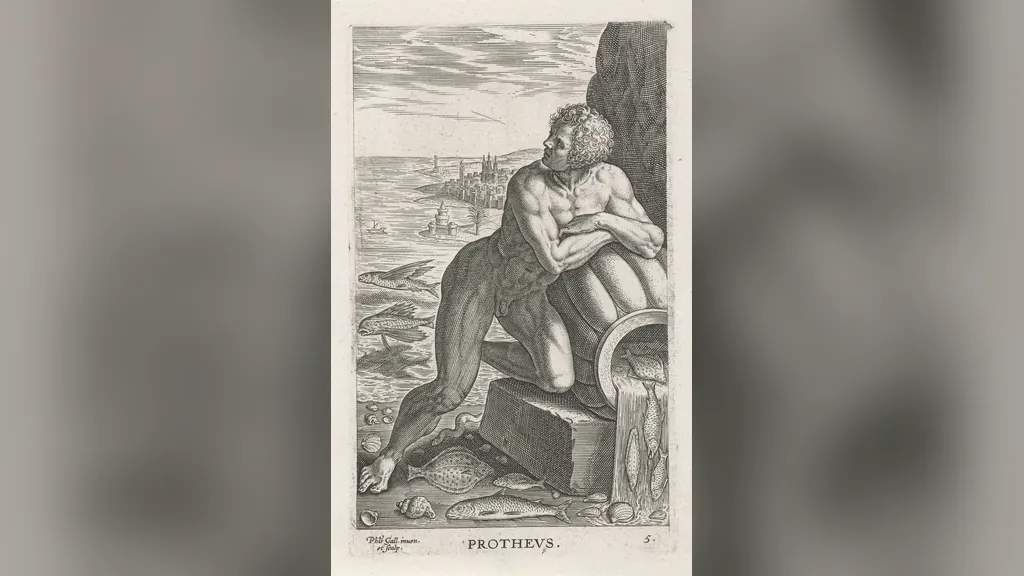
The protean nature is, in essence, the manifestation of the power of metamorphosis. Far from being merely a mythological trick, the ability to change form was, for Proteus, an intellectual and existential defense mechanism. By assuming different appearances, he ensured that his deepest knowledge—that which involved the future or unattainable truths—remained inaccessible. Thus, if you are interested in enigmas like exotic and mysterious legends, you will see that the myth establishes the shape-shifter not only as a being of great power but as the guardian of mystery, whose own fluid nature resists fixation.
The Meaning of Mutability
The adjective protean carries a meaning that transcends mere physical capacity for transformation. It came to designate everything that is versatile, mutable, or varied in nature. In a positive sense, protean symbolizes adaptability and the richness of being, the ability to navigate different states and contexts without losing its fundamental essence. This idea of flow and change is the core of its power, transforming it from a mere myth into a philosophical concept of existential flexibility.
This conceptual depth allowed Proteus to be absorbed and reinterpreted by various fields of human knowledge. In the field of alchemy, the German mystic alchemist Heinrich Khunrath associated the metamorphic sea god with the symbol of the unconscious and the perfection of art. He alluded to the scintilla, or spark of ‘nature’s light,’ and the anima mundi, treating the Protean element as Mercury. Later, the Swiss psychiatrist Carl Jung solidified this interpretation, defining the mythological figure of Proteus as the personification of the unconscious. For Jung, the god had a central and elusive parallel with alchemical Mercury, which underscores the importance of his cyclical and multifaceted nature.
The longevity of the myth is notable in its artistic and biological manifestations. In literature, the protean image was revived in grand works: John Milton used it in Paradise Lost, while William Shakespeare employed the figure to establish the character Richard III in Henry VI, Part Three. More recently, James Joyce incorporated the protean transformations of matter over time in Ulysses, giving the title to the third chapter of the Linati scheme. In the biological realm, the protean nature finds an echo in real species, such as the aquatic salamander that lives in caves in Europe, known as Proteus anguinus, the only species of the genus Proteus in the family Proteidae.
In summary, the myth of Proteus proves that transformation is not a loss of identity, but rather a state of maximum potential. Whether in alchemy, psychology, or biology, the protean figure teaches that strength lies in the ability to be, simultaneously, everything and nothing, keeping mystery as its greatest and most valuable power.
📊 The Protean Nature: Applications of the Concept of Mutability
| Field of Application | Concept/Association | Representation |
|---|---|---|
| Myth/Philosophy | Guardian of Mystery | Ability to change form (Metamorphosis) |
| Alchemy | Unconscious and Perfection | Associated with Mercury (scintilla and anima mundi) |
| Psychology | Unconscious | Personification of the elusive and cyclical aspect |
| Biology | Adaptation | Aquatic salamander (Proteus anguinus) |
The evolution of the concept: from alchemy to psychology
The journey of the myth of Proteus is a powerful testament to the human capacity to absorb and reinterpret archaic symbols. Far from the waters of the Mediterranean, the protean concept found fertile refuge in intellectual and artistic fields, proving that metamorphosis is not merely a divine attribute, but a model for the very experience of knowledge. This conceptual longevity allowed the god to be absorbed and reinterpreted by various fields of human knowledge.
The alchemical mirror and the unconscious
One of the first and deepest points of convergence was in alchemy. The German mystic alchemist Heinrich Khunrath dedicated himself to associating the sea god with complex esoteric symbols. For him, Proteus represented the element Mercury, a symbol that, due to its intrinsic relationship with the sea, was understood simultaneously as the symbol of the unconscious and artistic perfection. Khunrath alluded to the scintilla, the spark from the “light of nature,” and the anima mundi (world soul). In this Gnostic view, Proteus was the bearer of a universal knowledge that manifested in the search for material and spiritual transformation.
This esoteric connection was recovered centuries later by modern psychology. Carl Jung, the renowned Swiss psychologist, defined the mythological figure of Proteus as the personification of the unconscious. Jung noticed the profound similarity between the prophetic and mutable god and the central, yet elusive, alchemical concept of Mercurius. For the psychologist, Proteus was therefore the key to understanding the deepest mysteries of the human psyche.
The Literary Echo of Transformation
The Protean relevance transcended academic and esoteric circles, echoing in literature as a symbol of complex mysteries and the fluidity of identity. The poet John Milton, for example, was aware of the association between Proteus and the hermetic art of alchemy when writing Paradise Lost, where he addresses alchemists in search of the philosopher’s stone.
The image of the god of transformations also captivated great masters. Shakespeare used the reference in different contexts: in Henry VI, Part Three, the villain Richard III boasts protean power; and in The Two Gentlemen of Verona, one of the main characters is named Proteus. More recently, protean fluidity has been explored in modern works. In James Joyce’s Ulysses, the transformations of matter and time are explored in a process of self-knowledge, and the third chapter of the Linati scheme for the work is titled “Proteus.”
Other literary exponents also embraced the concept: William Wordsworth, in 1806, in his sonnet “The world is too much with us,” evokes a nostalgia for a world imbued with deities; and the Brazilian poet Bento Teixeira, in his epic Prosopopeia, has Proteus sing the glories of the House of Albuquerque to the other Greek gods. These examples show that Proteus’s power lies in being a supreme symbol of potential: the capacity to adapt and represent the complexity of any era.
Modern Manifestations: The Biological Proteus

The conceptual journey of the myth of Proteus, which led us from esoteric circles to modern psychology, finds a surprising and concrete echo in the natural world. If the myth taught us that metamorphosis is a state of maximum potential, biology offers us a living and fascinating example of this fluidity: the salamander that bears the name of the god of transformations.
The Biological Link: The Olm
In an impressive leap from the field of narrative to the realm of zoology, we find Proteus anguinus. This organism is not merely a distant relative of the myth; it is the only species of the genus Proteus, belonging to the family Proteidae. The scientific name, which echoes the mythological name directly, establishes an almost palpable connection between the legendary being and real life.
🤔 Did You Know?
Did you know? The Proteus anguinus, or olm, is a freshwater and cavern-dwelling salamander, and it is the only species of the genus Proteus, creating a direct link between myth and zoology.
It is a freshwater and cavern-dwelling salamander found in Europe. The animal, popularly known as the olm, inhabits subterranean environments and cold waters, an ecological niche that in itself evokes the mystery and isolation associated with the deep-sea depths of myth. The life of the Proteus anguinus is marked by extreme adaptation to caves, a refuge that protects it from sunlight and human sight. This adaptation is not merely physical, but almost a state of semi-absence, as if the environment itself has transformed it into something almost ethereal.
What makes this encounter between myth and science so powerful is the toponymic and biological coincidence. The name Proteus, applied to the salamander, suggests not just a casual word similarity, but a deep resonance between the power of change (myth) and the capacity for survival in extreme environments (biology). The olm, therefore, is not just an animal; it is the natural symbol of persistence and adaptation, characteristics that defined the god himself in mythology.
In summary, the Proteus anguinus serves as a powerful testament to the longevity of the Protean concept. It proves that the capacity for transformation, whether physical, psychological, or symbolic, is not a mere narrative whim, but a profound biological and cultural principle. By observing this blind salamander adapted to cavern depths, we realize that the power to be mutable—the power to survive and thrive where others cannot—is a manifestation that transcends time and myth, finding its place in the intricate tapestry of life on Earth. For more details about the species, zoology sources on the olm can be consulted.
The Philosophical Legacy: The Art of Being Mutable
The legacy of Proteus transcends the sphere of Greek myth, establishing itself as a powerful philosophical symbol of the fluidity of existence. He is not just the god of transformations, but the archetype of complexity. The richness of his manifestations—whether as a shepherd of sea creatures, a prophet guarding his knowledge, or the power to transform matter itself—allowed the Protean concept to be absorbed and reinterpreted in countless cultural contexts. The adjective “Protean” came to mean, by extension, anything that is versatile, mutable, and constantly changing in nature.
Protean as a Universal Concept
The depth of the myth allowed it to establish itself in different fields of human knowledge. In alchemy, for example, the German mystic Heinrich Khunrath associated the sea god with the very perfection of the art, viewing him as a symbol of the anima mundi and the scintilla, the spark of nature’s light. Later, the Swiss psychologist Carl Jung solidified this view by defining Proteus as a personification of the unconscious. For Jung, the god aligns with Mercurius, a concept that holds the key not only to the sea but to a universal power. This establishes metamorphosis not as a loss of identity, but as access to a vast reservoir of inner potential.
This capacity for reinterpretation caused the myth to resonate through art and literature. Shakespeare used the image of Proteus in plays like Henry VI, Part Three, where the villain Richard III makes allusions to metamorphosis. The concept was also explored by more modern writers, such as James Joyce, in Ulysses, which uses the protean transformations of matter in its writing scheme. This narrative longevity proves that the being in flux is a recurring theme in the human experience.
Adaptability as a vital force
Proteus’s power, on the most biological level, finds a remarkable parallel in the European aquatic and cavern salamander, the Proteus anguinus. The toponymic and biological coincidence between the myth and this real species serves as a powerful testament to the perennity of the protean concept. Essentially, the myth’s journey, which takes us from esoteric circles to the realm of zoology, teaches a timeless lesson: the capacity for adaptation is the engine of survival. The being that refuses to change, that clings rigidly to a single form, tends to become obsolete. True power, like that of Proteus, resides in fluidity, in accepting the flow, and in constant reinvention.
Thus, Proteus’s legacy invites us to view modern life not as a fixed destination, but as a state of constant potential. To be “protean” is to embrace complexity; it is to recognize that our identity, like the sea, is composed of many facets, and that adaptability is the most sublime and essential art of being.
Glossary
- Prōtos: A Greek term meaning ‘the first,’ bestowing upon Proteus a status of origin and primacy.
- Metamorfose: The ability to change physical form. For Proteus, it was a defense mechanism and a symbol of intellectual power.
- Nereida: A type of sea nymph, often associated with Proteus, indicating his connection to the aquatic environment.
- Scintilla: An alchemical term meaning ‘spark,’ referring to the light of nature or essential knowledge.
- Anima Mundi: A philosophical concept referring to the ‘soul of the world,’ the vital force that permeates all existence.
Frequently Asked Questions
What does the adjective ‘protean’ mean and how do I use it?
The adjective protean describes anything that is versatile, mutable, or varied in its nature. It transcends mere physical transformation, symbolizing adaptability and the richness of being. Using it refers to something that possesses a constant flow without losing its fundamental essence.
Is Proteus a Greek or Roman god?
Proteus is a central figure in Greek mythology. He is the son of Poseidon, the sea god, and his story is intrinsically linked to the Olympian pantheon. His narrative and the myths surrounding him are founded on the culture and accounts of Ancient Greece.
What is the difference between the myth of Proteus and the salamander Proteus anguinus?
The main difference is the nature: the myth is a divine figure and a philosophical concept of metamorphosis. The *Proteus anguinus*, however, is a real biological species, an aquatic salamander. While the myth represents the power of mystery and change, the animal is a physical example of survival and adaptation.
Why is the myth of Proteus used in alchemy?
In alchemy, the myth is used because of its mutable nature. Proteus was associated with the element Mercury, as his ability to change form mirrored the alchemical process of transformation. He represented the unconscious and the quest for material and spiritual perfection.
Who is the ‘Old Man of the Sea’ in Greek mythology?
The ‘Old Man of the Sea’ is Proteus. He is not merely a sea god, but an oracle who resides at Pharos. His function was to be the guardian of the deepest secrets, holding the knowledge of how to restore peace and the course of the future to whomever sought him.
Conclusion
The figure of Proteus transcends the mere mythological domain of the sea to establish itself as the archetype of mystery and unattainable knowledge. He is not just the “Old Man of the Sea,” but the guardian of truths that only yield under extreme coercion, as evidenced in the narratives of Homer and Virgil. The very etymology of his name, linked to “the first” (prōtos), reinforces his primordial nature. His ability to metamorphose is not a mere trick, but an existential defense mechanism that keeps him perpetually fluid, resisting the fixation of any absolute truth.
It is precisely this mutability that lends the term “protean” immense philosophical depth. The concept of Proteus expanded beyond geography, coming to symbolize the adaptability and flow of life in various fields of knowledge, such as in alchemy, where it was associated with the anima mundi. It teaches that truth, whether a prophecy of the future or a philosophical principle, is rarely granted simply.
Thus, the myth of Proteus invites us to reflect on the value of what cannot be captured: deep knowledge demands persistence, strength, and the willingness to confront the enigma. By delving into the legends, we realize that the greatest transformation lies not in physical form, but in our own capacity to navigate uncertainty.