
Read this article in: Portuguese (Português) · Spanish (Español)
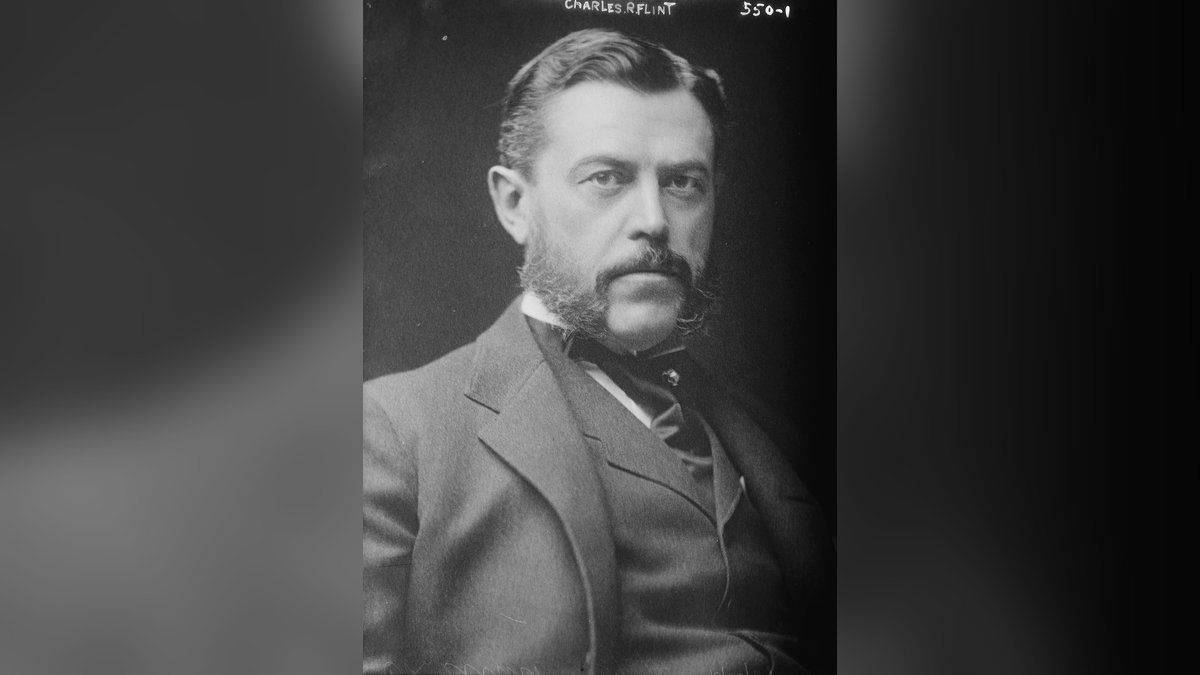
Who is Charles Ranlett Flint? He was an American businessman, born January 24, 1850, and passed away on February 26, 1934. Known by the moniker “Father of Trusts” for his financial dealings, Flint is best known as the founder of the Computing-Tabulating-Recording Company, the entity that would eventually become IBM. His life spanned a period of immense industrial transformation, solidifying his place in American history not only as a financier but also as a foundational figure in the modern corporate landscape.
Flint’s impact on the technology world is profound, beginning with his role in founding the Computing-Tabulating-Recording Company in 1911. This single venture laid the groundwork for what would become one of the world’s most influential technology corporations. His career trajectory also saw him involved in various industrial sectors, including his time with U.S. Rubber and his association with the syndicate that built the yacht Vigilant, the U.S. defender of the eighth America’s Cup.
This biography traces the remarkable life of Charles Ranlett Flint, exploring his early life and education in Maine and New York, his early career ventures, and the pivotal moments that led to the founding of the Computing-Tabulating-Recording Company. From his business acumen and philanthropic interests to his pioneering influence on modern technology, this article will illuminate how one man helped build the corporate giant known as IBM.
Key Takeaways
- Born January 24, 1850, in Thomaston, Maine, Flint built a foundation in mercantile and shipping trades.
- He earned the epithet “the Rubber King” for consolidating firms like Adams Chewing Gum, Chiclets, Dentyne, and Beemans in 1899.
- Flint founded the Computing-Tabulating-Recording Company in 1911, merging four distinct technology firms.
- His career spanned from international consul roles (e.g., Chilean consul, 1876-1879) to industrial consolidation.
- Flint served on the board of International Business Machines (IBM) until his retirement in 1930.
Charles Ranlett Flint at a Glance
| Born | January 24, 1850; Thomaston, Maine, U.S. |
|---|---|
| Died | February 26, 1934 (aged 84); Washington, D.C., U.S. |
| Other name | Computer King |
| Education | Polytechnic Institute of; Brooklyn (BS) |
| Occupation | Financial capitalist – founder of Computing-Tabulating-Recording Company |
| Spouses | Emma Kate Simmons; (m. 1883; died 1926); Charlotte Reeves; (m. 1927) |
| Citizenship | United States |
| Employer | IBM |
| Founded | IBM (1911), Computing Tabulating Recording Company (1911) |
Early Life and Education in Maine and New York

Charles Ranlett Flint arrived in the world on January 24, 1850, in Thomaston, Maine. His early roots were planted in a mercantile environment, a foundation that would prove crucial to his later understanding of commerce. The family history itself involved a notable change in identity; his father, Benjamin Chapman, adopted the surname Flint after being adopted by an uncle on his mother’s side. This initial establishment in Maine set the stage for a family trajectory that would eventually lead him across the country and into the bustling economic hub of New York City.
The Mercantile Foundation in New York
The family soon relocated from Maine to the greater New York City area. Here, his father solidified the family’s commercial standing by running the firm Chapman & Flint. This mercantile enterprise was not a recent venture; it had been established in 1837, providing Charles with an intimate, firsthand view of established commercial networks and the mechanics of early American trade. While the sources do not detail his direct involvement in the day-to-day operations of the firm, the mere existence of this successful, multi-decade family enterprise provided the crucial early context for his understanding of capital and business expansion.
Education and the Shipping Trade
Flint’s formal education took him through the institutions of Brooklyn. In 1868, he graduated from the Brooklyn Polytechnic Institute, an institution that would later become the New York University Tandon School of Engineering. This academic credential marked his entry into the professional world, but his real-world experience quickly pivoted toward the physical arteries of commerce: shipping. Just three years later, in 1871, he entered the maritime industry, partnering with Gilchrest, Flint & Co. This firm provided him with a deep immersion into the complexities of shipping, a sector reliant on global connectivity and precise logistical planning—skills that would prove invaluable decades later.
This pattern of professional evolution—from the foundational mercantile trade of his father’s firm, to the specialized, large-scale operations of shipping—demonstrates a steady accumulation of commercial expertise. By the time he was an adult, his life was interwoven with established financial and industrial structures. His personal life also began to take shape during this period, marked by his marriage in 1883 to the composer Kate Simmons. These early years, spanning the shift from Maine’s quiet origins to the roaring commerce of New York, provided Charles Ranlett Flint with the foundational knowledge of capitalism, logistics, and institutional growth that defined his career as a financial capitalist.
Diplomatic Service and Early Career Ventures
Before the gears and punch cards of his later career, Charles Ranlett Flint established a formidable reputation operating in the sphere of international commerce and diplomacy. His global reach was cemented during his service as a consul, providing him with unique insights into foreign markets and geopolitical currents. Between 1876 and 1879, he held the post of Chilean consul in New York City. Beyond this specific role, his diplomatic portfolio expanded, seeing him serve as consul general to the United States for both Nicaragua and Costa Rica. These postings were not merely ceremonial; they placed Flint at the nexus of American trade and Latin American political economies, sharpening a commercial acumen that would prove invaluable when he later turned his attention to large-scale industrial consolidation.
This international experience fueled a relentless drive for commercial expansion. The early years of the 20th century saw Flint repeatedly demonstrating an uncanny ability to consolidate disparate, seemingly unrelated companies into powerful, unified entities. His early ventures were marked by bold, geographically diverse moves. In 1892, he first achieved this feat by consolidating several companies to form U.S. Rubber. His commercial ambition soon took him beyond pure manufacturing; in 1893, he fitted out a substantial fleet of naval ships destined for the Brazilian Republic. His international flair was highlighted by the purchase of the Esmeralda from the Chilean Navy, which he then successfully delivered via Ecuador to Japan during the First Sino-Japanese War.
Flint’s pattern of aggressive consolidation continued with remarkable consistency. By 1899, he repeated his success in forming U.S. Rubber by creating American Chicle, an amalgamation of Adams Chewing Gum, Chiclets, Dentyne, and Beemans. Furthermore, that same year saw him responsible for the formation of The American Woolen Company. The sheer scope and success of these mergers led some newspapers to begin referring to him by the epithet “the Rubber King”—a title that encapsulated his mastery over merging commercial interests into massive, profitable enterprises.
These early, high-stakes ventures—ranging from managing Chilean diplomatic interests to cornering the chewing gum market and shipping naval vessels—established a pattern of accumulating commercial expertise and understanding complex, interconnected systems. This foundation of large-scale amalgamation proved the perfect precursor to his ultimate pivot. By 1911, Flint engineered the formation of the Computing-Tabulating-Recording Company, an amalgamation that brought together four separate entities: the Tabulating Machine Company, International Time Recording Company, Computing Scale Company of America, and the Bundy Manufacturing Company. This move signaled a dramatic shift from the physical commodities of rubber and wool to the abstract, yet revolutionary, world of data processing.
Consolidating Industries: From U.S. Rubber to Naval Fleets
Charles Ranlett Flint’s professional life was characterized by a relentless, almost singular focus: the identification of disparate, valuable components and their forceful consolidation into massive, unified commercial entities. This pattern of empire-building was not limited to one sector; it spanned everything from the commodity trade of vulcanized rubber to the complex machinery of data processing.
His early international experience, which included stints as the Chilean consul in New York City (1876 to 1879) and as consul general to the United States for Nicaragua and Costa Rica, provided a foundation in high-stakes, cross-border commerce. This global knowledge seemed to fuel a deep-seated ability to manage and integrate varied industrial interests. The scale of his enterprise building became dramatically apparent in the 1890s. In 1892, he orchestrated the consolidation of several pre-existing firms to establish U.S. Rubber. His commercial reach extended beyond consumer goods and into military hardware; the following year, in 1893, he was responsible for fitting out an entire fleet of naval ships for the Brazilian Republic. His involvement in the region was so profound that he even purchased the Esmeralda from the Chilean Navy, subsequently delivering the vessel via Ecuador to Japan during the First Sino-Japanese War.
If the naval and rubber ventures demonstrated his capacity for large-scale physical consolidation, the late 1890s showed his mastery of market dominance. In 1899, Flint repeated the foundational success he had achieved with U.S. Rubber by forming American Chicle. This new conglomerate was built through the consolidation of several key brands, including Adams Chewing Gum, Chiclets, Dentyne, and Beemans. That same year, he also engineered the formation of The American Woolen Company. The scope of these achievements—cornering the gum market and establishing a major textile firm—led some contemporary newspapers to refer to him simply as “the Rubber King.”
By the turn of the century, Flint had refined his approach to consolidation. Where previous ventures involved physical goods and consumer brands, his focus shifted to intellectual capital and machinery. In 1911, he formed the Computing-Tabulating-Recording Company. This was not a simple purchase but an amalgamation of stock acquisition involving four distinct companies: the Tabulating Machine Company, the International Time Recording Company, the Computing Scale Company of America, and the Bundy Manufacturing Company. Flint described this process as an “allied” consolidation, demonstrating his continued ability to weave together disparate technological threads into a single, powerful commercial instrument. This pattern of combining multiple, specialized operations—whether they were chewing gum brands, naval vessels, or calculating machines—remained the hallmark of his career until he served on the board of directors of International Business Machines until his retirement in 1930.
Founding the Computing-Tabulating-Recording Company

After successfully consolidating disparate commercial interests—from forming U.S. Rubber in 1892 to creating American Chicle by combining Adams Chewing Gum, Chiclets, Dentyne, and Beemans in 1899—Charles Ranlett Flint had perfected a repeatable formula: identifying valuable, yet separate, components and forcing their consolidation into a massive, unified commercial entity. While his earlier ventures demonstrated his mastery of physical goods and market dominance, the turn of the century signaled a profound pivot. Flint’s focus sharpened, moving from tangible commodities to the abstract, yet rapidly growing, realm of information itself. The burgeoning need to process and record vast quantities of data—from census figures to business transactions—provided the perfect new frontier for his formidable consolidation skills.
Founding the Computing-Tabulating-Recording Company
The pivotal moment arrived in 1911. Flint orchestrated the formation of the Computing-Tabulating-Recording Company. This was no simple merger; it was an amalgamation of stock acquisition involving four distinct, specialized firms. The foundational elements of the new enterprise were drawn from the Tabulating Machine Company, the International Time Recording Company, the Computing Scale Company of America, and the Bundy Manufacturing Company. At the time, such an “allied” consolidation was unusual, but Flint successfully executed the maneuver, birthing a powerhouse dedicated to mechanical data processing. This company represented a dramatic leap from the mercantile and industrial empires of the past, positioning Flint squarely at the vanguard of a wholly new technological industry.
The creation of the Computing-Tabulating-Recording Company established Flint’s enduring legacy, cementing his role as a pioneer in the modern data processing age. The sheer diversity of the acquired components—combining time recording, tabulation, and mechanical scaling—meant that the new entity possessed an unparalleled scope to handle complex business data. The company’s trajectory continued with remarkable stability and growth. In 1924, the Computing-Tabulating-Recording Company was officially re-christened as International Business Machines. Flint’s influence remained central to this growing giant; he served on the board of directors of IBM until his retirement in 1930, guiding the company through its most formative decades and ensuring its continued dominance in the emerging computational landscape.
The Man Behind the Machine: Business and Sportsmanship
While the historical record often fixates on the punch cards and the corporate behemoth he helped build, the life of Charles Ranlett Flint was anything but confined to the boardroom. Beyond the meticulous arithmetic of data processing, Flint possessed a profound and diverse passion for the physical world. He was, by all accounts, an avid sportsman whose interests spanned the deepest natural elements and the newest mechanical frontiers. His enthusiasm for the outdoors was comprehensive, encompassing the quiet solitude of hunting and fishing, the measured pursuit of sailing, and the sheer thrill of aviation.
His dedication to physical mastery was evident in his athletic achievements. Flint was a record-breaker in his own right, notably holding the world water speed record. This capacity for intense physical focus—whether mastering the water or traversing the air—mirrored the intellectual rigor he applied to his commercial ventures. This multifaceted life also led him into the realm of early motoring culture. He was one of seven founders of the Automobile Club of America, demonstrating an early and committed interest in the rapidly evolving world of personal mechanized travel.
The Intersection of Sport and Commerce
The synergy between his leisure pursuits and his professional acumen became most vividly apparent in the burgeoning field of flight. Flint’s interests did not merely observe new technologies; they placed him directly in the center of their commercialization. His involvement with aviation was significant enough that his Time magazine obituary noted his role in negotiating the Wright brothers’ first sales of airplanes overseas. While the negotiations were sometimes contentious, involving Charles R. Flint & Co., the critical determination of contract terms ultimately rested with the Wrights themselves. This detail speaks volumes, suggesting that even in the most high-stakes, modern industries—from rubber and shipping to flight—Flint’s influence was formidable, but his deep understanding of the technology, honed by his own passion for it, was the true engine of his success.
Flint’s life, spanning from his birth on January 24, 1850, to his passing on February 26, 1934, was thus a study in contrasts: the disciplined mind of a financial capitalist tackling the abstract challenge of data, paired with the robust energy of a sportsman who measured his achievements in miles, knots, and acres. These passions—sailing on a yacht like Gracie, tracking game, or flying over new territories—provided the vital context for the man who would become instrumental in pioneering the modern data processing age.
Pioneering Influence on Modern Technology
The narrative of Charles Ranlett Flint often centers on the abstract world of punch cards and corporate consolidation, but his influence extended far beyond the counting house. His life was marked by a deep, genuine enthusiasm for physical mastery and exploration, a passion that touched multiple burgeoning American industries. Beyond his role as a financial capitalist and co-founder of the Computing-Tabulating-Recording Company, Flint was an avid sportsman who enjoyed everything from swimming and hunting to sailing and, crucially, aviation. His dedication to physical feats was demonstrated by his holding of the world water speed record, showcasing a competitive spirit that translated across disparate fields.
This blend of commercial acumen and physical prowess led him to participate in foundational industry groups. For instance, he was one of seven founders of the Automobile Club of America, an early indicator of his willingness to engage with the evolving mechanical landscape of the nation. When the field of flight began to take shape, Flint’s involvement became particularly noteworthy. His sphere of influence intersected with the pioneering work of the Wright brothers, notably in the context of their commercial success. According to his Time magazine obituary, Flint had negotiated the Wright brothers’ first sales of airplanes overseas. Although the record notes that the Wrights themselves often controlled the contract terms during sometimes contentious negotiations with Charles R. Flint & Co., this connection highlights his critical role in linking nascent American invention to the global marketplace.
Flint’s professional journey was thus less a linear march toward a single industry and more a pattern of applying intense commercial will across technological frontiers. His career trajectory—from his education at the Polytechnic Institute of Brooklyn to founding the Computing-Tabulating-Recording Company—showed a remarkable adaptability. Whether organizing the early days of the automobile, facilitating the international sales of early aircraft, or pioneering data processing, Flint’s enduring impact lay in his ability to identify valuable, disparate components and forcefully consolidate them, transforming niche interests into massive, unified commercial forces that shaped modern American industry.
Frequently Asked Questions About Charles Ranlett Flint
When was Charles Ranlett Flint born and where did he die?
Charles Ranlett Flint was born on January 24, 1850, in Thomaston, Maine. He passed away on February 26, 1934, at the age of 84, in Washington, D.C., U.S.
What nickname was Charles Ranlett Flint known by in the technology industry?
While he was known as “the Rubber King” for his early market consolidations, he was also given the moniker “Computer King” for his pioneering work in the data processing sector.
What company did he found that eventually became IBM?
He founded the Computing-Tabulating-Recording Company in 1911. This company was formed through an amalgamation of four specialized entities: the Tabulating Machine Company, International Time Recording Company, Computing Scale Company of America, and the Bundy Manufacturing Company.
What was Charles Ranlett Flint’s primary career before founding computing companies?
His early career was highly varied, encompassing the mercantile trade, the shipping industry, and international diplomacy. He served as a consul in various Latin American nations, including Chile, which gave him global commercial insight.
Besides business, what was Charles Ranlett Flint passionate about?
Flint was an avid sportsman with diverse interests, including hunting, fishing, and sailing. His passion for physical mastery was evident in his athletic achievements, notably holding the world water speed record.
Final Thoughts: The Legacy of Charles Ranlett Flint
Charles Ranlett Flint’s remarkable career was defined by an unparalleled ability to identify disparate, valuable components and force their consolidation into massive, unified commercial entities. From his early success cornering the chewing gum market by forming American Chicle in 1899, earning him the epithet “the Rubber King,” to his orchestration of the U.S. Rubber conglomerate, Flint demonstrated a masterful aptitude for large-scale amalgamation. This pattern of empire-building, however, was not limited to the physical commodities of vulcanized rubber or American Woolen Company; it culminated in a profound pivot toward the abstract realm of data. In 1911, he engineered the formation of the Computing-Tabulating-Recording Company, an amalgamation that brought together key players in the burgeoning field of data processing.
This transition marked his ultimate contribution to modernity. By successfully merging the world of global shipping and commodity trade with the complex machinery of the tabulating machine, Flint laid the foundational commercial structure that would underpin the modern technological age. Though he passed away in 1934, his vision—the systematic consolidation of information processing capabilities—ensured his legacy resonated far beyond the scope of the original company. The sheer force of his commercial ambition, transforming disparate parts into powerful, unified systems, established a blueprint for industrial growth that continues to shape the global flow of data today.
Sources and Further Reading
- Charles Ranlett Flint — Wikipedia (text available under CC BY-SA 4.0)
- Father of Trusts’ Going Back to Work at 80; C.R. Flint Will Undertake Another Merger — nytimes.com
- Who’s who in New York City and State — archive.org