Read this article in: Portuguese (Português) · Spanish (Español)
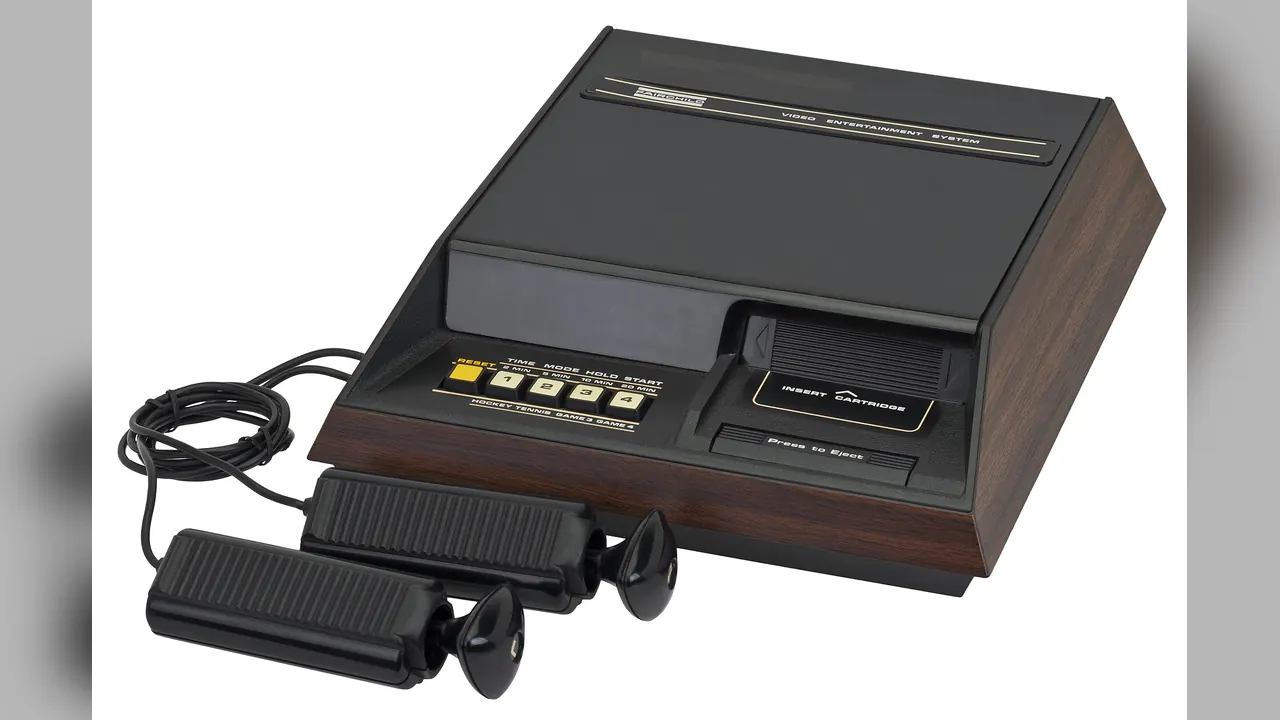
The Channel F, originally released by Fairchild Camera and Instrument as the “Video Entertainment System,” is a fundamental milestone in video game history because it was the first microprocessor-based home console to use memory cartridges (known as “Videocarts”) instead of having games built into the hardware. This revolutionary home entertainment system allowed players and developers access to an expandable game library, defining the business model that would become standard in the console industry for decades. Although it was officially launched in November 1976 in North America, its ability to accept removable media was the key element that set it apart from previous generations.
The importance of the Channel F lies in its technological innovation and its impact on an emerging market. The console was developed by Jerry Lawson and used the Fairchild F8 processor, operating with an architecture that supported game expansion. Despite being a pioneer, its commercial trajectory was challenging, and the system sold only about 350,000 units by 1979, eventually being discontinued in 1983. Nevertheless, it established the concept of interchangeable games, paving the way for the consolidation of the home console industry.
In this article, we will delve into the complete history of this pioneering system. We will cover everything from the system’s genesis and the industrial context of the time to the microprocessor revolution and the concept of cartridges. We will analyze the hardware’s architecture and technical specifications, examine its launch and initial competition, and finally, explore the game catalog and the lasting legacy of the Channel F in the formation of the electronic gaming industry.
Key Points
- Pioneering: It was the first home console to adopt interchangeable cartridges (Videocarts).
- Technology: It utilized the Fairchild F8 microprocessor, an advanced 8-bit chip for its time.
- Memory: It featured 64 bytes of RAM and a 2 KB video buffer for pixel tracking.
- Business Model: It established the ‘razor and blades’ model, maximizing profits through cartridge sales.
- Launch: It launched in November 1976 (NA) and was active until 1983.
Channel F Technical Specifications
| Alternate Name | Fairchild Video Entertainment System |
|---|---|
| Developer | Jerry Lawson |
| Manufacturer | Fairchild Camera and Instrument |
| Type | Home video game console |
| Generation | Second |
| Release | NA: November 1976; JP: October 1977 |
| Lifespan | 1976–1983 |
| Introductory Price | US$169.95 (equivalent to $960 in 2025) |
| Discontinued | 1983 |
| Units Sold | 350,000 (by 1979) |
| Media | ROM Cartridge |
| Best Game | Videocart-17: Pinball Challenge |
The Genesis of the System and Industry Context
The development of electronic game systems did not happen in a vacuum; it was the direct result of decades of advances in materials engineering and computer science. To understand the genesis of consoles like the Channel F, it is essential to revisit the technological landscape of the 1970s. During that time, companies such as Fairchild Semiconductor established themselves as leaders in the semiconductor industry. A crucial milestone was the development of the planar process, a revolutionary technique that allowed for the creation of the first integrated circuits (chips). Mastering this process not only boosted general computing but also paved the way for the miniaturization and complexity of processors.
The Transition from Laboratory to Entertainment
In a constant pursuit of new revenue streams, Fairchild attempted to apply its semiconductor expertise to various sectors. After initial success with 8-bit microprocessors, such as the Fairchild F8, the company faced difficulties in markets like digital calculators and watches. This search for new consumer niches led the company to look for applications for its semiconductors in general consumer products, including entertainment. It was in this context that small research and development firms, like Alpex Computer Corporation, began exploring the potential of video games.
Alpex, formed by former employees of American Machine and Foundry (AMF), shifted its focus to game development after losing a significant contract with Pitney Bowes at the end of 1973. Engineers Wallace Kirschner and Lawrence Haskel initiated an ambitious project called “RAVEN” (Remote Access Video Entertainment) in early 1974. The system was based on the Intel 8008 processor (later upgraded to the 8080) and demonstrated a considerable level of complexity for the time. The system was capable of mapping a black and white display of 128 x 64 pixels using 1 kilobyte of RAM, an extremely expensive and sophisticated amount of memory.
One of the most notable advances of this period was the invention of a prototype cartridge. Inspired by EEPROM chips, the engineers developed a more durable and practical method for connecting read-only memory (ROM) chips to the RAVEN system. Although Alpex had the software knowledge and the functional prototype, it lacked the capacity for large-scale manufacturing and distribution. It was at this point that the project’s destiny intersected with Fairchild. After attempts at partnerships with major electronics companies, Alpex secured a meeting with Fairchild representatives. Gene Landrum and Jerry Lawson, who were sent to assess the product’s viability, were impressed with the system. In January 1976, Fairchild granted a technology license for the project, marking the beginning of a new era in home entertainment.
🕒 Milestones in Game System Development
- 1970s — Development of semiconductors by companies like Fairchild Semiconductor, driven by the planar process and integrated circuits.
- Late 1973 — Alpex Computer Corporation shifts focus to video games after losing a contract with Pitney Bowes.
- Early 1974 — Wallace Kirschner and Lawrence Haskel begin the ‘RAVEN’ project, based on the Intel 8008 processor.
- 1976 — Fairchild licenses the technology for the RAVEN project, marking the beginning of home entertainment.
The Microprocessor Revolution and the Cartridge Concept
The true breakthrough in the electronic game industry was not just the microprocessor, but the revolutionary concept that games could be sold separately from the hardware. The Channel F pioneered this by being the first home console to adopt cartridges, or Videocarts. Until then, most electronic games used discrete logic circuits, where the game’s rules were interpreted by physical components. The cartridge, on the other hand, allowed the player to swap out the game, representing the software in computer code, not in fixed circuits.
The Architecture of Pioneering
This technological leap was made possible by the Fairchild F8 microprocessor. The system was complex, dividing functionality into two main parts: the CPU (3850) and the PSU (3851). Together, they formed a microcontroller capable of running a small computer. The development was a team effort involving Jerry Lawson, who already had prior experience with the subject, and with the support of Al Alcorn, after Lawson saw a prototype of Pong in 1972. Lawson then led a new video game division with the goal of turning a prototype into a viable product using the F8 processor.
The physical aspect of the cartridge was also crucial. Nick Talesfore, an industrial designer, and Ronald A. Smith, a mechanical engineer, were responsible for adapting the prototype’s complex controls into a single control stick and, most notably, for encapsulating the ROM circuit boards into plastic cartridges, resembling 8-degree-of-freedom cassette tapes. This design not only standardized the interface but also solidified the business model identified by the marketing director, John Donatoni: the “razor and blade” model, where profit would be maximized by the continuous sale of cartridges, and not just the initial console.
Technical Details and the Advantage of the BIOS
Technically, the Channel F had significant advantages over its competitors. The system operated with a framebuffer that tracked every pixel in two bits of video random access memory (VRAM), totaling 2 KB. Although the hardware supported a maximum resolution of 128 × 64 pixels, the generally visible resolution was approximately 104 × 60 pixels. Furthermore, the Channel F incorporated a very advanced system architecture: it featured two built-in game Personal System Units (PSUs) (such as Hockey and Tennis) and a shared code, known as the BIOS. This BIOS was a huge differentiator because it contained functionalities like number and letter displays, something that would have needed to be included separately in every cartridge for a competitor like the Atari 2600.
The launch occurred on June 14, 1976, at the Consumer Electronics Show, and it was initially sold as a Video Entertainment System (VES) for US$169.95. This ability to integrate basic functionalities into the system itself, along with the use of the cartridge as the primary media, cemented the Channel F as an engineering milestone and a business model that would shape the industry for decades.
📌 Channel F Technological Advantages
- Use of cartridges (Videocarts) for software, breaking away from fixed circuits.
- Fairchild F8 microprocessor, allowing for a more complex system.
- Shared BIOS (Operating System), saving space on each game.
- Standardized cartridge design, inspired by cassette tapes.
Hardware Architecture and Technical Specifications
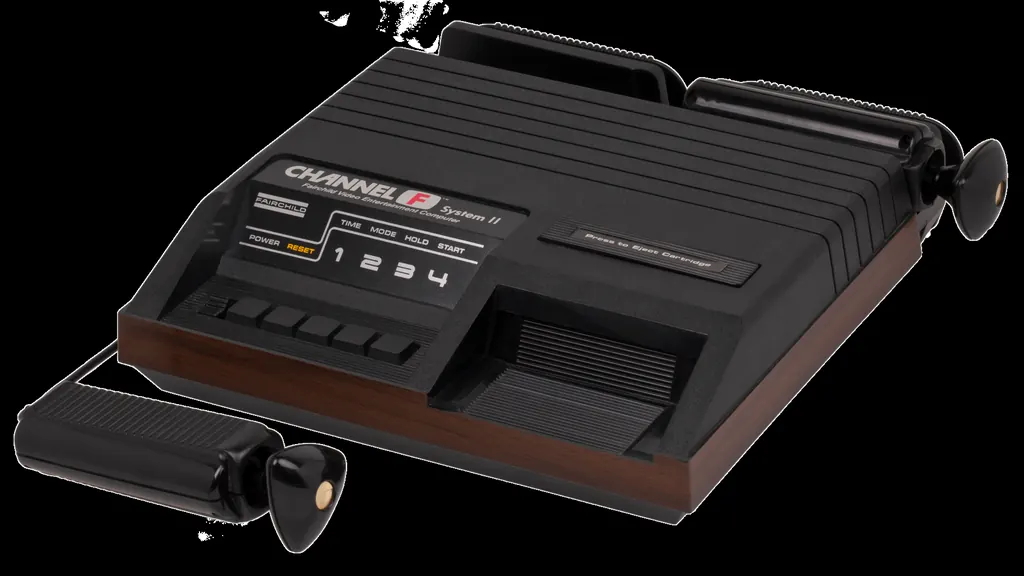
The engineering behind the Channel F reveals a set of advanced technical specifications for its time, positioning it as a pioneering and sophisticated console. The heart of the system is the Fairchild F8 microprocessor, an 8-bit chip that operated at notable frequencies, such as 1.7897725 MHz on the NTSC standard. To support the processing and display of games, the console utilized a robust memory architecture. It featured 64 bytes of general-purpose RAM (known as scratchpad memory) and a 2 KB block of VRAM (Video Random Access Memory). This video memory was crucial, as it was designated for the write only framebuffer, the mechanism responsible for tracking every pixel displayed on the screen.
Graphics Architecture and Video Processing
One of the most technically distinctive elements was the framebuffer-based rendering system. Instead of drawing the image line by line, as some rivals did, the Channel F maintained a dedicated two-bit record for every pixel in its 2 KB of VRAM. This allowed each pixel to be transparent or assume one of the three primary colors (red, green, and blue). Additionally, each line could be assigned one of four background colors (light gray, light green, light blue, or black). Although the hardware supported a maximum resolution of 128 × 64 pixels, the limitations of the CRT televisions of the time meant the visible resolution was approximately 102 × 58 pixels. This ability to use a framebuffer, which could theoretically support an unlimited number of game elements, gave the Channel F a graphical flexibility that few systems of the era possessed.
📘 framebuffer
It is a dedicated memory mechanism (VRAM) that tracks every pixel displayed on the screen. It allows the console to manage the color and transparency information for every image point.
Controls and Gameplay Experience
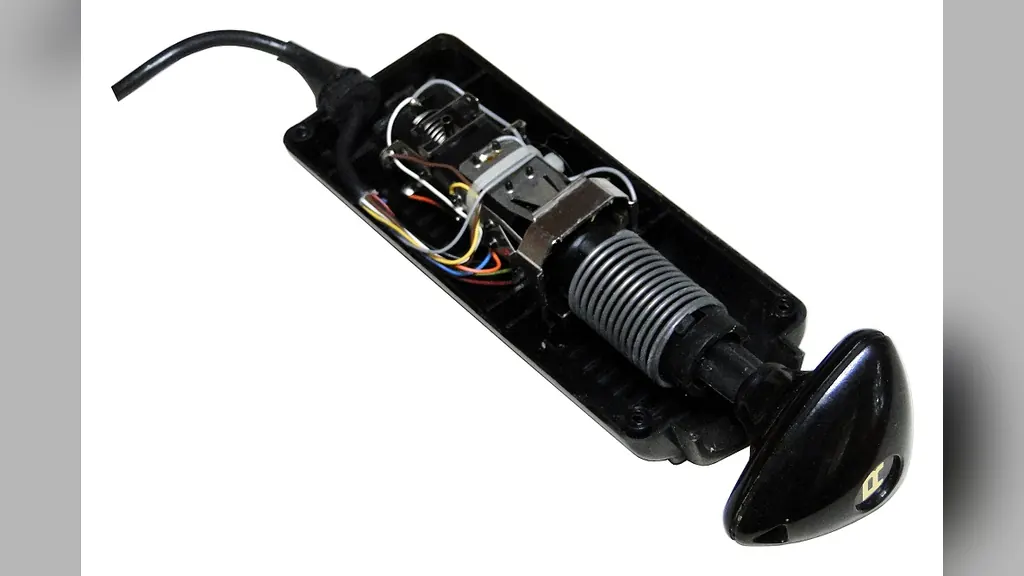
Interacting with the console was mediated by custom and unique controllers. The standard controller was a black joystick that functioned both as an eight-way joystick and as a push-pull paddle. Originally, the design was conceived to accommodate the commands for the built-in Hockey game. Over time, the design was refined, allowing the controls to become removable in models like the System II; it is worth remembering the evolution of these peripherals, as seen in Channel F System II: A History of the Console’s Development. Later, Zircon introduced the “Channel F Jet-Stick,” an enhanced version that added a front action button to the joystick, making it a more versatile device for players.
In terms of connections, the system used an RF-modulated composite video signal. Games were loaded via ROM cartridges, which contained not only the code but also the BIOS (Basic Input/Output System). This combination of an 8-bit processor, detailed video memory management, and an adaptable control system established the Channel F as a remarkable example of electronic engineering for the home entertainment market, a milestone that paved the way for subsequent generations of video game consoles. For more details on the system’s history, see Fairchild Channel F on Wikipedia in English.
Market Launch and Initial Competition
The commercial launch of the Channel F was a significant event in the residential electronics market. In the North American market, the system was released in November 1976, and in Japan, the launch occurred in October 1977. At the time, the system was sold for an initial price of US$169.95. The initial reception was marked by a market positioning that, while technologically advanced, faced conceptual challenges. Although the Channel F was technically pioneering, public and industry perception still categorized it as a “technology company,” rather than a “game company.”
Competition and Market Challenge
The competitive dynamic was intense and shaped the console’s destiny. One of the most cited points in historical analysis is Fairchild’s positioning compared to Atari. Atari 2600 engineers, like Joe Decuir, attributed part of the competition’s success to the fact that Atari was fundamentally a game-focused company. For Fairchild, on the other hand, the narrative was that of an electronics and semiconductor company. Although the Channel F reached the market before the Atari 2600, the rival’s subsequent success caused a decline in Channel F sales, partly due to the types of games offered. It is interesting to note how the market context influenced each unit, as seen in the analysis of console development history. While the Atari 2600 launched action titles, many of the Channel F’s games were slower, educational, or intellectually focused.
Despite this challenge, the system received reviews that highlighted its graphical quality. In 1978, the magazine Video Magazine, for example, expressed being “favorably impressed by the detail and sharpness” of the graphics. However, specialized criticism, such as that from Ken Uston in 1982, pointed out that while some games were considered “timeless,” they served a “limited, but useful purpose,” with a strong focus on the children’s educational line.
The Development of the System II
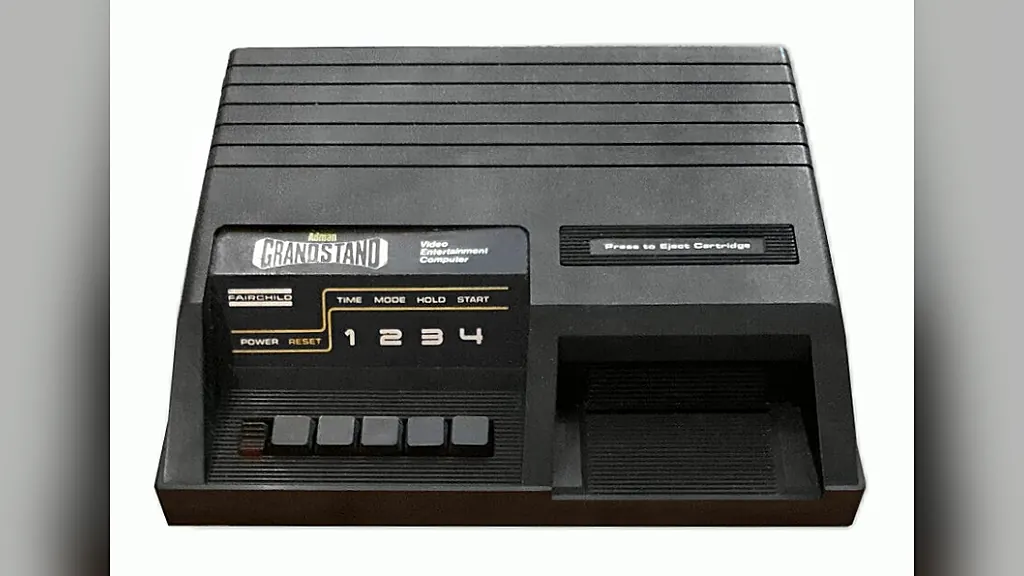
Recognizing the need for modernization and market response, the system underwent a crucial evolution. In 1979, Zircon International acquired the rights to the Channel F, giving rise to the Channel F System II. This new version retained many of the original technical properties but implemented significant improvements to make it more appealing and functional. The most noticeable changes included the implementation of detachable controllers (which were previously built-in) and an audio output for the television, instead of a fixed internal speaker. Furthermore, the console received a visual overhaul, and the selling price was adjusted, being sold for US$99.95, or US$69.95 with a trade-in of the previous model.
This pioneering and adaptive journey, marked by fierce competition with rivals like the Atari 2600, allowed the Channel F to remain relevant for years, even as the video game market underwent constant and rapid technological evolution.
📊 Market Focus Comparison: Channel F vs. Competitors
| Company’s Main Focus | Public Perception | Typical Game Nature |
|---|---|---|
| Electronics and Semiconductors (Fairchild) | Technology Company | Slower, educational, or intellectual nature |
| Games (Atari) | Game Company | Action |
Game catalog and cultural impact
The true cultural engine of the Channel F resided not just in its advanced technical specifications, but in the vast and growing library of content it could run. The system was not merely a sophisticated electronic toy; it established itself as a genuine home entertainment vehicle. Fairchild’s, and later Zircon’s, sales strategy was clear: the console’s value lay in the diversity of experiences users could purchase separately. This revolutionary approach transformed the video game into a content ecosystem that guaranteed product longevity.
The richness of the videocarts
The heart of this ecosystem was the cartridges, affectionately called “Videocarts.” Twenty-seven cartridges were officially released to consumers in the United States, with the first twenty-one developed by Fairchild itself. Many of these titles were multifunctional, allowing a single cartridge to offer more than one game, which was a market differentiator. For the audience transitioning from the arcade experience, the games built into the console were already demonstrations of addictive gameplay. The games Tennis and Hockey, for example, were advanced clones of the popular Pong, but with notable improvements: in Hockey, the player could alter the obstacle reflector diagonals by turning a dial on the controller; and Tennis allowed players to move forward and backward, adding a layer of tactical depth.
However, the title that stood out as a massive sales success and cemented the system’s commercial appeal was the Videocart-17: Pinball Challenge. This bestseller demonstrated that the public was not just interested in replicating known games, but in immersive and complex experiences that the console could deliver. The gameplay, simple to understand yet deeply addictive, was the factor that ensured continuous success.
Expanding the play universe
The game catalog extended far beyond the numbered titles. In 1978, the sales material listed “Keyboard Videocarts” (K-1 Casino Poker, K-2 Space Odyssey, and K-3 Pro-Football). Although designed to use a keyboard accessory, these examples illustrate the company’s ambition to adapt the console to different entertainment niches. Other notable developments include the Videocart-51, or “Demo 1,” a title released in a sales brochure in the winter of 1979, which added mystery and anticipation to the market. Furthermore, the console’s global influence is visible in localization efforts, such as the compatible cartridges developed by the German electronics manufacturer SABA, which released translated versions, like the Videocart-1 Tic-Tac-Toe in German, or the Videocart-18 with German word lists.
In summary, the Channel F proved that the hardware was merely the structure; the true draw was the system’s ability to be a portal to entertainment. The constant supply of new Videocarts, from enhanced clones of Pong to Pinball challenges, ensured that the console was perceived not as a mere consumer item, but as a dynamic and ever-evolving leisure center.
Legacy and Influence on the Gaming Industry
The Channel F’s legacy transcends its technical specifications and the period of its existence (1976–1983). Its most lasting impact lies in establishing a business model that would become the pillar of the video game industry to this day: the sale of hardware coupled with a robust ecosystem of removable media. The system pioneered that the console was not an autonomous end product, but rather a platform. The true engine of attraction and revenue resided in the ability to run a vast catalog of content, encapsulated in cartridges, which guaranteed the longevity and commercial relevance of the unit, regardless of its internal limitations.
Sponsorship and Patent Power
One of the most unique and influential elements in the history of the Channel F was the patent associated with its cartridge design. In 1977, Alpex Corporation received the patent for its original design, RAVEN, which served as the basis for the Channel F. This intellectual property, known as US Patent 4,026,555, came to hold jurisdiction over almost all cartridge-based video game consoles released after the Channel F. The power of the patent was a gigantic economic engine. Alpex exercised this control by contacting over 80 companies, successfully settling disputes out of court with six and suing ten. A notable example of this impact was the agreement with Atari, which was settled for US$380,000.
This legal battle established a precedent of industrial control over the media format. The power of the patent was so significant that, after Alpex went bankrupt in 1983, the company completely restructured around this valuable asset. The dispute spanned decades, as seen in the case of Nintendo, which refused to pay the patent licensing fees. This impasse led to a lawsuit that, in 1991, resulted in a judgment of over US$250 million, although this ruling was later overturned in 1997. This legal history underscores how the Channel F not only introduced the cartridge but also created a model of commercial control over the media format itself.
Decline and Structural Influence
Despite its pioneering and adaptive trajectory, marked by fierce competition with rivals, the system was discontinued in 1983. However, the influence of the Channel F was not limited to its lifespan. It paved the way for the business structure that defines the industry to this day: a piece of hardware (the console) that serves as a portal to vast and growing content (the cartridges). To better understand this pioneering spirit, it is interesting to look at the history of the Channel F System II. The Channel F proved that commercial success did not depend solely on raw processing power, but rather on the ability to nurture a content ecosystem—a lesson that shaped the development of all subsequent generations of entertainment systems.
Glossary
- Microprocessor: Electronic chip that functions as the console’s ‘brain,’ responsible for processing all game instructions.
- Framebuffer: Dedicated memory area that tracks every pixel displayed on the screen, crucial for graphics processing.
- BIOS: Basic input/output system that provides essential functionalities to the system, such as text display.
Frequently Asked Questions
What is the historical importance of the Channel F to the video game industry?
The Channel F is a landmark because it was the first home console to use interchangeable cartridges. This innovation separated software from hardware, allowing games to be sold separately from the console. It cemented the modern business model, where profit is generated by the continuous sale of game media.
What were ‘Videocarts’ and why were they a revolution?
Videocarts were the read-only memory (ROM) cartridges that contained the game code. They represented a revolution because, instead of depending on fixed logic circuits, the player could simply swap the cartridge to change the game. This made the system infinitely upgradeable and flexible.
How did the Channel F compare to the Atari 2600 in terms of technology?
The Channel F featured an advanced architecture for its time, notably for incorporating a BIOS (Basic Input/Output System). This BIOS provided basic functionalities, such as letter and number display, which were essential features that did not need to be replicated on every competitor’s cartridge.
Who was Jerry Lawson and what was his role in the console’s development?
Jerry Lawson was a pivotal engineer who led Fairchild’s video game division. He used his semiconductor experience to transform a prototype into a viable product. His role was crucial in applying the Fairchild F8 processor to create a sophisticated home entertainment system.
What was the launch price of the Fairchild Channel F, and in what year was it discontinued?
The system initially launched for US$169.95. Despite being a technologically advanced pioneer, its lifecycle was one of success and evolution. The Channel F was officially discontinued in 1983, closing an important era in video game history.
Conclusion
The trajectory of the Channel F transcends the mere history of a console; it narrates the convergence of advances in semiconductors, engineering, and business models. The system not only demonstrated the Fairchild F8 microprocessor’s ability to run a complex system but, above all, revolutionized how gaming was conceived and consumed. By introducing the concept of cartridges, the Channel F separated software from hardware, a leap that allowed for unlimited content expansion and established the “razor and blade” profit model that would define the industry for decades.
The console’s sophisticated architecture, with its use of VRAM for the framebuffer and the implementation of shared code (BIOS), represented an unprecedented level of engineering for home entertainment. This technical pioneering solidified the video game not just as an electronic toy, but as a highly architected digital product. The Channel F proved that success resided not merely in the raw power of a processor, but in the ability to create a standardized and economically viable ecosystem.
Thus, the legacy of the Channel F is proof that the deepest innovation lies in the fusion of technological capability and market vision. By understanding how these pioneers navigated the frontiers of science and consumption, it is clear that every advance in our current technology is, in fact, the next chapter in a continuous story of engineering.